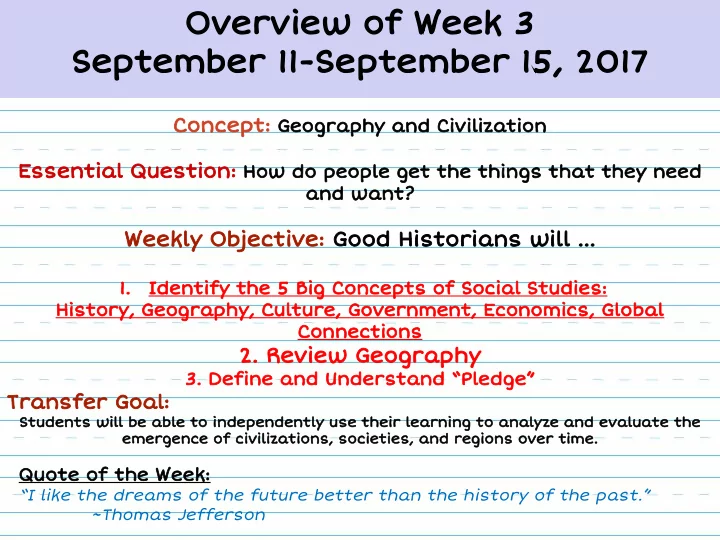
SLIDE 1 Overview of Week 3 September 11-September 15, 2017
Concept: Geography and Civilization Essential Question: How do people get the things that they need
and want?
Weekly Objective: Good Historians will …
1. Identify the 5 Big Concepts of Social Studies: History, Geography, Culture, Government, Economics, Global Connections
- 2. Review Geography
- 3. Define and Understand “Pledge”
Transfer Goal:
Students will be able to independently use their learning to analyze and evaluate the emergence of civilizations, societies, and regions over time.
Quote of the Week:
“I like the dreams of the future better than the history of the past.” ~Thomas Jefferson
SLIDE 2 Monday, September 11, 2017
Daily Objective: Geography
1.How does geography have an impact on a nation’s history?
Social Studies:
Agenda with Oops Passes, and check outs for the Restroom and Nurse.
- Good Historians are able to
identify the 5 Fields of Social Studies in past and present day events.
Complete the Tasks Prompted by the PPT slides concerning the 5 Fields of SS.
- Homework:
- Complete your Social Studies
Homework Packet
To-Do List Upon Entry:
Pick Up Each Sheet of your HW Packet IN ORDER and Staple. Agenda out on the desk. 5 Themes of Social Studies: History, Geography, Economics, Culture and Government
Quote of the Week: “The best way to predict the future is to create it.” ~ Abraham Lincoln
SLIDE 3 Tuesday, September 12, 2017
Daily Objective: Geography
1.How does geography have an impact on a nation’s history?
Social Studies:
- Good Historians are able to
identify the 5 Fields of Social Studies in past and present day events.
- Work with your Group & Make
a Collage of the assigned theme prompted by the PPT slides concerning the 5 Fields
Homework:
- Complete your Social Studies
Homework Packet
Sit ANYWHERE today!!! Work on Homework
Be prepared to discuss the
5 Themes of Social Studies: History, Geography, Economics, Culture and Government
Quote of the Week: “The best way to predict the future is to create it.” ~ Abraham Lincoln
SLIDE 4 Wednesday, September 13, 2017
Quote of the Week: “I like the dreams of the future better than the history of the past.” ~Thomas Jefferson
SLIDE 5 Wednesday, September 13, 2017
Lesson After the Field Trip
- Social Studies:
- Introduction of Pledge
- Brainstorm what the word “Pledge” means
- Video on the Pledge of Allegiance
- The Pledge Video
Quote of the Week: “I like the dreams of the future better than the history of the past.” ~Thomas Jefferson
SLIDE 6 Thursday, September 14, 2017
Concept: Civilization EQ: How do people and groups get the things that they want?
To-Do when you come in:
1. Open Your Composition Book to the Back Page. 2. Write the Date. 9/15/16 3. Respond to this picture:
- Social Studies
- Early Humans PPT
- We will go through the
PPT one time, and then go through it again next week to fill out your graphic organizer. The Discovery of Fire!
. Gather in Small Fire Groups. a. Take turns sharing the information that you learned today.
Homework:
SLIDE 7 Friday, September 15, 2017
Concept: Civilization EQ: How do people and groups get the things that they want?
To-Do Upon Entry: Take out your “I AM” Poem (in your Homework Packet) and line up to go to the Computer Lab. Social Studies
Complete Word Art for the front of your Composition Book.
What is WordArt?
Wordle enables users to generate “word clouds” from text that you provide. Clouds can be tweaked with different fonts, color schemes, and layouts. Images created are yours to use however you
- desire. They can be printed or
saved to the Wordle gallery to share.
Homework: Packet is due Today!
SLIDE 8
Monday’s Lesson/Slides
SLIDE 9 This is an example of what we are going to create on Friday in the computer lab. You will type out the key words from your “I am” poems and make a personalized WordArt with words from our poem for the front of our daybooks. FUN!!!
SLIDE 10
SLIDE 11
SLIDE 12 What is Social Studies?
▶ * Many people think that Social Studies is
- nly learning about History or things that
happened in the past.
▶ * Today we are going to prove that myth
wrong by learning about the 5 different areas that make up "Social Studies"!
▶
Brainstorm- Turn and talk… tell your neighbor any terms
- r words that come to mind when you hear “Social
Studies”.
▶
List on board…
SLIDE 13 History— A record
SLIDE 14
Examples: Ancient Egypt, The Middle Ages, World War 2.
SLIDE 15 Turn and talk…
▶ What are 2 more examples
that YOU can think up of things that happened in the past or “history”?
▶ Share your ideas.
SLIDE 16 Geography—Study
and the earth’s surface.
SLIDE 17
Some examples are: Continents, rivers and mountains; Africans, Asians and Americans.
SLIDE 18 Turn and talk…
▶ What are 2 more examples
that YOU can think up of things or places that are considered geography?
▶ Share your ideas.
SLIDE 19
Government—The people and groups in a country that make laws and enforce them.
SLIDE 20
Examples: The President;
Laws; judges, policemen, soldiers.
SLIDE 21 Turn and talk…
▶ What are 2 more examples
that YOU can think up of things that are examples of
say the word government?
▶ Share your ideas.
SLIDE 22
Economics—People and their money; how people produce, exchange and use goods and services.
SLIDE 23
Examples: Factories making Playstations; your allowance; taxes; buying groceries from Wal-Mart.
SLIDE 24 Turn and talk…
▶ What are 2 more examples
that YOU can think up of things that are examples of economy?
▶ Share your ideas.
SLIDE 25 Culture—The beliefs, customs, laws, art and way
- f life of a certain group of
people. Or … anything and everything about a certain group of people.
SLIDE 26
Examples:
Holidays, Languages, Aztecs, Egyptians, Chinese food!
SLIDE 27 Turn and talk…
▶ What are 2 more examples
that YOU can think up of things that are examples of a specific culture?
▶ Share your ideas.
SLIDE 28 At your table… ▶ I will assign each table one of
the 5 Fields of Social Studies and you will become an “expert” on this Field.
▶ Your group will then tell/teach
the class a little about your assigned field and what it’s about.
SLIDE 29 You have a worksheet that looks like the one below. After each group shares, decide which definition goes in each hexagon.
SLIDE 30
SLIDE 31 5 views of your World
▶ For Homework… On the back of your 5 fields
- f SS worksheet, you have an assignment to
complete.
▶ Write examples from you life by each
bullet point
▶ In each box draw a picture to illustrate
what you wrote about your life.
▶ Your Homework Packet is due on Friday.
SLIDE 32
Tuesday’s Lesson/Slides
SLIDE 33 This is an example of what we are going to create on Thursday in the computer lab. You will type out the key words from your “I am” poems and make a personalized WordArt with words from our poem for the front of our daybooks. FUN!!!
SLIDE 34
SLIDE 35 5 fields… Day 2
▶ Today we will make collages to
depict each of the 5 Fields of Social
- Studies. Using magazines, you will
work together to cut out pictures you think belong in each group. Label your posters!
SLIDE 36 Groups
▶ Group 1- Blue paper, Geography collage ▶ Group 2- Yellow paper, Government ▶ Group 3- Purple paper, History collage ▶ Group 4- Orange paper, Culture collage ▶ Group 5- Green paper, Economics collage ▶ Group 6-You are the “Runners” and will
take words from magazines to the appropriate 5 Fields groups.
SLIDE 37
Example Collages
SLIDE 38
Example Collages
SLIDE 39
Example Collages
SLIDE 40
Example Collages
SLIDE 41
Example Collages
SLIDE 42 Finished with your collage?
▶
Add captions under each picture to explain why you included it.
SLIDE 43
SLIDE 44
SLIDE 45
SLIDE 46
SLIDE 47
Wednesday’s Lesson/Slides
SLIDE 48 Wednesday, September 13, 2017
Quote of the Week: “I like the dreams of the future better than the history of the past.” ~Thomas Jefferson
SLIDE 49 This is an example of what we are going to create on Thursday in the computer lab. You will type out the key words from your “I am” poems and make a personalized Wordle with words from our poem for the front of our daybooks. FUN!!!
SLIDE 50 pledge/plej/
noun 1.a solemn promise or undertaking verb 1.commit (a person or organization) by a solemn promise Synonyms for pledge (noun) word of honor
- Students Should “Turn and Talk”
Brainstorming Session
SLIDE 51
SLIDE 52 pledge/plej/
noun 1.a solemn promise or undertaking verb 1.commit (a person or organization) by a solemn promise Synonyms for pledge (noun) word of honor
- agreement
- word
- Promise
- Vow
- covenant
- ath
- undertaking
- assurance
- guarantee
SLIDE 53
SLIDE 54 Majestic Wolves Social Studies Pledge As a Good Historian, I Pledge to… Be Positive Be Helpful Be Kind Be Respectful Be Honest Be Open-Minded Be Hardworking. I Pledge to… Be Good to my Learning Partner & to my Social Studies Classroom. I Pledge to… Be the Best Historian I can be. Be the Best Learner I can be. Be the Best Person I can be.
SLIDE 55
Thursday’s Lesson/Slides
SLIDE 56 Step-by-Step WordArt Directions www.wordart.com
Step 1. Begin using WordArt Go to www.wordart.com. Click on Create your
Step 2. You can also view and use examples created by others, by clicking More… Step 3. Once you click Create, you will be given two options:
- a. Type/Paste in your own text
- b. Enter the URL of any blog, blog feed, or any other web page that has an
Atom or RSS feed. Step 4. After entering text (or URL), click on Go or Submit Step 5. The words/text you have entered will appear in randomized order (*Note: Do not click the back button or you will have to start all over!). If you want to emphasize particular words, enter them more than one time into the text box. Step 6. Once your WordArt has been created, you can change a number of features (examples: shape, color scheme, layout, font)by selecting the
- ptions along the top of the WordArt
Step 7. There are several options along the bottom of the screen: To open your WordArt in a new window, click Open in Window For a hard copy, click Print To change the order/organization of text, click Randomize To save, click Save to Public Gallery
SLIDE 57
SLIDE 58
Early Man through the Stone Age
SLIDE 59 Soooo… What do we know about the Past???
Turn and Talk with your Group about your conceptions of Early Humans.
Video (Show first four.)
SLIDE 60 The First Humans
- The first humans are known as hominids
- No matter what you may have seen in the
movies, early man did not live during the same period in history as dinosaurs!
- Dinosaurs died out about 65 million years ago.
The first human like hominids did not appear until around 3 million years ago.
SLIDE 61
- 3 million years ago, the earth was full of life, including all kinds
- f plant, bird, and animal life (deer, giraffes, horses, lions,
wooly mammoths, etc.)
- It was during this time that the higher primates, including apes
and early man, first appeared.
- There was a difference between apes and man. Early
human-like hominids could stand upright. Apes could not.
- Their hands were different, too. Ape hands were made for
climbing and clinging. Man’s hands were jointed differently, which allowed them to make and use tools.
SLIDE 62 How do we know??
- Lucy!!!
- In 1974, the oldest known skeleton was found in Africa.
- The bones were those of a female, about 20 years old or so
when she died.
- Scientists named her Lucy (after a Beatles song).
- Tests showed that she lived more than 3 million years ago.
- Anthropologists could also tell from her bones that she
was small (only about 4 feet tall and 50 pounds!!) and had walked on two legs…a key step in human development.
SLIDE 63 Very Early Humans
How do scientists know about an early man who lived 3 million years ago?
The discovery of “Lucy” may answer some of their questions. But who in the world is “Lucy”?
SLIDE 64 Lucy
In 1974, a partial skeleton was found in Africa. The bones were those of a female, about 20 years old or so when she died. Scientists named her Lucy. About 3 million years ago, when Lucy was alive, she was about 4 feet tall and weighed about 50 pounds. Scientists suspect that she fell into a lake
(Video 1) In August, 2016, another possible explanation for Lucy’s death was given.
(See Full Article, if interested)
Scientists are like detectives. They can tell a great deal from a skeleton, whether it's one year old or 3 million years old!
Video 2 with SafeShare
SLIDE 65 The Old Stone Age
- The first humans were Hunters and Gatherers, meaning they did
not plant crops – they simply found the plants they needed, and hunted the food they wanted.
- Were Nomadic: Wandered from place to place in search of food
and shelter. Once the food they wanted ran out, they would move!
- Invented the first tools and weapons including simple stone tools.
- Lived in clans of about 20-30 people, used caves for shelter.
- Learned to make and control fire to keep warm and cook their
food.
- Developed oral, or spoken language
- Made cave art and statues.
SLIDE 66 The Middle Stone Age
- Domesticated plants and animals (this means they
figured out how plants grow. They weren’t good at it, but they were learning!)
- Settled in communities
- Tools became smaller
- Pottery and the use of the bow developed
SLIDE 67 The New Stone Age
- Also called the Agricultural Revolution - Agriculture means
farming, and revolution means a big change… The big change was that they got really good at growing plants and didn’t have to worry where they food was coming from anymore.
- Developed Agriculture and weaving (better clothing)
- Domesticated Animals
- Used Advanced Stone Tools
- Made Pottery (for food storage)
SLIDE 68 Neanderthals
- Named after the valley their fossils were found in, which is in
modern-day Germany
- While the Neanderthals died out, they were the first in a very
intelligent line of humans, called Cro-Magnon. These people did NOT struggle daily because they worked TOGETHER to provide food and shelter for the community.
- These people did a lot of things that showed how intelligent they
were!
- Cured and stored food
- Used traps for hunting
- Built rafts and canoes, and nets for fishing
- Made clothing and jewelry
- Used the first bow and arrow
- And created the first cave paintings (the first ones being discovered in
France during WWII)
SLIDE 69 Neanderthals
One day, scientists found a new skeleton. This skeleton was from another group of early men. Scientists named this man Neanderthal man, after the valley in which the skeleton had been found. Scientists announced that these early men were dim-witted brutes, who walked with bent knees, with their heads slung forward on their big necks. Could these early people really be our ancestors?
SLIDE 70 Neanderthals
But scientists had made a mistake!
The bones were bent because they were part
man suffering from arthritis! Arthritis is a disease that bends and cripples bones.
SLIDE 71 Neanderthals
Still, Neanderthals were different from
- ther species of early humans. They
were tall and smart, and used caves as their homes. They were great hunters. Considering how smart they were, and how advanced for their time, scientists are puzzled that the Neanderthals were
- ne of the early species of man to die
- ut. Many species of man died out in
these early days. But why the Neanderthals? It is a history mystery.
SLIDE 72 Neanderthals
Another group of early men stood out during this period. Scientists nicknamed this group “Cro-Magnon man”. Cro-Magnon man lived in Europe. This group did not live a life of constant struggle for survival because they worked together to provide food for their tribe.
SLIDE 73 Neanderthals
These Stone Age people learned to cure and store food for the long winter. They used traps, which allowed them to catch food while they were busy doing something else. Fisherman used nets woven from vines and fishhooks. Some groups built rafts and canoes to catch bigger fish in deeper waters. They made clothing and jewelry. They invented the bow and arrow. Neanderthals are the closest relation to modern humans.
SLIDE 74 The importance of fire
- With the increase in intelligence, man began to cook food,
which reduced disease
- People collected around the fire in their community to share
- ral histories, and to foster a sense of community.
- Their lives improved with the use of better tools such as axes,
knives, spears, as well as the bow and arrow.
- Because man could make fire, he was free to search for food
and didn’t have to worry about not having heat.
- He also began to create warm clothes from animal skins, and
learned to set up camp to both cook his food and stay warm during a hunting or gathering session.
SLIDE 75 Modern Human Beings
- Appeared in Africa between 150,000-200,000 years ago
- Began to migrate outside of Africa 100,000 years ago.
- Replaced the Neanderthals by 30,000 B.C..
- By 10,000 B.C. humans could be found throughout the world
due to migration.
During the last ice age between 100,000 B.C. and 8000 B.C. the water level in the oceans dropped revealing a land bridge connecting Asia and North America
SLIDE 76 Migration
- What are some reasons people back then
would have migrated (or moved)?
- These can also be called push and pull factors
- Can you think of some reasons that would
have ‘FORCED’ them to move?
- Can you think of some reasons they would
have ‘VOLUNTARILY’ moved?
SLIDE 77
Why do people move?
SLIDE 78 Possible reasons early humans moved…
Forced (Pull):
- Flood
- Natural disaster
- Disease
- Lack of food/resources
- Wars or conquest
- Dangerous conditions or animals
- Drought or famine
- Overcrowded
Voluntary (Pull):
- Better climate
- Proximity to resources
- Amount of resources
- Space
- Protection
- Better opportunities
- Curiosity/Adventure
- Discovering more land
SLIDE 79 Adaptation
- As man moved, they adapted to different ways of
life based on where they were, what (and who) they were around
- This includes the discovery and use of fire, a variety
- f tools (for hunting, building, and working),
different ways to plant crops and hunt, different kinds of shelters, language, art, and religions.
SLIDE 80 Review Questions
- What is a hunter-gatherer?
- Someone who gathers food
growing wild, and hunts for food.
SLIDE 81
- What is a Stone Age?
- A time in history when man was
making large improvements in how they lived, ate, and worked. Named mainly for the use of tools made from stone.
SLIDE 82
- Why was the ability to make fire
so important?
- Fire helped people survive. It served
as a source of heat, a source to cook food which reduced disease, and allowed people to move freely in search og food and shelter knowing they could create a heat source when needed.
SLIDE 83
- How could early humans travel
from places like Africa to Australia without a boat?
- During the last Ice Age, most major
landforms were connected through iced-over land bridges that allowed for large migrations
SLIDE 84
- What are some ways man has
adapted to his new environment?
- The use of fire, hunting and
gathering, stone tools, different kinds of shelters, religion, language, and art.
SLIDE 85
Vocab Box Example
SLIDE 86 Vocab Box Definitions
- Nomadic- moved from place to place in search of food
- Hunters/Gatherers- Did not know how to make their own food. Only knew how to
hunt/gather animals and plants that were there
- Hominid- humans and their ancestors that walk upright on two feet
- Technology- anything that makes life easier (can be as advanced as a computer or as
simple as a knife)
- Migration- when people move to another place. Can be forced (made to move) or
voluntary (choose to move)
- Adaptation- when people or animals must change or adjust to their environment ex.
Learning to make fire
- Domestication- to make plants or animals more useful to humans, “taming” them.
- Agriculture- farming
SLIDE 87 Friday, September 16, 2016
Concept: Civilization EQ: How do people and groups get the things that they want?
To-Do Upon Entry: Take out your “I AM” Poem (in your Homework Packet) and line up to go to the Computer Lab. Social Studies
Complete WordArt for the front of your Composition Book.
What is WordArt?
WordArt enables users to generate “word clouds” from text that you provide. Clouds can be tweaked with different fonts, color schemes, and layouts. Images created are yours to use however you
- desire. They can be printed or
saved to the WordArt gallery to share.
Homework: Packet is due Today!
SLIDE 88
Friday’s Lesson/Slides
SLIDE 89 This is an example of what we are going to create on Thursday in the computer lab. You will type out the key words from your “I am” poems and make a personalized Wordle with words from our poem for the front of our daybooks. FUN!!!
SLIDE 90