It was that churchs belief that religion is a by word for all that is - - PowerPoint PPT Presentation

it was that church s belief that religion is a by word
SMART_READER_LITE
LIVE PREVIEW

It was that churchs belief that religion is a by word for all that is - - PowerPoint PPT Presentation

It was that churchs belief that religion is a by word for all that is SERMON FOR THE PRESENTATION OF JESUS IN THE TEMPLE 3.2.20 wrong with faith. It certainly got me thinking as we approached a ALL SAINTS CHURCH, BIRKENHEAD Rev Jordan


slide-1
SLIDE 1

1

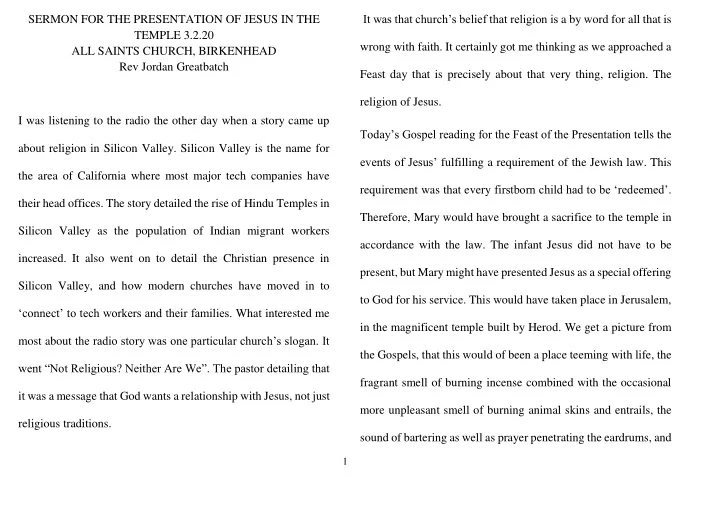
SERMON FOR THE PRESENTATION OF JESUS IN THE TEMPLE 3.2.20 ALL SAINTS CHURCH, BIRKENHEAD Rev Jordan Greatbatch I was listening to the radio the other day when a story came up about religion in Silicon Valley. Silicon Valley is the name for the area of California where most major tech companies have their head offices. The story detailed the rise of Hindu Temples in Silicon Valley as the population of Indian migrant workers

  • increased. It also went on to detail the Christian presence in

Silicon Valley, and how modern churches have moved in to ‘connect’ to tech workers and their families. What interested me most about the radio story was one particular church’s slogan. It went “Not Religious? Neither Are We”. The pastor detailing that it was a message that God wants a relationship with Jesus, not just religious traditions. It was that church’s belief that religion is a by word for all that is wrong with faith. It certainly got me thinking as we approached a Feast day that is precisely about that very thing, religion. The religion of Jesus. Today’s Gospel reading for the Feast of the Presentation tells the events of Jesus’ fulfilling a requirement of the Jewish law. This requirement was that every firstborn child had to be ‘redeemed’. Therefore, Mary would have brought a sacrifice to the temple in accordance with the law. The infant Jesus did not have to be present, but Mary might have presented Jesus as a special offering to God for his service. This would have taken place in Jerusalem, in the magnificent temple built by Herod. We get a picture from the Gospels, that this would of been a place teeming with life, the fragrant smell of burning incense combined with the occasional more unpleasant smell of burning animal skins and entrails, the sound of bartering as well as prayer penetrating the eardrums, and

slide-2
SLIDE 2

2

  • verwhelming the senses. It was a place alive with religious life.

A religious life Jesus was to become intimate with throughout his

  • upbringing. It was however a religious life that would produce

many tensions in his ministry. He was a devout Jew in every sense

  • f the word, and by participating in it affirmed its worth and
  • tradition. Nevertheless, he was also very critical of it, especially

those parts of religious life that seemed to burden people. Page 2 Still today, there are parts of religious life that we enjoy and cherish, but also some elements that make us uncomfortable. As with the slogan “Not Religious? Neither Are We”. There are many who see the institution of the church as a work of evil rather than good. There is and have been many movements throughout

1 Fr Richard Rohr “living on our one earth” retrieved from

http://www.cacradicalgrace.org/richard-rohr/dailymeditations

history that have analysed and renewed our religious institutional

  • life. Obviously there was Jesus and his disciples, Benedict and the

monastic tradition, St Francis and his social concern, then in later years Martin Luther and the reformation. In the 19th century it was the Evangelicals and Tractarianism in the Anglican tradition that shaped who we are. This has seen an expression of two forms of religious expression. There is the balancing act of non-rational and rational understandings, when the non-rational is stressed we see religion become over emotional, based in emotive conditioning, fundamentalist and tribal thinking. When the rational is over emphasised, religion can become legalistic, judgemental, and purely dogma.1 Interestingly enough the word religion

  • riginally

from the Latin religiōn (stem of religiō ) meaning

slide-3
SLIDE 3

3

conscientiousness, piety, ( āre ) to tie, fasten ( re- re- + ligāre) t

  • bind, tie; compare. It speaks of the knot that binds us together,

be it our worship, or our lifestyles. The word ‘religious’ has unfortunately had a bad rap over the years. Therefore it has developed to mean everything that is wrong about human notions

  • f faith and practice.

Page 3 All this negative press can leave one reeling, confused and

  • cynical. Are we then, like our Silicon Valley friends to abandon

religion all together? People may like Jesus as a teacher, and perhaps believe in a God but want to keep religion at arm’s length. I would argue however that the Christian life can be nothing but

  • religious. Everyone just does it differently. If we look closely at

the scriptures, the irony of such a belief is that Jesus himself was deeply religious, he was a religious and devout Jew, as our Gospel speaks of today in fine detail. He participated in the initiation rituals of Judaism, and we read that he was deeply involved in the life of the synagogue. We are informed in our epistle reading from the letter to the Hebrews that he “became like his brothers in sisters in every respect, so that he might be a merciful and faithful high priest in the service of God.” Meaning, he participated in the Jewish religious life so he could be the fulfiller of that life. That idea of fulfilling is the key in our conversation on religion, for while Jesus affirmed and participated in Jewish religious life he was also critical of those parts that had been interpreted through the lens of human selfishness and pride. We see this criticism throughout his ministry, critiquing the religious leaders who had used their power for personal gain, and made the law a burden. We, who are clergy, must place ourselves within that criticism, for many of us are guilty of the same things,

slide-4
SLIDE 4

4

and it is a collective problem of all religious people. However, it is not all doom and gloom, for Jesus always offers us a religion that holds the right balance. He affirms the institution and the rituals associated with it, yet always points to the deeper meaning behind them, they are structures, which facilitate the worship and ministry of the church. This coming together of institution and ritual is seen strikingly in the combination of the prophet figure Simeon from todays Gospel. He represented those who traditionally critiqued Israel’s religious life, being found in the temple of Jerusalem which was the representation of the institution of Israel’s religious and national identity. Page 4 The church today, especially the institutionalised churches of the Catholic or Orthodox tradition still have to hold that difficult

  • tension. Our Silicon Valley friends perhaps may have a point, if

institutional religion becomes involved with issues of power and dogma; it is in danger of losing its real purpose: a place where God should be met through its structures of accountable leadership, liturgy, rituals and beautiful buildings. We have to be constantly alert to Jesus’ affirmation of religious life and structures, but also as wise as serpents when it comes to his awareness of the pitfalls of such human systems. Like the old man Simeon, we must be patient in waiting, ready to listen, and able to approach the temple where God has promised to meet us through the reading of the scriptures, prayers and the bread and the wine of the Eucharist. My prayer is that men and women like everywhere, may find healing for the many wounds the institutional church has caused, and come to Jesus the Christ, who fulfils the law, redeems religion and reveals the inner thoughts of many, including us, his church, Amen.