Moses and The Exodus from Possible responses to problems Moses and - - PDF document

moses and the exodus from
SMART_READER_LITE
LIVE PREVIEW

Moses and The Exodus from Possible responses to problems Moses and - - PDF document

Religion 101: Te History and Religion of Israel Unit 2B: Moses and the Exodus from Egypt Religion 101: History & Religion of Israel Religion 101: History & Religion of Israel Today Today s Agenda s Agenda (Dr. (Dr. Chris


slide-1
SLIDE 1

Religion 101: Te History and Religion of Israel Unit 2B: Moses and the Exodus from Egypt 1

Religion 101: History & Religion of Israel Religion 101: History & Religion of Israel

(Dr. (Dr. Chris Heard Chris Heard •

  • Pepperdine University

Pepperdine University •

  • Fall 2005)

Fall 2005)

Moses and The Exodus from Moses and The Exodus from EgypT EgypT

Te Pivot of the Pentateuch Te Pivot of the Pentateuch

Today Today’ ’s Agenda s Agenda

  • Te exodus story and Israelite history

– Puzzles that inhibit understanding – Problems that inhibit belief – Possible responses to problems

  • Temes in the exodus story

– Pharaoh’s hardened heart – Te lessons of the plagues – Freedom and slavery

The Exodus and History The Exodus and History

1998 2004

Rationale Rationale

The Exodus and History The Exodus and History

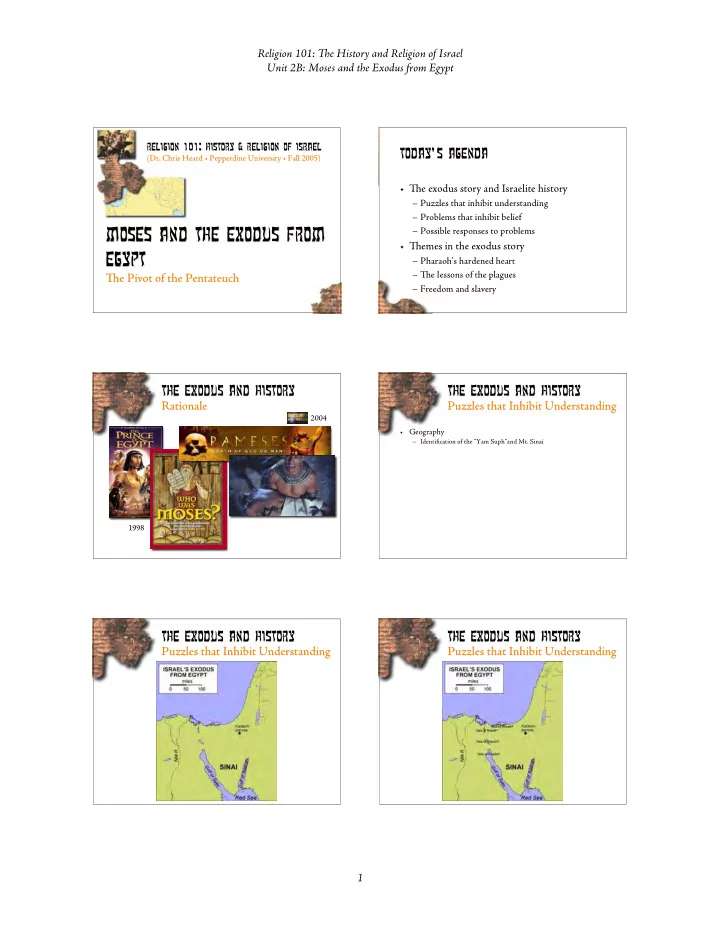
  • Geography

– Identification of the “Yam Suph”and Mt. Sinai

  • Time frame

– Puzzling features

  • Inconsistent data (Gen 15:13 vs. 15:16 vs. Num 32:39–41/Deut 3:14–15)
  • Uncertain starting point
  • Schematic chronologies

– Suggested time frames

  • 16th-century exodus (c. 1540 BCE) [almost no scholars]

– Possible Hyksos synchronism

  • 15th century exodus (c. 1440 BCE) [very few scholars]

– Better fits 1 Kings 6:1

  • 13th century exodus (c. 1250 BCE) [most scholars]

– Better fits Egyptian history – Better fits Palestinian archaeology

Puzzles that Inhibit Understanding Puzzles that Inhibit Understanding

The Exodus and History The Exodus and History

Puzzles that Inhibit Understanding Puzzles that Inhibit Understanding

The Exodus and History The Exodus and History

Puzzles that Inhibit Understanding Puzzles that Inhibit Understanding

slide-2
SLIDE 2

Religion 101: Te History and Religion of Israel Unit 2B: Moses and the Exodus from Egypt 2

The Exodus and History The Exodus and History

Puzzles that Inhibit Understanding Puzzles that Inhibit Understanding

The Exodus and History The Exodus and History

  • Geography

– Identification of the “Yam Suph”and Mt. Sinai

  • Time frame

– Puzzling features

  • Inconsistent data (Gen 15:13 vs. 15:16 vs. Num 32:39–41/Deut 3:14–15)
  • Uncertain starting point
  • Schematic chronologies

– Suggested time frames

  • 16th-century exodus (c. 1540 BCE) [almost no scholars]

– Possible Hyksos synchronism

  • 15th century exodus (c. 1440 BCE) [very few scholars]

– Better fits 1 Kings 6:1

  • 13th century exodus (c. 1250 BCE) [most scholars]

– Better fits Egyptian history – Better fits Palestinian archaeology

Puzzles that Inhibit Understanding Puzzles that Inhibit Understanding

The Exodus and History The Exodus and History

  • Miraculous/supernatural elements

– Te plagues: natural or legendary? – Over 2 million Israelites surviving in Sinai?

  • Lack of external evidence

– No Egyptian documentation

Problems that Inhibit Belief Problems that Inhibit Belief

The Exodus and History The Exodus and History

  • Miraculous/supernatural elements

– Te plagues: natural or legendary? – Over 2 million Israelites surviving in Sinai?

  • Lack of external evidence

– No Egyptian documentation – No archaeological remains

  • Of Israelite travelers
  • Of neighboring kingdoms

– Technological discontinuity

Problems that Inhibit Belief Problems that Inhibit Belief

The Exodus and History The Exodus and History

  • “Extreme” positions

– Reject biblical narrative altogether – Discount (lack of ) archaeological evidence

  • “Mediating” approaches

– Compressed narration – Exaggerated numbers – Large-group assimilation of small-group experience

Possible Responses to Problems Possible Responses to Problems

slide-3
SLIDE 3

Religion 101: Te History and Religion of Israel Unit 2B: Moses and the Exodus from Egypt 3

Themes in the Exodus Story Themes in the Exodus Story

Who Hardened Pharaoh’s Heart? 1. Unspecified 2. Pharaoh 3. Unspecified 4. Pharaoh 5. Unspecified 6. Te LORD 7. Pharaoh 8. Te LORD 9. Te LORD

  • 10. Te LORD
  • Premise: the LORD doesn’t need

Pharaoh’s cooperation

  • Purpose of the hardening:

to extend the plagues (Exod 7:3; 10:1)

  • Purpose of the plagues:

to show the LORD’s power (Exod 7:4–5; 9:14–16; 10:2; 12:12)

  • Addressing the moral dilemma (Rom

9:14–24)

Pharaoh Pharaoh’ ’s Hardened Heart s Hardened Heart

Themes in the Exodus Story Themes in the Exodus Story

Te LORD is incomparable Te LORD favors Israel Te LORD is real “Darkness” Boils “Gnats” No warning Locust Murrain Frogs “Untimed” warning Hail Flies Blood Morning warning

Lessons of the Plagues Lessons of the Plagues

Themes in the Exodus Story Themes in the Exodus Story

  • Te “liberation” theme
  • Laws for liberated slave-holders
  • Freed to serve

– “I am the LORD, and I will free you from the burdens of the Egyptians and deliver you from slavery (הדבע, ‘abodah = ‘service’) to them.” – “Let my people go, so that they may worship (דבע, ‘abad = ‘serve’) me in the wilderness.”

Slavery and Freedom Slavery and Freedom

Next Time in Religion 101 Next Time in Religion 101

  • Six distinct Torah law codes
  • Biblical attitudes toward biblical law
  • Biblical and ancient Near Eastern law
  • Te sin offering and the Day of Atonement

Unit 2C Te Torah’s Law Codes