
SLIDE 1
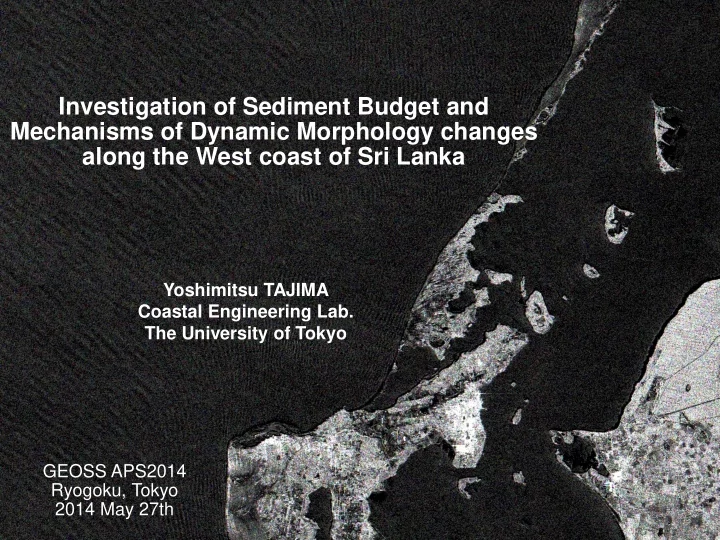
Investigation of Sediment Budget and Mechanisms of Dynamic Morphology changes along the West coast of Sri Lanka
Yoshimitsu TAJIMA Coastal Engineering Lab. The University of Tokyo GEOSS APS2014 Ryogoku, Tokyo 2014 May 27th
Investigation of Sediment Budget and Mechanisms of Dynamic - - PowerPoint PPT Presentation
Investigation of Sediment Budget and Mechanisms of Dynamic Morphology changes along the West coast of Sri Lanka Yoshimitsu TAJIMA Coastal Engineering Lab. The University of Tokyo GEOSS APS2014 Ryogoku, Tokyo 2014 May 27th Local erosion
Yoshimitsu TAJIMA Coastal Engineering Lab. The University of Tokyo GEOSS APS2014 Ryogoku, Tokyo 2014 May 27th
severe erosion
Groin & seawall protect beach Erosion. sand rock protects beach Local erosion & accumulations
2001 Mar.9
2005 Oct.27
2010 Aug.9
severe erosion
Groin & seawall protect beach Erosion. sand rock protects beach Local erosion & accumulations
2007.1 2009.12 PALSAR Good Relatively high resolution Shoreline is clearly detected Monitoring frequency Not so good
from the lower land like sand spit
in July 2010 (red lines) were compared with the PALSAR image.
is “darker” than the swash zone.
a useful data sets to monitor shoreline changes.
x y (xc,yc,zc)
φ v
u
σ
Shoreline locations in pixel coordinates Shoreline locations on fixed XY-horizontal coordinate system Comparisons of shoreline locations at different time
distance along the shoreline Shoreline change since 2007 Jan 14th time-series of shoreline change
X~20km whereas significant accumulation at X~15km
at X<14km
each beginning of the year?
sand accumulation?
Temporal variation of natural grain TL signal
Natural residual TL signal ~ Solar exposure ~ Sediment transport 1. Travelling duration 2. Moving distance 3. Source identification
Nearshore Sediment Movement
Time Luminescence signal Initial TL Initial OSL bleaching (short time) Sand buried under the ground (long period) Deposition TL OSL Erosion Nearshore Sediment transport Laboratory Measurement Natural residual TL Sunlight Bleaching Luminescence signal decrease No light exposure Natural irradiation Signal accumulation Fast stage Slow stage
Sand grain emits light (luminescence) when exposed to light (OSL: Optically Stimulated Luminescence) or heat (TL: Thermo Luminescence). Intensity of the luminescence depends on how long the grain was buried under the ground and how long it has been exposed to the sunlight.
Clear peak around Kalu river > sand supply from the land Gradual decay toward north > Northward transport No major peak in the north of Nigombo > No major sand supply from land
Small peak at the Kelani River mouth > relatively small sand supply from land
Wave
Current
Sediment transport / Topography change
Observed shoreline/bathymetry change wave observation Future change of the LSST can be estimated.
wave breaking y
θb
qy x
∞
=
s
x y s
dx q Q
α θ − ∝
b b g
EC sin
xs
∂ ∂ = y xs arctan α
QsIN QsOUT Ds Ds +Ru Δxs Δy
New Shoreline Old Shoreline
y
shallower than the critical depth, Ds.
s u s s
shoreline
Assumption
wave crest line
g f
EC E =
θ cos
g fx
EC E = θ sin
g fy
EC E =
x y y E E
fy fy
∆ ∆ ∂ ∂ + 2 1 x y y E E
fy fy
∆ ∆ ∂ ∂ − 2 1 y x x E E
fx fx
∆ ∆ ∂ ∂ + 2 1 y x x E E
fx fx
∆ ∆ ∂ ∂ − 2 1
∆x ∆y
Energy Balance Equation
time-average
in g
wind wave breaking friction loss
Aerial photo & Satellite Thermoluminescence Shoreline model 0.1~1km 陸 Offshore
Computed wave field Coastal Structures Shoreline Coastal Structures Northward LSST Block of LSST at Colombo No sand supply from land in the north
South North Land
wave height (m)
sea wall HL HL
0 Hs(m) 1.6
2km (b) (c) (d)
N S
meas. comp.
Colombo Nigombo Chilaw Kalpitiya
* Numbers are subject to change with further detailed analysis
100km 20km 10km 1km year after 1955
Predicted time-series of LSST
LSST [m3/year]
カルピティア北部 カルピティア南部 チラウ ニゴンボ
Nigombo : rapid decay in first 50 yrs. followed by nearly no LSST Chilaw : gradual decay is accelerated after 50 yrs.
Kalpitiya : No significant change
1956 1988 1988(cal.) 2000(cal.) 2050(cal.) 2100(cal.) 2000 Nigombo
Chilaw Kalpitiya Kalpitiya
Chilaw Nigombo