Investigating the Seasonal and Diurnal Cycles of Ocean Vector Winds, - - PowerPoint PPT Presentation

investigating the seasonal and diurnal cycles of ocean
SMART_READER_LITE
LIVE PREVIEW

Investigating the Seasonal and Diurnal Cycles of Ocean Vector Winds, - - PowerPoint PPT Presentation

https://ntrs.nasa.gov/search.jsp?R=20170004483 2018-07-26T23:36:06+00:00Z Investigating the Seasonal and Diurnal Cycles of Ocean Vector Winds, Precipitation, and Lightning near the Philippines Timothy Lang NASA Marshall Space Flight Center


slide-1
SLIDE 1

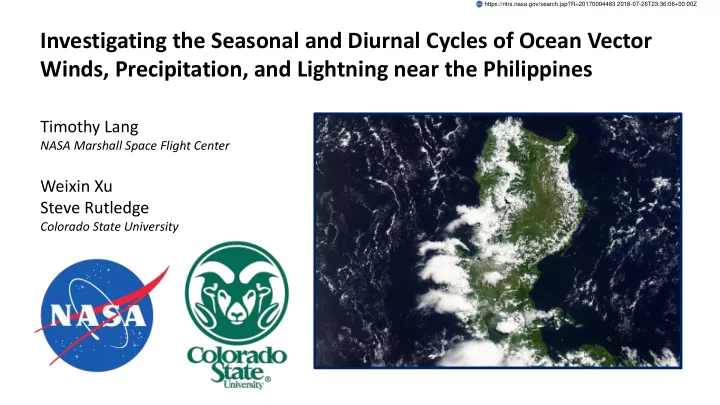
Investigating the Seasonal and Diurnal Cycles of Ocean Vector Winds, Precipitation, and Lightning near the Philippines

Timothy Lang

NASA Marshall Space Flight Center

Weixin Xu Steve Rutledge

Colorado State University

https://ntrs.nasa.gov/search.jsp?R=20170004483 2018-07-26T23:36:06+00:00Z

slide-2
SLIDE 2

Background Boreal Summer Intraseasonal Oscillation (BSISO) creates northeastward-moving disturbances, which interact with the strong diurnal cycle of the Maritime Continent, complicating sub-seasonal forecasts. Key Questions

  • Can we characterize the diurnal cycle of vector

winds near the west coast of Luzon using satellite-based datasets?

  • How does the BSISO affect the intraseasonal

variability and diurnal cycle of winds, precipitation, and lightning near the Philippines?

http://onrpiston.colostate.edu

slide-3
SLIDE 3

Datasets and Methodology RapidScat 12.5-km Climate V1.0

  • Each relevant swath binned to 0.25-degree,

2-hourly grid

  • Diurnal harmonic fit to dataset

Cross-Calibrated Multi-Platform (CCMP) Winds V2.0

  • Includes ASCAT-A, WindSat, GMI, AMSR-2, SSMI/S,

Buoys assimilated into model

  • 0.25-degree, 6-hourly grid

Tropical Rainfall Measuring Mission (TRMM)

  • 3B42 Rainfall Product
  • Lightning Imaging Sensor (LIS) Flashes

Primary Domain of Interest – 5 ⚬S to 20 ⚬N, 110-130 ⚬E

https://eol.jsc.nasa.gov/

slide-4
SLIDE 4

Seasonal Results May-Oct: “Monsoon” Nov-Apr: Trade wind regime Relatively good agreement between RapidScat and CCMP West of Luzon is region of relatively weak mean winds Several gap flows observed in both datasets (RapidScat filtered to remove grid boxes with < 400 samples 2014-2016)

slide-5
SLIDE 5

Nov-April 2015 May-Oct 2015

RapidScat – CCMP, Seasonal Means, Whole Domain

Bias = -0.12 m/s Bias = +0.07 m/s Bias = -0.09 m/s Bias = -0.01 m/s

slide-6
SLIDE 6

RapidScat (Diurnal Harmonic) CCMP 00 18 06 12 00 18 06 12

Diurnal Cycle – 2014-2016

slide-7
SLIDE 7

RapidScat 2-hourly Diurnal Harmonic Oct 2014 - August 2016 Peak winds closer to 10 (onshore) and 22 UTC (offshore) than 00/12 Diurnal influence extends ~200 km west

Grey curve: R2 = 0.5

slide-8
SLIDE 8

Sampling Considerations

  • Binning and averaging non-
  • ptimal; more sophisticated

methods being explored

  • However, near Philippines there

does not appear to be a major diurnal bias in sampling

All RapidScat RapidScat May-Oct 2015

slide-9
SLIDE 9

CCMP Diurnal Cycle Monthly 1997-2016 00 UTC Amplitude peaks in April

Wind Anomaly

slide-10
SLIDE 10

CCMP Winds by BSISO Phase – July-September 1997-2013, Magnitude > 1

slide-11
SLIDE 11

TRMM and ECMWF

slide-12
SLIDE 12

TRMM LIS Flash Density by BSISO Phase, JAS

slide-13
SLIDE 13

Inactive BSISO

Phases 1-3 Magnitude > 1 CCMP JAS 1997-2013

slide-14
SLIDE 14

Active BSISO

Phases 5-7 Magnitude > 1 CCMP JAS 1997-2013

slide-15
SLIDE 15

Inactive BSISO

Phases 1-3 Magnitude > 1 TRMM 3B42 JAS 1997-2013

slide-16
SLIDE 16

Active BSISO

Phases 5-7 Magnitude > 1 TRMM 3B42 JAS 1997-2013

slide-17
SLIDE 17

Conclusions CCMP and RapidScat agree on many basic characteristics of the seasonal and diurnal cycle of ocean vector winds near the Philippines Offshore flow near Luzon peaks at 22 UTC (06 L), and onshore flow peaks at 10 UTC (18 L) – Corresponds well to behavior of precipitation and lightning CCMP shows diurnal cycle amplitude near Luzon peaks in April, as trade wind regime is transitioning to monsoonal flow Active BSISO phases associated with weaker diurnal cycle of ocean vector winds – Consistent with more cloud cover/precipitation suppressing sea breeze “In situ” study of winds/precipitation will occur during PISTON 2018

Funded by:

slide-18
SLIDE 18

BACKUP SLIDES

slide-19
SLIDE 19

Nov-April 2015 May-Oct 2015

RapidScat – CCMP, Seasonal Means, Whole Domain (rain flagged removed)

Bias = -0.09 Bias = +0.14 Bias = -0.07 Bias = -0.11

slide-20
SLIDE 20

Entire RapidScat Dataset U component

slide-21
SLIDE 21

May-Oct 2015 U component

slide-22
SLIDE 22

Nov-Apr 2015 U component

slide-23
SLIDE 23