Inverse Kinematics This addresses the obvious question: what joint - - PowerPoint PPT Presentation

inverse kinematics
SMART_READER_LITE
LIVE PREVIEW

Inverse Kinematics This addresses the obvious question: what joint - - PowerPoint PPT Presentation

Inverse Kinematics This addresses the obvious question: what joint angles will place my end effector in a desired pose? Inverse kinematics Closed form (analytical) solution: a sequence or set of equations that can be solved for the desired


slide-1
SLIDE 1

Inverse Kinematics

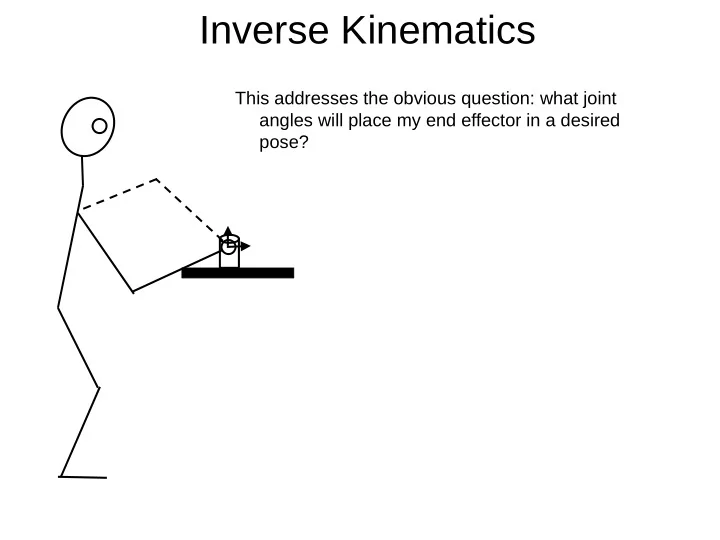
This addresses the obvious question: what joint angles will place my end effector in a desired pose?
slide-2
SLIDE 2

Closed form (analytical) solution: a sequence or set of equations that can be solved for the desired joint angles

  • Potentially faster than an iterative solution
  • A unique solution to all manipulator positions can be determined a priori.
  • Can guarantee “safe” joint configurations where the manipulator does

not collide with the body. Iterative (numerical) solution: numerical iteration toward a desired goal position (variation on Newton’s method)

  • Easier to think about
  • Better suited to incremental displacements and control.

Inverse kinematics

slide-3
SLIDE 3

There is no general analytical inverse kinematics solution

  • All analytical inverse kinematics solutions are specific to a robot or class
  • f robots.
  • based on geometric intuition about the robot
  • I’ll give one example – there are many variations.

Inverse kinematics

slide-4
SLIDE 4

Inverse kinematics

1

q

2

q

3

q

4

q

5

q

6

q

Spherical wrist: the axes of the last three joints intersect in a point. Consider this 6-joint robot:

  • this example is out of the book…
slide-5
SLIDE 5

Inverse kinematics

1

q

2

q

3

q

4

q

5

q

6

q

Problem:

  • Given: desired transform,
  • Find:

      = 1

eff eff eff

d R T

( )

n

q q q q q q 

4 3 2 1

=

Note:

  • The desired transform (pose) encodes six degrees of freedom (this info can

be represented by six numbers)

  • Since we only have six joints at our disposal, there is no manifold of

redundant solutions.

  • For this manipulator, the problem can be decomposed into a position

component (the first three joints) and an orientation component (the last three joints)

  • The first three joints tell you what the position of the spherical wrist
slide-6
SLIDE 6

Since it’s a spherical wrist, the last three joints can be thought of as rotating about a point.

  • A constant transform exists that goes from the last wrist joint out to the end

effector (sometimes this is called the “tool” transform):

  • Back out the position of the wrist:

Example: Inverse kinematics

1

q

2

q

3

q

4

q

5

q

6

q

Solution:

  • First, back out the position of the spherical

wrist:

eff swT 1 −

=

eff sw eff b sw b

T T T

slide-7
SLIDE 7

First, solve for . (look down from above)

1

q

2

q

3

q

4

q

5

q

6

q

  • Next, solve for the first three joints

( )

g g y

x a q , 2 tan

1 = 1

q

Goal position in horizontal plane

1

q

( )

π + =

g g y

x a q , 2 tan

1

  • r

Example: Inverse kinematics

slide-8
SLIDE 8

Next, solve for . (look at the manipulator orthogonal to the plane of the first two links)

1

q

2

q

3

q

4

q

5

q

6

q

( )

( )

D l l l l h z r

g g c

− = − − − + − =

2 1 2 2 2 1 2 2

2 cos θ

3

q

2

q

3

q

1

l

2

l ) cos( 2

2 2 2 c

ab b a c θ − + =

2 2 2 g g g

y x r + =

where

c

θ

and is the height of the first link

h

( )

D D q

2 3

1 tan − ± =

Example: Inverse kinematics

slide-9
SLIDE 9

Next, solve for . (continue to look at the manipulator

  • rthogonal to the plane of the

first two links)

1

q

2

q

3

q

4

q

5

q

6

q

2

q

2

q

3

q

1

l

2

l

( )

2 2

tan

g g g

y x h z + − = θ θ α

( )

3 2 1 3 2

tan c l l s l + = α α θ ± =

2

q

Example: Inverse kinematics

slide-10
SLIDE 10

Finally, the last three joints completely specify the

  • rientation of the end effector.
  • Note that the last three joints look just like ZYZ

Euler angles

  • Determination of the joint angles is easy –

just calculate the ZYZ Euler angles corresponding to the desired orientation.

1

q

2

q

3

q

4

q

5

q

6

q

Example: Inverse kinematics

slide-11
SLIDE 11

Remember: ZYZ Euler Angles

( )

          −           −           − = 1 cos sin sin cos cos sin 1 sin cos 1 cos sin sin cos , , ψ ψ ψ ψ θ θ θ θ φ φ φ φ ψ θ φ

zyz

R ( )

          − + − + − − − =

θ ψ θ ψ θ θ φ ψ φ ψ θ φ ψ φ ψ θ φ θ φ ψ φ ψ θ φ ψ φ ψ θ φ

ψ θ φ c s s c s s s c c s c s s c c c s s c c s s c c s s c c c Rzyz , ,

      − ± =

33 2 33 ,

1 2 tan r r a θ

( )

π φ k r r a + =

13 23,

2 tan

( )

31 32,

2 tan r r a = ψ

slide-12
SLIDE 12

Inverse kinematics for a humanoid arm

You can do similar types of things for a humanoid (7-DOF) arm.

  • Since this is a redundant arm, there are a

manifold of solutions… elbow Spherical wrist Spherical shoulder General strategy:

  • 1. Solve for elbow angle
  • 2. Solve for a set of shoulder angles that places the wrist in the right position

(note that you have to choose an elbow orbit angle)

  • 3. Solve for the wrist angles