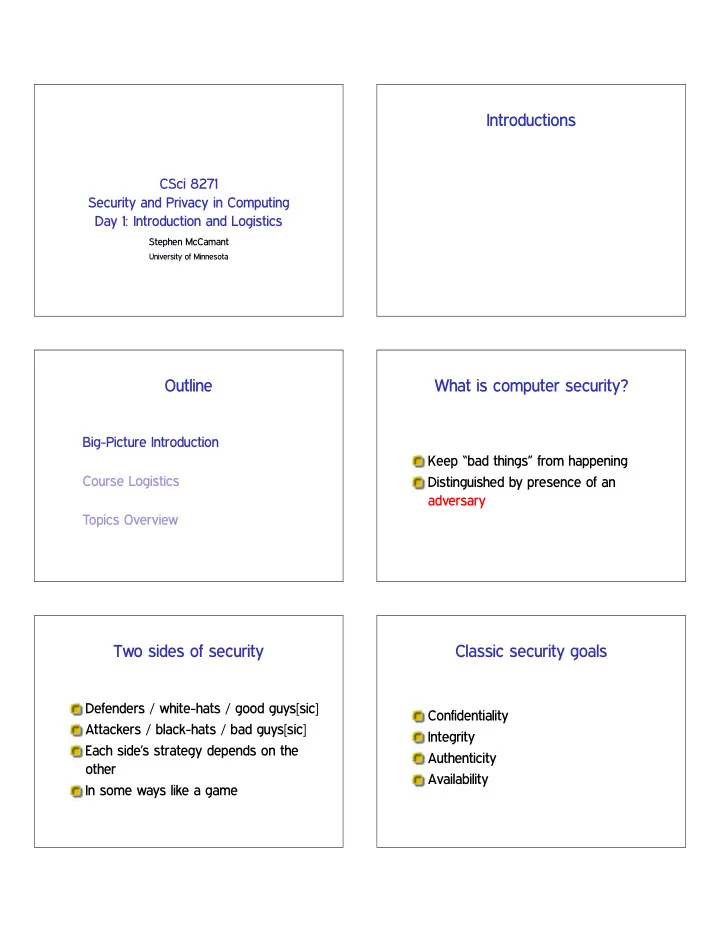
SLIDE 1 CSci 8271 Security and Privacy in Computing Day 1: Introduction and Logistics
Stephen McCamant
University of Minnesota
Introductions Outline
Big-Picture Introduction Course Logistics Topics Overview
What is computer security?
Keep “bad things” from happening Distinguished by presence of an adversary
Two sides of security
Defenders / white-hats / good guys[sic] Attackers / black-hats / bad guys[sic] Each side’s strategy depends on the
In some ways like a game
Classic security goals
Confidentiality Integrity Authenticity Availability
SLIDE 2 What about “privacy”?
One perspective: privacy ✚ security
Roughly a synonym for confidentiality
But, very different emphasis
“Security” often means interests of institutions, administrators “Privacy” is an interest of individuals often against institutions
Tool: cryptography
Math techniques for making things purposely hard to figure out More than just encryption and decryption We take a research but results rather than proof-focused perspective
Tool: program analysis
Programs whose job is to operate on
For bug finding, hardening, etc. De-emphasized a bit this year, because
Applications
Security problems occur all over computer science Broad division: systems and networks For 8271, mixture of standard and uncommon
Outline
Big-Picture Introduction Course Logistics Topics Overview
Instructor information
Stephen McCamant Office: 4-225E Keller Office hours: Monday 10-11am (may change), or by appointment Email: ♠❝❝❛♠❛♥t❅❝s✳✉♠♥✳❡❞✉
SLIDE 3
Evaluation components
15% Reading questions 10% Class attendance and participation 15% In-class paper presentation(s) 10% Hands-on demo assignment 50% Research project
Readings
Linked from the course web page Usually one main paper per class Most either public or UMN-licensed Take notes while reading Bring a copy (to refer to) to class Also: optional and background
Reading questions
Goal: make sure you read and understand the papers Answer one: a general question selected from list on next slide Ask one: suggest a question for in-class discussion
General questions
What interesting new thing did you learn? What question is raised but not answered? Do you disagree with a claim? Is something important left out or ambiguous? In hindsight, what would you do differently?
Submission logistics
Email or Moodle? Due the day before
9pm? midnight? 3am?
Late: 50% credit; after 9:45am: 0
In-class presentation
Three per student, scheduled in advance Can also promote an optional or chosen-by-you relevant paper Prepare 25 minutes of slides, but expect questions
SLIDE 4
Class participation
The goal of a seminar is discussion, not lecture I expect everyone to contribute Aim is not to show off knowledge
An interesting question ❃ a straightforward answer
Hands-on demo assignment
Experience actually using an existing research tool Done individually Find existing software, and get it to do something interesting Preparation in advance, short writeup, brief in-class demo
Research project
Idea: microcosm of research experience Formulate a question, answer it, convince others of your results Given enrollment, done individually
Project topics
Computer security, including privacy Can use one of our papers as a starting point But, must make your own novel contribution
Project goals
Innovative Scholarly
Put in context of related work
Appropriately evaluated
Able to convince a skeptic
Well presented
Project results
Report: about 10 pages, in the format of a conference paper In-class presentation: 20+5 minutes
SLIDE 5
Collaboration and cheating
Principle: learn from each other, but don’t substitute another’s understanding for your own Cardinal sin: taking ideas without acknowledgment
Course web site
Department web site under ❝s❝✐✽✷✼✶
Also linked from my home page ⑦♠❝❝❛♠❛♥t
Moodle page coming soon
Outline
Big-Picture Introduction Course Logistics Topics Overview
Security of clouds and outsourcing
How can I pay someone else to do my computing for me, and still have it be secure? Systems-based and cryptographic approaches
Blockchains and anonymous payment
What are Bitcoin-like systems good for? Can your transactions be private if the ledger is public?
Smartphone and app security
Android and iOS get avoid some desktop problems by design, but also introduce new dangers.
SLIDE 6 Anonymous overlays / Tor
How can we communicate anonymously on the Internet, when every packet has your IP address on it?
Web application security
The web has a complicated distributed trust model, and processing is all based on string
- parsing. What could go wrong?
Measuring privacy loss
Using math to define how computations reveal information or allow inferences.
(Anti-)censorship techniques
Can we communicate even when/how an ISP or government doesn’t want us to?
Architectural side channels
Instruction-level timing and other low-level CPU details can reveal information unintentionally.
Naming and PKI
Systems like DNS and HTTPS certificates are central, but depend on a lot of centralized trust.
SLIDE 7 Embedded applications
Domains with real-world implications, where hardware matters, like medical devices and cars.
Physical side channels
Information leakage or unexpected attacks made possible by the physical world.
Subverted infrastructure
Could our CPUs, compilers, etc., have hidden back doors? Is there anything we could do about it?
Security of machine learning
The power of machine learning is leading it to be widely adopted, but it also makes new kinds of attack possible.
Applied cryptanalysis
In practice, the security of cryptographic systems can be broken by both mathematical and implementation problems.
Malice in the network
Malware, botnets, and spam form economic and software ecosystems built on “efficient”
- fraud. How do they work and is there
anything we can do to stop them?
SLIDE 8
Passwords
Passwords are an authentication mode that users and researchers both love to hate, but they don’t seem to be going away. Maybe we can make them less bad.