Introduction to Version Control Who knows any of these? CVS, - - PDF document

introduction to version control
SMART_READER_LITE
LIVE PREVIEW

Introduction to Version Control Who knows any of these? CVS, - - PDF document

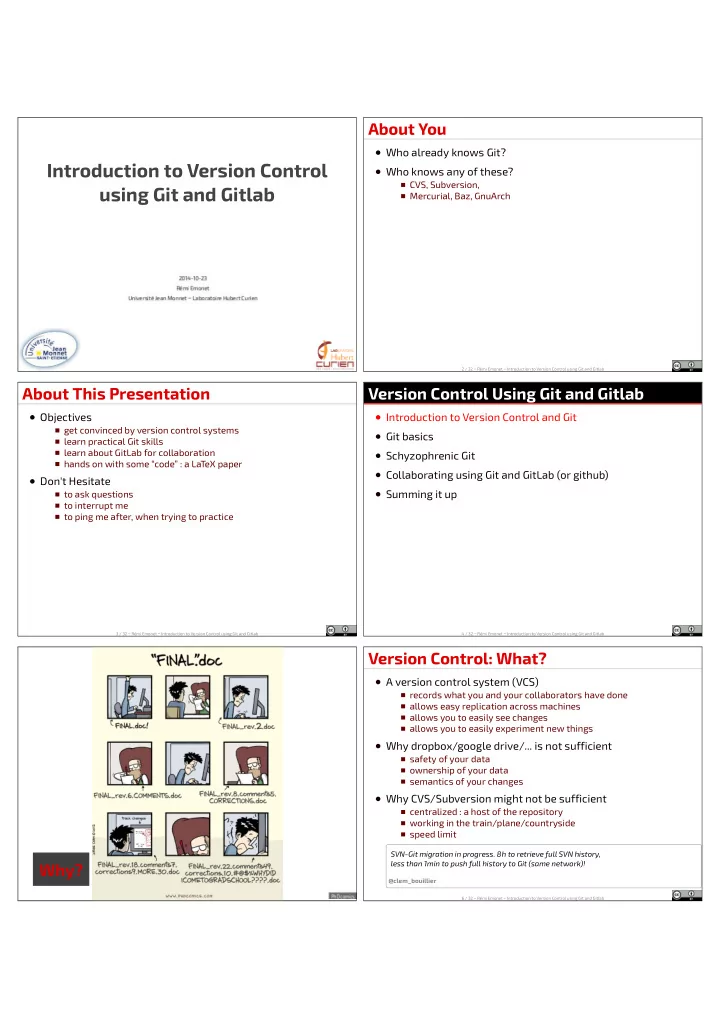
About You Who already knows Git? Introduction to Version Control Who knows any of these? CVS, Subversion, using Git and Gitlab Mercurial, Baz, GnuArch 2 / 32 Rmi Emonet Introduction to Version Control using Git and Gitlab About This


slide-1
SLIDE 1

Introduction to Version Control using Git and Gitlab

About You

Who already knows Git? Who knows any of these?

CVS, Subversion, Mercurial, Baz, GnuArch

2 / 32 − Rémi Emonet − Introduction to Version Control using Git and Gitlab

About This Presentation

Objectives

get convinced by version control systems learn practical Git skills learn about GitLab for collaboration hands on with some “code” : a LaTeX paper

Don't Hesitate

to ask questions to interrupt me to ping me after, when trying to practice

3 / 32 − Rémi Emonet − Introduction to Version Control using Git and Gitlab

Version Control Using Git and Gitlab

Introduction to Version Control and Git Git basics Schyzophrenic Git Collaborating using Git and GitLab (or github) Summing it up

4 / 32 − Rémi Emonet − Introduction to Version Control using Git and Gitlab

Why? Version Control: What?

A version control system (VCS)

records what you and your collaborators have done allows easy replication across machines allows you to easily see changes allows you to easily experiment new things

Why dropbox/google drive/... is not sufficient

safety of your data

  • wnership of your data

semantics of your changes

Why CVS/Subversion might not be sufficient

centralized : a host of the repository working in the train/plane/countryside speed limit

SVN-Git migration in progress. 8h to retrieve full SVN history, less than 1min to push full history to Git (same network)!

@clem_bouillier

6 / 32 − Rémi Emonet − Introduction to Version Control using Git and Gitlab

slide-2
SLIDE 2

Git

Git (/ɡɪt/) is a distributed revision control and source code management (SCM) system with an emphasis on speed, data integrity, and support for distributed, non-linear

  • workflows. Git was initially designed and developed by Linus Torvalds for Linux kernel

development in 2005, and has since become the most widely adopted version control system for software development.

wikipedia

History of Git

  • pen source

initiated by Linus Torvalds first release: 7 April 2005 version 2.1.2: 30 September 2014 fast and efficient most used

Good alternative: mercurial (hg)

7 / 32 − Rémi Emonet − Introduction to Version Control using Git and Gitlab

Version Control Using Git and Gitlab

Introduction to Version Control and Git Git basics Schyzophrenic Git Collaborating using Git and GitLab (or github) Summing it up

8 / 32 − Rémi Emonet − Introduction to Version Control using Git and Gitlab

Starting with Git

Initializing your project git init What's up? git status Deciding what is relevant git add file1 file2 … git commit first: introduce yourself

9 / 32 − Rémi Emonet − Introduction to Version Control using Git and Gitlab

Let's try it

cp -r base mypaper ; cd mypaper git init git status git add mypaper.tex cvpr.sty git status git commit git status ... and more …

10 / 32 − Rémi Emonet − Introduction to Version Control using Git and Gitlab

Recap

Beginning git init git add ... git commit [-m ...] Working git status git add ... git commit [-m ...]

11 / 32 − Rémi Emonet − Introduction to Version Control using Git and Gitlab

Recap 2

Keep your project clean: ignoring files

.gitignore file(s) blabla.* , !blabla.my_precious , *~

What did I just modify? git status git diff [...] What happened? git log

12 / 32 − Rémi Emonet − Introduction to Version Control using Git and Gitlab

slide-3
SLIDE 3

Nota Bene (vs CVS, Subversion)

You have the complete repository

have all commits locally commit often, fast and everywhere (train, plane, here) merge with 0-stress warning: commit ≠ backup

Need to “ git add ” modifications Repository == project

SVN has a big tree-shaped repository SVN allows to "checkout" any subtree Git works at the repository level you'll have a set of repository commits are at the repository level

13 / 32 − Rémi Emonet − Introduction to Version Control using Git and Gitlab

GUI for Git

Bundled with git: git gui Many others (gitg, qgit, GitX, tortoisegit, Netbeans, ...) graphical user interfaces for Git huge list of frontends and tools

14 / 32 − Rémi Emonet − Introduction to Version Control using Git and Gitlab

Customizing Git

Introducing yourself git config --global user.name "John Doe" git config --global user.email john@doe.com Fancy colors and shortcuts git config --global color.ui true git config --global alias.st status git config --global alias.ci commit Configuration in ~/.gitconfig

15 / 32 − Rémi Emonet − Introduction to Version Control using Git and Gitlab

Version Control Using Git and Gitlab

Introduction to Version Control and Git Git basics Schyzophrenic Git Collaborating using Git and GitLab (or github) Summing it up

16 / 32 − Rémi Emonet − Introduction to Version Control using Git and Gitlab

About History

Remember git log ? Each commit is written in stone

parent(s) commit modifications sha1sum (e.g. cb6dc3cb1f4f5eb15c1d9b2b25ae741cd73c0554)

can be diff'ed against git diff cb6dc3... can be retreived git checkout cb6dc3...

17 / 32 − Rémi Emonet − Introduction to Version Control using Git and Gitlab

Back to the Future: parallel universes

git log gitk # or gitg git checkout 41474a33e098689b... emacs paper.tex git commit gitk gitk --all ... and more …

18 / 32 − Rémi Emonet − Introduction to Version Control using Git and Gitlab

slide-4
SLIDE 4

Recap

Branch

a label for a commit automatically follows on new commit ( git commit )

Always commit before merging

commit is cheap, easy and local you never loose anything when merging

Use of “sha1” or branch-name (e.g. brrrr) Shortcuts cb6dc3, brrrr, HEAD, HEAD^, HEAD~, HEAD~~, HEAD~2, HEAD~42, HEAD^2, cb6dc3^42, tagggg

19 / 32 − Rémi Emonet − Introduction to Version Control using Git and Gitlab

Recap 2

Moving in the history git checkout sha1-or-branch-name Creating a new branch at current position git checkout -b new-branch-name Merging “brrrr” into “master” git checkout master git merge brrrr

20 / 32 − Rémi Emonet − Introduction to Version Control using Git and Gitlab

Recap 3

Automatic git merge ⇒ automatic commit On conflicting git merge

(partial merge) solve conflict git add git commit

Exploring history

git log gitk [--all] log --graph --decorate --oneline --all --color

21 / 32 − Rémi Emonet − Introduction to Version Control using Git and Gitlab

Best Practices

commit early and often always commit before merge (or pull) use meaningful commit messages avoid committing

binary files that change often (NB: word/excel/... are binary) generated files (that can be regenerated in a reasonable time) temporary files

keep your git status clean don't put git repositories inside git repositories more

23 / 32 − Rémi Emonet − Introduction to Version Control using Git and Gitlab

Version Control Using Git and Gitlab

Introduction to Version Control and Git Git basics Schyzophrenic Git Collaborating using Git and GitLab (or github) Summing it up

24 / 32 − Rémi Emonet − Introduction to Version Control using Git and Gitlab

What is GitLab (and GitHub)

GitLab

a company providing support and advanced features an open source project (Community Edition) a web application

collaboration platform hosting git repositories visualizing repositories managing issues/tickets GitLab offers git repository management, code reviews, issue tracking, activity feeds, wikis.

25 / 32 − Rémi Emonet − Introduction to Version Control using Git and Gitlab

slide-5
SLIDE 5

Let's Go

Create a repository on GitLab Push our content

link our repository to the remote repository (on GitLab) push the changes to this remote repository

On another machine

clone the repository make changes, commit and push them

On this machine

pull changes: fetch them and then merge

26 / 32 − Rémi Emonet − Introduction to Version Control using Git and Gitlab

Recap GitLab (and Git remotes)

GitLab project == git repository (+ more)

27 / 32 − Rémi Emonet − Introduction to Version Control using Git and Gitlab

More GitLab (additions to git)

Groups

groups of users (e.g., PhD student and supervisors) automatic access to the projects of the group

Forking

take a repository on GitLab make a “personal” copy of this repository (still on GitLab)

Merge requests (pull requests in GitHub)

ask for another repo to integrate changes from your fork

Issues

bug questions feature requests

Wikis

set of pages (also accessible as a git repository)

28 / 32 − Rémi Emonet − Introduction to Version Control using Git and Gitlab

Things to Know at UJM

SSH access is disabled

always use "https://gitlab...." to clone your repository

To avoid typing your login every time

add your user name and @ after https:// e.g.,

git clone https:// er1234h@ gitlab.univ-st-etienne.fr/remi.emonet/pyqtidoteach.git

in case you forgot, you can edit .git/config

In case of problems while pushing big sets of commits

error: RPC failed; result=22, HTTP code = 411 fatal: The remote end hung up unexpectedly just run git config http.postBuffer 524288000

29 / 32 − Rémi Emonet − Introduction to Version Control using Git and Gitlab

How to Get an Account on GitLab

For people with a UJM account

  • pen a ticket and asking “to get an account on GitLab”

wait until you're notified it has been done visit http://gitlab.univ-st-etienne.fr/ use your UJM login/pass to connect ignore the email you'll receive

For other people (interns, external collaborators)

a person from UJM needs to open a ticket asking for the account

providing an email and a name (for each collaborator)

upon creation, you receive your credentials to log in, visit https://gitlab.univ-st-etienne.fr/ click on the “Standard” tab use the credentials you've been given

30 / 32 − Rémi Emonet − Introduction to Version Control using Git and Gitlab

Version Control Using Git and Gitlab

Introduction to Version Control and Git Git basics Schyzophrenic Git Collaborating using Git and GitLab (or github) Summing it up

31 / 32 − Rémi Emonet − Introduction to Version Control using Git and Gitlab

slide-6
SLIDE 6

Key Points

Version control

keep track of what happened store semantic snapshots/versions of your “code”

Git

“distributed” version control: you have a complete repository efficient and widely used

  • ne repository per project

GitLab

a place to share repositories (projects) visualization of the repositories, wiki pages, issue tracker, … groups of users (e.g., PhD student and supervisors) available only via https, no SSH (in University Jean Monnet)

Links

interactive learning of branching in Git

  • fficial website

graphical user interfaces for Git for Git by a git, ask Linus Torvald Pro Git book (available online)

32 / 32 − Rémi Emonet − Introduction to Version Control using Git and Gitlab

Correspondence git <-> svn

git commit <-> none git commit ; git push <-> svn commit git fetch <-> none git fetch ; git merge <-> svn update git pull == git fetch ; git merge NB: you can use git to collaborate with SVN users

33 / 35 − Rémi Emonet − Introduction to Version Control using Git and Gitlab

Going further

git remote add git tag git rebase git commit --amend git reflog git ls-files git revert git bisect

34 / 35 − Rémi Emonet − Introduction to Version Control using Git and Gitlab 35 / 35 − Rémi Emonet − Introduction to Version Control using Git and Gitlab

Thanks!