Introduction Estimating Growing Season Hydraulic Loading Rate Using - - PDF document

introduction
SMART_READER_LITE
LIVE PREVIEW

Introduction Estimating Growing Season Hydraulic Loading Rate Using - - PDF document

5/10/2012 Introduction Estimating Growing Season Hydraulic Loading Rate Using U.S. Bureau of Reclamation Agricultural Meteorological In Idaho, wastewater approved for System (AgriMet) Data land application must be done in a manner that does


slide-1
SLIDE 1

5/10/2012 1

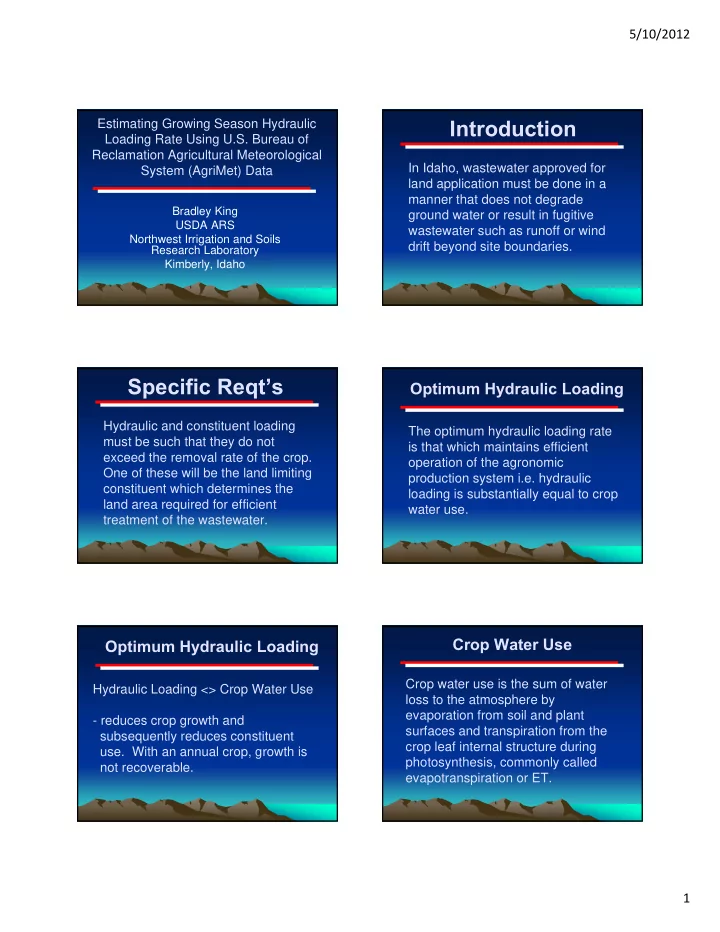
Estimating Growing Season Hydraulic Loading Rate Using U.S. Bureau of Reclamation Agricultural Meteorological System (AgriMet) Data

Bradley King USDA ARS Northwest Irrigation and Soils Research Laboratory Kimberly, Idaho

Introduction

In Idaho, wastewater approved for land application must be done in a manner that does not degrade ground water or result in fugitive wastewater such as runoff or wind drift beyond site boundaries.

Specific Reqt’s

Hydraulic and constituent loading must be such that they do not exceed the removal rate of the crop. One of these will be the land limiting constituent which determines the land area required for efficient treatment of the wastewater.

Optimum Hydraulic Loading

The optimum hydraulic loading rate is that which maintains efficient

  • peration of the agronomic

production system i.e. hydraulic loading is substantially equal to crop water use.

Optimum Hydraulic Loading

Hydraulic Loading <> Crop Water Use

  • reduces crop growth and

subsequently reduces constituent

  • use. With an annual crop, growth is

not recoverable. Crop water use is the sum of water loss to the atmosphere by evaporation from soil and plant surfaces and transpiration from the crop leaf internal structure during photosynthesis, commonly called evapotranspiration or ET.

Crop Water Use

slide-2
SLIDE 2

5/10/2012 2

Evapotranspiration is dynamic as it depends upon crop type, crop growth stage, nutrient availability, and environmental conditions (solar radiation, temperature, humidity, wind speed).

Evapotranspiration Sugar Beet ET – Kimberly

0.05 0.1 0.15 0.2 0.25 0.3 0.35 0.4

Evapotranspiration (in) Date

1994 1993

Wastewater land application permits may specify a source for estimating ET. For example:

  • www.kimberly.uidaho.edu/ETIdaho/
  • www.usbr.gov/pn/agrimet/

Estimating ET

www.kimberly.uidaho.edu/ETIdaho/ www.kimberly.uidaho.edu/ETIdaho/ The AgriMet system is a cooperative agricultural weather station network, managed and

  • perated by the U.S. Bureau of

Reclamation, dedicated to agricultural crop water use estimation.

AgriMet System

slide-3
SLIDE 3

5/10/2012 3

www.usbr.gov/pn/agrimet/ www.usbr.gov/pn/agrimet/ Evapotranspiration is an energy limited process. The energy for the latent heat of evaporation comes from two sources: solar radiation (heat function) and advective energy transfer (wind function)

ET

Evapotranspiration models that take into account both radiation energy and advective energy are called combination equations. The classical combination equation is the Penman

  • Equation. AgriMet uses a variant of

the Penman equation.

Combination Equation

The equation used by AgriMet is:

1982 Kimberly-Penman Equation

Latent Energy Radiant Energy Advective Energy

The wind function characterizes the effects of wind in the advection (motion of the atmosphere) of sensible heat for ET and is calculated as:

1982 Kimberly-Penman Equation Wind Function

slide-4
SLIDE 4

5/10/2012 4

The empirical coefficients are calibrated for the effect that surrounding rangeland is wetter earlier in the year and has less advection of sensible heat than later in the year.

1982 Kimberly-Penman Equation Wind Function

The Kimberly-Penman equation estimates evapotranspiration for a alfalfa crop (ETr) that is well-watered with 12 to 20 in of top growth which is denoted as ETr

Reference Crop ET

Estimated crop evapotranspiration, which is denoted as ETc, is calculated as:

Crop ET

where Kc is the crop coefficient.

Normalized Crop Coefficient

0.2 0.4 0.6 0.8 1 50 100 150 200

Crop Coefficient Percent of Growth Stage

Sugar Beet Spring Grain

Normalized Crop Coefficient

Growth Stage (%) Crop Coefficient Growth Stage Indicators 0.20 Emergence ….. ….. 70 1.00 Full Canopy ….. ….. 100 1.00 Heading ….. ..... 200 0.28 Leaves and Stem Dead

Spring Grain

Scaled Crop Coefficient

0.2 0.4 0.6 0.8 1 4/1 5/21 7/10 8/29 10/18

Crop Coefficient Date

Sugar Beet Spring Grain

slide-5
SLIDE 5

5/10/2012 5

Using terminology of DEQ Guidance the soil water budget is:

Soil Water Budget

where IRnet is net irrigation requirement, CU is crop consumptive use (ET), PPT

e is effective precipitation

SM is soil moisture and LR is the leaching requirement. Using terminology of DEQ Guidance, the irrigation water requirement is:

Irrigation Water Req’t

where IWR is irrigation water requirement and Ei is irrigation application efficiency. Daily maximum hydraulic loading rate can be determined using a running cumulative seasonal water balance:

Hydraulic Loading Rate Management

where j is day of the growing season from start of crop growth and IWRj is maximum application depth on day j.

www.usbr.gov/pn/agrimet/ www.usbr.gov/pn/agrimet/h2ouse.html www.usbr.gov/pn/agrimet/id_charts.html

slide-6
SLIDE 6

5/10/2012 6

www.usbr.gov/pn/agrimet/chart/nmpich.txt

************************************************************************ * * * ESTIMATED CROP WATER USE - Apr 17, 2012 NMPI * * * ************************************************************************ * * DAILY * * * * * * * * * CROP WATER USE-(IN) * DAILY* * * * 7 * 14 * * CROP START* PENMAN ET - Apr * FORE *COVER* TERM* SUM * DAY* DAY * * DATE*---------------------* CAST * DATE* DATE* ET * USE* USE * * * 13 14 15 16 * * * * * * * *-----------*---------------------*------*------------------*----------* * ETr 02/15* 0.18 0.25 0.25 0.09 * 0.20 *02/15*10/10* 7.2 * 1.3* 2.5 * *-----------*---------------------*------*------------------*----------* * ALFP 03/15* 0.14 0.20 0.20 0.07 * 0.16 *05/15*10/10* 2.5 * 1.0* 1.8 * *-----------*---------------------*------*------------------*----------* * ALFM 03/15* 0.14 0.20 0.20 0.07 * 0.16 *05/15*10/10* 2.5 * 1.0* 1.8 * *-----------*---------------------*------*------------------*----------* * PAST 03/10* 0.11 0.16 0.16 0.06 * 0.13 *05/05*10/10* 2.5 * 0.8* 1.5 * *-----------*---------------------*------*------------------*----------* * LAWN 03/10* 0.14 0.20 0.20 0.07 * 0.16 *04/25*10/10* 3.3 * 1.0* 2.0 * *-----------*---------------------*------*------------------*----------* * WGRN 02/15* 0.18 0.25 0.25 0.09 * 0.20 *05/05*07/05* 5.8 * 1.2* 2.5 * *-----------*---------------------*------*------------------*----------* * SGRN 03/15* 0.12 0.18 0.18 0.07 * 0.14 *06/10*07/25* 1.9 * 0.8* 1.4 * *-----------*---------------------*------*------------------*----------* * SGRN 04/05* 0.04 0.05 0.06 0.02 * 0.04 *06/20*08/05* 0.4 * 0.3* 0.4 * ************************************************************************

Numerical Example

Date ET ∑ET ∑PPTe ∑(ET-PPTe)/Ei ∑Irrig IWR Irrig in. In. in. in. in. in. in. 4/12 0.14 1.89 0.0 2.10 1.8 0.30 4/13 0.14 2.03 0.0 2.26 1.8 0.46 4/14 0.20 2.23 0.0 2.48 1.8 0.68 0.6 4/15 0.20 2.43 0.0 2.70 2.4 0.30 4/16 0.07 2.50 0.07 2.70 2.4 0.30

Location: Treasure Valley LR = 0 Center Pivot System Ei = 0.9 Water Application Depth = 0.6

Effectiveness

2 4 6 8 10 12 14 4/17/2011 6/6/2011 7/26/2011 9/14/2011 11/3/2011

Soil Water 0 - 3.5 ft (in.) Date

Sugar Beet Study 2011

100% 75% 50% Rainfed

Visual Confirmation

60% left 100% right

The AgriMet system provides data that can be used to determine hydraulic loading rates for wastewater land application systems in a relatively simple and effective manner.

Summary Potential Issues

  • 1. Lack of AgriMet station

near wastewater land application site.

  • 2. Lack of crop coefficient

curve.

slide-7
SLIDE 7

5/10/2012 7

Alfalfa vs. Grass Reference Crop ET

Two reference crop definitions are in use in various parts of the

  • world. Caution must be exercised

not to mix grass-based crop coefficient values with alfalfa reference ET and vise versa.

Crop Coefficient Conversion

where Kratio ranges from 1.0 to 1.3, depending upon climate; 1.05 for humid, calm conditions, 1.2 for semi-arid, moderately windy conditions, and 1.35 for arid, windy conditions.

Questions?