Introduction Embedded system architecture Electronic systems - - PDF document

introduction embedded system architecture
SMART_READER_LITE
LIVE PREVIEW

Introduction Embedded system architecture Electronic systems - - PDF document

Outline HDL and Embedded Systems Design SystemC and VHDL Platform Based Design Transaction Level Modeling


slide-1
SLIDE 1

1

Nicola Bombieri Franco Fummi Graziano Pravadelli Dipartimento di Informatica – Università di Verona

  • 22/05/2006

SFM'06-HW 2

Outline

  • HDL and Embedded Systems Design
  • SystemC and VHDL
  • Platform Based Design
  • Transaction Level Modeling
  • Verification by Simulation
  • Example: a real case
  • Summary

22/05/2006 SFM'06-HW 3

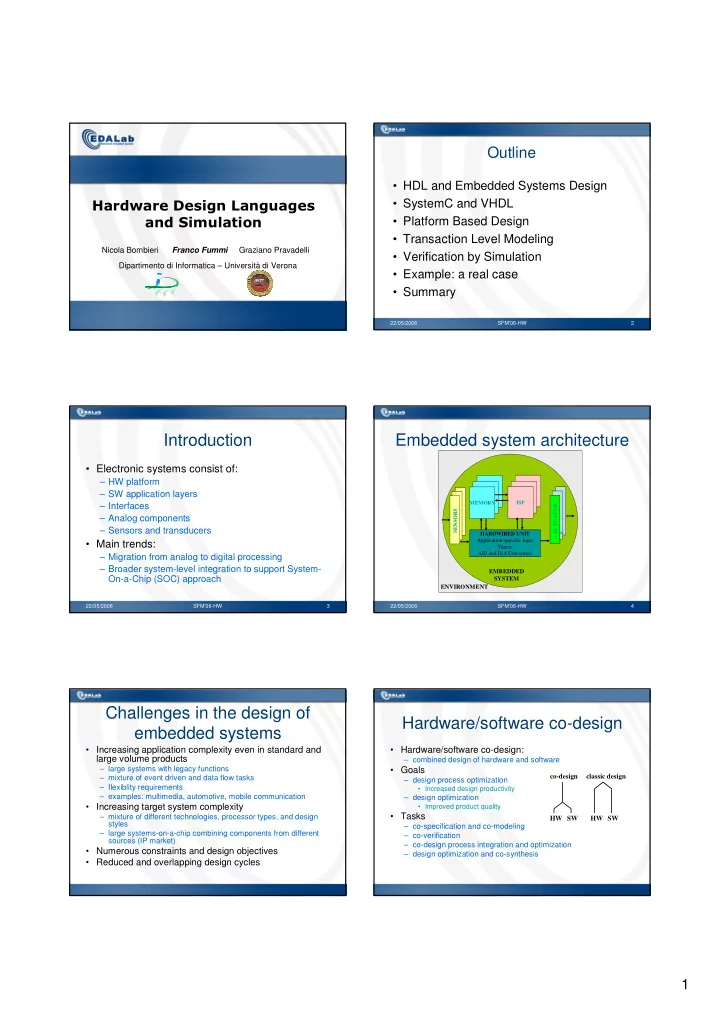
Introduction

  • Electronic systems consist of:

– HW platform – SW application layers – Interfaces – Analog components – Sensors and transducers

  • Main trends:

– Migration from analog to digital processing – Broader system-level integration to support System- On-a-Chip (SOC) approach

22/05/2006 SFM'06-HW 4

Embedded system architecture

ENVIRONMENT

MEMORY ISP HARDWIRED UNIT Application-specific logic Timers A/D and D/A Converters SENSORS ACTUATOR S

EMBEDDED SYSTEM

Challenges in the design of embedded systems

  • Increasing application complexity even in standard and

large volume products

– large systems with legacy functions – mixture of event driven and data flow tasks – flexiblity requirements – examples: multimedia, automotive, mobile communication

  • Increasing target system complexity

– mixture of different technologies, processor types, and design styles – large systems-on-a-chip combining components from different sources (IP market)

  • Numerous constraints and design objectives
  • Reduced and overlapping design cycles

Hardware/software co-design

  • Hardware/software co-design:

– combined design of hardware and software

  • Goals

– design process optimization

  • Increased design productivity

– design optimization

  • Improved product quality
  • Tasks

– co-specification and co-modeling – co-verification – co-design process integration and optimization – design optimization and co-synthesis

HW SW HW SW co-design classic design

slide-2
SLIDE 2

2

22/05/2006 SFM'06-HW 7

Co-design advantages

  • Explore different design alternatives in the

architectural design space

  • Tune HW to SW and vice-versa
  • Reduce the system design time
  • Support coherent design specification at the

system-level

  • Facilitate the re-use of HW and SW parts
  • Provide integrated environment for the synthesis

and validation of HW and SW components

22/05/2006 SFM'06-HW 8

Co-design of embedded systems

  • Design of dedicated computing and control

systems

  • Embedded controllers

– On-line control of manufacturing process – Robots guidance and control – Aircraft, automobile and ship control

  • Data processing and communication systems

– Telecom – Radio-navigation

22/05/2006 SFM'06-HW 9

Co-design of embedded systems

  • Design of dedicated HW parts

– Different design styles:

  • Co-processors, embedded cores, ASIPs, ...

– Widely varying design scale

  • Design of dedicated SW parts

– Special-purpose operating systems – Drivers of peripheral devices

22/05/2006 SFM'06-HW 10

HDL motivation

Manufacturing costs Design complexity Time to Market

22/05/2006 SFM'06-HW 11

HDL motivation

Does it really work?

  • 22/05/2006

SFM'06-HW 12

HDL motivation

Functional specifications failures? Performance expectations missing? Re-spins! Main reason: lacking of a concretely usable view

  • f the complete system before the

tape-out phase! Functional specif. Architect. specif Design

  • Fab. Breadboard

SW develop. Sys integration Sys validation Classical design flow

slide-3
SLIDE 3

3

State of the practice

  • Co-simulation as a support of design (process)

integration

– extension of simulation techniques to combined simulation of hardware and software components – allows permanent control of hardware and software component consistency – supports early validation of reused component integration

  • Integration validation more costly with increasing level of

detail

– current focus on co-simulation for lower levels of a design – simulation with models of specific processors, memories, busses, ... – reduction of accuracy mainly to improve simulation performance – examples: Mentor Seamless CVS, Viewlogic Eagle

State of the practice

  • “Executable” co-specification used as a basis for

system validation

  • Virtual prototyping

– simulation based validation – many commercial examples for different applications Statemate (i-Logix), MatrixX (ISI), MATLAB (MathWorks) – RASSP program (DARPA)

  • Rapid prototyping with “hardware-in-the-loop”

– hardware supported system emulation Þ real environment – often custom design

22/05/2006 SFM'06-HW 15

State of the practice

  • Executable co-specification problems

– combination of domain specific languages and semantics – integration of reused functions and components in abstract model – inclusion of non-functional constraints

22/05/2006 SFM'06-HW 16

Specification languages

  • Different communities:

– VLSI system design

VHDL, VERILOG, Specchart, …

– DSP

COSSAP, SPW, …

– Continuous design

MATLAB, MATRIXX, …

– Synchronous system designEsterel, Lustre, Statechart – Classical programming

C, C++, Java, …

– Functional and algebraic

VDM, Z, B, Funmath, …

– Structured design methods SART, OMT, …

22/05/2006 SFM'06-HW 17

Concepts for system level specification

  • CONCURRENCY

– different levels (bit, operation, statement, process, system) – two types: data-driven, control-driven

  • HIERARCHY

– needed for structured design methodologies – Two types: behavior, structure

  • COMMUNICATION

– data exchange between concurrent subsystems – two types: message passing, shared memory

  • SYNCHRONIZATION

– two models: synchronous, asynchronous

22/05/2006 SFM'06-HW 18

Example of specification Language

  • SDL

– well-suited for control-intensive, real-time systems – flow chart FSM, both graphics and text – abstract data types – dynamic process creation – synchronization via blocking, RPC – can monitor performance constraints

slide-4
SLIDE 4

4

22/05/2006 SFM'06-HW 19

Example of specification Language

  • StateCharts, SpecCharts

– graphical FSM of states and transitions – addition of hierarchical states for modeling complex reactive behaviors – SpecCharts adds

  • behavioral completion
  • exceptions

– may attach VHDL code to states and transitions arcs – extended with arithmetics – Easy to use for control-dominated systems

22/05/2006 SFM'06-HW 20

Simulation and debugging requirements

  • Embedded controllers:

– ASICs plus SW running on a processor – VHDL or Verilog plus C programs – Weakly heterogeneous systems

  • Embedded data processing and communication

systems

– ASICs plus SW running on a processor or ASIP – Environmental modeling (e.g. telephone lines) – Strongly heterogeneous systems

22/05/2006 SFM'06-HW 21

Co-simulation

  • Simulate at the same time both hardware

and software

  • Two conflicting requirements:

– execute the software as fast as possible – keep hardware and software simulations synchronized so they interact as they will in the target system.

22/05/2006 SFM'06-HW 22

Co-simulation

  • Desired features:

– Level of timing accuracy – Speed of simulation runs – Visibility of internal states

  • Potential problems:

– Meaningful results are obtained with large SW programs – Model availability – Strong heterogeneity requires specialized environment

22/05/2006 SFM'06-HW 23

Co-simulation paradigms

  • Homogeneous modeling:

– HW models in HDL – Processor model in HDL – SW in assembly code

  • Usage of HDL simulator for the whole system

including the processor model

  • Simple method but quite inefficient

22/05/2006 SFM'06-HW 24

Co-simulation paradigms

  • Weakly heterogeneous systems

– a) HDL simulators with processor model – b) Compiled SW – c) HW emulation

  • Strongly heterogeneous systems

– Require specialized simulation environments (e.g. Ptolemy) – Communication mechanisms among domains and their corresponding schedulers

slide-5
SLIDE 5

5

22/05/2006 SFM'06-HW 25

HDL processor modeling

  • Precise timing model

– Accurate timing and complete functionality

  • Event-driven simulation
  • Zero-Delay Model (ZDM) for timing

– Correct transitions at clock edges

  • Cycle-based simulation
  • Instruction-set simulator

– Model emulates processor while insuring correct register and memory values

22/05/2006 SFM'06-HW 26

Compiled SW

  • Basic assumption:

– HW/SW communication protocol such that communication delay has no effect on functionality

  • SW is compiled and linked to simulator
  • HW/SW communication is replaced by

handshake

  • Simulation speed is limited by HW

simulation speed

22/05/2006 SFM'06-HW 27

HW emulation

  • HW mapped onto programmable HW

– One order of magnitude loss in speed

  • Programmable HW boards connected to

workstations

  • Limited visibility of internal states

22/05/2006 SFM'06-HW 28

Software versus Hardware Design Software versus Hardware Design

Algorithm Algorithm T T MB MB Architecture Architecture MHz MHz

Gate Gate

Algorithm Algorithm

Pre Pre-

  • defined

defined Virtual Machine Virtual Machine

22/05/2006 SFM'06-HW 29

Example: GCD modeled in C Example: GCD modeled in C

#include <stdio.h> int gcd(int xi, int yi) { int x, y, temp; x = xi; y = yi; while (x > 0){ if (x <= y){ temp = y; y = x; x = temp; } x = x - y; } return(y); } main() { int xi, yi, ou; scanf("%d %d", &xi, &yi);

  • u = gcd(xi, yi);

printf("%d\n", ou); }

22/05/2006 SFM'06-HW 30

Hardware requirements (1)

  • Input /Output

S printf, scanf... Hcomponent interface must be defined

  • Timing

SCPU instructions are executed at the CPU clock speed Hone or more explicit CLOCK signals must be defined

slide-6
SLIDE 6

6

22/05/2006 SFM'06-HW 31

Hardware requirements (2)

  • Variables size

Shidden implicit definition (integer 4bytes, char 1byte, …) Hall pre-defined and user-defined types must be translated into bit vectors

  • Relationships operands/operators

Sall operators in the C libraries are accepted Hexplicit mapping of operands on operators

22/05/2006 SFM'06-HW 32

Hardware requirements (3)

  • Memory elements identification

Sthe optimization module of the compiler transparently maps variables onto CPU registers and memory elements Hthe synthesis tool identifies memory elements by analyzing the algorithmic semantics

  • Modules synchronization

Ssequential execution of instructions Hinherently parallel execution of all components

22/05/2006 SFM'06-HW 33

Entity/Architecture Entity/Architecture

GCD GCD YI YI XI XI OU OU CLOCK CLOCK RESET RESET

ENTITY gcd IS PORT ( clock, reset : IN bit; xi,yi : IN unsigned (size-1 DOWNTO 0);

  • u : OUT unsigned (size-1 DOWNTO 0)

); END gcd;

variable size variable size

22/05/2006 SFM'06-HW 34

Example: GCD modeled in VHDL Example: GCD modeled in VHDL

ARCHITECTURE behavioral OF gcd IS BEGIN PROCESS VARIABLE x, y,temp : unsigned (size-1 DOWNTO 0); BEGIN WAIT UNTIL clock = '1'; x := xi; y := yi; WHILE (x > 0) LOOP IF (x <= y) THEN temp:=y; y := x; x:=temp; END IF; x := x - y; END LOOP;

  • u <= y;

END PROCESS; END behavioral;

timing timing memories memories

22/05/2006 SFM'06-HW 35

  • Identification of a target architecture

– FSM + Data-Path (FSMD)

  • Identification of time instants for each
  • peration:

– time order – time length

  • Identification of operators:

– data size – time performance

Algorithmic (Behavioral) Synthesis

scheduling scheduling allocation allocation

22/05/2006 SFM'06-HW 36

FSMD Model FSMD Model

PRIMARY INPUTS CLOCK CONTROL UNIT (FSM) ELABORATION UNIT (Data-path) RESET PRIMARY OUTPUTS CONTROL SIGNALS CONDITION SIGNALS FSMD

slide-7
SLIDE 7

7

22/05/2006 SFM'06-HW 37

Scheduling (FSM) Scheduling (FSM)

ARCHITECTURE behavioral OF gcd IS BEGIN PROCESS VARIABLE x, y,temp : unsigned (size-1 DOWNTO 0); BEGIN WAIT UNTIL clock = '1'; x := xi; y := yi; WHILE (x > 0) LOOP IF (x <= y) THEN temp:=y; y := x; x:=temp; END IF; x := x - y; END LOOP;

  • u <= y;

END PROCESS; END behavioral;

S0 S0 S1 S1 S2 S2 S3 S3

22/05/2006 SFM'06-HW 38

Allocation (Data-Path) Allocation (Data-Path)

ARCHITECTURE behavioral OF gcd IS BEGIN PROCESS VARIABLE x, y,temp : unsigned (size-1 DOWNTO 0); BEGIN WAIT UNTIL clock = '1'; x := xi; y := yi; WHILE (x > 0) LOOP IF (x <= y) THEN temp:=y; y := x; x:=temp; END IF; x := x - y; END LOOP;

  • u <= y;

END PROCESS; END behavioral;

A B O n n

>

A B O n n

<=

S n n n O mux m A1

2m

A . . .

0...0 1...1

A B n O n n

+

CLOCK n D n Q reg

22/05/2006 SFM'06-HW 39

Register Transfer Level (RTL)

  • Interconnection of FSM + Data-path

– control/condition signals are identified – FSM is represented by states and transitions – Data-path is represented by registers, multiplexers and operators

  • Automatic translation into a set of

registers and library components (RTL)

22/05/2006 SFM'06-HW 40

Logic Synthesis

  • Each RTL module is optimized by means of:

– area – delay – power

  • Efficient synthesis algorithms exist for:

– two-level synthesis – multiple-level synthesis

  • A logic representation of each RTL module

is generated and optimized

22/05/2006 SFM'06-HW 41

Standard C-based design flow

Refine System Level Model C, C++ Results Analysis Manual converision VHDL/Verilog Simulation Synthesis FSMD description

22/05/2006 SFM'06-HW 42

SystemC-based design flow

VHDL/Verilog Synthesis FSMD Logic description SystemC Model System Level SystemC Model RT Level Refinement Simulation Authomatic translation

slide-8
SLIDE 8

8

22/05/2006 SFM'06-HW 43

SystemC story

  • Open SystemC Initiative (OSCI)

– a standard for modeling digital systems – founders:

  • Synopsys, CoWare, Frontier Design ... ARM,

Cygnus, Ericsson, Fujitsu, Infineon, Lucent, Sony, ST, TI ...

– Free use of the language – Controlled language extension – Open market for tools

22/05/2006 SFM'06-HW 44

SystemC key features

  • Concurrency:
  • Communication:
  • Notion of time:
  • Reactivity:
  • Hardware data types:
  • Simulation support:
  • Debugging support:
  • Processes (syn and asyn)
  • Signals, channel
  • Multiple clocks with

arbitrary phases

  • Waiting for events
  • Bit vectors, arbitrary

precision integer

  • Simulation kernel
  • C++ debugging tools

22/05/2006 SFM'06-HW 45

Use of SystemC distribution

  • Header files:

– SystemC class definition

  • Libraries:

– Class library – Simulation kernel

  • Building strategy:

– compilation of home-made classes – linking of libraries

Executable Executable program program with with simulation simulation capabilities capabilities

22/05/2006 SFM'06-HW 46

SystemC: main characteristics

  • Modules and Hierarchy (cap. 3)
  • Processes (cap. 4)
  • Ports and Signals (cap. 5)
  • Data Types (cap.6)
  • Hardware Examples (app. A)

22/05/2006 SFM'06-HW 47

SC_Module example

SC_MODULE(alu) { // input/output ports sc_in<bool> clock; sc_in<sc_int<N> >

  • p1;

... sc_out<sc_int<N> >

  • ;

// method void reg_par_par(); void calcola(); // internal signals sc_signal<sc_int<N> > acc; sc_signal<sc_int<N> > t6; // constructor SC_CTOR(alu) { SC_METHOD(reg_par_par); sensitive_pos(clock); SC_METHOD(calcola); sensitive(op1); ... }; };

22/05/2006 SFM'06-HW 48

Proces types

  • SystemC supports three kinds of proces:

– methods (SC_METHOD):

  • executed from the start to the end
  • sensitive to signals

– threads (SC_THREAD):

  • executed up to a wait()

– clocked threads (SC_CTHREAD):

  • sensitive to clocks
slide-9
SLIDE 9

9

22/05/2006 SFM'06-HW 49

Process example

SC_MODULE(my_module) { // ports declaration sc_in<int> a; sc_in<bool> b; sc_out<int> x; // signals declaration sc_signal<bool> c; // process declaration void my_method_proc(); // constructor SC_CTOR(my_module) { // process record SC_METHOD(my_method_proc); // sensitivity list declaration }; };

22/05/2006 SFM'06-HW 50

Simulation kernel

  • SystemC scheduler works as follows:

1.

  • 1. all

all clock clock signals signals are are updated updated 2.

  • 2. all

all SC_METHOD SC_METHOD’ ’s and SC_THREAD s and SC_THREAD’ ’s s with with modified modified input input values values are are executed executed 3.

  • 3. all

all SC_CTHREAD SC_CTHREAD’ ’s s which which must must be be executed executed are are inserted inserted into into a a queue queue 4.

  • 4. Steps

Steps 2 and 3 are 2 and 3 are repeated repeated up a up a fixed fixed point point 5.

  • 5. SC_CTHREAD

SC_CTHREAD’ ’s on s on queue queue are are executed executed 6.

  • 6. increase

increase execution execution time and goto 1 time and goto 1

22/05/2006 SFM'06-HW 51

Port and signal types

  • sc_int<n> e sc_uint<n>
  • sc_bigint<n> e sc_biguint<n>
  • sc_bit
  • sc_logic
  • sc_bv<n> e sc_lv<n>
  • sc_fixed e sc_ufixed
  • sc_fix e sc_ufix
  • end user self defined structures

22/05/2006 SFM'06-HW 52

Port and signal types example

  • sc_in<port_type>;

– // input port of type port_type

  • sc_out<port_tipe> x[32];

– // output port ranging from x[0] to x[31] of type port_type

  • sc_signal<port_type> i[4];

– // signal ranging from i[0] to i[3] of type port_type

22/05/2006 SFM'06-HW 53

Synchronous D-flip-flop

// dff.h #include "systemc.h" SC_MODULE(dff) { //module declaration sc_in<bool> clock; //input declaration sc_in<bool> din; sc_out<bool> dout; //output declaration void doit();{ dout = din; } SC_CTOR(dff) { // declaration of a SC_METHOD // process sensitive to clock SC_METHOD(doit); sensitive_pos(clock); }; };

22/05/2006 SFM'06-HW 54

Asynchronous D-flip-flop

// dffa.h #include "systemc.h" SC_MODULE(dffa) { //module declaration sc_in<bool> clock; //input declaration sc_in<bool> reset; sc_in<bool> din; sc_out<bool> dout; //output declaration void do_ffa();{ if (reset){ dout = false; }else if (clock.event()){ dout = din;} } SC_CTOR(dffa) { SC_METHOD(do_ffa); sensitive (reset); sensitive_pos(clock); }; };

slide-10
SLIDE 10

10

22/05/2006 SFM'06-HW 55

Parallel-parallel register

// reg_par_par.h #include "systemc.h" #define N 8 SC_MODULE(reg_par_par) { //module declaration sc_in<bool> clock; //input declaration sc_in<sc_bv<N> > d; sc_out<sc_bv<N> > q; //output declaration //method to build the register void register_par_par(); // constructor declaration SC_CTOR(reg_par_par) { // declaration of a SC_METHOD // process sensitive to clock SC_METHOD(register_par_par); sensitive_pos(clock); }; };

22/05/2006 SFM'06-HW 56

Parallel-parallel register

// reg_par_par.cpp #include "reg_par_par.h“ // method implementation void reg_par_par::register_par_par() { static sc_bv<N> reg;// local variable reg = d.read(); // input port reading q.write(reg); // output port writing }

22/05/2006 SFM'06-HW 57

Serial/serial register

// reg_ser_ser.h #include "systemc.h" #define N 8 SC_MODULE(reg_ser_ser) { sc_in<bool> clock; sc_in<bool> i0; sc_out<bool>

  • ;

void register_ser_ser(); SC_CTOR(reg_ser_ser) { SC_METHOD(register_ser_ser); sensitive_pos(clock); }; };

22/05/2006 SFM'06-HW 58

Serial/serial register

// reg_ser_ser.cpp #include "reg_ser_ser.h" void reg_ser_ser::register_ser_ser() { static sc_bv<N> reg = "00000000"; bool i01; i01 = i0.read(); reg.range(N-2,0) = reg.range(N-1,1); reg[N-1] = i01; i01 = (reg[0] == ’1’) ? 1 : 0;

  • .write(i01);

}

22/05/2006 SFM'06-HW 59

Parallel/serial register

// reg_par_ser.h #include "systemc.h" #define N 8 SC_MODULE(reg_par_ser) { sc_in<bool> clock; sc_in<bool> i0; sc_in<sc_bv<N> > d; sc_in<bool> ps; sc_out<sc_bv<N> > q; sc_out<bool>

  • ;

void register_par_ser(); SC_CTOR(reg_par_ser) { SC_METHOD(register_par_ser); sensitive_pos(clock); }; };

22/05/2006 SFM'06-HW 60

Parallel/serial register

// reg_par_ser.cpp void reg_par_ser::register_par_ser() { static sc_bv<N> reg = "00000000 bool i01, ps1; ps1 = ps.read(); if (ps1 == 1){ reg =d.read(); }else{ i01 = i0.read(); reg.range(N-2,0) = reg.range(N-1,1); reg[N-1] = i01; } i01 = (reg[0] == ’1’) ? 1 : 0;

  • .write(i01);

q.write(reg); }

slide-11
SLIDE 11

11

22/05/2006 SFM'06-HW 61

Shifter

// shiftrer.h #include "systemc.h" #define N 8 SC_MODULE(shifter) { sc_in<bool> ds; sc_in<sc_bv<N> > a; sc_in<bool> i0; sc_out<sc_bv<N> >

  • ;

void shift(); SC_CTOR(shifter) { SC_METHOD(shift); sensitive(ds); sensitive(a); sensitive(i0); }; };

22/05/2006 SFM'06-HW 62

Shifter

// shifter.cpp #include "shifter.h" void shifter::shift() { bool ds1; bool i01; sc_bv<N> a1; sc_bv<N> c1; i01 = i0.read(); ds1 = ds.read(); a1 = a.read(); // rigth shift if(ds1 == 1){ c1.range(N-2,0) = a1.range(N-1,1); c1[N-1] = i01; }else{ c1.range(N-1,1) = a1.range(N-2,0); c1[0] = i01; }

  • .write(c1);

} 22/05/2006 SFM'06-HW 63

ALU

// alu.h #include "systemc.h" #define N 8 #define P 2 SC_MODULE(alu) { sc_in<bool> clock; sc_in<sc_int<N> >

  • p1;

sc_in<sc_int<N> >

  • p2;

sc_in<bool> stored; sc_in<sc_uint<P> >

  • per;

sc_out<sc_int<N> >

  • ;

// methods void reg_par_par(); void calcola(); // signals sc_signal<sc_int<N> > acc; sc_signal<sc_int<N> > t6;

22/05/2006 SFM'06-HW 64

ALU

SC_CTOR(alu) { SC_METHOD(registro_par_par); sensitive_pos(clock); SC_METHOD(calcola); sensitive(op1); sensitive(op2); sensitive(stored); sensitive(oper); sensitive(acc); }; };

22/05/2006 SFM'06-HW 65

ALU

// alu.cpp #include "alu.h" void alu::register_par_par(){..} void alu::calcola() { sc_int<N>

  • p11, op21, acc1, sel, t61;

bool stored1; sc_uint<P>

  • per1;
  • p11 = op1.read(); op21 = op2.read();

acc1 = acc.read(); stored1 = stored.read();

  • per1 = oper.read()

sel = (stored1 == 1) ? acc1; op21; switch(opr1){ case 0: t61 = op11+sel; break; case 1: t61 = op11-sel; break; case 2: if(op11 < sel) t61=op11; else t61=sel; break; case 3: if(op11 > sel) t61=op11; else t61=sel; break; } t6.write(t61); o.write(t61); }

22/05/2006 SFM'06-HW 66

Platform Based Design

  • Definition: platform-based design is the creation of a stable microprocessor-

based architecture that can be rapidly extended, customized for a range of applications and delivered to customers for quick deployment. (J.M. Chateau – STMicroelectronics)

slide-12
SLIDE 12

12

22/05/2006 SFM'06-HW 67

Platform based design flow

! "#$# %&&' Functionalities test

Profiling and HW/SW partitioning M1 M2 M3 M4 M5 M6 M7 SoC design (SystemC?) M1 M2 M3 M4 M5 M6 M7 SoC design (SystemC?)

Performance analysis Real time, area, costs, and power constraints? Module (Object) To implement SW To implement HW

22/05/2006 SFM'06-HW 68

Platform based design flow

  • M1

M2 M3 M5 M7 Software M4 M6 Cross-comp. Synthesys

22/05/2006 SFM'06-HW 69

Platform based design: IPs re-use

  • M1

M2 M3 M5 M7 Software M4 M6 NB: Re-use Modularity

i.e., Digital Signal Processor (DSP) MPEG, Coder, Decoder, Filters, etc.

22/05/2006 SFM'06-HW 70

Platform based design: summary

  • High-level description for functional verification.
  • Timing estimation for performance analysis.
  • Hierarchy for HW/SW partitioning.
  • Modularity for IPs re-use and/or refinement.
  • Simulation speed vs. implementation details.
  • Synthesizable descriptions for HW modules.

Transaction Level Modeling (TLM)

22/05/2006 SFM'06-HW 71

Transaction Level Modeling (TLM)

  • Transaction Level is the new design and

verification abstraction above RTL.

Algo TLM Abstraction RTL

Synthesis TLM TLM

22/05/2006 SFM'06-HW 72

Transaction Level Modeling (TLM)

Functional specif. Architect. specif Design

  • Fab. Breadboard

SW develop. Sys integration Sys validation Classical design flow SW develop. Sys integration Sys validation GAIN!

  • Goal: enabling Software development to

start very early in the design flow

slide-13
SLIDE 13

13

22/05/2006 SFM'06-HW 73

Transaction Level Modeling (TLM)

  • Key concept: more emphasis on the data transfer functionality and

less on their implementation details at the early design stage.

write (data, addr); clk req gnt data_0 data_31 addr_0 addr_31 … … RTL TLM

22/05/2006 SFM'06-HW 74

TLM: design languages

Algo

Abstr.

RTL

Synthesis TLM TLM

  • (
  • 22/05/2006

SFM'06-HW 75

TLM design languages

  • SystemC 2.0.1 IEEE 1666.
  • Open SystemC Initiative (OSCI) Standard

TLM: released in February 2005, rigorously defines implementation rules:

– API defined for every TLM layer, since they form the heart of the TLM standard. – Transactor: to allow communications between components implemented at different abstraction levels.

22/05/2006 SFM'06-HW 76

TLM design languages

  • Other implementation rules:

– Argument passing semantics in function calls, to assure safety in concurrent environments. – Blocking/non-blocking calls to characterize communication semantics (i.e. polling, interrupt, etc.). – Pipelined communication mechanism, to implement different architectural choices to meet throughput requirements. – Uni/Bidirectional communication channels, to implement FIFO's or hierarchical channels.

22/05/2006 SFM'06-HW 77

TLM layers

! ( $

  • )* +

, )!

  • .

/ ")%' 0$(

  • )* ,

)

  • 1

")%' !

  • 2

"#

  • 34 ,

$5 6+67 85! ! 8 7, ) 9# :# (( ( 22/05/2006 SFM'06-HW 78

TLM key concepts

  • Factoring out the common elements, the key

concepts are:

– To implement a system at higher layer means to implement the system in a more abstract way:

  • leave implementation details in order to speed-up simulation

(for functional verification purpose).

– To implement a system at lower layer means to add implementation details to the system:

  • in order to simulate the system in a more accurate way (for

performance analysis purpose and architectural exploration).

slide-14
SLIDE 14

14

22/05/2006 SFM'06-HW 79

TLM: architectural exploration

  • Sequential re-timing: balancing combinational logic

to maximize clock speed.

  • Resources sharing: area vs. latency (High-level

synthesis).

  • Pipeline optimization.

Examples:

22/05/2006 SFM'06-HW 80

TLM layer 3

  • Interface

Module Process

Executable specifications and first level of data and control functional partitioning. System proof of concepts. Implementation architecture- abstract. Untimed functionalities modeling. Event-driven simulation semantics. Point-to-point Initiator-Target connection. Abstract data types. Functional verification goal. Simulation speed!

22/05/2006 SFM'06-HW 81

TLM layer 2

  • BUS
  • Process

Module Interface

Hardware architectural performance and detailed behavior analysis. HW/SW partitioning and co- development. Cycle performance estimation. Split pipeline with time delays. Mapping ideal architecture into resource-constrained world. Memory/Register map accurate. Event driven simulation with time estimation.

22/05/2006 SFM'06-HW 82

TLM layer 1

  • BUS
  • Process

Module clk

Detailed analysis and low level SW development. Modeling CA interface for abstract simulation models of IP blocks such as embedded processors. Clock-accurate performance simulation Clock-accurate protocols mapped to the chosen HW interfaces and bus structures. Interface pins are hidden. Parametrizable to model different bus protocol and signal interfaces. Performance analysis goal

22/05/2006 SFM'06-HW 83

TLM: transactor (TLM-TLM example)

TLM layer i block I1 I2 ….. In O

1 …

O

m

Transactor

O’1

O’

m

I1

status write (Address a, Data d) { . . . /* Reference block implemented at TLM layer i */ return a_status; }

I2 I’1

status write (Address a, Data d) { … request.a = a; request.d = d; request.type = WRITE; response = transport (request); return response.status; }

I’2 I’1 I’2 ….. I’n

Resp transport (Request r) { … /* Block implemented at TLM layer i - 1 */ return a_response; }

O

1

In O’

1 …

O

m …

O’

m …

I’n

Reference block Refined block

TLM layer i-1 block 22/05/2006 SFM'06-HW 84

basic_status mem_slave:: write( const ADDRESS_TYPE &a, const DATA_TYPE &d) { memory[a] = d; return basic_protocol::SUCCESS; } basic_status mem_slave:: read( const ADDRESS_TYPE &a, DATA_TYPE &d ) { d = memory[a]; return basic_protocol::SUCCESS; }

master slave

… statusw = port.write(SLAVE_ADDR, 27); … statusr = port.read(SLAVE_ADDR, mem); (thread)

write/read API (i.e.,TL3)

Transactor examples

tlm_transport channel slave master

while(true) { request = in_port->get(); switch( request.type ) { case READ : response.d = memory[request.a]; response.status = SUCCESS; break; case WRITE: … }

  • ut_port->put( response );

} sc_fifo … request.data = &data_pkt; request.address = SLAVE_ADDR; request.type = WRITE;

  • ut_port->put(request);

response = in_port->get(); … (thread) (thread)

put/get API (i.e.,TL2)

slide-15
SLIDE 15

15

22/05/2006 SFM'06-HW 85

TLM: transactor (TLM-RTL example)

  • )
  • )

clk

  • clk

req gnt data_0 data_31 addr_0 addr_31 … …

)

write (addr, data);

22/05/2006 SFM'06-HW 86

basic_status TLM_RTL_transactor:: write( const ADDRESS_TYPE &a , const DATA_TYPE &d ) { data=d->field; len= d->len; status=ST_1; return W_SUCCESS; } void fsm_protocol(){ while (true){ switch( fsm_state ){ case RESET: … ST_1:

  • ut_data.write(data);
  • ut_len.write(len);

state = ST_2; ST_2: … … } } }

TL3-RTL transactor

22/05/2006 SFM'06-HW 87

SoC verification

  • Validation:

– Does the design correctly work? – Are there implementation design errors? – No reference models!

  • Verification:

– Refinement (or abstraction) step verification: ascertaining that system functionality is kept unaltered throughout its representation hierarchy. – Golden Model as reference.

22/05/2006 SFM'06-HW 88

SoC verification techniques

  • !

"#

  • 22/05/2006

SFM'06-HW 89

Dynamic verification (simulation)

$

IN OUT

!

OUT’

?

$%

  • &

$'!()&'!

22/05/2006 SFM'06-HW 90

Dynamic verification: faults injection

IF (5 % 2) output = true; ELSE output = false; IN OUT IF (5 % 2) output = false; ELSE output = false; OUT’ Fault injected IF (5 % 2) output = true; ELSE output = true; OUT’’ Fault injected

  • =

Found! Not found!

IN IN

slide-16
SLIDE 16

16

22/05/2006 SFM'06-HW 91

Dynamic verification: faults injection

#$* +% & $'!(,)&'!

22/05/2006 SFM'06-HW 92

Property Specification Language (PSL)

TLM layer i block I1 I2 ….. In O

1 …

O

m

I1

status write (Address a, Data d) { . . . /* Reference block implemented at TLM layer i */ return a_status; }

I2 O

1

In

O

m …

// PSL property: //@PSL always ((a LOW && a HIGH && d == DATA ) => eventually (a_status == SUCCESS));

  • )-

$%

  • $'!()&'!

.

  • 22/05/2006

SFM'06-HW 93

Model checking

# # $ $

  • !'!/0'!

(0% (0%

1 / 2

+% & #$ $'!(,)&'!

22/05/2006 SFM'06-HW 94

Equivalence checking (EC)

  • %

22/05/2006 SFM'06-HW 95

Equivalence checking (EC)

  • Combinational Equivalence Checking

+% & #$ $&'! .

  • Sequential Equivalence Checking

+% $'!()&'! #$ "# "# &

22/05/2006 SFM'06-HW 96

Example: face recognition system

  • 1 2

(STMicroelectronics)

  • (

B U S

slide-17
SLIDE 17

17

22/05/2006 SFM'06-HW 97

Face recognition system: TLM level 3

; 099< / 99) 00 00 )95 )<0 <0 5)<5 :<<0 )0 )<0

3 3 3

  • 3
  • 03'&

$%

22/05/2006 SFM'06-HW 98

Face recognition system: TLM level 2

"&&'

) ()))')

  • 99)

/ 3 3

  • 3
  • 3
  • 3 3

$

22/05/2006 SFM'06-HW 99

Face recognition system: TLM level 1

"&&'

)

()))')

  • 99)

/ 3 3 $

  • 22/05/2006

SFM'06-HW 100

Face recognition system: RTL

*+$"

  • 99)

!

  • )

!

"&&' ()))') 014

  • /

!

22/05/2006 SFM'06-HW 101

Summary

  • Platform Based Design (PBD): the customization

approach for design complexity, manufacturing cost and time-to-market challenges.

  • Transaction Level Model (TLM) as SoC modeling style.
  • SystemC 2.1 as the de-facto reference languages for

SoC design: it rocks!

  • Assertion Based Verification (ABV) and Property

Specification Language (PSL)as the new validation and verification trend.

  • Dynamic approach for system level verification and static

approach for block level verification