Intro to Python programming Dept. of Informatics, Univ. of Oslo May - - PDF document

intro to python programming
SMART_READER_LITE
LIVE PREVIEW

Intro to Python programming Dept. of Informatics, Univ. of Oslo May - - PDF document

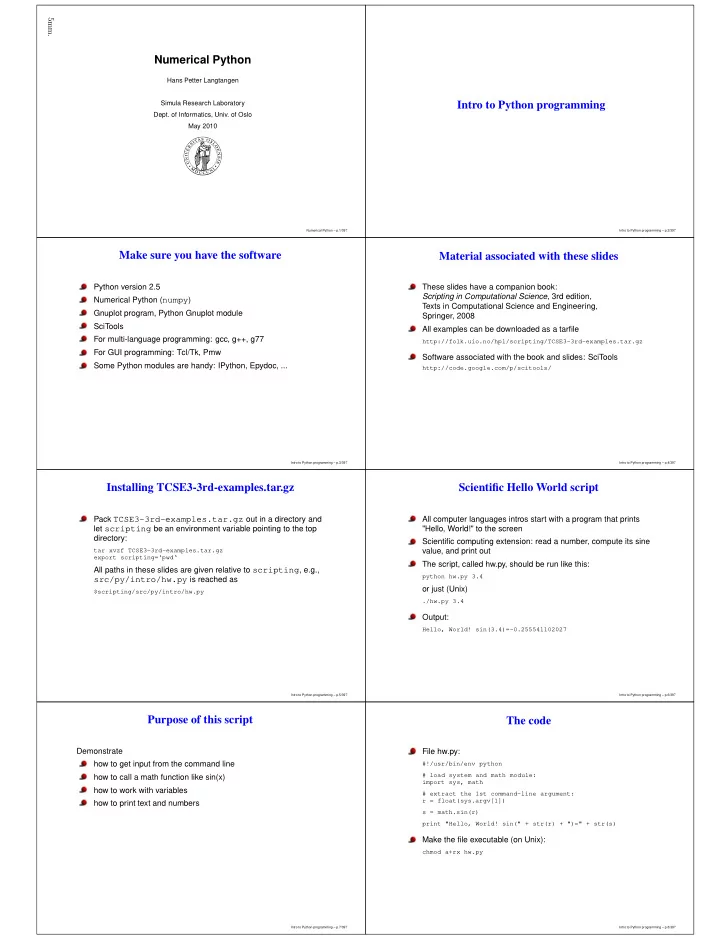
5mm. Numerical Python Hans Petter Langtangen Simula Research Laboratory Intro to Python programming Dept. of Informatics, Univ. of Oslo May 2010 Numerical Python p.1/397 Intro to Python programming p.2/397 Make sure you have the


slide-1
SLIDE 1

5mm.

Numerical Python

Hans Petter Langtangen Simula Research Laboratory

  • Dept. of Informatics, Univ. of Oslo

May 2010

Numerical Python – p.1/397

Intro to Python programming

Intro to Python programming – p.2/397

Make sure you have the software

Python version 2.5 Numerical Python (numpy) Gnuplot program, Python Gnuplot module SciTools For multi-language programming: gcc, g++, g77 For GUI programming: Tcl/Tk, Pmw Some Python modules are handy: IPython, Epydoc, ...

Intro to Python programming – p.3/397

Material associated with these slides

These slides have a companion book: Scripting in Computational Science, 3rd edition, Texts in Computational Science and Engineering, Springer, 2008 All examples can be downloaded as a tarfile

http://folk.uio.no/hpl/scripting/TCSE3-3rd-examples.tar.gz

Software associated with the book and slides: SciTools

http://code.google.com/p/scitools/

Intro to Python programming – p.4/397

Installing TCSE3-3rd-examples.tar.gz

Pack TCSE3-3rd-examples.tar.gz out in a directory and let scripting be an environment variable pointing to the top directory:

tar xvzf TCSE3-3rd-examples.tar.gz export scripting=‘pwd‘

All paths in these slides are given relative to scripting, e.g.,

src/py/intro/hw.py is reached as

$scripting/src/py/intro/hw.py

Intro to Python programming – p.5/397

Scientific Hello World script

All computer languages intros start with a program that prints "Hello, World!" to the screen Scientific computing extension: read a number, compute its sine value, and print out The script, called hw.py, should be run like this:

python hw.py 3.4

  • r just (Unix)

./hw.py 3.4

Output:

Hello, World! sin(3.4)=-0.255541102027

Intro to Python programming – p.6/397

Purpose of this script

Demonstrate how to get input from the command line how to call a math function like sin(x) how to work with variables how to print text and numbers

Intro to Python programming – p.7/397

The code

File hw.py:

#!/usr/bin/env python # load system and math module: import sys, math # extract the 1st command-line argument: r = float(sys.argv[1]) s = math.sin(r) print "Hello, World! sin(" + str(r) + ")=" + str(s)

Make the file executable (on Unix):

chmod a+rx hw.py

Intro to Python programming – p.8/397
slide-2
SLIDE 2

Comments

The first line specifies the interpreter of the script (here the first python program in your path)

python hw.py 1.4 # first line is treated as comment ./hw.py 1.4 # first line is used to specify an interpreter

Even simple scripts must load modules:

import sys, math

Numbers and strings are two different types:

r = sys.argv[1] # r is string s = math.sin(float(r)) # sin expects number, not string r # s becomes a floating-point number

Intro to Python programming – p.9/397

Alternative print statements

Desired output:

Hello, World! sin(3.4)=-0.255541102027

String concatenation:

print "Hello, World! sin(" + str(r) + ")=" + str(s)

printf-like statement:

print "Hello, World! sin(%g)=%g" % (r,s)

Variable interpolation:

print "Hello, World! sin(%(r)g)=%(s)g" % vars()

Intro to Python programming – p.10/397

printf format strings

%d : integer %5d : integer in a field of width 5 chars %-5d : integer in a field of width 5 chars, but adjusted to the left %05d : integer in a field of width 5 chars, padded with zeroes from the left %g : float variable in %f or %g notation %e : float variable in scientific notation %11.3e : float variable in scientific notation, with 3 decimals, field of width 11 chars %5.1f : float variable in fixed decimal notation, with one decimal, field of width 5 chars %.3f : float variable in fixed decimal form, with three decimals, field of min. width %s : string %-20s : string in a field of width 20 chars, and adjusted to the left

Intro to Python programming – p.11/397

Strings in Python

Single- and double-quoted strings work in the same way

s1 = "some string with a number %g" % r s2 = ’some string with a number %g’ % r # = s1

Triple-quoted strings can be multi line with embedded newlines:

text = """ large portions of a text can be conveniently placed inside triple-quoted strings (newlines are preserved)"""

Raw strings, where backslash is backslash:

s3 = r’\(\s+\.\d+\)’ # with ordinary string (must quote backslash): s3 = ’\\(\\s+\\.\\d+\\)’

Intro to Python programming – p.12/397

Where to find Python info

Make a bookmark for $scripting/doc.html Follow link to Index to Python Library Reference (complete on-line Python reference) Click on Python keywords, modules etc. Online alternative: pydoc, e.g., pydoc math

pydoc lists all classes and functions in a module

Alternative: Python in a Nutshell (or Beazley’s textbook) Recommendation: use these slides and associated book together with the Python Library Reference, and learn by doing exercises

Intro to Python programming – p.13/397

New example: reading/writing data files

Tasks: Read (x,y) data from a two-column file Transform y values to f(y) Write (x,f(y)) to a new file What to learn: How to open, read, write and close files How to write and call a function How to work with arrays (lists) File: src/py/intro/datatrans1.py

Intro to Python programming – p.14/397

Reading input/output filenames

Usage:

./datatrans1.py infilename outfilename

Read the two command-line arguments: input and output filenames

infilename = sys.argv[1]

  • utfilename = sys.argv[2]

Command-line arguments are in sys.argv[1:]

sys.argv[0] is the name of the script

Intro to Python programming – p.15/397

Exception handling

What if the user fails to provide two command-line arguments? Python aborts execution with an informative error message A good alternative is to handle the error manually inside the program code:

try: infilename = sys.argv[1]

  • utfilename = sys.argv[2]

except: # try block failed, # we miss two command-line arguments print ’Usage:’, sys.argv[0], ’infile outfile’ sys.exit(1)

This is the common way of dealing with errors in Python, called exception handling

Intro to Python programming – p.16/397
slide-3
SLIDE 3

Open file and read line by line

Open files:

ifile = open( infilename, ’r’) # r for reading

  • file = open(outfilename, ’w’)

# w for writing afile = open(appfilename, ’a’) # a for appending

Read line by line:

for line in ifile: # process line

Observe: blocks are indented; no braces!

Intro to Python programming – p.17/397

Defining a function

import math def myfunc(y): if y >= 0.0: return y**5*math.exp(-y) else: return 0.0 # alternative way of calling module functions # (gives more math-like syntax in this example): from math import * def myfunc(y): if y >= 0.0: return y**5*exp(-y) else: return 0.0

Intro to Python programming – p.18/397

Data transformation loop

Input file format: two columns with numbers

0.1 1.4397 0.2 4.325 0.5 9.0

Read a line with x and y, transform y, write x and f(y):

for line in ifile: pair = line.split() x = float(pair[0]); y = float(pair[1]) fy = myfunc(y) # transform y value

  • file.write(’%g

%12.5e\n’ % (x,fy))

Intro to Python programming – p.19/397

Alternative file reading

This construction is more flexible and traditional in Python (and a bit strange...):

while 1: line = ifile.readline() # read a line if not line: break # end of file: jump out of loop # process line

i.e., an ’infinite’ loop with the termination criterion inside the loop

Intro to Python programming – p.20/397

Loading data into lists

Read input file into list of lines:

lines = ifile.readlines()

Now the 1st line is lines[0], the 2nd is lines[1], etc. Store x and y data in lists:

# go through each line, # split line into x and y columns x = []; y = [] # store data pairs in lists x and y for line in lines: xval, yval = line.split() x.append(float(xval)) y.append(float(yval))

See src/py/intro/datatrans2.py for this version

Intro to Python programming – p.21/397

Loop over list entries

For-loop in Python:

for i in range(start,stop,inc): ... for j in range(stop): ...

generates

i = start, start+inc, start+2*inc, ..., stop-1 j = 0, 1, 2, ..., stop-1

Loop over (x,y) values:

  • file = open(outfilename, ’w’) # open for writing

for i in range(len(x)): fy = myfunc(y[i]) # transform y value

  • file.write(’%g

%12.5e\n’ % (x[i], fy))

  • file.close()
Intro to Python programming – p.22/397

Running the script

Method 1: write just the name of the scriptfile:

./datatrans1.py infile outfile # or datatrans1.py infile outfile

if . (current working directory) or the directory containing datatrans1.py is in the path Method 2: run an interpreter explicitly:

python datatrans1.py infile outfile

Use the first python program found in the path This works on Windows too (method 1 requires the right

assoc/ftype bindings for .py files)

Intro to Python programming – p.23/397

More about headers

In method 1, the interpreter to be used is specified in the first line Explicit path to the interpreter:

#!/usr/local/bin/python

  • r perhaps your own Python interpreter:

#!/home/hpl/projects/scripting/Linux/bin/python

Using env to find the first Python interpreter in the path:

#!/usr/bin/env python

Intro to Python programming – p.24/397
slide-4
SLIDE 4

Are scripts compiled?

Yes and no, depending on how you see it Python first compiles the script into bytecode The bytecode is then interpreted No linking with libraries; libraries are imported dynamically when needed It appears as there is no compilation Quick development: just edit the script and run! (no time-consuming compilation and linking) Extensive error checking at run time

Intro to Python programming – p.25/397

About Python for the experienced computer scientist

Everything in Python is an object (number, function, list, file, module, class, socket, ...) Objects are instances of a class – lots of classes are defined (float, int, list, file, ...) and the programmer can define new classes Variables are names for (or “pointers” or “references” to) objects:

A = 1 # make an int object with value 1 and name A A = ’Hi!’ # make a str object with value ’Hi!’ and name A print A[1] # A[1] is a str object ’i’, print this object A = [-1,1] # let A refer to a list object with 2 elements A[-1] = 2 # change the list A refers to in-place b = A # let name b refer to the same object as A print b # results in the string ’[-1, 2]’

Functions are either stand-alone or part of classes:

n = len(A) # len(somelist) is a stand-alone function A.append(4) # append is a list method (function)

Intro to Python programming – p.26/397

Python and error checking

Easy to introduce intricate bugs? no declaration of variables functions can "eat anything" No, extensive consistency checks at run time replace the need for strong typing and compile-time checks Example: sending a string to the sine function,

math.sin(’t’), triggers a run-time error (type incompatibility)

Example: try to open a non-existing file

./datatrans1.py qqq someoutfile Traceback (most recent call last): File "./datatrans1.py", line 12, in ? ifile = open( infilename, ’r’) IOError:[Errno 2] No such file or directory:’qqq’

Intro to Python programming – p.27/397

Computing with arrays

x and y in datatrans2.py are lists

We can compute with lists element by element (as shown) However: using Numerical Python (NumPy) arrays instead of lists is much more efficient and convenient Numerical Python is an extension of Python: a new fixed-size array type and lots of functions operating on such arrays

Intro to Python programming – p.28/397

A first glimpse of NumPy

Import (more on this later...):

from numpy import * x = linspace(0, 1, 1001) # 1001 values between 0 and 1 x = sin(x) # computes sin(x[0]), sin(x[1]) etc.

x=sin(x) is 13 times faster than an explicit loop:

for i in range(len(x)): x[i] = sin(x[i])

because sin(x) invokes an efficient loop in C

Intro to Python programming – p.29/397

Loading file data into NumPy arrays

A special module loads tabular file data into NumPy arrays:

import scitools.filetable f = open(infilename, ’r’) x, y = scitools.filetable.read_columns(f) f.close()

Now we can compute with the NumPy arrays x and y:

x = 10*x y = 2*y + 0.1*sin(x)

We can easily write x and y back to a file:

f = open(outfilename, ’w’) scitools.filetable.write_columns(f, x, y) f.close()

Intro to Python programming – p.30/397

More on computing with NumPy arrays

Multi-dimensional arrays can be constructed:

x = zeros(n) # array with indices 0,1,...,n-1 x = zeros((m,n)) # two-dimensional array x[i,j] = 1.0 # indexing x = zeros((p,q,r)) # three-dimensional array x[i,j,k] = -2.1 x = sin(x)*cos(x)

We can plot one-dimensional arrays:

from scitools.easyviz import * # plotting x = linspace(0, 2, 21) y = x + sin(10*x) plot(x, y)

NumPy has lots of math functions and operations SciPy is a comprehensive extension of NumPy NumPy + SciPy is a kind of Matlab replacement for many people

Intro to Python programming – p.31/397

Interactive Python

Python statements can be run interactively in a Python shell The “best” shell is called IPython Sample session with IPython:

Unix/DOS> ipython ... In [1]:3*4-1 Out[1]:11 In [2]:from math import * In [3]:x = 1.2 In [4]:y = sin(x) In [5]:x Out[5]:1.2 In [6]:y Out[6]:0.93203908596722629

Intro to Python programming – p.32/397
slide-5
SLIDE 5

Editing capabilities in IPython

Up- and down-arrays: go through command history Emacs key bindings for editing previous commands The underscore variable holds the last output

In [6]:y Out[6]:0.93203908596722629 In [7]:_ + 1 Out[7]:1.93203908596722629

Intro to Python programming – p.33/397

TAB completion

IPython supports TAB completion: write a part of a command or name (variable, function, module), hit the TAB key, and IPython will complete the word or show different alternatives:

In [1]: import math In [2]: math.<TABKEY> math.__class__ math.__str__ math.frexp math.__delattr__ math.acos math.hypot math.__dict__ math.asin math.ldexp ...

  • r

In [2]: my_variable_with_a_very_long_name = True In [3]: my<TABKEY> In [3]: my_variable_with_a_very_long_name

You can increase your typing speed with TAB completion!

Intro to Python programming – p.34/397

More examples

In [1]:f = open(’datafile’, ’r’) IOError: [Errno 2] No such file or directory: ’datafile’ In [2]:f = open(’.datatrans_infile’, ’r’) In [3]:from scitools.filetable import read_columns In [4]:x, y = read_columns(f) In [5]:x Out[5]:array([ 0.1, 0.2, 0.3, 0.4]) In [6]:y Out[6]:array([ 1.1 , 1.8 , 2.22222, 1.8 ])

Intro to Python programming – p.35/397

IPython and the Python debugger

Scripts can be run from IPython:

In [1]:run scriptfile arg1 arg2 ...

e.g.,

In [1]:run datatrans2.py .datatrans_infile tmp1

IPython is integrated with Python’s pdb debugger

pdb can be automatically invoked when an exception occurs:

In [29]:%pdb on # invoke pdb automatically In [30]:run datatrans2.py infile tmp2

Intro to Python programming – p.36/397

More on debugging

This happens when the infile name is wrong:

/home/work/scripting/src/py/intro/datatrans2.py 7 print "Usage:",sys.argv[0], "infile outfile"; sys.exit(1) 8

  • ---> 9 ifile = open(infilename, ’r’)

# open file for reading 10 lines = ifile.readlines() # read file into list of lines 11 ifile.close() IOError: [Errno 2] No such file or directory: ’infile’ > /home/work/scripting/src/py/intro/datatrans2.py(9)?()

  • > ifile = open(infilename, ’r’)

# open file for reading (Pdb) print infilename infile

Intro to Python programming – p.37/397

On the efficiency of scripts

Consider datatrans1.py: read 100 000 (x,y) data from a pure text (ASCII) file and write (x,f(y)) out again Pure Python: 4s Pure Perl: 3s Pure Tcl: 11s Pure C (fscanf/fprintf): 1s Pure C++ (iostream): 3.6s Pure C++ (buffered streams): 2.5s Numerical Python modules: 2.2s (!) (Computer: IBM X30, 1.2 GHz, 512 Mb RAM, Linux, gcc 3.3)

Intro to Python programming – p.38/397

The classical script

Simple, classical Unix shell scripts are widely used to replace sequences of manual steps in a terminal window Such scripts are crucial for scientific reliability and human efficiency! Shell script newbie? Wake up and adapt this example to your projects! Typical situation in computer simulation: run a simulation program with some input run a visualization program and produce graphs Programs are supposed to run from the command line, with input from files or from command-line arguments We want to automate the manual steps by a Python script

Intro to Python programming – p.39/397

What to learn

Parsing command-line options:

somescript -option1 value1 -option2 value2

Removing and creating directories Writing data to file Running stand-alone programs (applications)

Intro to Python programming – p.40/397
slide-6
SLIDE 6

A code: simulation of an oscillating system

  • b

y0 Acos(wt) func c m

md2y dt2 + bdy dt + cf(y) = A cos ωt y(0) = y0, d dty(0) = 0

Code: oscillator (written in Fortran 77)

Intro to Python programming – p.41/397

Usage of the simulation code

Input: m, b, c, and so on read from standard input How to run the code:

  • scillator < file

where file can be

3.0 0.04 1.0 ... i.e., values of m, b, c, etc. -- in the right order!

The resulting time series y(t) is stored in a file sim.dat with t and y(t) in the 1st and 2nd column, respectively

Intro to Python programming – p.42/397

A plot of the solution

  • 0.3
  • 0.2
  • 0.1

0.1 0.2 0.3 5 10 15 20 25 30 tmp2: m=2 b=0.7 c=5 f(y)=y A=5 w=6.28319 y0=0.2 dt=0.05 y(t)

Intro to Python programming – p.43/397

Plotting graphs in Gnuplot

Commands:

set title ’case: m=3 b=0.7 c=1 f(y)=y A=5 ...’; # screen plot: (x,y) data are in the file sim.dat plot ’sim.dat’ title ’y(t)’ with lines; # hardcopies: set size ratio 0.3 1.5, 1.0; set term postscript eps mono dashed ’Times-Roman’ 28; set output ’case.ps’; plot ’sim.dat’ title ’y(t)’ with lines; # make a plot in PNG format as well: set term png small; set output ’case.png’; plot ’sim.dat’ title ’y(t)’ with lines;

Commands can be given interactively or put in a file

Intro to Python programming – p.44/397

Typical manual work

Change physical or numerical parameters by editing the simulator’s input file Run simulator:

  • scillator < inputfile

Edit plot commands in the file case.gp Make plot:

gnuplot -persist -geometry 800x200 case.gp

Plot annotations in case.gp must be consistent with

inputfile

Let’s automate! You can easily adapt this example to your own work! Final script: src/py/intro/simviz1.py

Intro to Python programming – p.45/397

The user interface

Usage:

./simviz1.py -m 3.2 -b 0.9 -dt 0.01 -case run1

Sensible default values for all options Put simulation and plot files in a subdirectory (specified by -case run1)

Intro to Python programming – p.46/397

Program tasks

Set default values of m, b, c etc. Parse command-line options (-m, -b etc.) and assign new values to m, b, c etc. Create and move to subdirectory Write input file for the simulator Run simulator Write Gnuplot commands in a file Run Gnuplot

Intro to Python programming – p.47/397

Parsing command-line options

Set default values of the script’s input parameters:

m = 1.0; b = 0.7; c = 5.0; func = ’y’; A = 5.0; w = 2*math.pi; y0 = 0.2; tstop = 30.0; dt = 0.05; case = ’tmp1’; screenplot = 1

Examine command-line options in sys.argv:

# read variables from the command line, one by one: while len(sys.argv) >= 2:

  • ption = sys.argv[1];

del sys.argv[1] if

  • ption == ’-m’:

m = float(sys.argv[1]); del sys.argv[1] elif option == ’-b’: b = float(sys.argv[1]); del sys.argv[1] ...

Note: sys.argv[1] is text, but we may want a float for numerical operations

Intro to Python programming – p.48/397
slide-7
SLIDE 7

Modules for parsing command-line arguments

Python offers two modules for command-line argument parsing: getopt and optparse These accept short options (-m) and long options (-mass) getopt examines the command line and returns pairs of options and values ((-mass, 2.3))

  • ptparse is a bit more comprehensive to use and makes the

command-line options available as attributes in an object In this introductory example we rely on manual parsing since this exemplifies basic Python programming

Intro to Python programming – p.49/397

Creating a subdirectory

Python has a rich cross-platform operating system (OS) interface Skip Unix- or DOS-specific commands; do all OS operations in Python! Safe creation of a subdirectory:

dir = case # subdirectory name import os, shutil if os.path.isdir(dir): # does dir exist? shutil.rmtree(dir) # yes, remove old files

  • s.mkdir(dir)

# make dir directory

  • s.chdir(dir)

# move to dir

Intro to Python programming – p.50/397

Writing the input file to the simulator

f = open(’%s.i’ % case, ’w’) f.write(""" %(m)g %(b)g %(c)g %(func)s %(A)g %(w)g %(y0)g %(tstop)g %(dt)g """ % vars()) f.close()

Note: triple-quoted string for multi-line output

Intro to Python programming – p.51/397

Running the simulation

Stand-alone programs can be run as

failure = os.system(command) # or import commands failure, output = commands.getstatusoutput(command)

  • utput contains the output of command that in case of
  • s.system will be printed in the terminal window

failure is 0 (false) for a successful run of command

Our use:

cmd = ’oscillator < %s.i’ % case # command to run import commands failure, output = commands.getstatusoutput(cmd) if failure: print ’running the oscillator code failed’ print output sys.exit(1)

Intro to Python programming – p.52/397

Making plots

Make Gnuplot script:

f = open(case + ’.gnuplot’, ’w’) f.write(""" set title ’%s: m=%g b=%g c=%g f(y)=%s A=%g ...’; ... ... """ % (case,m,b,c,func,A,w,y0,dt,case,case)) ... f.close()

Run Gnuplot:

cmd = ’gnuplot -geometry 800x200 -persist ’ \ + case + ’.gnuplot’ failure, output = commands.getstatusoutput(cmd) if failure: print ’running gnuplot failed’; print output; sys.exit(1)

Intro to Python programming – p.53/397

Python vs Unix shell script

Our simviz1.py script is traditionally written as a Unix shell script What are the advantages of using Python here? Easier command-line parsing Runs on Windows and Mac as well as Unix Easier extensions (loops, storing data in arrays, analyzing results, etc.) Example on corresponding Bash script file: src/bash/simviz1.sh

Intro to Python programming – p.54/397

Other programs for curve plotting

It is easy to replace Gnuplot by another plotting program Matlab, for instance:

f = open(case + ’.m’, ’w’) # write to Matlab M-file # (the character % must be written as %% in printf-like strings) f.write(""" load sim.dat %% read sim.dat into sim matrix plot(sim(:,1),sim(:,2)) %% plot 1st column as x, 2nd as y legend(’y(t)’) title(’%s: m=%g b=%g c=%g f(y)=%s A=%g w=%g y0=%g dt=%g’)

  • utfile = ’%s.ps’;

print(’-dps’,

  • utfile)

%% ps BW plot

  • utfile = ’%s.png’; print(’-dpng’, outfile)

%% png color plot """ % (case,m,b,c,func,A,w,y0,dt,case,case)) if screenplot: f.write(’pause(30)\n’) f.write(’exit\n’); f.close() if screenplot: cmd = ’matlab -nodesktop -r ’ + case + ’ > /dev/null &’ else: cmd = ’matlab -nodisplay -nojvm -r ’ + case failure, output = commands.getstatusoutput(cmd)

Intro to Python programming – p.55/397

Series of numerical experiments

Suppose we want to run a series of experiments with different m values Put a script on top of simviz1.py,

./loop4simviz1.py m_min m_max dm \ [options as for simviz1.py]

with a loop over m, which calls simviz1.py inside the loop Each experiment is archived in a separate directory That is, loop4simviz1.py controls the -m and -case options to simviz1.py

Intro to Python programming – p.56/397
slide-8
SLIDE 8

Handling command-line args (1)

The first three arguments define the m values:

try: m_min = float(sys.argv[1]) m_max = float(sys.argv[2]) dm = float(sys.argv[3]) except: print ’Usage:’,sys.argv[0],\ ’m_min m_max m_increment [ simviz1.py options ]’ sys.exit(1)

Pass the rest of the arguments, sys.argv[4:], to

simviz1.py

Problem: sys.argv[4:] is a list, we need a string

[’-b’,’5’,’-c’,’1.1’] -> ’-b 5 -c 1.1’

Intro to Python programming – p.57/397

Handling command-line args (2)

’ ’.join(list) can make a string out of the list list, with a

blank between each item

simviz1_options = ’ ’.join(sys.argv[4:])

Example:

./loop4simviz1.py 0.5 2 0.5 -b 2.1 -A 3.6

results in the same as

m_min = 0.5 m_max = 2.0 dm = 0.5 simviz1_options = ’-b 2.1 -A 3.6’

Intro to Python programming – p.58/397

The loop over m

Cannot use

for m in range(m_min, m_max, dm):

because range works with integers only A while-loop is appropriate:

m = m_min while m <= m_max: case = ’tmp_m_%g’ % m s = ’python simviz1.py %s -m %g -case %s’ % \ (simviz1_options, m, case) failure, output = commands.getstatusoutput(s) m += dm

(Note: our -m and -case will override any -m or -case option provided by the user)

Intro to Python programming – p.59/397

Collecting plots in an HTML file

Many runs of simviz1.py can be automated, many results are generated, and we need a way to browse the results Idea: collect all plots in a common HTML file and let the script automate the writing of the HTML file

html = open(’tmp_mruns.html’, ’w’) html.write(’<HTML><BODY BGCOLOR="white">\n’) m = m_min while m <= m_max: case = ’tmp_m_%g’ % m cmd = ’python simviz1.py %s -m %g -case %s’ % \ (simviz1_options, m, case) failure, output = commands.getstatusoutput(cmd) html.write(’<H1>m=%g</H1> <IMG SRC="%s">\n’ \ % (m,os.path.join(case,case+’.png’))) m += dm html.write(’</BODY></HTML>\n’)

Only 4 additional statements!

Intro to Python programming – p.60/397

Animated GIF file

When we vary m, wouldn’t it be nice to see progressive plots put together in a movie? Can combine the PNG files together in an animated GIF file:

convert -delay 50 -loop 1000 -crop 0x0 \ plot1.png plot2.png plot3.png plot4.png ... movie.gif animate movie.gif # or display movie.gif

(convert and animate are ImageMagick tools) Collect all PNG filenames in a list and join the list items to form the convert arguments Run the convert program

Intro to Python programming – p.61/397

Some improvements

Enable loops over an arbitrary parameter (not only m)

’-m %g’ % m # is replaced with ’-%s %s’ % (str(prm_name), str(prm_value)) # prm_value plays the role of the m variable # prm_name (’m’, ’b’, ’c’, ...) is read as input

New feature: keep the range of the y axis fixed (for movie) Files:

simviz1.py : run simulation and visualization simviz2.py : additional option for yaxis scale loop4simviz1.py : m loop calling simviz1.py loop4simviz2.py : loop over any parameter in simviz2.py and make movie

Intro to Python programming – p.62/397

Playing around with experiments

We can perform lots of different experiments: Study the impact of increasing the mass:

./loop4simviz2.py m 0.1 6.1 0.5 -yaxis -0.5 0.5 -noscreenplot

Study the impact of a nonlinear spring:

./loop4simviz2.py c 5 30 2 -yaxis -0.7 0.7 -b 0.5 \

  • func siny -noscreenplot

Study the impact of increasing the damping:

./loop4simviz2.py b 0 2 0.25 -yaxis -0.5 0.5 -A 4

Intro to Python programming – p.63/397

Remarks

Reports:

tmp_c.gif # animated GIF (movie) animate tmp_c.gif tmp_c_runs.html # browsable HTML document

All experiments are archived in a directory with a filename reflecting the varying parameter:

tmp_m_2.1 tmp_b_0 tmp_c_29

All generated files/directories start with tmp so it is easy to clean up hundreds of experiments Try the listed loop4simviz2.py commands!!

Intro to Python programming – p.64/397
slide-9
SLIDE 9

Exercise

Make a summary report with the equation, a picture of the system, the command-line arguments, and a movie of the solution Make a link to a detailed report with plots of all the individual experiments Demo:

./loop4simviz2_2html.py m 0.1 6.1 0.5 -yaxis -0.5 0.5 \

  • noscreenplot

ls -d tmp_* firefox tmp_m_summary.html

Intro to Python programming – p.65/397

Increased quality of scientific work

Archiving of experiments and having a system for uniquely relating input data to visualizations or result files are fundamental for reliable scientific investigations The experiments can easily be reproduced New (large) sets of experiments can be generated All these items contribute to increased quality and reliability of computer experiments

Intro to Python programming – p.66/397

New example: converting data file formats

Input file with time series data:

some comment line 1.5 measurements model1 model2 0.0 0.1 1.0 0.1 0.1 0.188 0.2 0.2 0.25

Contents: comment line, time step, headings, time series data Goal: split file into two-column files, one for each time series Script: interpret input file, split text, extract data and write files

Intro to Python programming – p.67/397

Example on an output file

The model1.dat file, arising from column no 2, becomes

0.1 1.5 0.1 3 0.2

The time step parameter, here 1.5, is used to generate the first column

Intro to Python programming – p.68/397

Program flow

Read inputfile name (1st command-line arg.) Open input file Read and skip the 1st (comment) line Extract time step from the 2nd line Read time series names from the 3rd line Make a list of file objects, one for each time series Read the rest of the file, line by line: split lines into y values write t and y value to file, for all series File: src/py/intro/convert1.py

Intro to Python programming – p.69/397

What to learn

Reading and writing files Sublists List of file objects Dictionaries Arrays of numbers List comprehension Refactoring a flat script as functions in a module

Intro to Python programming – p.70/397

Reading in the first 3 lines

Open file and read comment line:

infilename = sys.argv[1] ifile = open(infilename, ’r’) # open for reading line = ifile.readline()

Read time step from the next line:

dt = float(ifile.readline())

Read next line containing the curvenames:

ynames = ifile.readline().split()

Intro to Python programming – p.71/397

Output to many files

Make a list of file objects for output of each time series:

  • utfiles = []

for name in ynames:

  • utfiles.append(open(name + ’.dat’, ’w’))
Intro to Python programming – p.72/397
slide-10
SLIDE 10

Writing output

Read each line, split into y values, write to output files:

t = 0.0 # t value # read the rest of the file line by line: while 1: line = ifile.readline() if not line: break yvalues = line.split() # skip blank lines: if len(yvalues) == 0: continue for i in range(len(outfiles)):

  • utfiles[i].write(’%12g %12.5e\n’ % \

(t, float(yvalues[i]))) t += dt for file in outfiles: file.close()

Intro to Python programming – p.73/397

Dictionaries

Dictionary = array with a text as index Also called hash or associative array in other languages Can store ’anything’:

prm[’damping’] = 0.2 # number def x3(x): return x*x*x prm[’stiffness’] = x3 # function object prm[’model1’] = [1.2, 1.5, 0.1] # list object

The text index is called key

Intro to Python programming – p.74/397

Dictionaries for our application

Could store the time series in memory as a dictionary of lists; the list items are the y values and the y names are the keys

y = {} # declare empty dictionary # ynames: names of y curves for name in ynames: y[name] = [] # for each key, make empty list lines = ifile.readlines() # list of all lines ... for line in lines[3:]: yvalues = [float(x) for x in line.split()] i = 0 # counter for yvalues for name in ynames: y[name].append(yvalues[i]); i += 1

File: src/py/intro/convert2.py

Intro to Python programming – p.75/397

Dissection of the previous slide

Specifying a sublist, e.g., the 4th line until the last line:

lines[3:] Transforming all words in a line to floats:

yvalues = [float(x) for x in line.split()] # same as numbers = line.split() yvalues = [] for s in numbers: yvalues.append(float(s))

Intro to Python programming – p.76/397

The items in a dictionary

The input file

some comment line 1.5 measurements model1 model2 0.0 0.1 1.0 0.1 0.1 0.188 0.2 0.2 0.25

results in the following y dictionary:

’measurements’: [0.0, 0.1, 0.2], ’model1’: [0.1, 0.1, 0.2], ’model2’: [1.0, 0.188, 0.25]

(this output is plain print: print y)

Intro to Python programming – p.77/397

Remarks

Fortran/C programmers tend to think of indices as integers Scripters make heavy use of dictionaries and text-type indices (keys) Python dictionaries can use (almost) any object as key (!) A dictionary is also often called hash (e.g. in Perl) or associative array Examples will demonstrate their use

Intro to Python programming – p.78/397

Next step: make the script reusable

The previous script is “flat” (start at top, run to bottom) Parts of it may be reusable We may like to load data from file, operate on data, and then dump data Let’s refactor the script: make a load data function make a dump data function collect these two functions in a reusable module

Intro to Python programming – p.79/397

The load data function

def load_data(filename): f = open(filename, ’r’); lines = f.readlines(); f.close() dt = float(lines[1]) ynames = lines[2].split() y = {} for name in ynames: # make y a dictionary of (empty) lists y[name] = [] for line in lines[3:]: yvalues = [float(yi) for yi in line.split()] if len(yvalues) == 0: continue # skip blank lines for name, value in zip(ynames, yvalues): y[name].append(value) return y, dt

Intro to Python programming – p.80/397
slide-11
SLIDE 11

How to call the load data function

Note: the function returns two (!) values; a dictionary of lists, plus a float It is common that output data from a Python function are returned, and multiple data structures can be returned (actually packed as a tuple, a kind of “constant list”) Here is how the function is called:

y, dt = load_data(’somedatafile.dat’) print y

Output from print y:

>>> y {’tmp-model2’: [1.0, 0.188, 0.25], ’tmp-model1’: [0.10000000000000001, 0.10000000000000001, 0.20000000000000001], ’tmp-measurements’: [0.0, 0.10000000000000001, 0.20000000000000001]}

Intro to Python programming – p.81/397

Iterating over several lists

C/C++/Java/Fortran-like iteration over two arrays/lists:

for i in range(len(list)): e1 = list1[i]; e2 = list2[i] # work with e1 and e2

Pythonic version:

for e1, e2 in zip(list1, list2): # work with element e1 from list1 and e2 from list2

For example,

for name, value in zip(ynames, yvalues): y[name].append(value)

Intro to Python programming – p.82/397

The dump data function

def dump_data(y, dt): # write out 2-column files with t and y[name] for each name: for name in y.keys():

  • file = open(name+’.dat’, ’w’)

for k in range(len(y[name])):

  • file.write(’%12g %12.5e\n’ % (k*dt, y[name][k]))
  • file.close()
Intro to Python programming – p.83/397

Reusing the functions

Our goal is to reuse load_data and dump_data, possibly with some operations on y in between:

from convert3 import load_data, dump_data y, timestep = load_data(’.convert_infile1’) from math import fabs for name in y: # run through keys in y maxabsy = max([fabs(yval) for yval in y[name]]) print ’max abs(y[%s](t)) = %g’ % (name, maxabsy) dump_data(y, timestep)

Then we need to make a module convert3!

Intro to Python programming – p.84/397

How to make a module

Collect the functions in the module in a file, here the file is called

convert3.py

We have then made a module convert3 The usage is as exemplified on the previous slide

Intro to Python programming – p.85/397

Module with application script

The scripts convert1.py and convert2.py load and dump data - this functionality can be reproduced by an application script using convert3 The application script can be included in the module:

if __name__ == ’__main__’: import sys try: infilename = sys.argv[1] except: usage = ’Usage: %s infile’ % sys.argv[0] print usage; sys.exit(1) y, dt = load_data(infilename) dump_data(y, dt)

If the module file is run as a script, the if test is true and the application script is run If the module is imported in a script, the if test is false and no statements are executed

Intro to Python programming – p.86/397

Usage of convert3.py

As script:

unix> ./convert3.py someinputfile.dat

As module:

import convert3 y, dt = convert3.load_data(’someinputfile.dat’) # do more with y? dump_data(y, dt)

The application script at the end also serves as an example on how to use the module

Intro to Python programming – p.87/397

How to solve exercises

Construct an example on the functionality of the script, if that is not included in the problem description Write very high-level pseudo code with words Scan known examples for constructions and functionality that can come into use Look up man pages, reference manuals, FAQs, or textbooks for functionality you have minor familiarity with, or to clarify syntax details Search the Internet if the documentation from the latter point does not provide sufficient answers

Intro to Python programming – p.88/397
slide-12
SLIDE 12

Example: write a join function

Exercise: Write a function myjoin that concatenates a list of strings to a single string, with a specified delimiter between the list elements. That is, myjoin is supposed to be an implementation of a string’s join method in terms of basic string operations. Functionality:

s = myjoin([’s1’, ’s2’, ’s3’], ’*’) # s becomes ’s1*s2*s3’

Intro to Python programming – p.89/397

The next steps

Pseudo code:

function myjoin(list, delimiter) joined = first element in list for element in rest of list: concatenate joined, delimiter and element return joined

Known examples: string concatenation (+ operator) from hw.py, list indexing (list[0]) from datatrans1.py, sublist extraction (list[1:]) from convert1.py, function construction from datatrans1.py

Intro to Python programming – p.90/397

Refined pseudo code

def myjoin(list, delimiter): joined = list[0] for element in list[1:]: joined += delimiter + element return joined

That’s it!

Intro to Python programming – p.91/397

How to present the answer to an exercise

Use comments to explain ideas Use descriptive variable names to reduce the need for more comments Find generic solutions (unless the code size explodes) Strive at compact code, but not too compact Always construct a demonstrating running example and include in it the source code file inside triple-quoted strings:

""" unix> python hw.py 3.1459 Hello, World! sin(3.1459)=-0.00430733309102 """

Invoke the Python interpreter and run import this

Intro to Python programming – p.92/397

How to print exercises with a2ps

Here is a suitable command for printing exercises:

Unix> a2ps --line-numbers=1 -4 -o outputfile.ps *.py

This prints all *.py files, with 4 (because of -4) pages per sheet See man a2ps for more info about this command

Intro to Python programming – p.93/397

Array computing and visualization

Array computing and visualization – p.94/397

Contents

Efficient array computing in Python Creating arrays Indexing/slicing arrays Random numbers Linear algebra Plotting

Array computing and visualization – p.95/397

More info

  • Ch. 4 in the course book

www.scipy.org The NumPy manual The SciPy tutorial

Array computing and visualization – p.96/397
slide-13
SLIDE 13

Numerical Python (NumPy)

NumPy enables efficient numerical computing in Python NumPy is a package of modules, which offers efficient arrays (contiguous storage) with associated array operations coded in C

  • r Fortran

There are three implementations of Numerical Python Numeric from the mid 90s (still widely used) numarray from about 2000 numpy from 2006 We recommend to use numpy (by Travis Oliphant)

from numpy import *

Array computing and visualization – p.97/397

A taste of NumPy: a least-squares procedure

x = linspace(0.0, 1.0, n) # coordinates y_line = -2*x + 3 y = y_line + random.normal(0, 0.25, n) # line with noise # goal: fit a line to the data points x, y # create and solve least squares system: A = array([x, ones(n)]) A = A.transpose() result = linalg.lstsq(A, y) # result is a 4-tuple, the solution (a,b) is the 1st entry: a, b = result[0] plot(x, y, ’o’, # data points w/noise x, y_line, ’r’, # original line x, a*x + b, ’b’) # fitted lines legend(’data points’, ’original line’, ’fitted line’) hardcopy(’myplot.png’)

Array computing and visualization – p.98/397

Resulting plot

1 1.5 2 2.5 3 3.5 0.2 0.4 0.6 0.8 1 y = -1.86794*x + 2.92875: fit to y = -2*x + 3.0 + normal noise data points
  • riginal line
fitted line Array computing and visualization – p.99/397

Making arrays

>>> from numpy import * >>> n = 4 >>> a = zeros(n) # one-dim. array of length n >>> print a [ 0. 0. 0. 0.] >>> a array([ 0., 0., 0., 0.]) >>> p = q = 2 >>> a = zeros((p,q,3)) # p*q*3 three-dim. array >>> print a [[[ 0. 0. 0.] [ 0. 0. 0.]] [[ 0. 0. 0.] [ 0. 0. 0.]]] >>> a.shape # a’s dimension (2, 2, 3)

Array computing and visualization – p.100/397

Making float, int, complex arrays

>>> a = zeros(3) >>> print a.dtype # a’s data type float64 >>> a = zeros(3, int) >>> print a [0 0 0] >>> print a.dtype int32 >>> a = zeros(3, float32) # single precision >>> print a [ 0. 0. 0.] >>> print a.dtype float32 >>> a = zeros(3, complex) >>> a array([ 0.+0.j, 0.+0.j, 0.+0.j]) >>> a.dtype dtype(’complex128’) >>> given an array a, make a new array of same dimension >>> and data type: >>> x = zeros(a.shape, a.dtype)

Array computing and visualization – p.101/397

Array with a sequence of numbers

linspace(a, b, n) generates n uniformly spaced

coordinates, starting with a and ending with b

>>> x = linspace(-5, 5, 11) >>> print x [-5. -4. -3. -2. -1. 0. 1. 2. 3. 4. 5.]

A special compact syntax is also available:

>>> a = r_[-5:5:11j] # same as linspace(-5, 5, 11) >>> print a [-5. -4. -3. -2. -1. 0. 1. 2. 3. 4. 5.]

arange works like range (xrange)

>>> x = arange(-5, 5, 1, float) >>> print x # upper limit 5 is not included!! [-5. -4. -3. -2. -1. 0. 1. 2. 3. 4.]

Array computing and visualization – p.102/397

Warning: arange is dangerous

arange’s upper limit may or may not be included (due to

round-off errors) Better to use a safer method: seq(start, stop,

increment)

>>> from scitools.numpyutils import seq >>> x = seq(-5, 5, 1) >>> print x # upper limit always included [-5. -4. -3. -2. -1. 0. 1. 2. 3. 4. 5.]

Array computing and visualization – p.103/397

Array construction from a Python list

array(list, [datatype]) generates an array from a list:

>>> pl = [0, 1.2, 4, -9.1, 5, 8] >>> a = array(pl)

The array elements are of the simplest possible type:

>>> z = array([1, 2, 3]) >>> print z # array of integers [1 2 3] >>> z = array([1, 2, 3], float) >>> print z [ 1. 2. 3.]

A two-dim. array from two one-dim. lists:

>>> x = [0, 0.5, 1]; y = [-6.1, -2, 1.2] # Python lists >>> a = array([x, y]) # form array with x and y as rows

From array to list: alist = a.tolist()

Array computing and visualization – p.104/397
slide-14
SLIDE 14

From “anything” to a NumPy array

Given an object a,

a = asarray(a)

converts a to a NumPy array (if possible/necessary) Arrays can be ordered as in C (default) or Fortran:

a = asarray(a, order=’Fortran’) isfortran(a) # returns True if a’s order is Fortran

Use asarray to, e.g., allow flexible arguments in functions:

def myfunc(some_sequence): a = asarray(some_sequence) return 3*a - 5 myfunc([1,2,3]) # list argument myfunc((-1,1)) # tuple argument myfunc(zeros(10)) # array argument myfunc(-4.5) # float argument myfunc(6) # int argument

Array computing and visualization – p.105/397

Changing array dimensions

>>> a = array([0, 1.2, 4, -9.1, 5, 8]) >>> a.shape = (2,3) # turn a into a 2x3 matrix >>> print a [[ 0. 1.2

  • 4. ]

[-9.1 5.

  • 8. ]]

>>> a.size 6 >>> a.shape = (a.size,) # turn a into a vector of length 6 again >>> a.shape (6,) >>> print a [ 0. 1.2 4.

  • 9.1

5.

  • 8. ]

>>> a = a.reshape(2,3) # same effect as setting a.shape >>> a.shape (2, 3)

Array computing and visualization – p.106/397

Array initialization from a Python function

>>> def myfunc(i, j): ... return (i+1)*(j+4-i) ... >>> # make 3x6 array where a[i,j] = myfunc(i,j): >>> a = fromfunction(myfunc, (3,6)) >>> a array([[ 4., 5., 6., 7., 8., 9.], [ 6., 8., 10., 12., 14., 16.], [ 6., 9., 12., 15., 18., 21.]])

Array computing and visualization – p.107/397

Basic array indexing

Note: all integer indices in Python start at 0!

a = linspace(-1, 1, 6) a[2:4] = -1 # set a[2] and a[3] equal to -1 a[-1] = a[0] # set last element equal to first one a[:] = 0 # set all elements of a equal to 0 a.fill(0) # set all elements of a equal to 0 a.shape = (2,3) # turn a into a 2x3 matrix print a[0,1] # print element (0,1) a[i,j] = 10 # assignment to element (i,j) a[i][j] = 10 # equivalent syntax (slower) print a[:,k] # print column with index k print a[1,:] # print second row a[:,:] = 0 # set all elements of a equal to 0

Array computing and visualization – p.108/397

More advanced array indexing

>>> a = linspace(0, 29, 30) >>> a.shape = (5,6) >>> a array([[ 0., 1., 2., 3., 4., 5.,] [ 6., 7., 8., 9., 10., 11.,] [ 12., 13., 14., 15., 16., 17.,] [ 18., 19., 20., 21., 22., 23.,] [ 24., 25., 26., 27., 28., 29.,]]) >>> a[1:3,:-1:2] # a[i,j] for i=1,2 and j=0,2,4 array([[ 6., 8., 10.], [ 12., 14., 16.]]) >>> a[::3,2:-1:2] # a[i,j] for i=0,3 and j=2,4 array([[ 2., 4.], [ 20., 22.]]) >>> i = slice(None, None, 3); j = slice(2, -1, 2) >>> a[i,j] array([[ 2., 4.], [ 20., 22.]])

Array computing and visualization – p.109/397

Slices refer the array data

With a as list, a[:] makes a copy of the data With a as array, a[:] is a reference to the data

>>> b = a[1,:] # extract 2nd row of a >>> print a[1,1] 12.0 >>> b[1] = 2 >>> print a[1,1] 2.0 # change in b is reflected in a!

Take a copy to avoid referencing via slices:

>>> b = a[1,:].copy() >>> print a[1,1] 12.0 >>> b[1] = 2 # b and a are two different arrays now >>> print a[1,1] 12.0 # a is not affected by change in b

Array computing and visualization – p.110/397

Loops over arrays (1)

Standard loop over each element:

for i in xrange(a.shape[0]): for j in xrange(a.shape[1]): a[i,j] = (i+1)*(j+1)*(j+2) print ’a[%d,%d]=%g ’ % (i,j,a[i,j]), print # newline after each row

A standard for loop iterates over the first index:

>>> print a [[ 2. 6. 12.] [ 4. 12. 24.]] >>> for e in a: ... print e ... [ 2. 6. 12.] [ 4. 12. 24.]

Array computing and visualization – p.111/397

Loops over arrays (2)

View array as one-dimensional and iterate over all elements:

for e in a.ravel(): print e

Use ravel() only when reading elements, for assigning it is better to use shape or reshape first! For loop over all index tuples and values:

>>> for index, value in ndenumerate(a): ... print index, value ... (0, 0) 2.0 (0, 1) 6.0 (0, 2) 12.0 (1, 0) 4.0 (1, 1) 12.0 (1, 2) 24.0

Array computing and visualization – p.112/397
slide-15
SLIDE 15

Array computations

Arithmetic operations can be used with arrays:

b = 3*a - 1 # a is array, b becomes array

1) compute t1 = 3*a, 2) compute t2= t1 - 1, 3) set b =

t2

Array operations are much faster than element-wise operations:

>>> import time # module for measuring CPU time >>> a = linspace(0, 1, 1E+07) # create some array >>> t0 = time.clock() >>> b = 3*a -1 >>> t1 = time.clock() # t1-t0 is the CPU time of 3*a-1 >>> for i in xrange(a.size): b[i] = 3*a[i] - 1 >>> t2 = time.clock() >>> print ’3*a-1: %g sec, loop: %g sec’ % (t1-t0, t2-t1) 3*a-1: 2.09 sec, loop: 31.27 sec

Array computing and visualization – p.113/397

Standard math functions can take array arguments

# let b be an array c = sin(b) c = arcsin(c) c = sinh(b) # same functions for the cos and tan families c = b**2.5 # power function c = log(b) c = exp(b) c = sqrt(b)

Array computing and visualization – p.114/397

Other useful array operations

# a is an array a.clip(min=3, max=12) # clip elements a.mean(); mean(a) # mean value a.var(); var(a) # variance a.std(); std(a) # standard deviation median(a) cov(x,y) # covariance trapz(a) # Trapezoidal integration diff(a) # finite differences (da/dx) # more Matlab-like functions: corrcoeff, cumprod, diag, eig, eye, fliplr, flipud, max, min, prod, ptp, rot90, squeeze, sum, svd, tri, tril, triu

Array computing and visualization – p.115/397

More useful array methods and attributes

>>> a = zeros(4) + 3 >>> a array([ 3., 3., 3., 3.]) # float data >>> a.item(2) # more efficient than a[2] 3.0 >>> a.itemset(3,-4.5) # more efficient than a[3]=-4.5 >>> a array([ 3. ,

  • 3. ,
  • 3. , -4.5])

>>> a.shape = (2,2) >>> a array([[ 3. ,

  • 3. ],

[ 3. , -4.5]]) >>> a.ravel() # from multi-dim to one-dim array([ 3. ,

  • 3. ,
  • 3. , -4.5])

>>> a.ndim # no of dimensions 2 >>> len(a.shape) # no of dimensions 2 >>> rank(a) # no of dimensions 2 >>> a.size # total no of elements 4 >>> b = a.astype(int) # change data type >>> b array([3, 3, 3, 3])

Array computing and visualization – p.116/397

Modules for curve plotting and 2D/3D visualization

Matplotlib (curve plotting, 2D scalar and vector fields) PyX (PostScript/TeX-like drawing) Interface to Gnuplot Interface to Vtk Interface to OpenDX Interface to IDL Interface to Grace Interface to Matlab Interface to R Interface to Blender

Array computing and visualization – p.117/397

Curve plotting with Easyviz

Easyviz is a light-weight interface to many plotting packages, using a Matlab-like syntax Goal: write your program using Easyviz (“Matlab”) syntax and postpone your choice of plotting package Note: some powerful plotting packages (Vtk, R, matplotlib, ...) may be troublesome to install, while Gnuplot is easily installed on all platforms Easyviz supports (only) the most common plotting commands Easyviz is part of SciTools (Simula development)

from scitools.all import *

(imports all of numpy, all of easyviz, plus scitools)

Array computing and visualization – p.118/397

Basic Easyviz example

from scitools.all import * # import numpy and plotting t = linspace(0, 3, 51) # 51 points between 0 and 3 y = t**2*exp(-t**2) # vectorized expression plot(t, y) hardcopy(’tmp1.eps’) # make PostScript image for reports hardcopy(’tmp1.png’) # make PNG image for web pages

0.05 0.1 0.15 0.2 0.25 0.3 0.35 0.4 0.5 1 1.5 2 2.5 3 Array computing and visualization – p.119/397

Decorating the plot

plot(t, y) xlabel(’t’) ylabel(’y’) legend(’t^2*exp(-t^2)’) axis([0, 3, -0.05, 0.6]) # [tmin, tmax, ymin, ymax] title(’My First Easyviz Demo’) # or plot(t, y, xlabel=’t’, ylabel=’y’, legend=’t^2*exp(-t^2)’, axis=[0, 3, -0.05, 0.6], title=’My First Easyviz Demo’, hardcopy=’tmp1.eps’, show=True) # display on the screen (default)

Array computing and visualization – p.120/397
slide-16
SLIDE 16

The resulting plot

0.1 0.2 0.3 0.4 0.5 0.6 0.5 1 1.5 2 2.5 3 y t My First Easyviz Demo t2*exp(-t2)

Array computing and visualization – p.121/397

Plotting several curves in one plot

Compare f1(t) = t2e−t2 and f2(t) = t4e−t2 for t ∈ [0, 3]

from scitools.all import * # for curve plotting def f1(t): return t**2*exp(-t**2) def f2(t): return t**2*f1(t) t = linspace(0, 3, 51) y1 = f1(t) y2 = f2(t) plot(t, y1) hold(’on’) # continue plotting in the same plot plot(t, y2) xlabel(’t’) ylabel(’y’) legend(’t^2*exp(-t^2)’, ’t^4*exp(-t^2)’) title(’Plotting two curves in the same plot’) hardcopy(’tmp2.eps’)

Array computing and visualization – p.122/397

The resulting plot

0.1 0.2 0.3 0.4 0.5 0.6 0.5 1 1.5 2 2.5 3 y t Plotting two curves in the same plot t2*exp(-t2) t4*exp(-t2)

Array computing and visualization – p.123/397

Example: plot a function given on the command line

Task: plot (e.g.) f(x) = e−0.2x sin(2πx) for x ∈ [0, 4π] Specify f(x) and x interval as text on the command line:

Unix/DOS> python plotf.py "exp(-0.2*x)*sin(2*pi*x)" 0 4*pi

Program:

from scitools.all import * formula = sys.argv[1] xmin = eval(sys.argv[2]) xmax = eval(sys.argv[3]) x = linspace(xmin, xmax, 101) y = eval(formula) plot(x, y, title=formula)

Thanks to eval, input (text) with correct Python syntax can be turned to running code on the fly

Array computing and visualization – p.124/397

Plotting 2D scalar fields

from scitools.all import * x = y = linspace(-5, 5, 21) xv, yv = ndgrid(x, y) values = sin(sqrt(xv**2 + yv**2)) surf(xv, yv, values)

  • 6
  • 4
  • 2

2 4 6

  • 6
  • 4
  • 2

2 4 6

  • 1
  • 0.8
  • 0.6
  • 0.4
  • 0.2

0.2 0.4 0.6 0.8 1

Array computing and visualization – p.125/397

Adding plot features

# Matlab style commands: setp(interactive=False) surf(xv, yv, values) shading(’flat’) colorbar() colormap(hot()) axis([-6,6,-6,6,-1.5,1.5]) view(35,45) show() # Optional Easyviz (Pythonic) short cut: surf(xv, yv, values, shading=’flat’, colorbar=’on’, colormap=hot(), axis=[-6,6,-6,6,-1.5,1.5], view=[35,45])

Array computing and visualization – p.126/397

The resulting plot

  • 1
  • 0.8
  • 0.6
  • 0.4
  • 0.2

0.2 0.4 0.6 0.8 1

  • 6
  • 4
  • 2

2 4

  • 4
  • 2

2 4 6

  • 1.5
  • 1
  • 0.5

0.5 1 1.5

Array computing and visualization – p.127/397

Other commands for visualizing 2D scalar fields

contour (standard contours)), contourf (filled contours), contour3 (elevated contours) mesh (elevated mesh), meshc (elevated mesh with contours in the xy plane) surf (colored surface), surfc (colored surface with contours in the xy plane) pcolor (colored cells in a 2D mesh)

Array computing and visualization – p.128/397
slide-17
SLIDE 17

Commands for visualizing 3D fields

Scalar fields:

isosurface slice_ (colors in slice plane), contourslice (contours in slice plane)

Vector fields:

quiver3 (arrows), (quiver for 2D vector fields) streamline, streamtube, streamribbon (flow sheets)

Array computing and visualization – p.129/397

More info about Easyviz

A plain text version of the Easyviz manual:

pydoc scitools.easyviz

The HTML version:

http://folk.uio.no/hpl/easyviz/

Download SciTools (incl. Easyviz):

http://code.google.com/p/scitools/

Array computing and visualization – p.130/397

More about array computing

More about array computing – p.131/397

Integer arrays as indices

An integer array or list can be used as (vectorized) index

>>> a = linspace(1, 8, 8) >>> a array([ 1., 2., 3., 4., 5., 6., 7., 8.]) >>> a[[1,6,7]] = 10 >>> a array([ 1., 10., 3., 4., 5., 6., 10., 10.]) >>> a[range(2,8,3)] = -2 >>> a array([ 1., 10.,

  • 2.,

4., 5.,

  • 2.,

10., 10.]) >>> a[a < 0] # pick out the negative elements of a array([-2., -2.]) >>> a[a < 0] = a.max() >>> a array([ 1., 10., 10., 4., 5., 10., 10., 10.])

Such array indices are important for efficient vectorized code

More about array computing – p.132/397

More about references to data

>>> A = array([[1,2,3],[4,5,6]], float) >>> print A [[ 1. 2. 3.] [ 4. 5. 6.]] >>> b = A[:,1:] >>> print b [[ 2. 3.] [ 5. 6.]] >>> c = 3*b >>> b[:,:] = c # this affects A! >>> print A [[ 1. 6. 9.] [ 4. 15. 18.]] >>> b = 2*c # b refers to new array >>> b[0,0] = -1 # does not affect A >>> print A[0,0] 1.0 >>> A[:,:-1] = 3*c # does not affect b >>> print A [[ 18. 27. 9.] [ 45. 54. 18.]]

More about array computing – p.133/397

Complex number computing

>>> from math import sqrt >>> sqrt(-1) Traceback (most recent call last): File "<stdin>", line 1, in <module> ValueError: math domain error >>> from numpy import sqrt >>> sqrt(-1) Warning: invalid value encountered in sqrt nan >>> from cmath import sqrt # complex math functions >>> sqrt(-1) 1j >>> sqrt(4) # cmath functions always return complex... (2+0j) >>> from numpy.lib.scimath import sqrt >>> sqrt(4) 2.0 # real when possible >>> sqrt(-1) 1j # otherwise complex

More about array computing – p.134/397

A root function

# Goal: compute roots of a parabola, return real when possible, # otherwise complex def roots(a, b, c): # compute roots of a*x^2 + b*x + c = 0 from numpy.lib.scimath import sqrt q = sqrt(b**2 - 4*a*c) # q is real or complex r1 = (-b + q)/(2*a) r2 = (-b - q)/(2*a) return r1, r2 >>> a = 1; b = 2; c = 100 >>> roots(a, b, c) # complex roots ((-1+9.94987437107j), (-1-9.94987437107j)) >>> a = 1; b = 4; c = 1 >>> roots(a, b, c) # real roots (-0.267949192431, -3.73205080757)

More about array computing – p.135/397

Array type and data type

>>> import numpy >>> a = numpy.zeros(5) >>> type(a) <type ’numpy.ndarray’> >>> isinstance(a, ndarray) # is a of type ndarray? True >>> a.dtype # data (element) type object dtype(’float64’) >>> a.dtype.name ’float64’ >>> a.dtype.char # character code ’d’ >>> a.dtype.itemsize # no of bytes per array element 8 >>> b = zeros(6, float32) >>> a.dtype == b.dtype # do a and b have the same data type? False >>> c = zeros(2, float) >>> a.dtype == c.dtype True

More about array computing – p.136/397
slide-18
SLIDE 18

Matrix objects (1)

NumPy has an array type, matrix, much like Matlab’s array type

>>> x1 = array([1, 2, 3], float) >>> x2 = matrix(x1) # or just mat(x) >>> x2 # row vector matrix([[ 1., 2., 3.]]) >>> x3 = matrix(x1.transpose() # column vector >>> x3 matrix([[ 1.], [ 2.], [ 3.]]) >>> type(x3) <class ’numpy.core.defmatrix.matrix’> >>> isinstance(x3, matrix) True

Only 1- and 2-dimensional arrays can be matrix

More about array computing – p.137/397

Matrix objects (2)

For matrix objects, the * operator means matrix-matrix or matrix-vector multiplication (not elementwise multiplication)

>>> A = eye(3) # identity matrix >>> A = mat(A) # turn array to matrix >>> A matrix([[ 1., 0., 0.], [ 0., 1., 0.], [ 0., 0., 1.]]) >>> y2 = x2*A # vector-matrix product >>> y2 matrix([[ 1., 2., 3.]]) >>> y3 = A*x3 # matrix-vector product >>> y3 matrix([[ 1.], [ 2.], [ 3.]])

More about array computing – p.138/397

Compound expressions generate temporary arrays

Let us evaluate f1(x) for a vector x:

def f1(x): return exp(-x*x)*log(1+x*sin(x))

Calling f1(x) is equivalent to the code

temp1 = -x temp2 = temp1*x temp3 = exp(temp2) temp4 = sin(x)} temp5 = x*temp4 temp6 = 1 + temp4 temp7 = log(temp5) result = temp3*temp7

More about array computing – p.139/397

In-place array arithmetics

Expressions like 3*a-1 generates temporary arrays With in-place modifications of arrays, we can avoid temporary arrays (to some extent)

b = a b *= 3 # or multiply(b, 3, b) b -= 1 # or subtract(b, 1, b)

Note: a is changed, use b = a.copy() In-place operations:

a *= 3.0 # multiply a’s elements by 3 a -= 1.0 # subtract 1 from each element a /= 3.0 # divide each element by 3 a += 1.0 # add 1 to each element a **= 2.0 # square all elements

Assign values to all elements of an existing array:

a[:] = 3*c - 1 # insert values into a a = 3*c - 1 # let a refer to new array object

More about array computing – p.140/397

Vectorization (1)

Loops over an array run slowly Vectorization = replace explicit loops by functions calls such that the whole loop is implemented in C (or Fortran) Explicit loops:

r = zeros(x.shape, x.dtype) for i in xrange(x.size): r[i] = sin(x[i])

Vectorized version:

r = sin(x)

Arithmetic expressions work for both scalars and arrays Many fundamental functions work for scalars and arrays Ex: x**2 + abs(x) works for x scalar or array

More about array computing – p.141/397

Vectorization (2)

A mathematical function written for scalar arguments can (normally) take array arguments:

>>> def f(x): ... return x**2 + sinh(x)*exp(-x) + 1 ... >>> # scalar argument: >>> x = 2 >>> f(x) 5.4908421805556333 >>> # array argument: >>> y = array([2, -1, 0, 1.5]) >>> f(y) array([ 5.49084218, -1.19452805, 1. , 3.72510647])

More about array computing – p.142/397

Vectorization of functions with if tests; problem

Consider a function with an if test:

def somefunc(x): if x < 0: return 0 else: return sin(x) # or def somefunc(x): return 0 if x < 0 else sin(x)

This function works with a scalar x but not an array Problem: x<0 results in a boolean array, not a boolean value that can be used in the if test

>>> x = linspace(-1, 1, 3); print x [-1. 0. 1.] >>> y = x < 0 >>> y array([ True, False, False], dtype=bool) >>> bool(y) # turn object into a scalar boolean value ... ValueError: The truth value of an array with more than one element is ambiguous. Use a.any() or a.all()

More about array computing – p.143/397

Vectorization of functions with if tests; solutions

Simplest remedy: use NumPy’s vectorize class to allow array arguments to a function:

>>> somefuncv = vectorize(somefunc, otypes=’d’) >>> # test: >>> x = linspace(-1, 1, 3); print x [-1. 0. 1.] >>> somefuncv(x) array([ 0. , 0. , 0.84147098])

Note: The data type must be specified as a character (’d’ for double) The speed of somefuncv is unfortunately quite slow A better solution, using where:

def somefuncv2(x): x2 = sin(x) return where(x < 0, 0, x2)

More about array computing – p.144/397
slide-19
SLIDE 19

General vectorization of if-else tests

def f(x): # scalar x if condition: x = <expression1> else: x = <expression2> return x def f_vectorized(x): # scalar or array x x1 = <expression1> x2 = <expression2> return where(condition, x1, x2)

More about array computing – p.145/397

Vectorization via slicing

Consider a recursion scheme like uℓ+1

i

= βuℓ

i−1 + (1 − 2β)uℓ i + βuℓ i+1,

i = 1, . . . , n − 1, (which arises from a one-dimensional diffusion equation) Straightforward (slow) Python implementation:

n = size(u)-1 for i in xrange(1,n,1): u_new[i] = beta*u[i-1] + (1-2*beta)*u[i] + beta*u[i+1]

Slices enable us to vectorize the expression:

u[1:n] = beta*u[0:n-1] + (1-2*beta)*u[1:n] + beta*u[2:n+1]

Speed-up: factor 10–150 (150 for 3D arrays)

More about array computing – p.146/397

Random numbers

Drawing scalar random numbers:

import random random.seed(2198) # control the seed u = random.random() # uniform number on [0,1) u = random.uniform(-1, 1) # uniform number on [-1,1) u = random.gauss(m, s) # number from N(m,s)

Vectorized drawing of random numbers (arrays):

from numpy import random random.seed(12) # set seed u = random.random(n) # n uniform numbers on (0,1) u = random.uniform(-1, 1, n) # n uniform numbers on (-1,1) u = random.normal(m, s, n) # n numbers from N(m,s)

Note that both modules have the name random! A remedy:

import random as random_number # rename random for scalars from numpy import * # random is now numpy.random

More about array computing – p.147/397

Basic linear algebra

NumPy contains the linalg module for solving linear systems computing the determinant of a matrix computing the inverse of a matrix computing eigenvalues and eigenvectors of a matrix solving least-squares problems computing the singular value decomposition of a matrix computing the Cholesky decomposition of a matrix

More about array computing – p.148/397

A linear algebra session

from numpy import * # includes import of linalg # fill matrix A and vectors x and b b = dot(A, x) # matrix-vector product y = linalg.solve(A, b) # solve A*y = b if allclose(x, y, atol=1.0E-12, rtol=1.0E-12): print ’correct solution!’ d = linalg.det(A) B = linalg.inv(A) # check result: R = dot(A, B) - eye(n) # residual R_norm = linalg.norm(R) # Frobenius norm of matrix R print ’Residual R = A*A-inverse - I:’, R_norm A_eigenvalues = linalg.eigvals(A) # eigenvalues only A_eigenvalues, A_eigenvectors = linalg.eig(A) for e, v in zip(A_eigenvalues, A_eigenvectors): print ’eigenvalue %g has corresponding vector\n%s’ % (e, v)

More about array computing – p.149/397

A least-squares procedure

x = linspace(0.0, 1.0, n) # coordinates y_line = -2*x + 3 y = y_line + random.normal(0, 0.25, n) # line with noise # goal: fit a line to the data points x, y # create and solve least squares system: A = array([x, ones(n)]) A = A.transpose() result = linalg.lstsq(A, y) # result is a 4-tuple, the solution (a,b) is the 1st entry: a, b = result[0] plot(x, y, ’o’, # data points w/noise x, y_line, ’r’, # original line x, a*x + b, ’b’) # fitted lines legend(’data points’, ’original line’, ’fitted line’) hardcopy(’myplot.png’)

More about array computing – p.150/397

File I/O with arrays; plain ASCII format

Plain text output to file (just dump repr(array)):

a = linspace(1, 21, 21); a.shape = (2,10) file = open(’tmp.dat’, ’w’) file.write(’Here is an array a:\n’) file.write(repr(a)) # dump string representation of a file.close()

Plain text input (just take eval on input line):

file = open(’tmp.dat’, ’r’) file.readline() # load the first line (a comment) b = eval(file.read()) file.close()

More about array computing – p.151/397

File I/O with arrays; binary pickling

Dump arrays with cPickle:

# a1 and a2 are two arrays import cPickle file = open(’tmp.dat’, ’wb’) file.write(’This is the array a1:\n’) cPickle.dump(a1, file) file.write(’Here is another array a2:\n’) cPickle.dump(a2, file) file.close()

Read in the arrays again (in correct order):

file = open(’tmp.dat’, ’rb’) file.readline() # swallow the initial comment line b1 = cPickle.load(file) file.readline() # swallow next comment line b2 = cPickle.load(file) file.close()

More about array computing – p.152/397
slide-20
SLIDE 20

ScientificPython

ScientificPython (by Konrad Hinsen) Modules for automatic differentiation, interpolation, data fitting via nonlinear least-squares, root finding, numerical integration, basic statistics, histogram computation, visualization, parallel computing (via MPI or BSP), physical quantities with dimension (units), 3D vectors/tensors, polynomials, I/O support for Fortran files and netCDF Very easy to install

More about array computing – p.153/397

ScientificPython: numbers with units

>>> from Scientific.Physics.PhysicalQuantities \ import PhysicalQuantity as PQ >>> m = PQ(12, ’kg’) # number, dimension >>> a = PQ(’0.88 km/s**2’) # alternative syntax (string) >>> F = m*a >>> F PhysicalQuantity(10.56,’kg*km/s**2’) >>> F = F.inBaseUnits() >>> F PhysicalQuantity(10560.0,’m*kg/s**2’) >>> F.convertToUnit(’MN’) # convert to Mega Newton >>> F PhysicalQuantity(0.01056,’MN’) >>> F = F + PQ(0.1, ’kPa*m**2’) # kilo Pascal m^2 >>> F PhysicalQuantity(0.010759999999999999,’MN’) >>> F.getValue() 0.010759999999999999

More about array computing – p.154/397

SciPy

SciPy is a comprehensive package (by Eric Jones, Travis Oliphant, Pearu Peterson) for scientific computing with Python Much overlap with ScientificPython SciPy interfaces many classical Fortran packages from Netlib (QUADPACK, ODEPACK, MINPACK, ...) Functionality: special functions, linear algebra, numerical integration, ODEs, random variables and statistics, optimization, root finding, interpolation, ... May require some installation efforts (applies ATLAS) See www.scipy.org

More about array computing – p.155/397

SymPy: symbolic computing in Python

SymPy is a Python package for symbolic computing Easy to install, easy to extend Easy to use:

>>> from sympy import * >>> x = Symbol(’x’) >>> f = cos(acos(x)) >>> f cos(acos(x)) >>> sin(x).series(x, 4) # 4 terms of the Taylor series x - 1/6*x**3 + O(x**4) >>> dcos = diff(cos(2*x), x) >>> dcos

  • 2*sin(2*x)

>>> dcos.subs(x, pi).evalf() # x=pi, float evaluation >>> I = integrate(log(x), x) >>> print I

  • x + x*log(x)
More about array computing – p.156/397

Python + Matlab = true

A Python module, pymat, enables communication with Matlab:

from numpy import * import pymat x = linspace(0, 4*math.pi, 11) m = pymat.open() # can send numpy arrays to Matlab: pymat.put(m, ’x’, x); pymat.eval(m, ’y = sin(x)’) pymat.eval(m, ’plot(x,y)’) # get a new numpy array back: y = pymat.get(m, ’y’)

More about array computing – p.157/397

Intro to mixed language programming

Intro to mixed language programming – p.158/397

Contents

Why Python and C are two different worlds Wrapper code Wrapper tools F2PY: wrapping Fortran (and C) code SWIG: wrapping C and C++ code

Intro to mixed language programming – p.159/397

More info

  • Ch. 5 in the course book

F2PY manual SWIG manual Examples coming with the SWIG source code

  • Ch. 9 and 10 in the course book
Intro to mixed language programming – p.160/397
slide-21
SLIDE 21

Optimizing slow Python code

Identify bottlenecks (via profiling) Migrate slow functions to Fortran, C, or C++ Tools make it easy to combine Python with Fortran, C, or C++

Intro to mixed language programming – p.161/397

Getting started: Scientific Hello World

Python-F77 via F2PY Python-C via SWIG Python-C++ via SWIG Later: Python interface to oscillator code for interactive computa- tional steering of simulations (using F2PY)

Intro to mixed language programming – p.162/397

The nature of Python vs. C

A Python variable can hold different objects:

d = 3.2 # d holds a float d = ’txt’ # d holds a string d = Button(frame, text=’push’) # instance of class Button

In C, C++ and Fortran, a variable is declared of a specific type:

double d; d = 4.2; d = "some string"; /* illegal, compiler error */

This difference makes it quite complicated to call C, C++ or Fortran from Python

Intro to mixed language programming – p.163/397

Calling C from Python

Suppose we have a C function

extern double hw1(double r1, double r2);

We want to call this from Python as

from hw import hw1 r1 = 1.2; r2 = -1.2 s = hw1(r1, r2)

The Python variables r1 and r2 hold numbers (float), we need to extract these in the C code, convert to double variables, then call hw1, and finally convert the double result to a Python

float

All this conversion is done in wrapper code

Intro to mixed language programming – p.164/397

Wrapper code

Every object in Python is represented by C struct PyObject Wrapper code converts between PyObject variables and plain C variables (from PyObject r1 and r2 to double, and

double result to PyObject):

static PyObject *_wrap_hw1(PyObject *self, PyObject *args) { PyObject *resultobj; double arg1, arg2, result; PyArg_ParseTuple(args,(char *)"dd:hw1",&arg1,&arg2)) result = hw1(arg1,arg2); resultobj = PyFloat_FromDouble(result); return resultobj; }

Intro to mixed language programming – p.165/397

Extension modules

The wrapper function and hw1 must be compiled and linked to a shared library file This file can be loaded in Python as module Such modules written in other languages are called extension modules

Intro to mixed language programming – p.166/397

Writing wrapper code

A wrapper function is needed for each C function we want to call from Python Wrapper codes are tedious to write There are tools for automating wrapper code development We shall use SWIG (for C/C++) and F2PY (for Fortran)

Intro to mixed language programming – p.167/397

Integration issues

Direct calls through wrapper code enables efficient data transfer; large arrays can be sent by pointers COM, CORBA, ILU, .NET are different technologies; more complex, less efficient, but safer (data are copied) Jython provides a seamless integration of Python and Java

Intro to mixed language programming – p.168/397
slide-22
SLIDE 22

Scientific Hello World example

Consider this Scientific Hello World module (hw):

import math def hw1(r1, r2): s = math.sin(r1 + r2) return s def hw2(r1, r2): s = math.sin(r1 + r2) print ’Hello, World! sin(%g+%g)=%g’ % (r1,r2,s)

Usage:

from hw import hw1, hw2 print hw1(1.0, 0) hw2(1.0, 0)

We want to implement the module in Fortran 77, C and C++, and use it as if it were a pure Python module

Intro to mixed language programming – p.169/397

Fortran 77 implementation

We start with Fortran (F77) F77 code in a file hw.f:

real*8 function hw1(r1, r2) real*8 r1, r2 hw1 = sin(r1 + r2) return end subroutine hw2(r1, r2) real*8 r1, r2, s s = sin(r1 + r2) write(*,1000) ’Hello, World! sin(’,r1+r2,’)=’,s 1000 format(A,F6.3,A,F8.6) return end

Intro to mixed language programming – p.170/397

One-slide F77 course

Fortran is case insensitive (reAL is as good as real) One statement per line, must start in column 7 or later Comma on separate lines All function arguments are input and output (as pointers in C, or references in C++) A function returning one value is called function A function returning no value is called subroutine Types: real, double precision, real*4, real*8,

integer, character (array)

Arrays: just add dimension, as in

real*8 a(0:m, 0:n)

Format control of output requires FORMAT statements

Intro to mixed language programming – p.171/397

Using F2PY

F2PY automates integration of Python and Fortran Say the F77 code is in the file hw.f Run F2PY (-m module name, -c for compile+link):

f2py -m hw -c hw.f

Load module into Python and test:

from hw import hw1, hw2 print hw1(1.0, 0) hw2(1.0, 0)

In Python, hw appears as a module with Python code... It cannot be simpler!

Intro to mixed language programming – p.172/397

Call by reference issues

In Fortran (and C/C++) functions often modify arguments; here the result s is an output argument:

subroutine hw3(r1, r2, s) real*8 r1, r2, s s = sin(r1 + r2) return end

Running F2PY results in a module with wrong behavior:

>>> from hw import hw3 >>> r1 = 1; r2 = -1; s = 10 >>> hw3(r1, r2, s) >>> print s 10 # should be 0

Why? F2PY assumes that all arguments are input arguments Output arguments must be explicitly specified!

Intro to mixed language programming – p.173/397

General adjustment of interfaces to Fortran

Function with multiple input and output variables

subroutine somef(i1, i2, o1, o2, o3, o4, io1)

input: i1, i2

  • utput: o1, ..., o4

input and output: io1 Pythonic interface, as generated by F2PY:

  • 1, o2, o3, o4, io1 = somef(i1, i2, io1)
Intro to mixed language programming – p.174/397

Check F2PY-generated doc strings

What happened to our hw3 subroutine? F2PY generates doc strings that document the interface:

>>> import hw >>> print hw.__doc__ # brief module doc string Functions: hw1 = hw1(r1,r2) hw2(r1,r2) hw3(r1,r2,s) >>> print hw.hw3.__doc__ # more detailed function doc string hw3 - Function signature: hw3(r1,r2,s) Required arguments: r1 : input float r2 : input float s : input float

We see that hw3 assumes s is input argument! Remedy: adjust the interface

Intro to mixed language programming – p.175/397

Interface files

We can tailor the interface by editing an F2PY-generated interface file Run F2PY in two steps: (i) generate interface file, (ii) generate wrapper code, compile and link Generate interface file hw.pyf (-h option):

f2py -m hw -h hw.pyf hw.f

Intro to mixed language programming – p.176/397
slide-23
SLIDE 23

Outline of the interface file

The interface applies a Fortran 90 module (class) syntax Each function/subroutine, its arguments and its return value is specified:

python module hw ! in interface ! in :hw ... subroutine hw3(r1,r2,s) ! in :hw:hw.f real*8 :: r1 real*8 :: r2 real*8 :: s end subroutine hw3 end interface end python module hw

(Fortran 90 syntax)

Intro to mixed language programming – p.177/397

Adjustment of the interface

We may edit hw.pyf and specify s in hw3 as an output argument, using F90’s intent(out) keyword:

python module hw ! in interface ! in :hw ... subroutine hw3(r1,r2,s) ! in :hw:hw.f real*8 :: r1 real*8 :: r2 real*8, intent(out) :: s end subroutine hw3 end interface end python module hw

Next step: run F2PY with the edited interface file:

f2py -c hw.pyf hw.f

Intro to mixed language programming – p.178/397

Output arguments are always returned

Load the module and print its doc string:

>>> import hw >>> print hw.__doc__ Functions: hw1 = hw1(r1,r2) hw2(r1,r2) s = hw3(r1,r2)

Oops! hw3 takes only two arguments and returns s! This is the “Pythonic” function style; input data are arguments,

  • utput data are returned

By default, F2PY treats all arguments as input F2PY generates Pythonic interfaces, different from the original Fortran interfaces, so check out the module’s doc string!

Intro to mixed language programming – p.179/397

General adjustment of interfaces

Function with multiple input and output variables

subroutine somef(i1, i2, o1, o2, o3, o4, io1)

input: i1, i2

  • utput: o1, ..., o4

input and output: io1 Pythonic interface (as generated by F2PY):

  • 1, o2, o3, o4, io1 = somef(i1, i2, io1)
Intro to mixed language programming – p.180/397

Specification of input/output arguments; .pyf file

In the interface file:

python module somemodule interface ... subroutine somef(i1, i2, o1, o2, o3, o4, io1) real*8, intent(in) :: i1 real*8, intent(in) :: i2 real*8, intent(out) :: o1 real*8, intent(out) :: o2 real*8, intent(out) :: o3 real*8, intent(out) :: o4 real*8, intent(in,out) :: io1 end subroutine somef ... end interface end python module somemodule

Note: no intent implies intent(in)

Intro to mixed language programming – p.181/397

Specification of input/output arguments; .f file

Instead of editing the interface file, we can add special F2PY comments in the Fortran source code:

subroutine somef(i1, i2, o1, o2, o3, o4, io1) real*8 i1, i2, o1, o2, o3, o4, io1 Cf2py intent(in) i1 Cf2py intent(in) i2 Cf2py intent(out) o1 Cf2py intent(out) o2 Cf2py intent(out) o3 Cf2py intent(out) o4 Cf2py intent(in,out) io1

Now a single F2PY command generates correct interface:

f2py -m hw -c hw.f

Intro to mixed language programming – p.182/397

Specification of input/output arguments; .f90 file

With Fortran 90:

subroutine somef(i1, i2, o1, o2, o3, o4, io1) real*8 i1, i2, o1, o2, o3, o4, io1 !f2py intent(in) i1 !f2py intent(in) i2 !f2py intent(out) o1 !f2py intent(out) o2 !f2py intent(out) o3 !f2py intent(out) o4 !f2py intent(in,out) io1

Now a single F2PY command generates correct interface:

f2py -m hw -c hw.f

Intro to mixed language programming – p.183/397

Integration of Python and C

Let us implement the hw module in C:

#include <stdio.h> #include <math.h> #include <stdlib.h> double hw1(double r1, double r2) { double s; s = sin(r1 + r2); return s; } void hw2(double r1, double r2) { double s; s = sin(r1 + r2); printf("Hello, World! sin(%g+%g)=%g\n", r1, r2, s); } /* special version of hw1 where the result is an argument: */ void hw3(double r1, double r2, double *s) { *s = sin(r1 + r2); }

Intro to mixed language programming – p.184/397
slide-24
SLIDE 24

Using F2PY

F2PY can also wrap C code if we specify the function signatures as Fortran 90 modules My procedure: write the C functions as empty Fortran 77 functions or subroutines run F2PY on the Fortran specification to generate an interface file run F2PY with the interface file and the C source code

Intro to mixed language programming – p.185/397

Step 1: Write Fortran 77 signatures

C file signatures.f real*8 function hw1(r1, r2) Cf2py intent(c) hw1 real*8 r1, r2 Cf2py intent(c) r1, r2 end subroutine hw2(r1, r2) Cf2py intent(c) hw2 real*8 r1, r2 Cf2py intent(c) r1, r2 end subroutine hw3(r1, r2, s) Cf2py intent(c) hw3 real*8 r1, r2, s Cf2py intent(c) r1, r2 Cf2py intent(out) s end

Intro to mixed language programming – p.186/397

Step 2: Generate interface file

Run

Unix/DOS> f2py -m hw -h hw.pyf signatures.f

Result: hw.pyf

python module hw ! in interface ! in :hw function hw1(r1,r2) ! in :hw:signatures.f intent(c) hw1 real*8 intent(c) :: r1 real*8 intent(c) :: r2 real*8 intent(c) :: hw1 end function hw1 ... subroutine hw3(r1,r2,s) ! in :hw:signatures.f intent(c) hw3 real*8 intent(c) :: r1 real*8 intent(c) :: r2 real*8 intent(out) :: s end subroutine hw3 end interface end python module hw

Intro to mixed language programming – p.187/397

Step 3: compile C code into extension module

Run

Unix/DOS> f2py -c hw.pyf hw.c

Test:

import hw print hw.hw3(1.0,-1.0) print hw.__doc__

One can either write the interface file by hand or write F77 code to generate, but for every C function the Fortran signature must be specified

Intro to mixed language programming – p.188/397

Using SWIG

Wrappers to C and C++ codes can be automatically generated by SWIG SWIG is more complicated to use than F2PY First make a SWIG interface file Then run SWIG to generate wrapper code Then compile and link the C code and the wrapper code

Intro to mixed language programming – p.189/397

SWIG interface file

The interface file contains C preprocessor directives and special SWIG directives:

/* file: hw.i */ %module hw %{ /* include C header files necessary to compile the interface */ #include "hw.h" %} /* list functions to be interfaced: */ double hw1(double r1, double r2); void hw2(double r1, double r2); void hw3(double r1, double r2, double *s); # or %include "hw.h" /* make interface to all funcs in hw.h */

Intro to mixed language programming – p.190/397

Making the module

Run SWIG (preferably in a subdirectory):

swig -python -I.. hw.i

SWIG generates wrapper code in

hw_wrap.c

Compile and link a shared library module:

gcc -I.. -O -I/some/path/include/python2.5 \

  • c ../hw.c hw_wrap.c

gcc -shared -o _hw.so hw.o hw_wrap.o

Note the underscore prefix in _hw.so

Intro to mixed language programming – p.191/397

A build script

Can automate the compile+link process Can use Python to extract where Python.h resides (needed by any wrapper code)

swig -python -I.. hw.i root=‘python -c ’import sys; print sys.prefix’‘ ver=‘python -c ’import sys; print sys.version[:3]’‘ gcc -O -I.. -I$root/include/python$ver -c ../hw.c hw_wrap.c gcc -shared -o _hw.so hw.o hw_wrap.o python -c "import hw" # test

(these statements are found in make_module_1.sh) The module consists of two files: hw.py (which loads) _hw.so

Intro to mixed language programming – p.192/397
slide-25
SLIDE 25

Building modules with Distutils (1)

Python has a tool, Distutils, for compiling and linking extension modules First write a script setup.py:

import os from distutils.core import setup, Extension name = ’hw’ # name of the module version = 1.0 # the module’s version number swig_cmd = ’swig -python -I.. %s.i’ % name print ’running SWIG:’, swig_cmd

  • s.system(swig_cmd)

sources = [’../hw.c’, ’hw_wrap.c’] setup(name = name, version = version, ext_modules = [Extension(’_’ + name, # SWIG requires _ sources, include_dirs=[os.pardir]) ])

Intro to mixed language programming – p.193/397

Building modules with Distutils (2)

Now run

python setup.py build_ext python setup.py install --install-platlib=. python -c ’import hw’ # test

Can install resulting module files in any directory Use Distutils for professional distribution!

Intro to mixed language programming – p.194/397

Testing the hw3 function

Recall hw3:

void hw3(double r1, double r2, double *s) { *s = sin(r1 + r2); }

Test:

>>> from hw import hw3 >>> r1 = 1; r2 = -1; s = 10 >>> hw3(r1, r2, s) >>> print s 10 # should be 0 (sin(1-1)=0)

Major problem - as in the Fortran case

Intro to mixed language programming – p.195/397

Specifying input/output arguments

We need to adjust the SWIG interface file:

/* typemaps.i allows input and output pointer arguments to be specified using the names INPUT, OUTPUT, or INOUT */ %include "typemaps.i" void hw3(double r1, double r2, double *OUTPUT);

Now the usage from Python is

s = hw3(r1, r2)

Unfortunately, SWIG does not document this in doc strings

Intro to mixed language programming – p.196/397

Other tools

SIP: tool for wrapping C++ libraries Boost.Python: tool for wrapping C++ libraries CXX: C++ interface to Python (Boost is a replacement) Note: SWIG can generate interfaces to most scripting languages (Perl, Ruby, Tcl, Java, Guile, Mzscheme, ...)

Intro to mixed language programming – p.197/397

Integrating Python with C++

SWIG supports C++ The only difference is when we run SWIG (-c++ option):

swig -python -c++ -I.. hw.i # generates wrapper code in hw_wrap.cxx

Use a C++ compiler to compile and link:

root=‘python -c ’import sys; print sys.prefix’‘ ver=‘python -c ’import sys; print sys.version[:3]’‘ g++ -O -I.. -I$root/include/python$ver \

  • c ../hw.cpp hw_wrap.cxx

g++ -shared -o _hw.so hw.o hw_wrap.o

Intro to mixed language programming – p.198/397

Interfacing C++ functions (1)

This is like interfacing C functions, except that pointers are usual replaced by references

void hw3(double r1, double r2, double *s) // C style { *s = sin(r1 + r2); } void hw4(double r1, double r2, double& s) // C++ style { s = sin(r1 + r2); }

Intro to mixed language programming – p.199/397

Interfacing C++ functions (2)

Interface file (hw.i):

%module hw %{ #include "hw.h" %} %include "typemaps.i" %apply double *OUTPUT { double* s } %apply double *OUTPUT { double& s } %include "hw.h"

That’s it!

Intro to mixed language programming – p.200/397
slide-26
SLIDE 26

Interfacing C++ classes

C++ classes add more to the SWIG-C story Consider a class version of our Hello World module:

class HelloWorld { protected: double r1, r2, s; void compute(); // compute s=sin(r1+r2) public: HelloWorld(); ~HelloWorld(); void set(double r1, double r2); double get() const { return s; } void message(std::ostream& out) const; };

Goal: use this class as a Python class

Intro to mixed language programming – p.201/397

Function bodies and usage

Function bodies:

void HelloWorld:: set(double r1_, double r2_) { r1 = r1_; r2 = r2_; compute(); // compute s } void HelloWorld:: compute() { s = sin(r1 + r2); }

etc. Usage:

HelloWorld hw; hw.set(r1, r2); hw.message(std::cout); // write "Hello, World!" message

Files: HelloWorld.h, HelloWorld.cpp

Intro to mixed language programming – p.202/397

Adding a subclass

To illustrate how to handle class hierarchies, we add a subclass:

class HelloWorld2 : public HelloWorld { public: void gets(double& s_) const; }; void HelloWorld2:: gets(double& s_) const { s_ = s; }

i.e., we have a function with an output argument Note: gets should return the value when called from Python Files: HelloWorld2.h, HelloWorld2.cpp

Intro to mixed language programming – p.203/397

SWIG interface file

/* file: hw.i */ %module hw %{ /* include C++ header files necessary to compile the interface */ #include "HelloWorld.h" #include "HelloWorld2.h" %} %include "HelloWorld.h" %include "typemaps.i" %apply double* OUTPUT { double& s } %include "HelloWorld2.h"

Intro to mixed language programming – p.204/397

Adding a class method

SWIG allows us to add class methods Calling message with standard output (std::cout) is tricky from Python so we add a print method for printing to std.output

print coincides with Python’s keyword print so we follow the

convention of adding an underscore:

%extend HelloWorld { void print_() { self->message(std::cout); } }

This is basically C++ syntax, but self is used instead of this and %extend HelloWorld is a SWIG directive Make extension module:

swig -python -c++ -I.. hw.i # compile HelloWorld.cpp HelloWorld2.cpp hw_wrap.cxx # link HelloWorld.o HelloWorld2.o hw_wrap.o to _hw.so

Intro to mixed language programming – p.205/397

Using the module

from hw import HelloWorld hw = HelloWorld() # make class instance r1 = float(sys.argv[1]); r2 = float(sys.argv[2]) hw.set(r1, r2) # call instance method s = hw.get() print "Hello, World! sin(%g + %g)=%g" % (r1, r2, s) hw.print_() hw2 = HelloWorld2() # make subclass instance hw2.set(r1, r2) s = hw.gets() # original output arg. is now return value print "Hello, World2! sin(%g + %g)=%g" % (r1, r2, s)

Intro to mixed language programming – p.206/397

Remark

It looks that the C++ class hierarchy is mirrored in Python Actually, SWIG wraps a function interface to any class:

import _hw # use _hw.so directly _hw.HelloWorld_set(r1, r2)

SWIG also makes a proxy class in hw.py, mirroring the original C++ class:

import hw # use hw.py interface to _hw.so c = hw.HelloWorld() c.set(r1, r2) # calls _hw.HelloWorld_set(r1, r2)

The proxy class introduces overhead

Intro to mixed language programming – p.207/397

Intro to GUI programming

Intro to GUI programming – p.208/397
slide-27
SLIDE 27

Contents

Introductory GUI programming Scientific Hello World examples GUI for simviz1.py GUI elements: text, input text, buttons, sliders, frames (for controlling layout)

Intro to GUI programming – p.209/397

GUI toolkits callable from Python

Python has interfaces to the GUI toolkits Tk (Tkinter) Qt (PyQt) wxWidgets (wxPython) Gtk (PyGtk) Java Foundation Classes (JFC) (java.swing in Jython) Microsoft Foundation Classes (PythonWin)

Intro to GUI programming – p.210/397

Discussion of GUI toolkits

Tkinter has been the default Python GUI toolkit Most Python installations support Tkinter PyGtk, PyQt and wxPython are increasingly popular and more sophisticated toolkits These toolkits require huge C/C++ libraries (Gtk, Qt, wxWindows) to be installed on the user’s machine Some prefer to generate GUIs using an interactive designer tool, which automatically generates calls to the GUI toolkit Some prefer to program the GUI code (or automate that process) It is very wise (and necessary) to learn some GUI programming even if you end up using a designer tool We treat Tkinter (with extensions) here since it is so widely available and simpler to use than its competitors See doc.html for links to literature on PyGtk, PyQt, wxPython and associated designer tools

Intro to GUI programming – p.211/397

More info

  • Ch. 6 in the course book

“Introduction to Tkinter” by Lundh (see doc.html) Efficient working style: grab GUI code from examples Demo programs:

$PYTHONSRC/Demo/tkinter demos/All.py in the Pmw source tree $scripting/src/gui/demoGUI.py

Intro to GUI programming – p.212/397

Tkinter, Pmw and Tix

Tkinter is an interface to the Tk package in C (for Tcl/Tk) Megawidgets, built from basic Tkinter widgets, are available in Pmw (Python megawidgets) and Tix Pmw is written in Python Tix is written in C (and as Tk, aimed at Tcl users) GUI programming becomes simpler and more modular by using classes; Python supports this programming style

Intro to GUI programming – p.213/397

Scientific Hello World GUI

Graphical user interface (GUI) for computing the sine of numbers The complete window is made of widgets (also referred to as windows) Widgets from left to right: a label with "Hello, World! The sine of" a text entry where the user can write a number pressing the button "equals" computes the sine of the number a label displays the sine value

Intro to GUI programming – p.214/397

The code (1)

#!/usr/bin/env python from Tkinter import * import math root = Tk() # root (main) window top = Frame(root) # create frame (good habit) top.pack(side=’top’) # pack frame in main window hwtext = Label(top, text=’Hello, World! The sine of’) hwtext.pack(side=’left’) r = StringVar() # special variable to be attached to widgets r.set(’1.2’) # default value r_entry = Entry(top, width=6, relief=’sunken’, textvariable=r) r_entry.pack(side=’left’)

Intro to GUI programming – p.215/397

The code (2)

s = StringVar() # variable to be attached to widgets def comp_s(): global s s.set(’%g’ % math.sin(float(r.get()))) # construct string compute = Button(top, text=’ equals ’, command=comp_s) compute.pack(side=’left’) s_label = Label(top, textvariable=s, width=18) s_label.pack(side=’left’) root.mainloop()

Intro to GUI programming – p.216/397
slide-28
SLIDE 28

Structure of widget creation

A widget has a parent widget A widget must be packed (placed in the parent widget) before it can appear visually Typical structure:

widget = Tk_class(parent_widget, arg1=value1, arg2=value2) widget.pack(side=’left’)

Variables can be tied to the contents of, e.g., text entries, but only special Tkinter variables are legal: StringVar, DoubleVar,

IntVar

Intro to GUI programming – p.217/397

The event loop

No widgets are visible before we call the event loop:

root.mainloop()

This loop waits for user input (e.g. mouse clicks) There is no predefined program flow after the event loop is invoked; the program just responds to events The widgets define the event responses

Intro to GUI programming – p.218/397

Binding events

Instead of clicking "equals", pressing return in the entry window computes the sine value

# bind a Return in the .r entry to calling comp_s: r_entry.bind(’<Return>’, comp_s)

One can bind any keyboard or mouse event to user-defined functions We have also replaced the "equals" button by a straight label

Intro to GUI programming – p.219/397

Packing widgets

The pack command determines the placement of the widgets:

widget.pack(side=’left’)

This results in stacking widgets from left to right

Intro to GUI programming – p.220/397

Packing from top to bottom

Packing from top to bottom:

widget.pack(side=’top’)

results in Values of side: left, right, top, bottom

Intro to GUI programming – p.221/397

Lining up widgets with frames

Frame: empty widget holding other widgets (used to group widgets) Make 3 frames, packed from top Each frame holds a row of widgets Middle frame: 4 widgets packed from left

Intro to GUI programming – p.222/397

Code for middle frame

# create frame to hold the middle row of widgets: rframe = Frame(top) # this frame (row) is packed from top to bottom: rframe.pack(side=’top’) # create label and entry in the frame and pack from left: r_label = Label(rframe, text=’The sine of’) r_label.pack(side=’left’) r = StringVar() # variable to be attached to widgets r.set(’1.2’) # default value r_entry = Entry(rframe, width=6, relief=’sunken’, textvariable=r) r_entry.pack(side=’left’)

Intro to GUI programming – p.223/397

Change fonts

# platform-independent font name: font = ’times 18 bold’ # or X11-style: font = ’-adobe-times-bold-r-normal-*-18-*-*-*-*-*-*-*’ hwtext = Label(hwframe, text=’Hello, World!’, font=font)

Intro to GUI programming – p.224/397
slide-29
SLIDE 29

Add space around widgets

padx and pady adds space around widgets:

hwtext.pack(side=’top’, pady=20) rframe.pack(side=’top’, padx=10, pady=20)

Intro to GUI programming – p.225/397

Changing colors and widget size

quit_button = Button(top, text=’Goodbye, GUI World!’, command=quit, background=’yellow’, foreground=’blue’) quit_button.pack(side=’top’, pady=5, fill=’x’) # fill=’x’ expands the widget throughout the available # space in the horizontal direction

Intro to GUI programming – p.226/397

Translating widgets

The anchor option can move widgets:

quit_button.pack(anchor=’w’) # or ’center’, ’nw’, ’s’ and so on # default: ’center’

ipadx/ipady: more space inside the widget

quit_button.pack(side=’top’, pady=5, ipadx=30, ipady=30, anchor=’w’)

Intro to GUI programming – p.227/397

Learning about pack

Pack is best demonstrated through packdemo.tcl:

$scripting/src/tools/packdemo.tcl

Intro to GUI programming – p.228/397

The grid geometry manager

Alternative to pack: grid Widgets are organized in m times n cells, like a spreadsheet Widget placement:

widget.grid(row=1, column=5)

A widget can span more than one cell

widget.grid(row=1, column=2, columnspan=4)

Intro to GUI programming – p.229/397

Basic grid options

Padding as with pack (padx, ipadx etc.)

sticky replaces anchor and fill

Intro to GUI programming – p.230/397

Example: Hello World GUI with grid

# use grid to place widgets in 3x4 cells: hwtext.grid(row=0, column=0, columnspan=4, pady=20) r_label.grid(row=1, column=0) r_entry.grid(row=1, column=1) compute.grid(row=1, column=2) s_label.grid(row=1, column=3) quit_button.grid(row=2, column=0, columnspan=4, pady=5, sticky=’ew’)

Intro to GUI programming – p.231/397

The sticky option

sticky=’w’ means anchor=’w’

(move to west)

sticky=’ew’ means fill=’x’

(move to east and west)

sticky=’news’ means fill=’both’

(expand in all dirs)

Intro to GUI programming – p.232/397
slide-30
SLIDE 30

Configuring widgets (1)

So far: variables tied to text entry and result label Another method: ask text entry about its content update result label with configure Can use configure to update any widget property

Intro to GUI programming – p.233/397

Configuring widgets (2)

No variable is tied to the entry:

r_entry = Entry(rframe, width=6, relief=’sunken’) r_entry.insert(’end’,’1.2’) # insert default value r = float(r_entry.get()) s = math.sin(r) s_label.configure(text=str(s))

Other properties can be configured:

s_label.configure(background=’yellow’)

Intro to GUI programming – p.234/397

Glade: a designer tool

With the basic knowledge of GUI programming, you may try out a designer tool for interactive automatic generation of a GUI Glade: designer tool for PyGtk Gtk, PyGtk and Glade must be installed (not part of Python!) See doc.html for introductions to Glade Working style: pick a widget, place it in the GUI window, open a properties dialog, set packing parameters, set callbacks (signals in PyGtk), etc. Glade stores the GUI in an XML file The GUI is hence separate from the application code

Intro to GUI programming – p.235/397

GUI as a class

GUIs are conveniently implemented as classes Classes in Python are similar to classes in Java and C++ Constructor: create and pack all widgets Methods: called by buttons, events, etc. Attributes: hold widgets, widget variables, etc. The class instance can be used as an encapsulated GUI component in other GUIs (like a megawidget)

Intro to GUI programming – p.236/397

The basics of Python classes

Declare a base class MyBase:

class MyBase: def __init__(self,i,j): # constructor self.i = i; self.j = j def write(self): # member function print ’MyBase: i=’,self.i,’j=’,self.j

self is a reference to this object

Data members are prefixed by self:

self.i, self.j

All functions take self as first argument in the declaration, but not in the call

inst1 = MyBase(6,9); inst1.write()

Intro to GUI programming – p.237/397

Implementing a subclass

Class MySub is a subclass of MyBase:

class MySub(MyBase): def __init__(self,i,j,k): # constructor MyBase.__init__(self,i,j) self.k = k; def write(self): print ’MySub: i=’,self.i,’j=’,self.j,’k=’,self.k

Example:

# this function works with any object that has a write method: def write(v): v.write() # make a MySub instance inst2 = MySub(7,8,9) write(inst2) # will call MySub’s write

Intro to GUI programming – p.238/397

Creating the GUI as a class (1)

class HelloWorld: def __init__(self, parent): # store parent # create widgets as in hwGUI9.py def quit(self, event=None): # call parent’s quit, for use with binding to ’q’ # and quit button def comp_s(self, event=None): # sine computation root = Tk() hello = HelloWorld(root) root.mainloop()

Intro to GUI programming – p.239/397

Creating the GUI as a class (2)

class HelloWorld: def __init__(self, parent): self.parent = parent # store the parent top = Frame(parent) # create frame for all class widgets top.pack(side=’top’) # pack frame in parent’s window # create frame to hold the first widget row: hwframe = Frame(top) # this frame (row) is packed from top to bottom: hwframe.pack(side=’top’) # create label in the frame: font = ’times 18 bold’ hwtext = Label(hwframe, text=’Hello, World!’, font=font) hwtext.pack(side=’top’, pady=20)

Intro to GUI programming – p.240/397
slide-31
SLIDE 31

Creating the GUI as a class (3)

# create frame to hold the middle row of widgets: rframe = Frame(top) # this frame (row) is packed from top to bottom: rframe.pack(side=’top’, padx=10, pady=20) # create label and entry in the frame and pack from left: r_label = Label(rframe, text=’The sine of’) r_label.pack(side=’left’) self.r = StringVar() # variable to be attached to r_entry self.r.set(’1.2’) # default value r_entry = Entry(rframe, width=6, textvariable=self.r) r_entry.pack(side=’left’) r_entry.bind(’<Return>’, self.comp_s) compute = Button(rframe, text=’ equals ’, command=self.comp_s, relief=’flat’) compute.pack(side=’left’)

Intro to GUI programming – p.241/397

Creating the GUI as a class (4)

self.s = StringVar() # variable to be attached to s_label s_label = Label(rframe, textvariable=self.s, width=12) s_label.pack(side=’left’) # finally, make a quit button: quit_button = Button(top, text=’Goodbye, GUI World!’, command=self.quit, background=’yellow’, foreground=’blue’) quit_button.pack(side=’top’, pady=5, fill=’x’) self.parent.bind(’<q>’, self.quit) def quit(self, event=None): self.parent.quit() def comp_s(self, event=None): self.s.set(’%g’ % math.sin(float(self.r.get())))

Intro to GUI programming – p.242/397

More on event bindings (1)

Event bindings call functions that take an event object as argument:

self.parent.bind(’<q>’, self.quit) def quit(self,event): # the event arg is required! self.parent.quit()

Button must call a quit function without arguments:

def quit(): self.parent.quit() quit_button = Button(frame, text=’Goodbye, GUI World!’, command=quit)

Intro to GUI programming – p.243/397

More on event bindings (1)

Here is aunified quit function that can be used with buttons and event bindings:

def quit(self, event=None): self.parent.quit()

Keyword arguments and None as default value make Python programming effective!

Intro to GUI programming – p.244/397

A kind of calculator

Label + entry + label + entry + button + label

# f_widget, x_widget are text entry widgets f_txt = f_widget.get() # get function expression as string x = float(x_widget.get()) # get x as float ##### res = eval(f_txt) # turn f_txt expression into Python code ##### label.configure(text=’%g’ % res) # display f(x)

Intro to GUI programming – p.245/397

Turn strings into code: eval and exec

eval(s) evaluates a Python expression s

eval(’sin(1.2) + 3.1**8’)

exec(s) executes the string s as Python code

s = ’x = 3; y = sin(1.2*x) + x**8’ exec(s)

Main application: get Python expressions from a GUI (no need to parse mathematical expressions if they follow the Python syntax!), build tailored code at run-time depending on input to the script

Intro to GUI programming – p.246/397

A GUI for simviz1.py

Recall simviz1.py: automating simulation and visualization of an

  • scillating system via a simple command-line interface

GUI interface:

Intro to GUI programming – p.247/397

The code (1)

class SimVizGUI: def __init__(self, parent): """build the GUI""" self.parent = parent ... self.p = {} # holds all Tkinter variables self.p[’m’] = DoubleVar(); self.p[’m’].set(1.0) self.slider(slider_frame, self.p[’m’], 0, 5, ’m’) self.p[’b’] = DoubleVar(); self.p[’b’].set(0.7) self.slider(slider_frame, self.p[’b’], 0, 2, ’b’) self.p[’c’] = DoubleVar(); self.p[’c’].set(5.0) self.slider(slider_frame, self.p[’c’], 0, 20, ’c’)

Intro to GUI programming – p.248/397
slide-32
SLIDE 32

The code (2)

def slider(self, parent, variable, low, high, label): """make a slider [low,high] tied to variable""" widget = Scale(parent, orient=’horizontal’, from_=low, to=high, # range of slider # tickmarks on the slider "axis": tickinterval=(high-low)/5.0, # the steps of the counter above the slider: resolution=(high-low)/100.0, label=label, # label printed above the slider length=300, # length of slider in pixels variable=variable) # slider value is tied to variable widget.pack(side=’top’) return widget def textentry(self, parent, variable, label): """make a textentry field tied to variable""" ...

Intro to GUI programming – p.249/397

Layout

Use three frames: left, middle, right Place sliders in the left frame Place text entry fields in the middle frame Place a sketch of the system in the right frame

Intro to GUI programming – p.250/397

The text entry field

Version 1 of creating a text field: straightforward packing of labels and entries in frames:

def textentry(self, parent, variable, label): """make a textentry field tied to variable""" f = Frame(parent) f.pack(side=’top’, padx=2, pady=2) l = Label(f, text=label) l.pack(side=’left’) widget = Entry(f, textvariable=variable, width=8) widget.pack(side=’left’, anchor=’w’) return widget

Intro to GUI programming – p.251/397

The result is not good...

The text entry frames (f) get centered: Ugly!

Intro to GUI programming – p.252/397

Improved text entry layout

Use the grid geometry manager to place labels and text entry fields in a spreadsheet-like fashion:

def textentry(self, parent, variable, label): """make a textentry field tied to variable""" l = Label(parent, text=label) l.grid(column=0, row=self.row_counter, sticky=’w’) widget = Entry(parent, textvariable=variable, width=8) widget.grid(column=1, row=self.row_counter) self.row_counter += 1 return widget

You can mix the use of grid and pack, but not within the same frame

Intro to GUI programming – p.253/397

The image

sketch_frame = Frame(self.parent) sketch_frame.pack(side=’left’, padx=2, pady=2) gifpic = os.path.join(os.environ[’scripting’], ’src’,’gui’,’figs’,’simviz2.xfig.t.gif’) self.sketch = PhotoImage(file=gifpic) # (images must be tied to a global or class variable!) Label(sketch_frame,image=self.sketch).pack(side=’top’,pady=20)

Intro to GUI programming – p.254/397

Simulate and visualize buttons

Straight buttons calling a function Simulate: copy code from simviz1.py (create dir, create input file, run simulator) Visualize: copy code from simviz1.py (create file with Gnuplot commands, run Gnuplot) Complete script: src/py/gui/simvizGUI2.py

Intro to GUI programming – p.255/397

Resizing widgets (1)

Example: display a file in a text widget

root = Tk() top = Frame(root); top.pack(side=’top’) text = Pmw.ScrolledText(top, ... text.pack() # insert file as a string in the text widget: text.insert(’end’, open(filename,’r’).read())

Problem: the text widget is not resized when the main window is resized

Intro to GUI programming – p.256/397
slide-33
SLIDE 33

Resizing widgets (2)

Solution: combine the expand and fill options to pack:

text.pack(expand=1, fill=’both’) # all parent widgets as well: top.pack(side=’top’, expand=1, fill=’both’)

expand allows the widget to expand, fill tells in which

directions the widget is allowed to expand Try fileshow1.py and fileshow2.py! Resizing is important for text, canvas and list widgets

Intro to GUI programming – p.257/397

Pmw demo program

Very useful demo program in All.py (comes with Pmw)

Intro to GUI programming – p.258/397

Test/doc part of library files

A Python script can act both as a library file (module) and an executable test example The test example is in a special end block

# demo program ("main" function) in case we run the script # from the command line: if __name__ == ’__main__’: root = Tkinter.Tk() Pmw.initialise(root) root.title(’preliminary test of ScrolledListBox’) # test: widget = MyLibGUI(root) root.mainloop()

Makes a built-in test for verification Serves as documentation of usage

Intro to GUI programming – p.259/397

Numerical mixed-language programming

Numerical mixed-language programming – p.260/397

Contents

Migrating slow for loops over NumPy arrays to Fortran, C and C++ F2PY handling of arrays Handwritten C and C++ modules C++ class for wrapping NumPy arrays C++ modules using SCXX Pointer communication and SWIG Efficiency considerations

Numerical mixed-language programming – p.261/397

More info

  • Ch. 5, 9 and 10 in the course book

F2PY manual SWIG manual Examples coming with the SWIG source code Electronic Python documentation: Extending and Embedding..., Python/C API Python in a Nutshell Python Essential Reference (Beazley)

Numerical mixed-language programming – p.262/397

Is Python slow for numerical computing?

Fill a NumPy array with function values:

n = 2000 a = zeros((n,n)) xcoor = arange(0,1,1/float(n)) ycoor = arange(0,1,1/float(n)) for i in range(n): for j in range(n): a[i,j] = f(xcoor[i], ycoor[j]) # f(x,y) = sin(x*y) + 8*x

Fortran/C/C++ version: (normalized) time 1.0 NumPy vectorized evaluation of f: time 3.0 Python loop version (version): time 140 (math.sin) Python loop version (version): time 350 (numarray.sin)

Numerical mixed-language programming – p.263/397

Comments

Python loops over arrays are extremely slow NumPy vectorization may be sufficient However, NumPy vectorization may be inconvenient

  • plain loops in Fortran/C/C++ are much easier

Write administering code in Python Identify bottlenecks (via profiling) Migrate slow Python code to Fortran, C, or C++ Python-Fortran w/NumPy arrays via F2PY: easy Python-C/C++ w/NumPy arrays via SWIG: not that easy, handwritten wrapper code is most common

Numerical mixed-language programming – p.264/397
slide-34
SLIDE 34

Case: filling a grid with point values

Consider a rectangular 2D grid

1 1

A NumPy array a[i,j] holds values at the grid points

Numerical mixed-language programming – p.265/397

Python object for grid data

Python class:

class Grid2D: def __init__(self, xmin=0, xmax=1, dx=0.5, ymin=0, ymax=1, dy=0.5): self.xcoor = sequence(xmin, xmax, dx) self.ycoor = sequence(ymin, ymax, dy) # make two-dim. versions of these arrays: # (needed for vectorization in __call__) self.xcoorv = self.xcoor[:,newaxis] self.ycoorv = self.ycoor[newaxis,:] def __call__(self, f): # vectorized code: return f(self.xcoorv, self.ycoorv)

Numerical mixed-language programming – p.266/397

Slow loop

Include a straight Python loop also:

class Grid2D: .... def gridloop(self, f): lx = size(self.xcoor); ly = size(self.ycoor) a = zeros((lx,ly)) for i in range(lx): x = self.xcoor[i] for j in range(ly): y = self.ycoor[j] a[i,j] = f(x, y) return a

Usage:

g = Grid2D(dx=0.01, dy=0.2) def myfunc(x, y): return sin(x*y) + y a = g(myfunc) i=4; j=10; print ’value at (%g,%g) is %g’ % (g.xcoor[i],g.ycoor[j],a[i,j])

Numerical mixed-language programming – p.267/397

Migrate gridloop to F77

class Grid2Deff(Grid2D): def __init__(self, xmin=0, xmax=1, dx=0.5, ymin=0, ymax=1, dy=0.5): Grid2D.__init__(self, xmin, xmax, dx, ymin, ymax, dy) def ext_gridloop1(self, f): """compute a[i,j] = f(xi,yj) in an external routine.""" lx = size(self.xcoor); ly = size(self.ycoor) a = zeros((lx,ly)) ext_gridloop.gridloop1(a, self.xcoor, self.ycoor, f) return a

We can also migrate to C and C++ (done later)

Numerical mixed-language programming – p.268/397

F77 function

First try (typical attempt by a Fortran/C programmer):

subroutine gridloop1(a, xcoor, ycoor, nx, ny, func1) integer nx, ny real*8 a(0:nx-1,0:ny-1), xcoor(0:nx-1), ycoor(0:ny-1) real*8 func1 external func1 integer i,j real*8 x, y do j = 0, ny-1 y = ycoor(j) do i = 0, nx-1 x = xcoor(i) a(i,j) = func1(x, y) end do end do return end

Note: float type in NumPy array must match real*8 or

double precision in Fortran! (Otherwise F2PY will take a

copy of the array a so the type matches that in the F77 code)

Numerical mixed-language programming – p.269/397

Making the extension module

Run F2PY:

f2py -m ext_gridloop -c gridloop.f

Try it from Python:

import ext_gridloop ext_gridloop.gridloop1(a, self.xcoor, self.ycoor, myfunc, size(self.xcoor), size(self.ycoor))

wrong results; a is not modified! Reason: the gridloop1 function works on a copy a (because higher-dimensional arrays are stored differently in C/Python and Fortran)

Numerical mixed-language programming – p.270/397

Array storage in Fortran and C/C++

C and C++ has row-major storage (two-dimensional arrays are stored row by row) Fortran has column-major storage (two-dimensional arrays are stored column by column) Multi-dimensional arrays: first index has fastest variation in Fortran, last index has fastest variation in C and C++

Numerical mixed-language programming – p.271/397

Example: storing a 2x3 array

1 2 3 4 5 6 1 4 2 5 3 6 C storage Fortran storage

  • 1

2 3 4 5 6

  • Numerical mixed-language programming – p.272/397
slide-35
SLIDE 35

F2PY and multi-dimensional arrays

F2PY-generated modules treat storage schemes transparently If input array has C storage, a copy is taken, calculated with, and returned as output F2PY needs to know whether arguments are input, output or both To monitor (hidden) array copying, turn on the flag

f2py ... -DF2PY_REPORT_ON_ARRAY_COPY=1

In-place operations on NumPy arrays are possible in Fortran, but the default is to work on a copy, that is why our gridloop1 function does not work

Numerical mixed-language programming – p.273/397

Always specify input/output data

Insert Cf2py comments to tell that a is an output variable:

subroutine gridloop2(a, xcoor, ycoor, nx, ny, func1) integer nx, ny real*8 a(0:nx-1,ny-1), xcoor(0:nx-1), ycoor(0:ny-1), func1 external func1 Cf2py intent(out) a Cf2py intent(in) xcoor Cf2py intent(in) ycoor Cf2py depend(nx,ny) a

Numerical mixed-language programming – p.274/397

gridloop2 seen from Python

F2PY generates this Python interface:

>>> import ext_gridloop >>> print ext_gridloop.gridloop2.__doc__ gridloop2 - Function signature: a = gridloop2(xcoor,ycoor,func1,[nx,ny,func1_extra_args]) Required arguments: xcoor : input rank-1 array(’d’) with bounds (nx) ycoor : input rank-1 array(’d’) with bounds (ny) func1 : call-back function Optional arguments: nx := len(xcoor) input int ny := len(ycoor) input int func1_extra_args := () input tuple Return objects: a : rank-2 array(’d’) with bounds (nx,ny)

nx and ny are optional (!)

Numerical mixed-language programming – p.275/397

Handling of arrays with F2PY

Output arrays are returned and are not part of the argument list, as seen from Python Need depend(nx,ny) a to specify that a is to be created with size nx, ny in the wrapper Array dimensions are optional arguments (!)

class Grid2Deff(Grid2D): ... def ext_gridloop2(self, f): a = ext_gridloop.gridloop2(self.xcoor, self.ycoor, f) return a

The modified interface is well documented in the doc strings generated by F2PY

Numerical mixed-language programming – p.276/397

Input/output arrays (1)

What if we really want to send a as argument and let F77 modify it?

def ext_gridloop1(self, f): lx = size(self.xcoor); ly = size(self.ycoor) a = zeros((lx,ly)) ext_gridloop.gridloop1(a, self.xcoor, self.ycoor, f) return a

This is not Pythonic code, but it can be realized

  • 1. the array must have Fortran storage
  • 2. the array argument must be intent(inout)

(in general not recommended)

Numerical mixed-language programming – p.277/397

Input/output arrays (2)

F2PY generated modules has a function for checking if an array has column major storage (i.e., Fortran storage):

>>> a = zeros((n,n), order=’Fortran’) >>> isfortran(a) True >>> a = asarray(a, order=’C’) # back to C storage >>> isfortran(a) False

Numerical mixed-language programming – p.278/397

Input/output arrays (3)

Fortran function:

subroutine gridloop1(a, xcoor, ycoor, nx, ny, func1) integer nx, ny real*8 a(0:nx-1,ny-1), xcoor(0:nx-1), ycoor(0:ny-1), func1 C call this function with an array a that has C column major storage! Cf2py intent(inout) a Cf2py intent(in) xcoor Cf2py intent(in) ycoor Cf2py depend(nx, ny) a

Python call:

def ext_gridloop1(self, f): lx = size(self.xcoor); ly = size(self.ycoor) a = asarray(a, order=’Fortran’) ext_gridloop.gridloop1(a, self.xcoor, self.ycoor, f) return a

Numerical mixed-language programming – p.279/397

Storage compatibility requirements

Only when a has Fortran (column major) storage, the Fortran function works on a itself If we provide a plain NumPy array, it has C (row major) storage, and the wrapper sends a copy to the Fortran function and transparently transposes the result Hence, F2PY is very user-friendly, at a cost of some extra memory The array returned from F2PY has Fortran (column major) storage

Numerical mixed-language programming – p.280/397
slide-36
SLIDE 36

F2PY and storage issues

intent(out) a is the right specification; a should not be an

argument in the Python call F2PY wrappers will work on copies, if needed, and hide problems with different storage scheme in Fortran and C/Python Python call:

a = ext_gridloop.gridloop2(self.xcoor, self.ycoor, f)

Numerical mixed-language programming – p.281/397

Caution

Find problems with this code (comp is a Fortran function in the extension module pde):

x = arange(0, 1, 0.01) b = myfunc1(x) # compute b array of size (n,n) u = myfunc2(x) # compute u array of size (n,n) c = myfunc3(x) # compute c array of size (n,n) dt = 0.05 for i in range(n) u = pde.comp(u, b, c, i*dt)

Numerical mixed-language programming – p.282/397

About Python callbacks

It is convenient to specify the myfunc in Python However, a callback to Python is costly, especially when done a large number of times (for every grid point) Avoid such callbacks; vectorize callbacks The Fortran routine should actually direct a back to Python (i.e., do nothing...) for a vectorized operation Let’s do this for illustration

Numerical mixed-language programming – p.283/397

Vectorized callback seen from Python

class Grid2Deff(Grid2D): ... def ext_gridloop_vec(self, f): """Call extension, then do a vectorized callback to Python.""" lx = size(self.xcoor); ly = size(self.ycoor) a = zeros((lx,ly)) a = ext_gridloop.gridloop_vec(a, self.xcoor, self.ycoor, f) return a def myfunc(x, y): return sin(x*y) + 8*x def myfuncf77(a, xcoor, ycoor, nx, ny): """Vectorized function to be called from extension module.""" x = xcoor[:,NewAxis]; y = ycoor[NewAxis,:] a[:,:] = myfunc(x, y) # in-place modification of a g = Grid2Deff(dx=0.2, dy=0.1) a = g.ext_gridloop_vec(myfuncf77)

Numerical mixed-language programming – p.284/397

Vectorized callback from Fortran

subroutine gridloop_vec(a, xcoor, ycoor, nx, ny, func1) integer nx, ny real*8 a(0:nx-1,ny-1), xcoor(0:nx-1), ycoor(0:ny-1) Cf2py intent(in,out) a Cf2py intent(in) xcoor Cf2py intent(in) ycoor external func1 C fill array a with values taken from a Python function, C do that without loop and point-wise callback, do a C vectorized callback instead: call func1(a, xcoor, ycoor, nx, ny) C could work further with array a here... return end

Numerical mixed-language programming – p.285/397

Caution

What about this Python callback:

def myfuncf77(a, xcoor, ycoor, nx, ny): """Vectorized function to be called from extension module.""" x = xcoor[:,NewAxis]; y = ycoor[NewAxis,:] a = myfunc(x, y)

a now refers to a new NumPy array; no in-place modification of

the input argument

Numerical mixed-language programming – p.286/397

Avoiding callback by string-based if-else wrapper

Callbacks are expensive Even vectorized callback functions degrades performace a bit Alternative: implement “callback” in F77 Flexibility from the Python side: use a string to switch between the “callback” (F77) functions

a = ext_gridloop.gridloop2_str(self.xcoor, self.ycoor, ’myfunc’)

F77 wrapper:

subroutine gridloop2_str(xcoor, ycoor, func_str) character*(*) func_str ... if (func_str .eq. ’myfunc’) then call gridloop2(a, xcoor, ycoor, nx, ny, myfunc) else if (func_str .eq. ’f2’) then call gridloop2(a, xcoor, ycoor, nx, ny, f2) ...

Numerical mixed-language programming – p.287/397

Compiled callback function

Idea: if callback formula is a string, we could embed it in a Fortran function and call Fortran instead of Python F2PY has a module for “inline” Fortran code specification and building

source = """ real*8 function fcb(x, y) real*8 x, y fcb = %s return end """ % fstr import f2py2e f2py_args = "--fcompiler=’Gnu’ --build-dir tmp2 etc..." f2py2e.compile(source, modulename=’callback’, extra_args=f2py_args, verbose=True, source_fn=’sourcecodefile.f’) import callback <work with the new extension module>

Numerical mixed-language programming – p.288/397
slide-37
SLIDE 37

gridloop2 wrapper

To glue F77 gridloop2 and the F77 callback function, we make a gridloop2 wrapper:

subroutine gridloop2_fcb(a, xcoor, ycoor, nx, ny) integer nx, ny real*8 a(0:nx-1,ny-1), xcoor(0:nx-1), ycoor(0:ny-1) Cf2py intent(out) a Cf2py depend(nx,ny) a real*8 fcb external fcb call gridloop2(a, xcoor, ycoor, nx, ny, fcb) return end

This wrapper and the callback function fc constitute the F77 source code, stored in source The source calls gridloop2 so the module must be linked with the module containing gridloop2 (ext_gridloop.so)

Numerical mixed-language programming – p.289/397

Building the module on the fly

source = """ real*8 function fcb(x, y) ... subroutine gridloop2_fcb(a, xcoor, ycoor, nx, ny) ... """ % fstr f2py_args = "--fcompiler=’Gnu’ --build-dir tmp2"\ " -DF2PY_REPORT_ON_ARRAY_COPY=1 "\ " ./ext_gridloop.so" f2py2e.compile(source, modulename=’callback’, extra_args=f2py_args, verbose=True, source_fn=’_cb.f’) import callback a = callback.gridloop2_fcb(self.xcoor, self.ycoor)

Numerical mixed-language programming – p.290/397

gridloop2 could be generated on the fly

def ext_gridloop2_compile(self, fstr): if not isinstance(fstr, str): <error> # generate Fortran source for gridloop2: import f2py2e source = """ subroutine gridloop2(a, xcoor, ycoor, nx, ny) ... do j = 0, ny-1 y = ycoor(j) do i = 0, nx-1 x = xcoor(i) a(i,j) = %s ... """ % fstr # no callback, the expression is hardcoded f2py2e.compile(source, modulename=’ext_gridloop2’, ...) def ext_gridloop2_v2(self): import ext_gridloop2 return ext_gridloop2.gridloop2(self.xcoor, self.ycoor)

Numerical mixed-language programming – p.291/397

Extracting a pointer to the callback function

We can implement the callback function in Fortran, grab an F2PY-generated pointer to this function and feed that as the

func1 argument such that Fortran calls Fortran and not Python

For a module m, the pointer to a function/subroutine f is reached as m.f._cpointer

def ext_gridloop2_fcb_ptr(self): from callback import fcb a = ext_gridloop.gridloop2(self.xcoor, self.ycoor, fcb._cpointer) return a

fcb is a Fortran implementation of the callback in an

F2PY-generated extension module callback

Numerical mixed-language programming – p.292/397

C implementation of the loop

Let us write the gridloop1 and gridloop2 functions in C Typical C code:

void gridloop1(double** a, double* xcoor, double* ycoor, int nx, int ny, Fxy func1) { int i, j; for (i=0; i<nx; i++) { for (j=0; j<ny; j++) { a[i][j] = func1(xcoor[i], ycoor[j]) }

Problem: NumPy arrays use single pointers to data The above function represents a as a double pointer (common in C for two-dimensional arrays)

Numerical mixed-language programming – p.293/397

Using F2PY to wrap the C function

Use single-pointer arrays Write C function signature with Fortran 77 syntax Use F2PY to generate an interface file Use F2PY to compile the interface file and the C code

Numerical mixed-language programming – p.294/397

Step 0: The modified C function

ypedef double (*Fxy)(double x, double y); #define index(a, i, j) a[j*ny + i] void gridloop2(double *a, double *xcoor, double *ycoor, int nx, int ny, Fxy func1) { int i, j; for (i=0; i<nx; i++) { for (j=0; j<ny; j++) { index(a, i, j) = func1(xcoor[i], ycoor[j]); } } }

Numerical mixed-language programming – p.295/397

Step 1: Fortran 77 signatures

C file: signatures.f subroutine gridloop2(a, xcoor, ycoor, nx, ny, func1) Cf2py intent(c) gridloop2 integer nx, ny Cf2py intent(c) nx,ny real*8 a(0:nx-1,0:ny-1), xcoor(0:nx-1), ycoor(0:ny-1), func1 external func1 Cf2py intent(c, out) a Cf2py intent(in) xcoor, ycoor Cf2py depend(nx,ny) a C sample call of callback function: real*8 x, y, r real*8 func1 Cf2py intent(c) x, y, r, func1 x = 1 y = 1.51981721222 r = func1(x, y) end

Numerical mixed-language programming – p.296/397
slide-38
SLIDE 38

Step 3 and 4: Generate interface file and compile module

3: Run

Unix/DOS> f2py -m ext_gridloop -h ext_gridloop.pyf signatures.f

4: Run

Unix/DOS> f2py -c --fcompiler=Gnu --build-dir tmp1 \

  • DF2PY_REPORT_ON_ARRAY_COPY=1 ext_gridloop.pyf gridloop.c

See

src/py/mixed/Grid2D/C/f2py

for all the involved files

Numerical mixed-language programming – p.297/397

Manual writing of extension modules

SWIG needs some non-trivial tweaking to handle NumPy arrays (i.e., the use of SWIG is much more complicated for array arguments than running F2PY) We shall write a complete extension module by hand We will need documentation of the Python C API (from Python’s electronic doc.) and the NumPy C API (from the NumPy book) Source code files in

src/mixed/py/Grid2D/C/plain

Warning: manual writing of extension modules is very much more complicated than using F2PY on Fortran or C code! You need to know C quite well...

Numerical mixed-language programming – p.298/397

NumPy objects as seen from C

NumPy objects are C structs with attributes:

int nd: no of indices (dimensions) int dimensions[nd]: length of each dimension char *data: pointer to data int strides[nd]: no of bytes between two successive data

elements for a fixed index Access element (i,j) by

a->data + i*a->strides[0] + j*a->strides[1]

Numerical mixed-language programming – p.299/397

Creating new NumPy array in C

Allocate a new array:

PyObject * PyArray_FromDims(int n_dimensions, int dimensions[n_dimensions], int type_num); PyArrayObject *a; int dims[2]; dims[0] = 10; dims[1] = 21; a = (PyArrayObject *) PyArray_FromDims(2, dims, PyArray_DOUBLE);

Numerical mixed-language programming – p.300/397

Wrapping data in a NumPy array

Wrap an existing memory segment (with array data) in a NumPy array object:

PyObject * PyArray_FromDimsAndData(int n_dimensions, int dimensions[n_dimensions], int item_type, char *data); /* vec is a double* with 10*21 double entries */ PyArrayObject *a; int dims[2]; dims[0] = 10; dims[1] = 21; a = (PyArrayObject *) PyArray_FromDimsAndData(2, dims, PyArray_DOUBLE, (char *) vec);

Note: vec is a stream of numbers, now interpreted as a two-dimensional array, stored row by row

Numerical mixed-language programming – p.301/397

From Python sequence to NumPy array

Turn any relevant Python sequence type (list, type, array) into a NumPy array:

PyObject * PyArray_ContiguousFromObject(PyObject *object, int item_type, int min_dim, int max_dim);

Use min_dim and max_dim as 0 to preserve the original dimensions of object Application: ensure that an object is a NumPy array,

/* a_ is a PyObject pointer, representing a sequence (NumPy array or list or tuple) */ PyArrayObject a; a = (PyArrayObject *) PyArray_ContiguousFromObject(a_, PyArray_DOUBLE, 0, 0);

a list, tuple or NumPy array a is now a NumPy array

Numerical mixed-language programming – p.302/397

Python interface

class Grid2Deff(Grid2D): def __init__(self, xmin=0, xmax=1, dx=0.5, ymin=0, ymax=1, dy=0.5): Grid2D.__init__(self, xmin, xmax, dx, ymin, ymax, dy) def ext_gridloop1(self, f): lx = size(self.xcoor); ly = size(self.ycoor) a = zeros((lx,ly)) ext_gridloop.gridloop1(a, self.xcoor, self.ycoor, f) return a def ext_gridloop2(self, f): a = ext_gridloop.gridloop2(self.xcoor, self.ycoor, f) return a

Numerical mixed-language programming – p.303/397

gridloop1 in C; header

Transform PyObject argument tuple to NumPy arrays:

static PyObject *gridloop1(PyObject *self, PyObject *args) { PyArrayObject *a, *xcoor, *ycoor; PyObject *func1, *arglist, *result; int nx, ny, i, j; double *a_ij, *x_i, *y_j; /* arguments: a, xcoor, ycoor */ if (!PyArg_ParseTuple(args, "O!O!O!O:gridloop1", &PyArray_Type, &a, &PyArray_Type, &xcoor, &PyArray_Type, &ycoor, &func1)) { return NULL; /* PyArg_ParseTuple has raised an exception */ }

Numerical mixed-language programming – p.304/397
slide-39
SLIDE 39

gridloop1 in C; safety checks

if (a->nd != 2 || a->descr->type_num != PyArray_DOUBLE) { PyErr_Format(PyExc_ValueError, "a array is %d-dimensional or not of type float", a->nd); return NULL; } nx = a->dimensions[0]; ny = a->dimensions[1]; if (xcoor->nd != 1 || xcoor->descr->type_num != PyArray_DOUBLE || xcoor->dimensions[0] != nx) { PyErr_Format(PyExc_ValueError, "xcoor array has wrong dimension (%d), type or length (%d)", xcoor->nd,xcoor->dimensions[0]); return NULL; } if (ycoor->nd != 1 || ycoor->descr->type_num != PyArray_DOUBLE || ycoor->dimensions[0] != ny) { PyErr_Format(PyExc_ValueError, "ycoor array has wrong dimension (%d), type or length (%d)", ycoor->nd,ycoor->dimensions[0]); return NULL; } if (!PyCallable_Check(func1)) { PyErr_Format(PyExc_TypeError, "func1 is not a callable function"); return NULL; }

Numerical mixed-language programming – p.305/397

Callback to Python from C

Python functions can be called from C Step 1: for each argument, convert C data to Python objects and collect these in a tuple

PyObject *arglist; double x, y; /* double x,y -> tuple with two Python float objects: */ arglist = Py_BuildValue("(dd)", x, y);

Step 2: call the Python function

PyObject *result; /* return value from Python function */ PyObject *func1; /* Python function object */ result = PyEval_CallObject(func1, arglist);

Step 3: convert result to C data

double r; /* result is a Python float object */ r = PyFloat_AS_DOUBLE(result);

Numerical mixed-language programming – p.306/397

gridloop1 in C; the loop

for (i = 0; i < nx; i++) { for (j = 0; j < ny; j++) { a_ij = (double *)(a->data+i*a->strides[0]+j*a->strides[1]); x_i = (double *)(xcoor->data + i*xcoor->strides[0]); y_j = (double *)(ycoor->data + j*ycoor->strides[0]); /* call Python function pointed to by func1: */ arglist = Py_BuildValue("(dd)", *x_i, *y_j); result = PyEval_CallObject(func1, arglist); *a_ij = PyFloat_AS_DOUBLE(result); } } return Py_BuildValue(""); /* return None: */ }

Numerical mixed-language programming – p.307/397

Memory management

There is a major problem with our loop:

arglist = Py_BuildValue("(dd)", *x_i, *y_j); result = PyEval_CallObject(func1, arglist); *a_ij = PyFloat_AS_DOUBLE(result);

For each pass, arglist and result are dynamically allocated, but not destroyed From the Python side, memory management is automatic From the C side, we must do it ourself Python applies reference counting Each object has a number of references, one for each usage The object is destroyed when there are no references

Numerical mixed-language programming – p.308/397

Reference counting

Increase the reference count:

Py_INCREF(myobj);

(i.e., I need this object, it cannot be deleted elsewhere) Decrease the reference count:

Py_DECREF(myobj);

(i.e., I don’t need this object, it can be deleted)

Numerical mixed-language programming – p.309/397

gridloop1; loop with memory management

for (i = 0; i < nx; i++) { for (j = 0; j < ny; j++) { a_ij = (double *)(a->data + i*a->strides[0] + j*a->strides[1]); x_i = (double *)(xcoor->data + i*xcoor->strides[0]); y_j = (double *)(ycoor->data + j*ycoor->strides[0]); /* call Python function pointed to by func1: */ arglist = Py_BuildValue("(dd)", *x_i, *y_j); result = PyEval_CallObject(func1, arglist); Py_DECREF(arglist); if (result == NULL) return NULL; /* exception in func1 */ *a_ij = PyFloat_AS_DOUBLE(result); Py_DECREF(result); } }

Numerical mixed-language programming – p.310/397

gridloop1; more testing in the loop

We should check that allocations work fine:

arglist = Py_BuildValue("(dd)", *x_i, *y_j); if (arglist == NULL) { /* out of memory */ PyErr_Format(PyExc_MemoryError, "out of memory for 2-tuple);

The C code becomes quite comprehensive; much more testing than “active” statements

Numerical mixed-language programming – p.311/397

gridloop2 in C; header

gridloop2: as gridloop1, but array a is returned

static PyObject *gridloop2(PyObject *self, PyObject *args) { PyArrayObject *a, *xcoor, *ycoor; int a_dims[2]; PyObject *func1, *arglist, *result; int nx, ny, i, j; double *a_ij, *x_i, *y_j; /* arguments: xcoor, ycoor, func1 */ if (!PyArg_ParseTuple(args, "O!O!O:gridloop2", &PyArray_Type, &xcoor, &PyArray_Type, &ycoor, &func1)) { return NULL; /* PyArg_ParseTuple has raised an exception */ } nx = xcoor->dimensions[0]; ny = ycoor->dimensions[0];

Numerical mixed-language programming – p.312/397
slide-40
SLIDE 40

gridloop2 in C; macros

NumPy array code in C can be simplified using macros First, a smart macro wrapping an argument in quotes:

#define QUOTE(s) # s /* turn s into string "s" */

Check the type of the array data:

#define TYPECHECK(a, tp) \ if (a->descr->type_num != tp) { \ PyErr_Format(PyExc_TypeError, \ "%s array is not of correct type (%d)", QUOTE(a), tp); \ return NULL; \ }

PyErr_Format is a flexible way of raising exceptions in C (must

return NULL afterwards!)

Numerical mixed-language programming – p.313/397

gridloop2 in C; another macro

Check the length of a specified dimension:

#define DIMCHECK(a, dim, expected_length) \ if (a->dimensions[dim] != expected_length) { \ PyErr_Format(PyExc_ValueError, \ "%s array has wrong %d-dimension=%d (expected %d)", \ QUOTE(a),dim,a->dimensions[dim],expected_length); \ return NULL; \ }

Numerical mixed-language programming – p.314/397

gridloop2 in C; more macros

Check the dimensions of a NumPy array:

#define NDIMCHECK(a, expected_ndim) \ if (a->nd != expected_ndim) { \ PyErr_Format(PyExc_ValueError, \ "%s array is %d-dimensional, expected to be %d-dimensional",\ QUOTE(a), a->nd, expected_ndim); \ return NULL; \ }

Application:

NDIMCHECK(xcoor, 1); TYPECHECK(xcoor, PyArray_DOUBLE);

If xcoor is 2-dimensional, an exceptions is raised by

NDIMCHECK:

exceptions.ValueError xcoor array is 2-dimensional, but expected to be 1-dimensional

Numerical mixed-language programming – p.315/397

gridloop2 in C; indexing macros

Macros can greatly simplify indexing:

#define IND1(a, i) *((double *)(a->data + i*a->strides[0])) #define IND2(a, i, j) \ *((double *)(a->data + i*a->strides[0] + j*a->strides[1]))

Application:

for (i = 0; i < nx; i++) { for (j = 0; j < ny; j++) { arglist = Py_BuildValue("(dd)", IND1(xcoor,i), IND1(ycoor,j)); result = PyEval_CallObject(func1, arglist); Py_DECREF(arglist); if (result == NULL) return NULL; /* exception in func1 */ IND2(a,i,j) = PyFloat_AS_DOUBLE(result); Py_DECREF(result); } }

Numerical mixed-language programming – p.316/397

gridloop2 in C; the return array

Create return array:

a_dims[0] = nx; a_dims[1] = ny; a = (PyArrayObject *) PyArray_FromDims(2, a_dims, PyArray_DOUBLE); if (a == NULL) { printf("creating a failed, dims=(%d,%d)\n", a_dims[0],a_dims[1]); return NULL; /* PyArray_FromDims raises an exception */ }

After the loop, return a:

return PyArray_Return(a);

Numerical mixed-language programming – p.317/397

Registering module functions

The method table must always be present - it lists the functions that should be callable from Python:

static PyMethodDef ext_gridloop_methods[] = { {"gridloop1", /* name of func when called from Python */ gridloop1, /* corresponding C function */ METH_VARARGS, /* ordinary (not keyword) arguments */ gridloop1_doc}, /* doc string for gridloop1 function */ {"gridloop2", /* name of func when called from Python */ gridloop2, /* corresponding C function */ METH_VARARGS, /* ordinary (not keyword) arguments */ gridloop2_doc}, /* doc string for gridloop1 function */ {NULL, NULL} };

METH_KEYWORDS (instead of METH_VARARGS) implies that the

function takes 3 arguments (self, args, kw)

Numerical mixed-language programming – p.318/397

Doc strings

static char gridloop1_doc[] = \ "gridloop1(a, xcoor, ycoor, pyfunc)"; static char gridloop2_doc[] = \ "a = gridloop2(xcoor, ycoor, pyfunc)"; static char module_doc[] = \ "module ext_gridloop:\n\ gridloop1(a, xcoor, ycoor, pyfunc)\n\ a = gridloop2(xcoor, ycoor, pyfunc)";

Numerical mixed-language programming – p.319/397

The required init function

PyMODINIT_FUNC initext_gridloop() { /* Assign the name of the module and the name of the method table and (optionally) a module doc string: */ Py_InitModule3("ext_gridloop", ext_gridloop_methods, module_doc); /* without module doc string: Py_InitModule ("ext_gridloop", ext_gridloop_methods); */ import_array(); /* required NumPy initialization */ }

Numerical mixed-language programming – p.320/397
slide-41
SLIDE 41

Building the module

root=‘python -c ’import sys; print sys.prefix’‘ ver=‘python -c ’import sys; print sys.version[:3]’‘ gcc -O3 -g -I$root/include/python$ver \

  • I$scripting/src/C \
  • c gridloop.c -o gridloop.o

gcc -shared -o ext_gridloop.so gridloop.o # test the module: python -c ’import ext_gridloop; print dir(ext_gridloop)’

Numerical mixed-language programming – p.321/397

A setup.py script

The script:

from distutils.core import setup, Extension import os name = ’ext_gridloop’ setup(name=name, include_dirs=[os.path.join(os.environ[’scripting’], ’src’, ’C’)], ext_modules=[Extension(name, [’gridloop.c’])])

Usage:

python setup.py build_ext python setup.py install --install-platlib=. # test module: python -c ’import ext_gridloop; print ext_gridloop.__doc__’

Numerical mixed-language programming – p.322/397

Using the module

The usage is the same as in Fortran, when viewed from Python No problems with storage formats and unintended copying of a in

gridloop1, or optional arguments; here we have full control of

all details

gridloop2 is the “right” way to do it

It is much simpler to use Fortran and F2PY

Numerical mixed-language programming – p.323/397

Debugging

Things usually go wrong when you program... Errors in C normally shows up as “segmentation faults” or “bus error” - no nice exception with traceback Simple trick: run python under a debugger

unix> gdb ‘which python‘ (gdb) run test.py

When the script crashes, issue the gdb command where for a traceback (if the extension module is compiled with -g you can see the line number of the line that triggered the error) You can only see the traceback, no breakpoints, prints etc., but a tool, PyDebug, allows you to do this

Numerical mixed-language programming – p.324/397

Debugging example (1)

In src/py/mixed/Grid2D/C/plain/debugdemo there are some C files with errors Try

./make_module_1.sh gridloop1

This scripts runs

../../../Grid2Deff.py verify1

which leads to a segmentation fault, implying that something is wrong in the C code (errors in the Python script shows up as exceptions with traceback)

Numerical mixed-language programming – p.325/397

1st debugging example (1)

Check that the extension module was compiled with debug mode

  • n (usually the -g option to the C compiler)

Run python under a debugger:

unix> gdb ‘which python‘ GNU gdb 6.0-debian ... (gdb) run ../../../Grid2Deff.py verify1 Starting program: /usr/bin/python ../../../Grid2Deff.py verify1 ... Program received signal SIGSEGV, Segmentation fault. 0x40cdfab3 in gridloop1 (self=0x0, args=0x1) at gridloop1.c:20 20 if (!PyArg_ParseTuple(args, "O!O!O!O:gridloop1",

This is the line where something goes wrong...

Numerical mixed-language programming – p.326/397

1st debugging example (3)

(gdb) where #0 0x40cdfab3 in gridloop1 (self=0x0, args=0x1) at gridloop1.c:20 #1 0x080fde1a in PyCFunction_Call () #2 0x080ab824 in PyEval_CallObjectWithKeywords () #3 0x080a9bde in Py_MakePendingCalls () #4 0x080aa76c in PyEval_EvalCodeEx () #5 0x080ab8d9 in PyEval_CallObjectWithKeywords () #6 0x080ab71c in PyEval_CallObjectWithKeywords () #7 0x080a9bde in Py_MakePendingCalls () #8 0x080ab95d in PyEval_CallObjectWithKeywords () #9 0x080ab71c in PyEval_CallObjectWithKeywords () #10 0x080a9bde in Py_MakePendingCalls () #11 0x080aa76c in PyEval_EvalCodeEx () #12 0x080acf69 in PyEval_EvalCode () #13 0x080d90db in PyRun_FileExFlags () #14 0x080d9d1f in PyRun_String () #15 0x08100c20 in _IO_stdin_used () #16 0x401ee79c in ?? () #17 0x41096bdc in ?? ()

Numerical mixed-language programming – p.327/397

1st debugging example (3)

What is wrong? The import_array() call was removed, but the segmentation fault happended in the first call to a Python C function

Numerical mixed-language programming – p.328/397
slide-42
SLIDE 42

2nd debugging example

Try

./make_module_1.sh gridloop2

and experience that

python -c ’import ext_gridloop; print dir(ext_gridloop); \ print ext_gridloop.__doc__’

ends with an exception

Traceback (most recent call last): File "<string>", line 1, in ? SystemError: dynamic module not initialized properly

This signifies that the module misses initialization Reason: no Py_InitModule3 call

Numerical mixed-language programming – p.329/397

3rd debugging example (1)

Try

./make_module_1.sh gridloop3

Most of the program seems to work, but a segmentation fault

  • ccurs (according to gdb):

(gdb) where (gdb) #0 0x40115d1e in mallopt () from /lib/libc.so.6 #1 0x40114d33 in malloc () from /lib/libc.so.6 #2 0x40449fb9 in PyArray_FromDimsAndDataAndDescr () from /usr/lib/python2.3/site-packages/Numeric/_numpy.so ... #42 0x080d90db in PyRun_FileExFlags () #43 0x080d9d1f in PyRun_String () #44 0x08100c20 in _IO_stdin_used () #45 0x401ee79c in ?? () #46 0x41096bdc in ?? ()

Hmmm...no sign of where in gridloop3.c the error

  • ccurs, except that the Grid2Deff.py script successfully

calls both gridloop1 and gridloop2, it fails when printing the returned array

Numerical mixed-language programming – p.330/397

3rd debugging example (2)

Next step: print out information

for (i = 0; i <= nx; i++) { for (j = 0; j <= ny; j++) { arglist = Py_BuildValue("(dd)", IND1(xcoor,i), IND1(ycoor,j)); result = PyEval_CallObject(func1, arglist); IND2(a,i,j) = PyFloat_AS_DOUBLE(result); #ifdef DEBUG printf("a[%d,%d]=func1(%g,%g)=%g\n",i,j, IND1(xcoor,i),IND1(ycoor,j),IND2(a,i,j)); #endif } }

Run

./make_module_1.sh gridloop3 -DDEBUG

Numerical mixed-language programming – p.331/397

3rd debugging example (3)

Loop debug output:

a[2,0]=func1(1,0)=1 f1...x-y= 3.0 a[2,1]=func1(1,1)=3 f1...x-y= 1.0 a[2,2]=func1(1,7.15113e-312)=1 f1...x-y= 7.66040480538e-312 a[3,0]=func1(7.6604e-312,0)=7.6604e-312 f1...x-y= 2.0 a[3,1]=func1(7.6604e-312,1)=2 f1...x-y= 2.19626564365e-311 a[3,2]=func1(7.6604e-312,7.15113e-312)=2.19627e-311

Ridiculous values (coordinates) and wrong indices reveal the problem: wrong upper loop limits

Numerical mixed-language programming – p.332/397

4th debugging example

Try

./make_module_1.sh gridloop4

and experience

python -c import ext_gridloop; print dir(ext_gridloop); \ print ext_gridloop.__doc__ Traceback (most recent call last): File "<string>", line 1, in ? ImportError: dynamic module does not define init function (initext_gridl

Eventuall we got a precise error message (the

initext_gridloop was not implemented)

Numerical mixed-language programming – p.333/397

5th debugging example

Try

./make_module_1.sh gridloop5

and experience

python -c import ext_gridloop; print dir(ext_gridloop); \ print ext_gridloop.__doc__ Traceback (most recent call last): File "<string>", line 1, in ? ImportError: ./ext_gridloop.so: undefined symbol: mydebug

gridloop2 in gridloop5.c calls a function mydebug, but

the function is not implemented (or linked) Again, a precise ImportError helps detecting the problem

Numerical mixed-language programming – p.334/397

Summary of the debugging examples

Check that import_array() is called if the NumPy C API is in use! ImportError suggests wrong module initialization or missing required/user functions You need experience to track down errors in the C code An error in one place often shows up as an error in another place (especially indexing out of bounds or wrong memory handling) Use a debugger (gdb) and print statements in the C code and the calling script C++ modules are (almost) as error-prone as C modules

Numerical mixed-language programming – p.335/397

Next example

Implement the computational loop in a traditional C function Aim: pretend that we have this loop already in a C library Need to write a wrapper between this C function and Python Could think of SWIG for generating the wrapper, but SWIG with NumPy arrays is a bit tricky - it is in fact simpler to write the wrapper by hand

Numerical mixed-language programming – p.336/397
slide-43
SLIDE 43

Two-dim. C array as double pointer

C functions taking a two-dimensional array as argument will normally represent the array as a double pointer:

void gridloop1_C(double **a, double *xcoor, double *ycoor, int nx, int ny, Fxy func1) { int i, j; for (i=0; i<nx; i++) { for (j=0; j<ny; j++) { a[i][j] = func1(xcoor[i], ycoor[j]); } } }

Fxy is a function pointer:

typedef double (*Fxy)(double x, double y);

An existing C library would typically work with multi-dim. arrays and callback functions this way

Numerical mixed-language programming – p.337/397

Problems

How can we write wrapper code that sends NumPy array data to a C function as a double pointer? How can we make callbacks to Python when the C function expects callbacks to standard C functions, represented as function pointers? We need to cope with these problems to interface (numerical) C libraries! src/mixed/py/Grid2D/C/clibcall

Numerical mixed-language programming – p.338/397

From NumPy array to double pointer

2-dim. C arrays stored as a double pointer:

. . .

double**

. . . . . .

double*

The wrapper code must allocate extra data:

double **app; double *ap; ap = (double *) a->data; /* a is a PyArrayObject* pointer */ app = (double **) malloc(nx*sizeof(double*)); for (i = 0; i < nx; i++) { app[i] = &(ap[i*ny]); /* point row no. i in a->data */ } /* clean up when app is no longer needed: */ free(app);

Numerical mixed-language programming – p.339/397

Callback via a function pointer (1)

gridloop1_C calls a function like

double somefunc(double x, double y)

but our function is a Python object... Trick: store the Python function in

PyObject* _pyfunc_ptr; /* global variable */

and make a “wrapper” for the call:

double _pycall(double x, double y) { /* perform call to Python function object in _pyfunc_ptr */ }

Numerical mixed-language programming – p.340/397

Callback via a function pointer (2)

Complete function wrapper:

double _pycall(double x, double y) { PyObject *arglist, *result; arglist = Py_BuildValue("(dd)", x, y); result = PyEval_CallObject(_pyfunc_ptr, arglist); return PyFloat_AS_DOUBLE(result); }

Initialize _pyfunc_ptr with the func1 argument supplied to the gridloop1 wrapper function

_pyfunc_ptr = func1; /* func1 is PyObject* pointer */

Numerical mixed-language programming – p.341/397

The alternative gridloop1 code (1)

static PyObject *gridloop1(PyObject *self, PyObject *args) { PyArrayObject *a, *xcoor, *ycoor; PyObject *func1, *arglist, *result; int nx, ny, i; double **app; double *ap, *xp, *yp; /* arguments: a, xcoor, ycoor, func1 */ /* parsing without checking the pointer types: */ if (!PyArg_ParseTuple(args, "OOOO", &a, &xcoor, &ycoor, &func1)) { return NULL; } NDIMCHECK(a, 2); TYPECHECK(a, PyArray_DOUBLE); nx = a->dimensions[0]; ny = a->dimensions[1]; NDIMCHECK(xcoor, 1); DIMCHECK(xcoor, 0, nx); TYPECHECK(xcoor, PyArray_DOUBLE); NDIMCHECK(ycoor, 1); DIMCHECK(ycoor, 0, ny); TYPECHECK(ycoor, PyArray_DOUBLE); CALLABLECHECK(func1);

Numerical mixed-language programming – p.342/397

The alternative gridloop1 code (2)

_pyfunc_ptr = func1; /* store func1 for use in _pycall */ /* allocate help array for creating a double pointer: */ app = (double **) malloc(nx*sizeof(double*)); ap = (double *) a->data; for (i = 0; i < nx; i++) { app[i] = &(ap[i*ny]); } xp = (double *) xcoor->data; yp = (double *) ycoor->data; gridloop1_C(app, xp, yp, nx, ny, _pycall); free(app); return Py_BuildValue(""); /* return None */ }

Numerical mixed-language programming – p.343/397

gridloop1 with C++ array object

Programming with NumPy arrays in C is much less convenient than programming with C++ array objects

SomeArrayClass a(10, 21); a(1,2) = 3; // indexing

Idea: wrap NumPy arrays in a C++ class Goal: use this class wrapper to simplify the gridloop1 wrapper src/py/mixed/Grid2D/C++/plain

Numerical mixed-language programming – p.344/397
slide-44
SLIDE 44

The C++ class wrapper (1)

class NumPyArray_Float { private: PyArrayObject* a; public: NumPyArray_Float () { a=NULL; } NumPyArray_Float (int n1, int n2) { create(n1, n2); } NumPyArray_Float (double* data, int n1, int n2) { wrap(data, n1, n2); } NumPyArray_Float (PyArrayObject* array) { a = array; }

Numerical mixed-language programming – p.345/397

The C++ class wrapper (2)

// redimension (reallocate) an array: int create (int n1, int n2) { int dim2[2]; dim2[0] = n1; dim2[1] = n2; a = (PyArrayObject*) PyArray_FromDims(2, dim2, PyArray_DOUBLE); if (a == NULL) { return 0; } else { return 1; } } // wrap existing data in a NumPy array: void wrap (double* data, int n1, int n2) { int dim2[2]; dim2[0] = n1; dim2[1] = n2; a = (PyArrayObject*) PyArray_FromDimsAndData(\ 2, dim2, PyArray_DOUBLE, (char*) data); } // for consistency checks: int checktype () const; int checkdim (int expected_ndim) const; int checksize (int expected_size1, int expected_size2=0, int expected_size3=0) const;

Numerical mixed-language programming – p.346/397

The C++ class wrapper (3)

// indexing functions (inline!): double

  • perator() (int i, int j) const

{ return *((double*) (a->data + i*a->strides[0] + j*a->strides[1])); } double& operator() (int i, int j) { return *((double*) (a->data + i*a->strides[0] + j*a->strides[1])); } // extract dimensions: int dim() const { return a->nd; } // no of dimensions int size1() const { return a->dimensions[0]; } int size2() const { return a->dimensions[1]; } int size3() const { return a->dimensions[2]; } PyArrayObject* getPtr () { return a; } };

Numerical mixed-language programming – p.347/397

Using the wrapper class

static PyObject* gridloop2(PyObject* self, PyObject* args) { PyArrayObject *xcoor_, *ycoor_; PyObject *func1, *arglist, *result; /* arguments: xcoor, ycoor, func1 */ if (!PyArg_ParseTuple(args, "O!O!O:gridloop2", &PyArray_Type, &xcoor_, &PyArray_Type, &ycoor_, &func1)) { return NULL; /* PyArg_ParseTuple has raised an exception */ } NumPyArray_Float xcoor (xcoor_); int nx = xcoor.size1(); if (!xcoor.checktype()) { return NULL; } if (!xcoor.checkdim(1)) { return NULL; } NumPyArray_Float ycoor (ycoor_); int ny = ycoor.size1(); // check ycoor dimensions, check that func1 is callable... NumPyArray_Float a(nx, ny); // return array

Numerical mixed-language programming – p.348/397

The loop is straightforward

int i,j; for (i = 0; i < nx; i++) { for (j = 0; j < ny; j++) { arglist = Py_BuildValue("(dd)", xcoor(i), ycoor(j)); result = PyEval_CallObject(func1, arglist); a(i,j) = PyFloat_AS_DOUBLE(result); } } return PyArray_Return(a.getPtr());

Numerical mixed-language programming – p.349/397

Reference counting

We have omitted a very important topic in Python-C programming: reference counting Python has a garbage collection system based on reference counting Each object counts the no of references to itself When there are no more references, the object is automatically deallocated Nice when used from Python, but in C we must program the reference counting manually

PyObject *obj; ... Py_XINCREF(obj); /* new reference created */ ... Py_DECREF(obj); /* a reference is destroyed */

Numerical mixed-language programming – p.350/397

SCXX: basic ideas

Thin C++ layer on top of the Python C API Each Python type (number, tuple, list, ...) is represented as a C++ class The resulting code is quite close to Python SCXX objects performs reference counting automatically

Numerical mixed-language programming – p.351/397

Example

#include <PWONumber.h> // class for numbers #include <PWOSequence.h> // class for tuples #include <PWOMSequence.h> // class for lists (immutable sequences) void test_scxx() { double a_ = 3.4; PWONumber a = a_; PWONumber b = 7; PWONumber c; c = a + b; PWOList list; list.append(a).append(c).append(b); PWOTuple tp(list); for (int i=0; i<tp.len(); i++) { std::cout << "tp["<<i<<"]="<<double(PWONumber(tp[i]))<<" "; } std::cout << std::endl; PyObject* py_a = (PyObject*) a; // convert to Python C struct }

Numerical mixed-language programming – p.352/397
slide-45
SLIDE 45

The similar code with Python C API

void test_PythonAPI() { double a_ = 3.4; PyObject* a = PyFloat_FromDouble(a_); PyObject* b = PyFloat_FromDouble(7); PyObject* c = PyNumber_Add(a, b); PyObject* list = PyList_New(0); PyList_Append(list, a); PyList_Append(list, c); PyList_Append(list, b); PyObject* tp = PyList_AsTuple(list); int tp_len = PySequence_Length(tp); for (int i=0; i<tp_len; i++) { PyObject* qp = PySequence_GetItem(tp, i); double q = PyFloat_AS_DOUBLE(qp); std::cout << "tp[" << i << "]=" << q << " "; } std::cout << std::endl; }

Note: reference counting is omitted

Numerical mixed-language programming – p.353/397

gridloop1 with SCXX

static PyObject* gridloop1(PyObject* self, PyObject* args_) { /* arguments: a, xcoor, ycoor */ try { PWOSequence args (args_); NumPyArray_Float a ((PyArrayObject*) ((PyObject*) args[0])); NumPyArray_Float xcoor ((PyArrayObject*) ((PyObject*) args[1])); NumPyArray_Float ycoor ((PyArrayObject*) ((PyObject*) args[2])); PWOCallable func1 (args[3]); // work with a, xcoor, ycoor, and func1 ... return PWONone(); } catch (PWException e) { return e; } }

Numerical mixed-language programming – p.354/397

Error checking

NumPyArray_Float objects are checked using their member

functions (checkdim, etc.) SCXX objects also have some checks:

if (!func1.isCallable()) { PyErr_Format(PyExc_TypeError, "func1 is not a callable function"); return NULL; }

Numerical mixed-language programming – p.355/397

The loop over grid points

int i,j; for (i = 0; i < nx; i++) { for (j = 0; j < ny; j++) { PWOTuple arglist(Py_BuildValue("(dd)", xcoor(i), ycoor(j))); PWONumber result(func1.call(arglist)); a(i,j) = double(result); } }

Numerical mixed-language programming – p.356/397

The Weave tool (1)

Weave is an easy-to-use tool for inlining C++ snippets in Python codes A quick demo shows its potential

class Grid2Deff: ... def ext_gridloop1_weave(self, fstr): """Migrate loop to C++ with aid of Weave.""" from scipy import weave # the callback function is now coded in C++ # (fstr must be valid C++ code): extra_code = r""" double cppcb(double x, double y) { return %s; } """ % fstr

Numerical mixed-language programming – p.357/397

The Weave tool (2)

The loops: inline C++ with Blitz++ array syntax:

code = r""" int i,j; for (i=0; i<nx; i++) { for (j=0; j<ny; j++) { a(i,j) = cppcb(xcoor(i), ycoor(j)); } } """

Numerical mixed-language programming – p.358/397

The Weave tool (3)

Compile and link the extra code extra_code and the main code (loop) code:

nx = size(self.xcoor); ny = size(self.ycoor) a = zeros((nx,ny)) xcoor = self.xcoor; ycoor = self.ycoor err = weave.inline(code, [’a’, ’nx’, ’ny’, ’xcoor’, ’ycoor’], type_converters=weave.converters.blitz, support_code=extra_code, compiler=’gcc’) return a

Note that we pass the names of the Python objects we want to access in the C++ code Weave is smart enough to avoid recompiling the code if it has not changed since last compilation

Numerical mixed-language programming – p.359/397

Exchanging pointers in Python code

When interfacing many libraries, data must be grabbed from one code and fed into another Example: NumPy array to/from some C++ data class Idea: make filters, converting one data to another Data objects are represented by pointers SWIG can send pointers back and forth without needing to wrap the whole underlying data object Let’s illustrate with an example!

Numerical mixed-language programming – p.360/397
slide-46
SLIDE 46

MyArray: some favorite C++ array class

Say our favorite C++ array class is MyArray

template< typename T > class MyArray { public: T* A; // the data int ndim; // no of dimensions (axis) int size[MAXDIM]; // size/length of each dimension int length; // total no of array entries ... };

We can work with this class from Python without needing to SWIG the class (!) We make a filter class converting a NumPy array (pointer) to/from a MyArray object (pointer) src/py/mixed/Grid2D/C++/convertptr

Numerical mixed-language programming – p.361/397

Filter between NumPy array and C++ class

class Convert_MyArray { public: Convert_MyArray(); // borrow data: PyObject* my2py (MyArray<double>& a); MyArray<double>* py2my (PyObject* a); // copy data: PyObject* my2py_copy (MyArray<double>& a); MyArray<double>* py2my_copy (PyObject* a); // print array: void dump(MyArray<double>& a); // convert Py function to C/C++ function calling Py: Fxy set_pyfunc (PyObject* f); protected: static PyObject* _pyfunc_ptr; // used in _pycall static double _pycall (double x, double y); };

Numerical mixed-language programming – p.362/397

Typical conversion function

PyObject* Convert_MyArray:: my2py(MyArray<double>& a) { PyArrayObject* array = (PyArrayObject*) \ PyArray_FromDimsAndData(a.ndim, a.size, PyArray_DOUBLE, (char*) a.A); if (array == NULL) { return NULL; /* PyArray_FromDimsAndData raised exception */ } return PyArray_Return(array); }

Numerical mixed-language programming – p.363/397

Version with data copying

PyObject* Convert_MyArray:: my2py_copy(MyArray<double>& a) { PyArrayObject* array = (PyArrayObject*) \ PyArray_FromDims(a.ndim, a.size, PyArray_DOUBLE); if (array == NULL) { return NULL; /* PyArray_FromDims raised exception */ } double* ad = (double*) array->data; for (int i = 0; i < a.length; i++) { ad[i] = a.A[i]; } return PyArray_Return(array); }

Numerical mixed-language programming – p.364/397

Ideas

SWIG Convert_MyArray Do not SWIG MyArray Write numerical C++ code using MyArray (or use a library that already makes use of MyArray) Convert pointers (data) explicitly in the Python code

Numerical mixed-language programming – p.365/397

gridloop1 in C++

void gridloop1(MyArray<double>& a, const MyArray<double>& xcoor, const MyArray<double>& ycoor, Fxy func1) { int nx = a.shape(1), ny = a.shape(2); int i, j; for (i = 0; i < nx; i++) { for (j = 0; j < ny; j++) { a(i,j) = func1(xcoor(i), ycoor(j)); } } }

Numerical mixed-language programming – p.366/397

Calling C++ from Python (1)

Instead of just calling

ext_gridloop.gridloop1(a, self.xcoor, self.ycoor, func) return a

as before, we need some explicit conversions:

# a is a NumPy array # self.c is the conversion module (class Convert_MyArray) a_p = self.c.py2my(a) x_p = self.c.py2my(self.xcoor) y_p = self.c.py2my(self.ycoor) f_p = self.c.set_pyfunc(func) ext_gridloop.gridloop1(a_p, x_p, y_p, f_p) return a # a_p and a share data!

Numerical mixed-language programming – p.367/397

Calling C++ from Python (2)

In case we work with copied data, we must copy both ways:

a_p = self.c.py2my_copy(a) x_p = self.c.py2my_copy(self.xcoor) y_p = self.c.py2my_copy(self.ycoor) f_p = self.c.set_pyfunc(func) ext_gridloop.gridloop1(a_p, x_p, y_p, f_p) a = self.c.my2py_copy(a_p) return a

Note: final a is not the same a object as we started with

Numerical mixed-language programming – p.368/397
slide-47
SLIDE 47

SWIG’ing the filter class

C++ code: convert.h/.cpp + gridloop.h/.cpp SWIG interface file:

/* file: ext_gridloop.i */ %module ext_gridloop %{ /* include C++ header files needed to compile the interface */ #include "convert.h" #include "gridloop.h" %} %include "convert.h" %include "gridloop.h"

Important: call NumPy’s import_array (here in

Convert_MyArray constructor)

Run SWIG:

swig -python -c++ -I. ext_gridloop.i

Compile and link shared library module

Numerical mixed-language programming – p.369/397

setup.py

import os from distutils.core import setup, Extension name = ’ext_gridloop’ swig_cmd = ’swig -python -c++ -I. %s.i’ % name

  • s.system(swig_cmd)

sources = [’gridloop.cpp’,’convert.cpp’,’ext_gridloop_wrap.cxx’] setup(name=name, ext_modules=[Extension(’_’ + name, # SWIG requires _ sources=sources, include_dirs=[os.curdir])])

Numerical mixed-language programming – p.370/397

Manual alternative

swig -python -c++ -I. ext_gridloop.i root=‘python -c ’import sys; print sys.prefix’‘ ver=‘python -c ’import sys; print sys.version[:3]’‘ g++ -I. -O3 -g -I$root/include/python$ver \

  • c convert.cpp gridloop.cpp ext_gridloop_wrap.cxx

g++ -shared -o _ext_gridloop.so \ convert.o gridloop.o ext_gridloop_wrap.o

Numerical mixed-language programming – p.371/397

Summary

We have implemented several versions of gridloop1 and

gridloop2:

Fortran subroutines, working on Fortran arrays, automatically wrapped by F2PY Hand-written C extension module, working directly on NumPy array structs in C Hand-written C wrapper to a C function, working on standard C arrays (incl. double pointer) Hand-written C++ wrapper, working on a C++ class wrapper for NumPy arrays As last point, but simplified wrapper utilizing SCXX C++ functions based on MyArray, plus C++ filter for pointer conversion, wrapped by SWIG

Numerical mixed-language programming – p.372/397

Comparison

What is the most convenient approach in this case? Fortran! If we cannot use Fortran, which solution is attractive? C++, with classes allowing higher-level programming To interface a large existing library, the filter idea and exchanging pointers is attractive (no need to SWIG the whole library) When using the Python C API extensively, SCXX simplifies life

Numerical mixed-language programming – p.373/397

Efficiency

Which alternative is computationally most efficient? Fortran, but C/C++ is quite close – no significant difference between all the C/C++ versions Too bad: the (point-wise) callback to Python destroys the efficiency of the extension module! Pure Python script w/NumPy is much more efficient... Nevertheless: this is a pedagogical case teaching you how to migrate/interface numerical code

Numerical mixed-language programming – p.374/397

Efficiency test: 1100x1100 grid

language function func1 argument CPU time F77 gridloop1 F77 function with formula 1.0 C++ gridloop1 C++ function with formula 1.07 Python Grid2D.__call__ vectorized numpy myfunc 1.5 Python Grid2D.gridloop myfunc w/math.sin 120 Python Grid2D.gridloop myfunc w/numpy.sin 220 F77 gridloop1 myfunc w/math.sin 40 F77 gridloop1 myfunc w/numpy.sin 180 F77 gridloop2 myfunc w/math.sin 40 F77 gridloop_vec2 vectorized myfunc 2.7 F77 gridloop2_str F77 myfunc 1.1 F77 gridloop_noalloc (no alloc. as in pure C++) 1.0 C gridloop1 myfunc w/math.sin 38 C gridloop2 myfunc w/math.sin 38 C++ (with class NumPyArray) had the same numbers as C

Numerical mixed-language programming – p.375/397

Conclusions about efficiency

math.sin is much faster than numpy.sin for scalar

expressions Callbacks to Python are extremely expensive Python+NumPy is 1.5 times slower than pure Fortran C and C++ run equally fast C++ w/MyArray was only 7% slower than pure F77 Minimize the no of callbacks to Python!

Numerical mixed-language programming – p.376/397
slide-48
SLIDE 48

More F2PY features

Hide work arrays (i.e., allocate in wrapper):

subroutine myroutine(a, b, m, n, w1, w2) integer m, n real*8 a(m), b(n), w1(3*n), w2(m) Cf2py intent(in,hide) w1 Cf2py intent(in,hide) w2 Cf2py intent(in,out) a

Python interface:

a = myroutine(a, b)

Reuse work arrays in subsequent calls (cache):

subroutine myroutine(a, b, m, n, w1, w2) integer m, n real*8 a(m), b(n), w1(3*n), w2(m) Cf2py intent(in,hide,cache) w1 Cf2py intent(in,hide,cache) w2

Numerical mixed-language programming – p.377/397

Other tools

Pyfort for Python-Fortran integration (does not handle F90/F95, not as simple as F2PY) SIP: tool for wrapping C++ libraries Boost.Python: tool for wrapping C++ libraries CXX: C++ interface to Python (Boost is a replacement) Note: SWIG can generate interfaces to most scripting languages (Perl, Ruby, Tcl, Java, Guile, Mzscheme, ...)

Numerical mixed-language programming – p.378/397

Quick Python review

Quick Python review – p.379/397

Python info

doc.html is the resource portal for the course; load it into a web

browser from

http://www.ifi.uio.no/~inf3330/scripting/doc.html

and make a bookmark

doc.html has links to the electronic Python documentation,

F2PY, SWIG, Numeric/numarray, and lots of things used in the course The course book “Python scripting for computational science” (the PDF version is fine for searching) Python in a Nutshell (by Martelli) Programming Python 2nd ed. (by Lutz) Python Essential Reference (Beazley) Quick Python Book

Quick Python review – p.380/397

Electronic Python documentation

Python Tutorial Python Library Reference (start with the index!) Python Reference Manual (less used) Extending and Embedding the Python Interpreter Quick references from doc.html

pydoc anymodule, pydoc anymodule.anyfunc

Quick Python review – p.381/397

Python variables

Variables are not declared Variables hold references to objects of any type

a = 3 # reference to an int object containing 3 a = 3.0 # reference to a float object containing 3.0 a = ’3.’ # reference to a string object containing ’3.’ a = [’1’, 2] # reference to a list object containing # a string ’1’ and an integer 2

Test for a variable’s type:

if isinstance(a, int): # int? if isinstance(a, (list, tuple)): # list or tuple?

Quick Python review – p.382/397

Common types

Numbers: int, float, complex Sequences: str (string), list, tuple, NumPy array Mappings: dict (dictionary/hash) User-defined type in terms of a class

Quick Python review – p.383/397

Numbers

Integer, floating-point number, complex number

a = 3 # int a = 3.0 # float a = 3 + 0.1j # complex (3, 0.1)

Quick Python review – p.384/397
slide-49
SLIDE 49

List and tuple

List:

a = [1, 3, 5, [9.0, 0]] # list of 3 ints and a list a[2] = ’some string’ a[3][0] = 0 # a is now [1,3,5,[0,0]] b = a[0] # b refers first element in a

Tuple (“constant list”):

a = (1, 3, 5, [9.0, 0]) # tuple of 3 ints and a list a[3] = 5 # illegal! (tuples are const/final)

Traversing list/tuple:

for item in a: # traverse list/tuple a # item becomes, 1, 3, 5, and [9.0,0]

Quick Python review – p.385/397

Dictionary

Making a dictionary:

a = {’key1’: ’some value’, ’key2’: 4.1} a[’key1’] = ’another string value’ a[’key2’] = [0, 1] # change value from float to string a[’another key’] = 1.1E+7 # add a new (key,value) pair

Important: no natural sequence of (key,value) pairs! Traversing dictionaries:

for key in some_dict: # process key and corresponding value in some_dict[key]

Quick Python review – p.386/397

Strings

Strings apply different types of quotes

s = ’single quotes’ s = "double quotes" s = """triple quotes are used for multi-line strings """ s = r’raw strings start with r and backslash \ is preserved’ s = ’\t\n’ # tab + newline s = r’\t\n’ # a string with four characters: \t\n

Some useful operations:

if sys.platform.startswith(’win’): # Windows machine? ... file = infile[:-3] + ’.gif’ # string slice of infile answer = answer.lower() # lower case answer = answer.replace(’ ’, ’_’) words = line.split()

Quick Python review – p.387/397

NumPy arrays

Efficient arrays for numerical computing

from Numeric import * # classical, widely used module from numarray import * # alternative version a = array([[1, 4], [2, 1]], Float) # 2x2 array from list a = zeros((n,n), Float) # nxn array with 0

Indexing and slicing:

for i in xrange(a.shape[0]): for j in xrange(a.shape[1]): a[i,j] = ... b = a[0,:] # reference to 1st row b = a[:,1] # reference to 2nd column

Avoid loops and indexing, use operations that compute with whole arrays at once (in efficient C code)

Quick Python review – p.388/397

Mutable and immutable types

Mutable types allow in-place modifications

>>> a = [1, 9, 3.2, 0] >>> a[2] = 0 >>> a [1, 9, 0, 0]

Types: list, dictionary, NumPy arrays, class instances Immutable types do not allow in-place modifications

>>> s = ’some string containing x’ >>> s[-1] = ’y’ # try to change last character - illegal! TypeError: object doesn’t support item assignment >>> a = 5 >>> b = a # b is a reference to a (integer 5) >>> a = 9 # a becomes a new reference >>> b # b still refers to the integer 5 5

Types: numbers, strings

Quick Python review – p.389/397

Operating system interface

Run arbitrary operating system command:

cmd = ’myprog -f -g 1.0 < input’ failure, output = commands.getstatusoutput(cmd)

Use commands.getstatsoutput for running applications Use Python (cross platform) functions for listing files, creating directories, traversing file trees, etc.

psfiles = glob.glob(’*.ps’) + glob.glob(’*.eps’) allfiles = os.listdir(os.curdir)

  • s.mkdir(’tmp1’); os.chdir(’tmp1’)

print os.getcwd() # current working dir. def size(arg, dir, files): for file in files: fullpath = os.path.join(dir,file) s = os.path.getsize(fullpath) arg.append((fullpath, s)) # save name and size name_and_size = []

  • s.path.walk(os.curdir, size, name_and_size)
Quick Python review – p.390/397

Files

Open and read:

f = open(filename, ’r’) filestr = f.read() # reads the whole file into a string lines = f.readlines() # reads the whole file into a list of lines for line in f: # read line by line <process line> while True: # old style, more flexible reading line = f.readline() if not line: break <process line> f.close()

Open and write:

f = open(filename, ’w’) f.write(somestring) f.writelines(list_of_lines) print >> f, somestring

Quick Python review – p.391/397

Functions

Two types of arguments: positional and keyword

def myfync(pos1, pos2, pos3, kw1=v1, kw2=v2): ...

3 positional arguments, 2 keyword arguments (keyword=default-value) Input data are arguments, output variables are returned as a tuple

def somefunc(i1, i2, i3, io1): """i1,i2,i3: input, io1: input and output""" ...

  • 1 = ...; o2 = ...; o3 = ...; io1 = ...

... return o1, o2, o3, io1

Quick Python review – p.392/397
slide-50
SLIDE 50

Example: a grep script (1)

Find a string in a series of files:

grep.py ’Python’ *.txt *.tmp

Python code:

def grep_file(string, filename): res = {} # result: dict with key=line no. and value=line f = open(filename, ’r’) line_no = 1 for line in f: #if line.find(string) != -1: if re.search(string, line): res[line_no] = line line_no += 1

Quick Python review – p.393/397

Example: a grep script (2)

Let us put the previous function in a file grep.py This file defines a module grep that we can import Main program:

import sys, re, glob, grep grep_res = {} string = sys.argv[1] for filespec in sys.argv[2:]: for filename in glob.glob(filespec): grep_res[filename] = grep.grep(string, filename) # report: for filename in grep_res: for line_no in grep_res[filename]: print ’%-20s.%5d: %s’ % (filename, line_no, grep_res[filename][line_no])

Quick Python review – p.394/397

Interactive Python

Just write python in a terminal window to get an interactive Python shell:

>>> 1269*1.24 1573.5599999999999 >>> import os; os.getcwd() ’/home/hpl/work/scripting/trunk/lectures’ >>> len(os.listdir(’modules’)) 60

We recommend to use IPython as interactive shell

Unix/DOS> ipython In [1]: 1+1 Out[1]: 2

Quick Python review – p.395/397

IPython and the Python debugger

Scripts can be run from IPython:

In [1]:run scriptfile arg1 arg2 ...

e.g.,

In [1]:run datatrans2.py .datatrans_infile tmp1

IPython is integrated with Python’s pdb debugger

pdb can be automatically invoked when an exception occurs:

In [29]:%pdb on # invoke pdb automatically In [30]:run datatrans2.py infile tmp2

Quick Python review – p.396/397

More on debugging

This happens when the infile name is wrong:

/home/work/scripting/src/py/intro/datatrans2.py 7 print "Usage:",sys.argv[0], "infile outfile"; sys.exit(1) 8

  • ---> 9 ifile = open(infilename, ’r’)

# open file for reading 10 lines = ifile.readlines() # read file into list of lines 11 ifile.close() IOError: [Errno 2] No such file or directory: ’infile’ > /home/work/scripting/src/py/intro/datatrans2.py(9)?()

  • > ifile = open(infilename, ’r’)

# open file for reading (Pdb) print infilename infile

Quick Python review – p.397/397