Intro to Chemistry What are the molecules on the left of the - - PDF document

intro to chemistry
SMART_READER_LITE
LIVE PREVIEW

Intro to Chemistry What are the molecules on the left of the - - PDF document

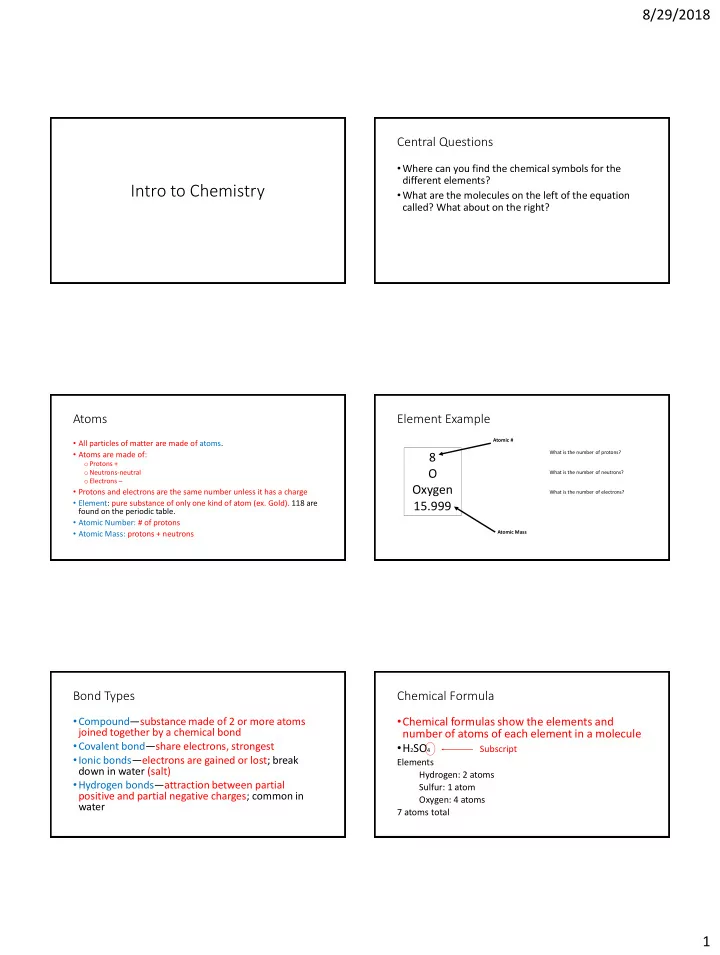
8/29/2018 Central Questions Where can you find the chemical symbols for the different elements? Intro to Chemistry What are the molecules on the left of the equation called? What about on the right? Atoms Element Example All


slide-1
SLIDE 1

8/29/2018 1

Intro to Chemistry

Central Questions

  • Where can you find the chemical symbols for the

different elements?

  • What are the molecules on the left of the equation

called? What about on the right?

Atoms

  • All particles of matter are made of atoms.
  • Atoms are made of:
  • Protons +
  • Neutrons-neutral
  • Electrons –
  • Protons and electrons are the same number unless it has a charge
  • Element: pure substance of only one kind of atom (ex. Gold). 118 are

found on the periodic table.

  • Atomic Number: # of protons
  • Atomic Mass: protons + neutrons

Element Example 8 O Oxygen 15.999

Atomic # Atomic Mass What is the number of protons? What is the number of neutrons? What is the number of electrons?

Bond Types

  • Compound—substance made of 2 or more atoms

joined together by a chemical bond

  • Covalent bond—share electrons, strongest
  • Ionic bonds—electrons are gained or lost; break

down in water (salt)

  • Hydrogen bonds—attraction between partial

positive and partial negative charges; common in water

Chemical Formula

  • Chemical formulas show the elements and

number of atoms of each element in a molecule

  • H2SO4

Subscript Elements Hydrogen: 2 atoms Sulfur: 1 atom Oxygen: 4 atoms 7 atoms total

slide-2
SLIDE 2

8/29/2018 2

Coefficients

  • A formula may begin with a number called a coefficient. It

represents the # of molecules of that compound or atom need in the reaction.

  • For example:
  • 2H2SO4—2 molecules of Sulfuric Acid

Coefficients

  • 2H2SO4—2 molecules of Sulfuric Acid
  • A coefficient is distributed to ALL elements in a

compound

  • 2—H2 (for a total of 4 H atoms)
  • 2—S (for a total of 2 S atoms)
  • 2—O4 (for a total of 8 O atoms)

Reading Chemical Equations

  • Each side of an equation represents a combination of

chemicals.

  • The combination is written as a set of chemical

formulas, separated by + symbols. CH4 + 2O2  CO2 + 2H2O

Coefficient

Reading Chemical Equations

  • The two sides of the equation are separated by an

arrow.

  • The combination of chemicals before the reaction

are on the left side of the arrow. These are the reactants.

  • The right side indicates the combination of

chemicals after the reaction. These are the products.

For Example:

REACTANTS PRODUCTS Na + O2  Na2O

  • The reactants are Na and O2
  • The products are Na2O

Balancing Equations

  • The Law of Conservation of Mass states that in a

chemical reaction, the quantity or amount of each element does not change.

  • This means that each side of the equation must

represent the same quantity of each element; in other words have the same number of each kind of atom.

slide-3
SLIDE 3

8/29/2018 3

Balancing Equations

Na + O2  Na2O

  • In order for this equation to be balanced, there

must be equal amount of Na on the left hand side and on the right hand side.

  • Right now, there is 1 Na atom on the left but 2

Na atoms on the right. We solve this problem by putting a 2 in front of the Na on the left hand side, like this: 2Na + O2  Na2O

Balancing Equations

2Na + O2  Na2O

  • There are 2 Na’s on the left and 2 Na’s on the right. But

what about the O?

  • We now must check to see if the O’s are balanced on both

sides of the equation. On the left hand side, there are 2 O’s and the right hand side only has one. This is still an unbalanced equation. To fix this, we must put a 2 in front

  • f the Na2O on the right hand side. Now our equation

reads: 2Na + O2  2Na2O Is this equation balanced now?

Central Questions

  • Where can you find the chemical symbols for the

different elements?

  • What are the molecules on the left of the equation

called? What about on the right?