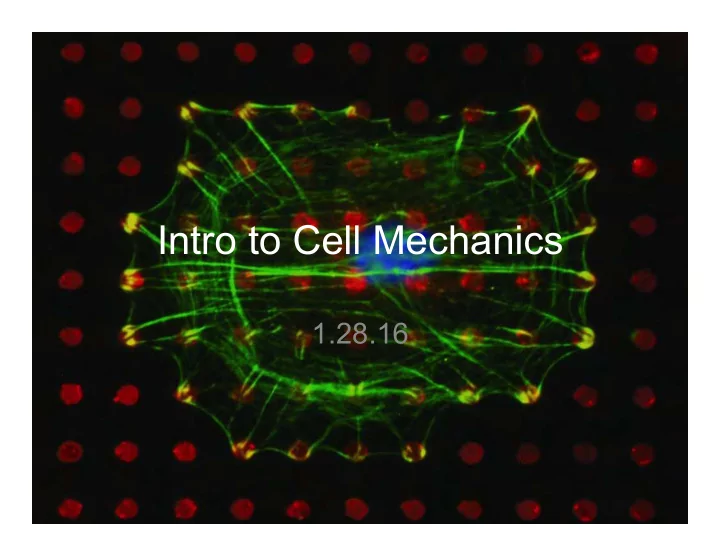
SLIDE 1
Intro to Cell Mechanics
1.28.16
SLIDE 2 Biological Hierarchy- Whole Body
Tennis Anatomy (2011)
SLIDE 3
Biological Hierarchy – Muscles to Cells
SLIDE 4
Biological Hierarchy – Cells to Proteins
Muscles contract via sliding the myosin and actin filaments along each other.
SLIDE 5
Fermi Problem: Number of cells
The Human Body ~ 70% water, ρ =1000 kg/m3 Let’s say the average mass of a human is 85 kg.
ρ = m/V → 1000 kg/m3 = (0.7)(85 kg)(1/Vhuman)
Vhuman ~ 0.0595 m3
What is the volume of a cell? Pretend a cell is a cube.
Vcell = (20 µm)3 = 8 x 10-15 m3 Ncell = Vhuman/Vcell ~ 10 trillion
Current data estimation ~ 3.72 x 10¹³ Types of cells ~ 210 Typical mass ~ 1 ng
SLIDE 6
Fermi Problem: Number of cells
The Human Body ~ 70% water, ρ =1000 kg/m3 Let’s say the average weight of a human is 85 kg.
ρ = m/V → 1000 kg/m3 = (0.7)(85 kg)(1/Vhuman)
Vhuman ~ 0.0595 m3
What is the volume of a cell? Pretend a cell is a cube.
Vcell = (20 µm)3 = 8 x 10-15 m3 Ncell = Vhuman/Vcell ~ 10 trillion
Current data estimation ~ 3.72 x 10¹³ Types of cells ~ 210 Typical mass ~ 1 ng
SLIDE 7
Fermi Problem: Number of cells
The Human Body ~ 70% water, ρ =1000 kg/m3 Let’s say the average weight of a human is 85 kg.
ρ = m/V → 1000 kg/m3 = (0.7)(85 kg)(1/Vhuman)
Vhuman ~ 0.0595 m3
What is the volume of a cell? Pretend a cell is a cube.
Vcell = (20 µm)3 = 8 x 10-15 m3 Ncell = Vhuman/Vcell ~ 10 trillion
Current data estimation ~ 3.72 x 10¹³ Types of cells ~ 210 Typical mass ~ 1 ng
SLIDE 8
Fermi Problem: Number of cells
The Human Body ~ 70% water, ρ =1000 kg/m3 Let’s say the average weight of a human is 85 kg.
ρ = m/V → 1000 kg/m3 = (0.7)(85 kg)(1/Vhuman)
Vhuman ~ 0.0595 m3
What is the volume of a cell? Pretend a cell is a cube.
Vcell = (20 µm)3 = 8 x 10-15 m3 Ncell = Vhuman/Vcell ~ 10 trillion
Current data estimation ~ 3.72 x 10¹³ Types of cells ~ 210 Typical mass ~ 1 ng
SLIDE 9 The Numbers
Current data estimation ~ 3.72 x 10¹³ Types of cells ~ 210 Typical mass ~ 1 ng Distance – microns Force – pN to nN Stress – 1 Pa to 1 kPa
Nature Education
SLIDE 10 The Numbers
“If an apple is magnified to the size of the earth, then the atoms in the apple are
- approx. the size of the original apple.”
~ Richard Feynman
Nature Education
SLIDE 11 68 Molecular Building Blocks
“From the construction, modification, and interaction of these components, the cell develops and functions.” –Jamey Marth
- J. Marth “A Unified Vision of the Building Blocks of Life” Nature Cell Biology, 2008,10(9):1015-16
Nucleic Acids 8 nucleosides Proteins 20 amino acids Glycans 32+ sugars Lipids 8 types
SLIDE 12
The Subsystems (Organelles)
SLIDE 13 From Stimulus to Cell Response
Nanobiomedicine, 2014, 1:5 | doi: 10.5772/59379
SLIDE 14 What is Cell Mechanics?
“The subject of cell mechanics encompasses a wide range of essential cellular processes, ranging from macroscopic events like the maintenance of cell shape, cell motility, adhesion, and deformation to microscopic events such as how cells sense mechanical signals and transduce them into a cascade of biochemical signals ultimately leading to a host of biological responses.”
SLIDE 15
SLIDE 16
SLIDE 17
SLIDE 18
Micropipette Aspiration (Application)
SLIDE 19 Optical Tweezers (Application)
Nature Materials 7, 15 - 23 (2008)
Biomechanics of RBC infected by the malaria-inducing parasite P. falciparum. Normal RBCs (H-RBC, n = 7) and RBC infected by P. falciparum at the ring stage (Pf-R- pRBC, n = 5) and the schizont stage (Pf-S-pRBC, n = 23). The solid lines are from three-dimensional finite-element simulations of an optical tweezers stretching experiment of RBC with an effective shear modulus of the cell membrane = 5.3 N m-1 (H-RBC), 16 N m-1 (Pf-R-pRBC) and 53.3 N m-1 (Pf-S-pRBC).
SLIDE 20
Laser Tweezers (Application)
SLIDE 21
Microfluidic Device (Application/Sensing)
SLIDE 22 Magnetic Cantilever (Actuation)
Bielawski, K.S., Sniadecki, N.J., J Microelectromechanical Systems. (2015)
SLIDE 23 Micropost Technology (Sensing)
Rodriguez, M.L., et al (2014) J Biomechanical Engineering. 136(5), 051005
SLIDE 24 AFM (Application and Sensing)
Haase K, Pelling AE. (2015) J. R. Soc. Interface 12: 20140970.
Apply compressive strains AFM force - indentation curve used to measure elasticity Single molecule interaction experiments PSD Stress and strain relaxation curves to measure time dependent cellular behaviors Spherical tip used to measure distributed forces
SLIDE 25 Modeling Approaches
Nature Materials 7, 15 - 23 (2008)
SLIDE 26 We study cell mechanics...
- to understand interaction between cells and their environment
- to improve the control/function of cells
- to improve cell growth/cell production
- to manipulate cells for medical applications
- to treatment of certain diseases
- to understand how cells move and change cell motion
- to build/engineer tissues with desired mechanical properties
- to understand how cell growth is affected by stress and mechanical properties of the
substrate the cells are in
- to understand how cells are affected by their environment
- to understand how mechanical factors alter cell behavior and gene expression
- to understand how different cells interact with each other
- to understand how mechanical loading affects cells, e.g. stem cell differentiation or
cell morphology
- to understand how mechanically gated ion channels work
- to understand how the loading of cells could aid developing structures to grow cells
- r organize existing cells more efficiently
- to understand macrostructural behavior
- to build machines/sensors similar to cells
- to be able to study the impact of different parts of a cell on its overall behavior
- to provide scientific guidance for targeted cell manipulation
SLIDE 27
Back Up
SLIDE 28 Cells in Context
Cells/Tissue
Animate Basic Unit of Living Composed of Proteins Defines structure/function of tissue Sensitive to temperature, radiation, water, pH, nutrients, pressure, ionic strength, osmolarity, hormones, etc.
Grains/Material
Inanimate Basic Unit of Metal/Ceramics Composed of Atoms Defines structure strength of material Sensitive to temperature, radiation, corrosion, loading
SLIDE 29 Modeling Approaches
Haase K, Pelling AE. (2015) J. R. Soc. Interface 12: 20140970.
SLIDE 30
SLIDE 31
SLIDE 32