Internet The value of Internet is in global reachability - - PowerPoint PPT Presentation

internet
SMART_READER_LITE
LIVE PREVIEW

Internet The value of Internet is in global reachability - - PowerPoint PPT Presentation

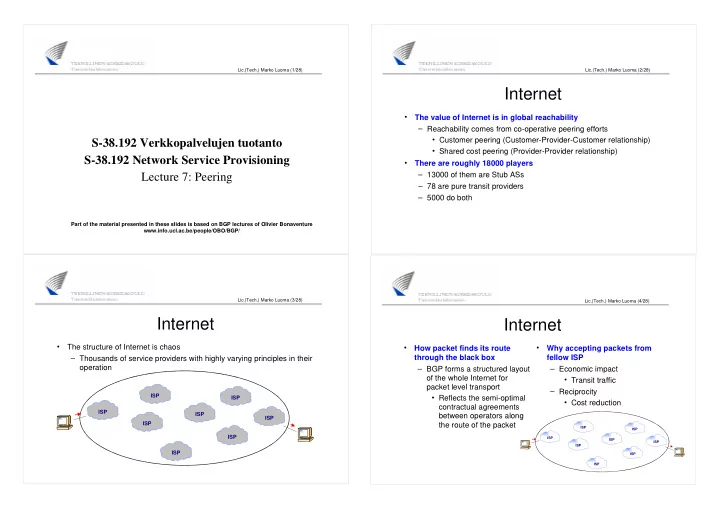
Lic.(Tech.) Marko Luoma (1/28) Lic.(Tech.) Marko Luoma (2/28) Internet The value of Internet is in global reachability Reachability comes from co-operative peering efforts Customer peering (Customer-Provider-Customer relationship)


slide-1
SLIDE 1

Lic.(Tech.) Marko Luoma (1/28)

S-38.192 Verkkopalvelujen tuotanto S-38.192 Network Service Provisioning Lecture 7: Peering

Part of the material presented in these slides is based on BGP lectures of Olivier Bonaventure www.info.ucl.ac.be/people/OBO/BGP/

Lic.(Tech.) Marko Luoma (2/28)

Internet

  • The value of Internet is in global reachability

Reachability comes from co-operative peering efforts Customer peering (Customer-Provider-Customer relationship) Shared cost peering (Provider-Provider relationship)

  • There are roughly 18000 players

13000 of them are Stub ASs 78 are pure transit providers 5000 do both

Lic.(Tech.) Marko Luoma (3/28)

Internet

ISP ISP ISP ISP ISP ISP ISP ISP

  • The structure of Internet is chaos

Thousands of service providers with highly varying principles in their

  • peration

Lic.(Tech.) Marko Luoma (4/28)

Internet

ISP ISP ISP ISP ISP ISP ISP ISP

  • How packet finds its route

through the black box BGP forms a structured layout

  • f the whole Internet for

packet level transport Reflects the semi-optimal contractual agreements between operators along the route of the packet

  • Why accepting packets from

fellow ISP Economic impact Transit traffic Reciprocity Cost reduction

slide-2
SLIDE 2

Lic.(Tech.) Marko Luoma (5/28)

Agreements

  • Form the basis between inter-provider communications

Small ISPs are customers of larger ones Larger ISPs deliver their customer traffic as their own traffic Larger ISPs deliver their customer traffic as transit traffic Equal size providers exchange their traffic pro bonus Both save money by interconnecting directly rather than through 3rd party Mutual agreement for exchanging only their customer traffic

Lic.(Tech.) Marko Luoma (6/28)

Strict hierarchy

ISP ISP ISP ISP ISP ISP ISP ISP ISP ISP

Lic.(Tech.) Marko Luoma (7/28)

Strict hierarchy

  • Based on structural and regulated manner of forming customer/provider

relationships Valid in telco operations Operators for a chain of customer/provider relationships Based on regulation of operational arena Local operators Long distance operators International operators Cash flows to the top of the hierarchy Local operators collect the money from end users Middle layers take their premiums

Lic.(Tech.) Marko Luoma (8/28)

Loose hierarchy

ISP ISP ISP ISP ISP ISP ISP ISP ISP ISP

slide-3
SLIDE 3

Lic.(Tech.) Marko Luoma (9/28)

Loose hierarchy

  • Local providers compete the local market but share common need to

exchange their customer traffic on a local level It is profitable for all to have direct exchange of traffic without 3rd parties Better marginal revenue Requires Interconnection points Bilateral agreement to establish equality Zero payment principle Both parties benefit from peering No mutual transfer of money

Lic.(Tech.) Marko Luoma (10/28)

Internet

  • Naturally loose in hierarchy
  • Local ISPs maximize their revenue by minimazing their transit traffic
  • Same structure on all levels of hierarchy
  • Any connection through the Internet is formed with chain of

customer/provider relationships with a single zero payment border Cost of connection is therefore divided into two From source to top of the chain From destination to top of the chain Peering does not cover transit traffic Only one zero payment border

Lic.(Tech.) Marko Luoma (11/28)

Internet

ISP ISP ISP ISP ISP

Zero payment Cost Area A Cost Area B

Lic.(Tech.) Marko Luoma (12/28)

Transit domain

  • A transit domain allows external domains to use its own infrastructure to

send packets to other domains

  • Examples

FuNET, NorduNET, GEANT, Internet2, BT, Telia, Level3,...

T1 T2 T3 S1 S2 S3 S4

slide-4
SLIDE 4

Lic.(Tech.) Marko Luoma (13/28)

Stub domain

  • A stub domain does not allow external domains to

use its infrastructure to send packets to other domains A stub is connected to at least one transit domain Single-homed stub : connected to one transit domain (S1) Dual-homed stub : connected to two transit domains (S2-S4)

T1 T2 T3 S1 S2 S3 S4

Lic.(Tech.) Marko Luoma (14/28)

Stub domain

  • Examples:

Content-rich stub domain Large web servers : Yahoo, Google, MSN, TF1, BBC,... Access-rich stub domain ISPs providing Internet access via CATV, ADSL, ... Saunalahti, Kolumbus, Welho etc

Lic.(Tech.) Marko Luoma (15/28)

Internet

  • Tier-1 ISPs

Dozen of large ISPs interconnected by shared-cost peering arrangements Form the core of the Internet Provide transit service for T2/T3 service providers

Lic.(Tech.) Marko Luoma (16/28)

Tier-1 service providers

  • AOL Transit Data Network
  • AT&T
  • BBN
  • British Telecom
  • Cable and Wireless
  • Connect Internet Solutions
  • Deutsche Telekom
  • Global Crossing
  • Level 3
  • NTT/Verio
  • Optus
  • Primus Telecom
  • Qwest
  • Sprint
  • Telstra
  • UUNET
  • WilTel (Williams

Communications)

slide-5
SLIDE 5

Lic.(Tech.) Marko Luoma (17/28)

Internet

  • Tier-2 ISPs

Regional or National ISPs Customer of T1 ISP(s) Provider of T3 ISP(s) shared-cost with other T2 ISPs

Lic.(Tech.) Marko Luoma (18/28)

Internet

  • Tier-3 ISPs

Smaller ISPs, Corporate Networks, Content providers Customers of T2 or T1 ISPs shared-cost with other T3 ISPs

Lic.(Tech.) Marko Luoma (19/28)

Customer-provider peering

Principle Customer sends to its provider its internal routes and the routes learned from its own customers Provider will advertise those routes to the entire Internet to allow anyone to reach the Customer Provider sends to its customers all known routes Customer will be able to reach anyone on the Internet

AS2 AS1 AS3 AS4 AS7 $ $ $ $ Customer Provider $ Lic.(Tech.) Marko Luoma (20/28)

Shared-cost peering

Principle PeerX sends to PeerY its internal routes and the routes learned from its own customers PeerY will use shared link to reach PeerX and PeerX's customers PeerX's providers are not reachable via the shared link PeerY sends to PeerX its internal routes and the routes learned from its own customers PeerX will use shared link to reach PeerY and PeerY's customers PeerY's providers are not reachable via the shared link

slide-6
SLIDE 6

Lic.(Tech.) Marko Luoma (21/28)

Shared-cost peering

AS2 AS1 AS3 AS4 AS7 Customer provider $ $ $ $ $ Shared-cost

  • AS1 send routes of AS{1,3,4,7} to AS2
  • AS2 sends routes of AS{2,4,7} to AS1

Not AS3 while those routes come from shared-cost peering Routes from shared-cost peering are not advertised to providers

Lic.(Tech.) Marko Luoma (22/28)

Internet

  • Local providers aim to minimize their expenses by interconnecting

at local level Local exchange points ..CIX (Commercial Internet eXchange) MAE.. (Metropolitan Area eXchange) NAP (Network Access Point) IXP (Internet eXchange Point) EP (Exchange Point) Bilateral interconnections

Lic.(Tech.) Marko Luoma (23/28)

Internet exhange

  • Commercial starting point

A company builds an interconnection point to Gain revenue from peering traffic Gain revenue from transmission links coming to exchange Gain revenue from transit traffic

  • Co-operative starting point

Neutral partner runs the exchange None of the partners owns the premises None of the partners owns the transmission links into exchange None of the partners owns the equipment in exchange

Lic.(Tech.) Marko Luoma (24/28)

Internet exhange

  • Build over L2 technology

Ethernet, ATM, FrameRelay switch

  • Each provider connects into shared media with transmission link

terminated to border router of provider Everybody is able to see everybody

ISP ISP ISP ISP

slide-7
SLIDE 7

Lic.(Tech.) Marko Luoma (25/28)

Internet exhange

  • Peering agreements can be based on

Multilateral agreements Every partner is peering with every other partner All border routers share a common subnet which is not filtered Ideal situation for Ethernet type of IXP solution

ISP ISP ISP ISP

Lic.(Tech.) Marko Luoma (26/28)

Internet exhange

Bilateral agreements Partners peer only based on bilateral agreements Requires L2 technology that is able to create virtual connections between peering partners ATM PVC FR DLCI Ethernet VLAN

ISP ISP ISP ISP

Lic.(Tech.) Marko Luoma (27/28)

Internet exhange

  • Multilateral peering reguires either

Separate BGP session between each border router N(N-1) sessions IXP offers route server capabilities Only N sessions BGP-route reflector

Lic.(Tech.) Marko Luoma (28/28)

Internet exhange

  • Depending on operational philosphy of IXP

Partners can make bilateral transit agreements in IXP Partners are already in same premises Required separate virtual connections between transit provider and customer Partners can make QoS peering Several virtual connections between peers One per VPN per QoS class One per MPLS LSP etc