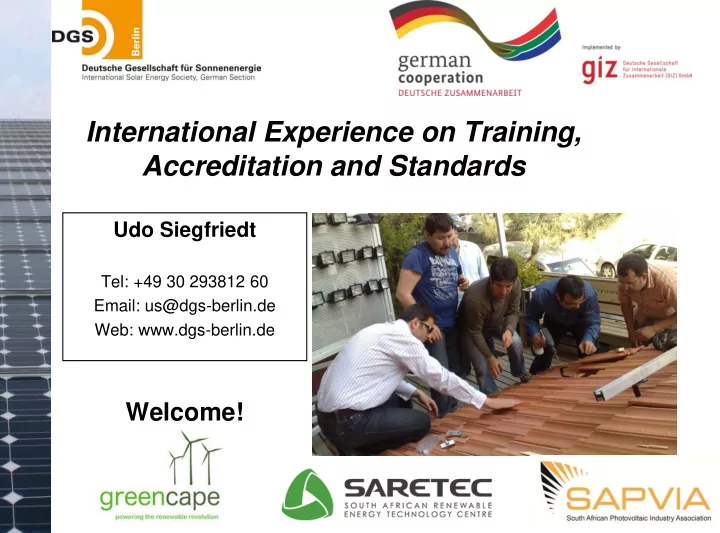
SLIDE 1 Udo Siegfriedt
Tel: +49 30 293812 60 Email: us@dgs-berlin.de Web: www.dgs-berlin.de
Welcome!
International Experience on Training, Accreditation and Standards
SLIDE 2
Agenda
Introduction PV Systems Standards Commissioning / Operating / Maintenance PV Training Discussion
SLIDE 3 Introduction DGS
Germanys first non profit association aiming a renewable and environmental friendly energy supply. Founded in1975, the section Berlin in 1982 Aims: foster the usage of renewable energies by means of information, education and political influence
- Approx. 3.000 members incl. 350 companies
National agency of International Solar Energy Society (ISES) Magazine SONNENENERGIE, six times per year The DGS is representing renewable energies in the German Federation of Technical and Scientific organisations (DVT).
- ther DVT-Members: DIN, VDI, VDE, VBI...
SLIDE 4
Technical Due Diligence Plant acceptances in cooperation with TÜV - Rheinland e.V. – „PV system –TÜVdotCOM “ Technical consulting Expert opinions for courts and insurances Yield studies Internal consumption calculations for the industry Review of operation data / resimulation Short term Performance Ratio acceptance tests Reflection and shading analysis www.dgs-berlin.de DGS-Berlin: Expert services for PV systems
SLIDE 5
Publications
Comprehensive overview on PV technology For planers, installers, architects... Information are manufacturer independent Actual Publications: Manual: Photovoltaic Systems (5th German edition, 3rd English) Manual: Solar Thermal Systems (9th German edition, 2nd English) Also available in Turkish, Macedonian and French Manuals are the basic for all SolarSchool courses
SLIDE 6
SolarSchool Berlin
Training courses for engineers, architects, craftsmen since 1996 more than 6.000 participants DGS Fachkraft Photovoltaik / Solarthermie Solar(fach)berater Photovoltaik / Solarthermie One day courses: i.e. simulation, off-grid systems, marketing, overview for non technicians Courses on Renewables world wide Development and coordination of a country wide network of DGS SolarSchools
SLIDE 7
Residential houses in Germany
SLIDE 8
PV in South Africa (as seen last weekend)
SLIDE 9
PV in South Africa (as seen yesterday)
Shopping Center Water Front Residential House Constantia
SLIDE 10
SLIDE 11
Grid tied PV Systems do not figure in national standards in South Afrika
Limited standards for wiring Limited standards for connection to the grid New standards or guidelines shall ensure high quality installation, grid safety and quality at an affordable price
SLIDE 12 Alternating current / direct current
- Sine curve of voltage and current
- Periodic zero crossing
- Arcs due to switching quench
at the next zero crossing
- Possibly phase shift between
voltage and current
- No zero crossing
- Arcs don’t quench automatically
- PV module cannot be switched off
Voltage Current (with phase shift) Voltage Current
SLIDE 13 PV system: DC components
PV cables with scoop-proof plugs Inverter DC main cable Isolators String fuses Generator junction box Isolators ( String diodes ) String fuses
SLIDE 14
PV-Modules IEC 61215 (crystall.) and IEC 61646 (thin film) IEC 61730 part1 and 2: Safety… Inverter Safety standards EN 62109 part1 and 2 … Installation: IEC/VDE 0100 part 712: PV-systems + all relevant other parts VDE 0282 und VDE 0298: high voltage cables DIN EN 62305-3 supplementary sheet 5: Lightning and overvoltage protection for PV Mounting systems load assumption and static according DIN EN 1991
Standards and guidelines
SLIDE 15 Grid connection (Germany)
Standards and Guidelines:
- DIN EN 61727: PV systems – Characteristics of the utility interface
- DIN VDE 0126-1: Automatic isolation unit between a private power
generator and the public grid (incl. anti islanding)
- VDEW-“Guideline for connecting and parallel operating of a private power
generator to the public grid
- TAB 2007 Technical requirements by the grid companies for connecting to
the public grid Grid connection point (German Renewable Energy Law EEG)
- Technical and economically most suitable connecting point
- Power generator < 30 kW: existing grid connection point = most suitable
- larger generator: : Assignation / in consultation with the grid company
- in case of dispute: - EEG-Clearingstelle: www.clearingstelle-eeg.de
SLIDE 16 Requirements EEG 2014 Part 2 FNN (Committee on the elaboration of VDE guidelines)- guideline VDE-AR-N 4105 for connecting and operating of private power generators at the low voltage grid BDEW-guideline „Erzeugungsanlagen am Mittelspannungsnetz (10 to 35 kV) – for connecting an operating of private power generators at the medium voltage grid 06/2008 „European Network of Transmission System Operators for Electricity“ (entsoe) “ENTSO-E Draft Requirements for Grid Connection Applicable to all Generators”. Will come midyear
- 2016. Regulations close to VDE 4105 and BDEW
Technical requirements for connecting to the public low voltage and medium voltage grid of the BDEW
New requirements for grid integration of PV systems since 2014
SLIDE 17 Generator power Nessecary measures ≤ 3,68 kVA Active power reduction if frequency > 50,2 Hz and shut down if frequency < 47,5Hz
- Reactive power cos φ = +/- 0,95 according EN 50438
- Remote feed in reduction / shut down or feed in reduction to max. active power of 70%
≤ 13,8 kVA max 4,6 kVA unbalanced load
- Reactive power according given characteristic with cos φ = +/- 0,95
- Central or inverter integrated grid protection
- Remote feed in reduction / shut down or feed in reduction to
- max. active power of 70%
≤ 30 kVA
- Reactive power according given characteristic with cos φ = +/- 0,9
- Central or inverter integrated grid protection
- 3 phase inverter or 1 phase inverter and communication
- Remote feed in reduction / shut down or feed in reduction to
- max. active power of 70%
≤ 100 kVA
- Reactive power according given characteristic with cos φ = +/- 0,9
- Central grid protection, anti islanding protection integrated in inverter possible
- 3 phase inverter or 1 phase inverter and communication
- Remote feed in reduction
> 100 kVA
- Reactive power according given characteristic with cos φ = +/- 0,9
- Central grid protection, anti islanding protection integrated in inverter possible
- 3 phase inverter or 1 phase inverter and communication
- Remote feed in reduction in several steps (mostly done with centralized telecontrol
signal 100%, 60%, 30%, 0%) and transmission of actual feed in power to the grid company
Requirements to the grid connection of PV-systems according §6 EEG and VDE 4105
SLIDE 18
SLIDE 19 Commissioning of a PV plant
In accordance with DIN VDE 0100 part 610 and BGV A2 (electrical installations and equipment) a test has to be done for personal and
- perational safety. A report has to record the measurement of (sample):
- isolation resistance of the PV-generator
- open circuit voltage of each string
- short circuit current of each string (DGS: operation current)...
The start up has to be done by a accredited electrically skilled person sometimes in the presence of a staff member of the grid company including the following (sample)
- Inspection of the plant
- Comparison installation / planning
- Accessibility of all parts relevant for the energy supply company
- Inspection of potential equalization
- Assembly of the measuring equipment in accordance to the
technical specifications
SLIDE 20 Announcement of completion An electrician approved by the grid company has to sign the following statement : “The installed system has been built, tested and completed by me / us according to the applicable regulations and rules of the art, in particular according to DIN VDE standards , the technical connection requirements (TAB) from The test results are documented . The system can be put into operation in accordance with § 13 of AVBEltV (Regulation
- n General Conditions for electricity supply of tariff customers )and
Paragraph 3 of the TAB" Documents required for sign on at the grid company
- Wiring diagram of the PV installation with nominal values of the
installed utilities
- Description of the safety devices including information of it‘s function
- Information of the short circuit withstand of the isolators
- Description of the inverter operating method
- Inverter manufacturer declaration on conformity
- Description of the method used to connect the inverter to the grid
- Certification for the inverter / certification for the whole system
Announcement of completion at the grid company
SLIDE 21 Federal Grid Agency
- Only if the feed in tariff according EEG (German renewable energy
law) is demanded Registration according the ordinance to register PV installations (Anlagenregisterverordnung (AnlRegV)
- Also obligatoray for installations, where no feed in tariff is demanded
- Only for grid connected installations
- Registration must be done within 3 weeks after completion
Obligatory registration of the PV System
SLIDE 22 Independent Quality Control
- BSW Passport for PV systems
List of necessary documents and measurements, no quality control
- Quality seals (DGS, TÜV.com…)
Planning check, documentation check, visual inspection, measurements Sometimes yield recalculation based on real irradiation
SLIDE 23 BSW Passport for PV Systems
- Appendix 1: Components Used
Photovoltaic modules Photovoltaic Inverter Isolator (DC) and cables / wires Photovoltaic mounting system
- Appendix 2: Information on planning / installation
System configuration
- Appendix 2: Certificate / Reports
Certificates Report on design, construction, inspection Report on the electrical testing of the PV arrays Report of the electrical testing of the AC side
- f the PV plant
- Appendix 4: Overview Documents annexed
SLIDE 24
Goals for PV-training
Planning (component choice, dimensioning, legal aspects...) Craftsmanship (cable laying, safety at work...) Operation + Maintenance (monitoring, error detection, service call...) The following topics should be taken into account Country specific manners Education level Existing infrastructure (grid situation, manufacturer attendance) Economic situation
SLIDE 25
Possible ways to go
Long time education (3 years) including normal electric installation and PV topics Additional long time qualification (several weeks) for electricians Additional qualification courses (several days) for electricians Manufacturer qualification courses may be requested in addition to the already mentioned topics
SLIDE 26
Situation in Germany
Due to the high qualification level of electricians no additional qualification is recommended for installing a PV system Shielded DC installations (not connected to the public grid, no touchable live parts) can be done by an instructed non-electrician under surveillance of an electrically skilled person The AC side can only be done by an electrician An electrician listed by the grid company must sign and is responsible for the whole installation
SLIDE 27
Discussion points
Based on the discussions at SARETEC 1. Development of solar industry guidelines inspired by national PV curriculum (on the way) 2. Implement and promote quality assurance test for practitioners in the market 3. Development of a PV passport 4. Establishing of a 1 week PV installer training course with focus on design and inspection 5. Approval of QCTO PV technician curriculum
SLIDE 28 Thank you for your attention
- Dipl.-Ing. Udo Siegfriedt
- DGS - Deutsche Gesellschaft für Sonnenenergie
- Landesverband Berlin Brandenburg e.V.
- Erich-Steinfurth-Str. 8
- D – 10243 Berlin
Fon: +49 30 293812 60 Fax: +49 30 293812 61 Mail: us@dgs-berlin.de Web: http://www.dgs-berlin.de