1 Accreditation Impact Accreditation Impact Fifteen years ago the - - PDF document

1
SMART_READER_LITE
LIVE PREVIEW

1 Accreditation Impact Accreditation Impact Fifteen years ago the - - PDF document

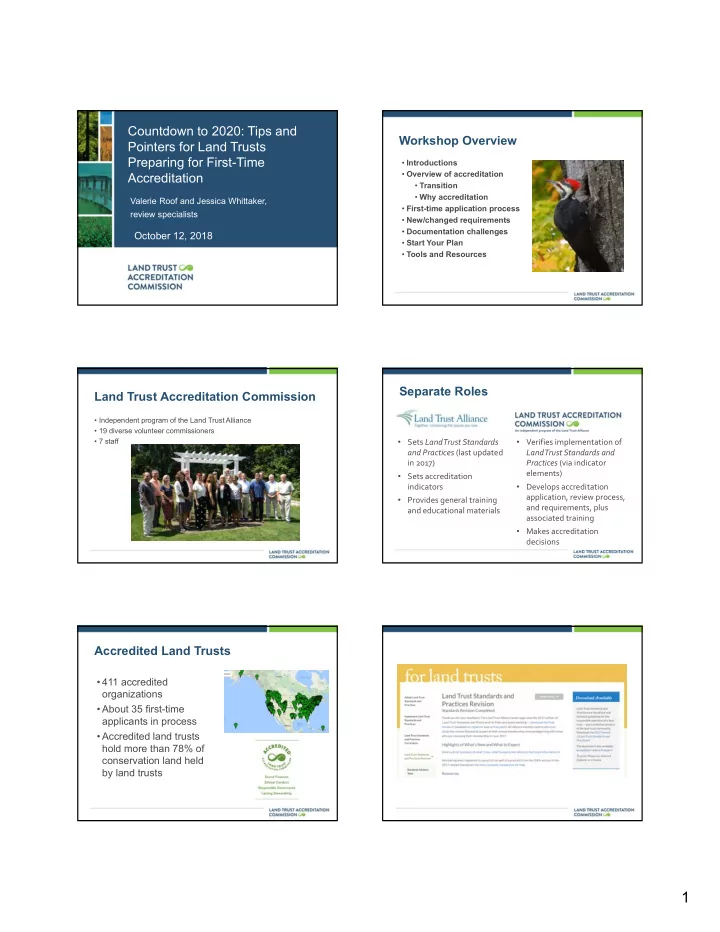
Countdown to 2020: Tips and Workshop Overview Pointers for Land Trusts Preparing for First-Time Introductions Overview of accreditation Accreditation Transition Why accreditation Valerie Roof and Jessica Whittaker,


slide-1
SLIDE 1

1

Countdown to 2020: Tips and Pointers for Land Trusts Preparing for First-Time Accreditation

October 12, 2018

Valerie Roof and Jessica Whittaker, review specialists

Workshop Overview

  • Introductions
  • Overview of accreditation
  • Transition
  • Why accreditation
  • First-time application process
  • New/changed requirements
  • Documentation challenges
  • Start Your Plan
  • Tools and Resources

Land Trust Accreditation Commission

  • Independent program of the Land Trust Alliance
  • 19 diverse volunteer commissioners
  • 7 staff
  • Sets Land Trust Standards

and Practices (last updated in 2017)

  • Sets accreditation

indicators

  • Provides general training

and educational materials

  • Verifies implementation of

Land Trust Standards and Practices (via indicator elements)

  • Develops accreditation

application, review process, and requirements, plus associated training

  • Makes accreditation

decisions

Separate Roles Accredited Land Trusts

  • 411 accredited
  • rganizations
  • About 35 first-time

applicants in process

  • Accredited land trusts

hold more than 78% of conservation land held by land trusts

slide-2
SLIDE 2

2

Accreditation Impact

 Fifteen years ago the land trust community was ill prepared to live up to the promise of perpetuity and was under legislative and regulatory threat. ⁻ The Alliance created the Accreditation Commission as a solution and offered accredited preparation services to its members.  Today, accredited land trusts far outpace those not yet accredited. ⁻ They have significantly bigger budgets, more staff and volunteers and ⁻ 8 times more money invested to steward and defend their conservation lands than their peers of similar size – they also save 3 times more land.

10

 Accreditation was a strong motivator for change in land trusts; 87% of accredited land trusts responded that accreditation moderately or substantially motivated them to make organizational improvements.  Public confidence in land trusts increased as a result; 85% of public agencies and foundations say accreditation increases their confidence in land trusts and 83% of landowners feel the same way. These positive impacts can grow as more land trusts join the program.

Accreditation Impact

D01: Transformation through Land Trust Accreditation

SATURDAY 10:30-Noon

11

slide-3
SLIDE 3

3

Application Review

  • Review team (staff and commissioners)

evaluates compliance with indicator elements by considering:

– Pre-application/Application – Supporting documents – Project documentation – Public notice/comments – Research

Applicant Conference Call

  • Detailed agenda sent in advance
  • Clarification/more information
  • Lasts about 2 hours

Additional Information Request

  • Follow-up letter with document requests or

corrective action

Commission’s Review Approach

  • Consistency
  • Fair but flexible
  • All must demonstrate

compliance

  • No one-size-fits all
  • Recognize diversity

Decision by Full Commission

  • Accredit

– Awarded for 5-year term – Expectations for Improvement

  • Table
  • Not Accredit

Questions on the Application Process?

18

slide-4
SLIDE 4

4

2017 Standards  2018 Requirements

2018 Requirements Framework: Key Concepts

  • 1. Indicator Elements in Four

Groups

  • 2. Documents for Each Group
  • 3. Requirements for Each Group
  • 4. Two Categories of

Requirements

  • Bold

‒ Proactive Verification ‒ Hard Stop!

  • Not Bold

‒ Red Flags ‒ Next Step Depends on Risk

Bold Example  New board members trained. Documentation of training new board members will be verified for every applicant. Non-bold Example  Land trust generally operates in accordance with its bylaws. Red flag: look at risk in the context of the entire application. ‒ Low risk: Bylaws require 9-15 board members; land trust has 8 board members; board operates effectively. No questions. ‒ High risk: Bylaws require a 9-15 member board; land trust has 4 board members; board appears to be controlled by one member. Questions.

Requirements: Risk-Based

Governance Finance Transactions Stewardship

New Finance Requirements: Records & Financial Health

  • Operating surplus exists at the end of

last fiscal year [statement from board

  • fficer explains reason for deficit]
  • Operating reserves at the end of last

fiscal year sufficiently cover three months of operating expenses [board evaluation of operating reserve needs and a feasible plan to address the needs]

  • Concentrated or sole source of funding not
  • verly relied on
  • Debt or lease payments can generally be

met.

24

slide-5
SLIDE 5

5

New Finance Requirements: Board Oversight & Donor Restrictions

  • Board approval of annual budget
  • Board review of periodic financial reports that include:

‒ Unrestricted, board-designated and restricted net assets ‒ Actual unrestricted and restricted revenue and expenses for the reporting period as compared to budget

  • Documentation of the business process system it

follows when a) soliciting and accepting restricted gifts/grants b) determining restrictions on gifts/grants c) documenting donor restrictions and d) tracking receipt

  • f and expenditures from restricted gifts/grants to

comply with donor restrictions

25

New Finance Requirements: Internal Controls and Insurance

  • Written internal controls or

accounting procedures

  • Have general liability insurance

that covers significant risks

  • Board [or delegated entity]

evaluates insurance needs at least every five years:

‒ Directors and officers liability insurance ‒ Property insurance ‒ Insurance required by law

26

Changed Requirements for Audit, Review, Compilation

2016 2018

Defense Fund Requirements

2016 2018

29

New Transaction Requirements

  • Evaluate the Form 8283 and landowner’s appraisal and document the

following: ‒ Did not knowingly participate in potentially fraudulent or abusive transactions ‒ Involved legal counsel as appropriate, especially in potentially fraudulent or abusive transactions ‒ Took appropriate action to resolve substantial concerns with the appraisal, appraised value or other terms of the transaction Signed the Form 8283 only when a gift was received

  • Follow the then current Land Trust Alliance Tax Shelter Advisory

30

slide-6
SLIDE 6

6

Land Conservation Project List

New Stewardship Requirements

  • Fee Inspection reports include the following:

‒ Inspection date ‒ Property inspected ‒ Name of inspector ‒ Observations related to property’s condition and conservation values ‒ Observations related to any potential conservation easement violations or conservation property ownership challenges

  • Inspect fee properties annually
  • Monitoring or inspection reports completed

promptly after monitoring or inspection event.

32

Land Conservation Project List

B02: Tackling Land Trust Accreditation Requirements

FRIDAY 1:30 PM – 3:00 PM

Friday 1:30 pm – 3:00 pm

Critical Application Needs

  • Take actions to meet

the requirement

  • Document that you met

the requirement

  • Communicate that you

met the requirement

Common Documentation Problems

  • Evidence an insider was absent for discussion

and vote

  • Copy of notification sent to landowners about

tax and appraisal issues

  • Documentation of review and approval of

transactions

  • Information sent to board in advance of final

project approval

  • Documentation of no private inurement or

impermissible private benefit

  • Documentation that mortgages, liens and other

encumbrances were addressed

  • Evidence that title was brought current at

closing (30 days)

36

Lack of complete documentation (or missing)

slide-7
SLIDE 7

7

Documentation Challenges

For each project selected you will be asked to provide:

  • Evidence of the review of the project by the full board and/or by a

committee

  • Material provided to the board (or other decision maker) before final

approval

  • Minutes of the board meeting when the project was approved or other

record of final decision – How do you document review of projects? – Do you keep a record of what was sent to the board and when?

37

Documenting review and approval of transactions

Documentation Challenges

Encumbrances or severed mineral rights shown in the title investigation are appropriately addressed so they will not result in extinguishment of the conservation easement or significantly undermine the conservation values

  • Situation A: Title investigation indicated coal, natural gas and other

mineral rights have been severed fee project

  • Situation B: $500,000 mortgage showing on title commitment showing
  • n easement project

– Could these potentially result in the extinguishment of the conservation easement or significantly undermine the conservation values? – How would you address the potential encumbrances? – What documentation would you provide?

38

Documenting that mortgages, liens and other encumbrances were addressed

Documentation Challenges

Title investigation is updated by title company or attorney generally within 30 days of closing

39

Documenting title was updated at closing

– What documentation would you provide?

Use the Requirements Manual

40

Conflict of interest policy:

  • Applies to all insiders

–Board members –Staff members (if the organization has staff) –Substantial contributors –Parties related to board members, staff (if the organization has staff), and substantial contributors –Those who have an ability to influence decisions of the

  • rganization (such as committee members)

–Those with access to information not available to the general public (such as volunteers, contractors, consultants, advisory board members, etc.)

  • Addresses how conflicts are identified, and avoided or

managed.

Gathering Information

  • Conflicts of interest (financial and land/easement)
  • Single audit (if > $750,000 in federal funds)
  • Purchase appraisals (most recent)
  • Above appraised value purchases (most recent)
  • Forms 8283 and landowners’ appraisals
  • Conservation easement violations
  • Fee ownership challenges
  • Conservation easement amendments
  • Conservation easement extinguishments

Accreditation Tools

  • Applicant Handbook
  • Requirements Manual
slide-8
SLIDE 8

8

43

www.landtrustaccreditation.org

Other Tools

Alliance

  • The Learning Center
  • Standards and Practices

background narratives

  • Training, conferences,
  • nline learning and

webinars

  • Staff

Commission

  • Enews
  • Factsheets/Policies
  • Application Materials
  • Webinars
  • Tutorials
  • Sample Statements
  • Template Policies and

Accreditation Tips

  • Staff

Narratives for Practice Elements

Are You Ready?

  • Is our land trust committed?
  • Is our land trust eligible?
  • Does (or will) our land trust meet the pre-application

requirements?

  • Will our land trust be ready to complete the

accreditation application?

  • Is this the right time?

46

  • Valerie Roof

vroof@landtrustaccreditation.org 518-587-3143

  • Jessica Whittaker

jwhittaker@landtrustaccreditation.org 508-763-2053

Final Questions and Thank you!