
SLIDE 1
FOSTERING INTERGENERATIONAL CONNECTIONS
Jennifer Kulik, Ph.D. Silver Kite Community Arts & Wendy Pender, MLS King County Library System
All images (c) Silver Kite Community Arts and used with permission.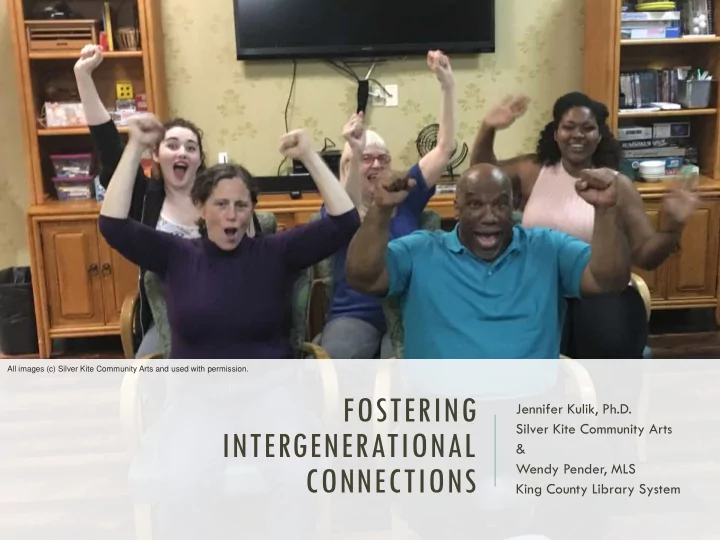
INTERGENERATIONAL & Wendy Pender, MLS CONNECTIONS King County - - PowerPoint PPT Presentation
All images (c) Silver Kite Community Arts and used with permission. FOSTERING Jennifer Kulik, Ph.D. Silver Kite Community Arts INTERGENERATIONAL & Wendy Pender, MLS CONNECTIONS King County Library System INTRODUCTIONS A little about
FOSTERING INTERGENERATIONAL CONNECTIONS
Jennifer Kulik, Ph.D. Silver Kite Community Arts & Wendy Pender, MLS King County Library System
All images (c) Silver Kite Community Arts and used with permission. A little about us… and a little about you…
ANNOTATION TOOLS
Find the grey marker pen in top left corner of the presentation screen. Click to open the tool buttons in a column on the left side; the marker pen will turn blue.
Check mark
▪ Click on square, half-way down. ▪ Use the drop-down menu and choose the check mark. ▪ Click on slide to indicate choice.
WHAT DO YOU KNOW ABOUT INTERGENERATIONAL PROGRAMMING?
It’s all new to me!
I think we’re doing it… I’m an expert!
I’d like to do it but I don’t know how to start
TODAY’S AGENDA
Part 1: Importance of Intergenerational relationships Part 2: Exploring intergenerational structures, programs and intergenerational activities Part 3: Intergenerational connections in the library space – how can libraries help foster intergenerational connections? Part 4: Bringing it home: creating a plan for your library
PART 1: INTERGENERATIONAL RELATIONSHIPS
Their importance, how they are changing, and why rebuilding them is important
WHAT DO WE MEAN BY “INTERGENERATIONAL?”
DEFINING TERMS…
DEFINING “INTERGENERATIONAL”
Term started being used in the 1970s Multi-generational: people of different generations are represented Intergenerational: people of different generations are interacting in meaningful ways Often works towards uniting “book-end” generations
WHY IG CONNECTIONS? WHY NOW?
▪ By 2050 adults over the age of 65 will outnumber children under 15 ▪ 10,000 Americans turn 65 each day with a life expectancy of 85 ▪ Girls born in the 1990s can expect to live to be over 100 years of age ▪ Cultural shifts:
Sources: Generations United, Connecting Generations, Bowling Alone
BENEFITS OF FOSTERING INTERGENERATIONAL CONNECTIONS
Breaks down age stereotypes
Helps eliminate fear of old / young Create seeds of compassion Eliminates loneliness / isolationism Children feel special Adults get a second chance Strengthens communities
WAIT… THERE’S MORE!
Studies show that “in schools where older adults were a regular fixture, children had improved readings scores and fewer behavioral problems their peers at other schools” (Elementary & Secondary Education Act, gu.org) Older adults who volunteered with children burned 20% more calories per week, had fewer falls, and performed better on a memory test Beneficial to persons with dementia 97% of adult participants reported feeling happy, interested, loved, younger, and needed
Organizational, program, and activity models & resources
SOME IG CONNECTION BUILDING STRUCTURES
CURRICULUM-BASED INTERGENERATIONAL PROGRAMS
Often tied to reading, writing, history Elders serve as curriculum experts to authenticate moments Ongoing mentorships or in-class projects
ACTIVITY: FINDING CONNECTION
Live in Washington State Live in the US Live outside of the US Have been 5 years old Have been 50 years old Have been 80 years old Play or have played a musical instrument Have or have had a pet Have ridden on a bus Have ridden in an airplane
Tutoring Mentorship Class–arts or other kind of enrichment together
Discussions about life, aging Structured small group or larger group conversations All have equal say and sharing ideas
SHARING STORIES
STAND ALONE INTERGENERATIONAL WORKSHOPS
Structured workshops to do a project or have an experience Can be family oriented or community
Often offered on the weekends / evenings Some ideas: card making, puppet making, dance, poetry, storytelling, gardening, first aid / disaster prep
LINES, LINES, LINES
SHARING STORIES
writing, or singing the story.
INFORMAL INTERACTIONS IN SHARED SPACES
Opportunities to create deeper interactions in shared spaces Activities that anyone can participate in at any time Examples: Life story sharing, Wisdom Tree, Mural, Collaborative Drawing
WHO ARE WE? BETTER TOGETHER!
puzzles together and then posting them in the library.
FINDING PARTICIPANTS
Partnership possibilities: Chamber of Commerce Local businesses Life Enrichment Directors at local senior living communities Existing after school programs (schools. YMCA, Boys & Girls Club, etc.) Faith communities Cultural associations
THE SECRET IG SAUCE
Create something your community would like Take the time to create a safe community space to do the program Relationships start by finding something in common Create opportunities for participants to be both teachers and learners as part of the program After this is established, create opportunities for everyone to do something new – together
YOUR IDEAS?
What programs have worked in your libraries?
PART 3: INTERGENERATIONAL CONNECTIONS IN THE LIBRARY
How can the libraries be used to promote intergenerational connections?
THE LIBRARY SPACE…
Multigenerational space Shared spaces where informal intergenerational interactions happen How can we increase opportunities for intergenerational connections to happen? How can we foster intergenerational connections?
ACTIVITY
CONSIDERING THE LIBRARY
Take a walk around your library and look at how the generations are mixing:
Why?
level of interaction, etc.?
PART 4: CREATING YOUR INTERGENERATIONAL CONNECTION IDEA
Let’s put what we’ve learned into action!
CREATING YOUR INTERGENERATIONAL CONNECTIONS IDEA… (PART 1)
Keep in mind:
beneficial – “nothing for us without us”
for interaction and engagement between generations
space with the resources available to you
CREATING IG CONNECTIONS… (PART 2)
Brainstorm ways to accomplish your idea, identifying:
CONTACT US
Jennifer Kulik, Ph.D. Founder & CEO Silver Kite Community Arts www.silverkite.us jen@silverkite.us (360) 218-4884 Wendy Pender, MLS Older Adults Program Coordinator King County Library System www.kcls.org/browse/50/ wgpender@kcls.org (425) 369-3285
All images (c) Silver Kite Community Arts and used with permission.