Integration of Textural and Material Information Into Existing BIM - - PowerPoint PPT Presentation

integration of textural and material
SMART_READER_LITE
LIVE PREVIEW

Integration of Textural and Material Information Into Existing BIM - - PowerPoint PPT Presentation

Integration of Textural and Material Information Into Existing BIM Using IR Sensing A research by: Asem Zabin Baha Khalil Asem Zabin Senior BIM Engineer at iTech Management Consultancy Master of Science in Civil Engineering (MSCE)

slide-1
SLIDE 1

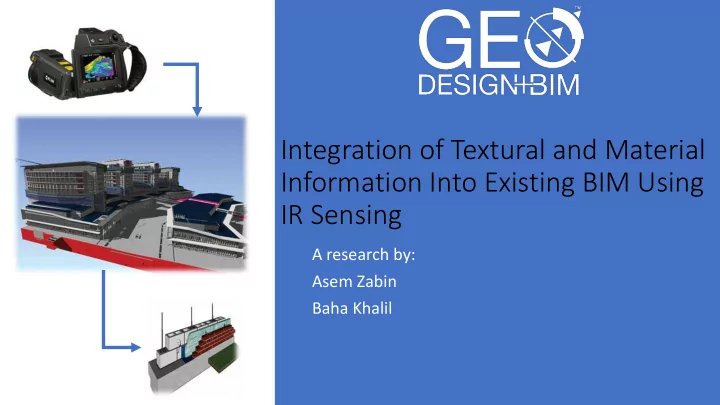
Integration of Textural and Material Information Into Existing BIM Using IR Sensing

A research by: Asem Zabin Baha Khalil

slide-2
SLIDE 2

Presenters Background

Asem Zabin

  • Senior BIM Engineer at iTech Management Consultancy
  • Master of Science in Civil Engineering (MSCE)
  • Winner of the BIM For Innovation Award for

Hyperloop Competition Area of interests: BIM for Infrastructure, Satellite Remote Sensing, As-Built BIM, BIM for FM, Post-construction BIM analysis

Baha Khalil

  • Data Scientist at Unilever
  • Master of Science in Mathematics

Area of interests: Convex optimization, Neural networks

slide-3
SLIDE 3

Contents

Problem statement IR Camera Texture analysis Math + case study Q&A

slide-4
SLIDE 4

The Problem…

Why do we need As- built BIM ?

1

As-built BIM is now done using laser scanners.

  • Limitations:
  • laser scanners are limited

(Only geometry is identified)

2

Surface Materials? Texture Homogeneity?

3

Solution

  • A Semi-automated method

that is able to identify an unknown material and texture and then integrate it with BIM.

4

slide-5
SLIDE 5
  • Definition:
  • Set of drawing and documents submitted by a

contractor upon completion of a project or a particular job.

  • Reflect all changes made in the specifications and

working drawings during the construction process.

  • Show the exact dimensions, geometry, and location of

all elements of the work completed under the contract.

  • Also known as “record drawings” or “as is”.
  • Applications

Introduction As-Built

slide-6
SLIDE 6

Problem Statement

As-Built Drawings

  • Rolls of drawings from the architect and engineers
  • Folders of equipment information for each type of

equipment

  • 2D CAD Files
slide-7
SLIDE 7

Current Data Acquisition Methods

  • Use of Barcodes in Construction to extract location

information of objects

  • Radio Frequency Identification (RFID) tags
  • Laser Scanners or Light Detection And Ranging

(LiDAR)

  • Photogrammetry
slide-8
SLIDE 8

Remote Sensing, Infrared (IR)

  • Remote Sensing is the science and art of capturing

information about objects, areas, or a phenomenon through the analysis of data acquired by device that is not in physical contact with the object, area or the phenomenon.

  • Infrared (IR) sensing is a form of remote sensing

that employs electromagnetic radiations (EMR) between the visible and microwave radiations in the wavelength range from 700 nanometer at the edge of the red to about 1 mm.

slide-9
SLIDE 9

Thermal IR Camera

  • Advantages in Construction:
  • It’s contactless, therefore nondestructive and

reactionless.

  • It can be used to measure objects in very hot and

difficult-to-access areas.

  • It allows for rapid data acquisition.
  • It measures the temperature of a solid-state body

surface not the surrounding atmosphere.

slide-10
SLIDE 10

Texture

  • Image texture is the frequency of tonal

change of an image

  • Smoothness
  • Coarseness
  • Heterogeneity of classes
  • Contrast
  • Uniformity
slide-11
SLIDE 11

Texture Extraction

Over the past decade, multiple striving efforts have been made to make computers acquire, understand, index, and interpret images expressing a wide variety

  • f concepts, with much progress

The objective is to retrieve texture with high accuracy utilizing the least complicated computational approaches. A main form of image processing is image classification, which means segmenting the image into homogeneous zones and labeling the resulted zones with distinct class labels.

Previous Researches

slide-12
SLIDE 12

Previous Researches

Edge Detection Machine Learning

slide-13
SLIDE 13

Objectives

  • Extract material and textural information of an

existing building interior walls using a thermal infrared camera.

  • Develop a framework for representing,
  • rganizing, and integrating the acquired material

and textural data into the BIM.

  • Perform basic analysis on the rich BIM after

integrating the new information to explore the advantages and limitations of the study for the industry.

slide-14
SLIDE 14

Methodology

1.Take the picture of the unknown structure 2.Feed the image to the code 3.Algorithm will identify the materials in the provided images

slide-15
SLIDE 15

Methodology

slide-16
SLIDE 16

Materials Identification

slide-17
SLIDE 17

Texture Identification

slide-18
SLIDE 18

Material and Texture Identification Using Gaussian Mixture Models (GMM)

slide-19
SLIDE 19

Material and Texture Identification Using Gaussian Mixture Models (GMM)

Normalized Radiance Values of Different Walls Materials

slide-20
SLIDE 20

Material and Texture Identification Using Gaussian Mixture Models (GMM)

Gaussian Mixture Models (GMM) for Concrete & Gypsum board

slide-21
SLIDE 21

Data Acquisition (Gypsum Board)

slide-22
SLIDE 22

Data Acquisition (Concrete)

slide-23
SLIDE 23

Data Acquisition (Concrete)

slide-24
SLIDE 24

Feature Extraction

An algorithm which automatically extracts textural information was developed and applied, needed for identification of the walls. This texture segmentation algorithm splits the image into different homogeneous texture regions

slide-25
SLIDE 25

Exploration

slide-26
SLIDE 26
  • Monte Carlo Simulation is a modeling and simulating technique that generates

several scenarios and gathers relevant statistics in order to assess relationship between the variable in question and a model of interest.

  • This method is often used when the model is nonlinear, or involves more than

just a couple uncertain parameters.

Bell-shape distribution of Radiance values

In each scenario, different means and standard deviations were simulated and the relationship between them was noted.

Materials & Methodology

Data Analysis: Monte Carlo Simulation

slide-27
SLIDE 27

Results Data Integration in BIM

slide-28
SLIDE 28

Results Data Integration in BIM

slide-29
SLIDE 29

Results Data Integration in BIM

slide-30
SLIDE 30

Results Data Integration in BIM

slide-31
SLIDE 31

Results Data Integration in BIM

slide-32
SLIDE 32

Results Data Integration in BIM

slide-33
SLIDE 33

Conclusions

Thermal Image Acquisition State of Art Artificial Intelligence

  • Feature Extraction (Interior Walls)
  • Data Analysis
  • Testing and Validation

Integration with BIM Model

The proposed method used thermal infrared sensing to capture thermal images of the interior walls of an existing building. These images were then processed, and only wall features were extracted using a texture feature extraction algorithm. The resulted sub-images were then transformed into temperature values at each pixel of the interior walls.

slide-34
SLIDE 34

Conclusions

A statistical correlations between the mean and standard deviation of interior gypsum and concrete were

  • btained through a Monte Carlo simulation approach.

The extracted texture and material information were then integrated in the BIM Model.

Thermal Image Acquisition State of Art Artificial Intelligence

  • Feature Extraction (Interior Walls)
  • Data Analysis
  • Testing and Validation

Integration with BIM Model

slide-35
SLIDE 35

Texture Rich BIM models can be used in LIVE assessment of building conditions in relation to energy efficiency and water and waste systems leaks.

Conclusions