
SLIDE 1
RFID LABELS
2506
PROTECTION- CONTROL- IDENTIFICATION– TRACKING
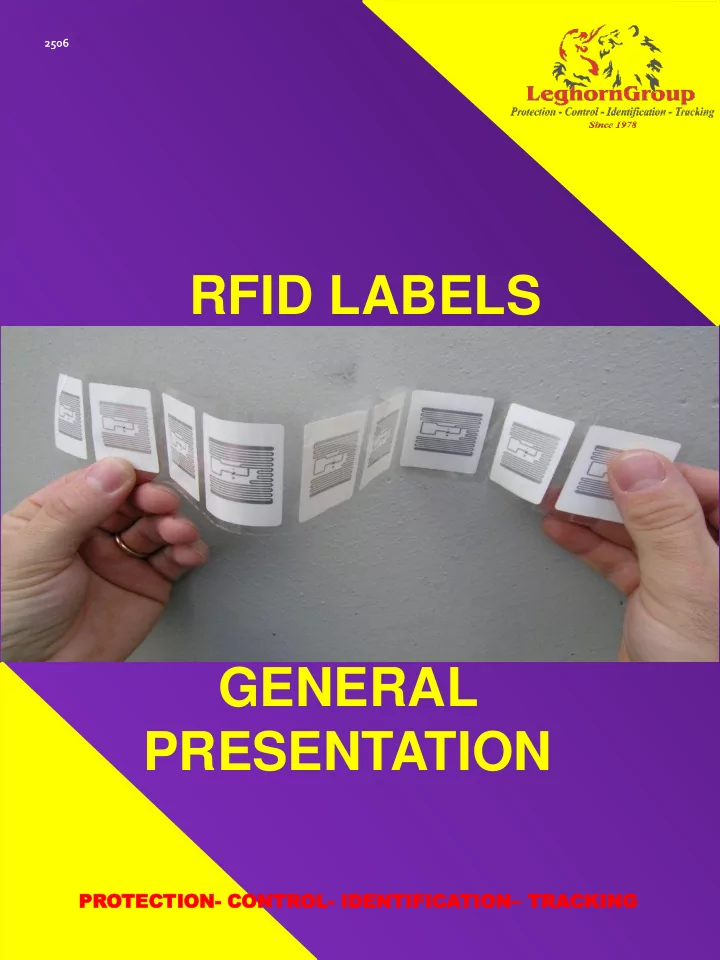
GENERAL PRESENTATION PROTECTION- CONTROL- IDENTIFICATION TRACKING - - PDF document
2506 RFID LABELS GENERAL PRESENTATION PROTECTION- CONTROL- IDENTIFICATION TRACKING 2506 RFID LABELS 02 What they are 1/2 RFID labels are based on a Radio Frequency Identification technology. This technology allows to uniquely
2506
PROTECTION- CONTROL- IDENTIFICATION– TRACKING
RFID LABELS What they are 1/2
02
RFID labels are based on a Radio Frequency Identification technology. This technology allows to uniquely identify any objects
labels have been attached. Basically, RFID labels allow to have the information
a particular product, thanks to a radio frequency detector (reader). Therefore, using RFID labels, several activities can be done:
2506
34/36, Via degli Arrotini - 57121 Livorno Tuscany Italy Ph: +39 0586 406376 - Fax:+39 0586 407621
www.leghorngroup.it - info@leghorngroup.it
03
Thanks to this technology, several uses have been developed such as the identification or the control of the livestock living in animal preserves. But also in the automation of the automobile industry, including the identification of car keys. RFID labels have also been fully used as security tags in the clothing sector. RFID labels offer the following advantages :
All this translates into a considerable saving of time and therefore of money. RFID technology requires 3 components : a tag (for example: label), a reader and a management system.
RFID LABELS What they are 2/2
2506
34/36, Via degli Arrotini - 57121 Livorno Tuscany Italy Ph: +39 0586 406376 - Fax:+39 0586 407621
www.leghorngroup.it - info@leghorngroup.it
04 WHAT DOES A RFID PASSIVE LABEL LOOK LIKE?(or tag)
The main elements of a RFID label are: Circuit. Antenna. Support. The circuit (or chip) includes the data storage on which the following data are registered :
The antenna receives the radio communication from the Reader and launch the tagged electromagnetic signal, converted into electricity, to the chip, allowing its activation. The chip sends its response to the interrogation and sends it again to the Reader. The support is basically the material on which the chip and the antenna are assembled and it can be made of several materials :
2506
34/36, Via degli Arrotini - 57121 Livorno Tuscany Italy Ph: +39 0586 406376 - Fax:+39 0586 407621
www.leghorngroup.it - info@leghorngroup.it
ANTENNA CHIP SUPPORT
05 HOW DOES A RFID PASSIVE LABEL WORK? (or tag)
A RFID system is composed of a tag, whose chip includes the data, an antenna, to communicate with the tag and a reader (or controller) which, thanks to the communication signal, reads the ID of the tag and writes the data storage, sending the signal to the host (PC). A RFID system can work at low frequency ( LF), high frequency ( HF) or very high/ultra high frequency (VHF e UHF). This identification occurs through radio frequency, thanks to which a reader is able to communicate and/or update the information in the tag that is interrogating; Indeed, despite its name, not only is the reader able to read, but also to write information. RFID devices can in a way be treated as wireless readers and writers with multiple
Communication, 13,56 MHz up to10 cm, but with a data rate up to 424 kbit/s) which extends the standards to allow the information exchange among readers.
2506
34/36, Via degli Arrotini - 57121 Livorno Tuscany Italy Ph: +39 0586 406376 - Fax:+39 0586 407621
www.leghorngroup.it - info@leghorngroup.it
ANTENNA
CHIP SUPPORT
06 COMMUNICATION BETWEEN RFID LABELS (TAG) AND READER.
RFID labels (tag) are associated to several objects through radio frequency systems. The RFID label (tag) becomes active once the electromagnetic field of the Reader reaches it and sends, through its antenna, all the information in its data storage, according to the object to which it has been attached. The data storage of RFID label has normally a unique identification of the
2506
34/36, Via degli Arrotini - 57121 Livorno Tuscany Italy Ph: +39 0586 406376 - Fax:+39 0586 407621
www.leghorngroup.it - info@leghorngroup.it
07 RFID READERS.
The Reader is a transceiver, which is connected to a management system and is able to read the information provided in the RFID labels. Readers can be fixed or mobile. Fixed Readers are for example those positioned at the entrance of a shop that read the security tags or the smart card readers, while those mobile look like bar code readers.
2506
34/36, Via degli Arrotini - 57121 Livorno Tuscany Italy Ph: +39 0586 406376 - Fax:+39 0586 407621
www.leghorngroup.it - info@leghorngroup.it
08 RFID LABELS ADVANTAGES
There are several advantages using RFID labels. RFID labels (TAG) are easily able to recognise goods thanks to a non-contact communication, enabling a control of the goods from a safety point of view, a fast filling and inventory
Moreover, information on the products are easily inserted and managed, which allows time savings in terms
reading the products and it avoids managements errors.
2506
34/36, Via degli Arrotini - 57121 Livorno Tuscany Italy Ph: +39 0586 406376 - Fax:+39 0586 407621
www.leghorngroup.it - info@leghorngroup.it
09 MAIN FIELDS OF APPLICATION OF RFID LABELS (1/3) LOGISTIC FIELD
In the logistic sector they have a range of purposes such as the tracking of the product. The goods control, shipping and delivery. The identification
the single item and the inventory. In the transport security, RFID labels may be supplemented by traditional seals, thus becoming a very effective control system against tampering.
2506
34/36, Via degli Arrotini - 57121 Livorno Tuscany Italy Ph: +39 0586 406376 - Fax:+39 0586 407621
www.leghorngroup.it - info@leghorngroup.it
10 MAIN FIELDS OF APPLICATION OF RFID LABELS (2/3) RETAIL
In the retail sector, RFID labels allow a quick management of the item in the shop. They make the inventory fast. They simplify any goods relocation in the store. They authorise discounts and price managements. They also have a security tag function with suitable readers both at the exit of the shop and at the changing rooms.
2506
34/36, Via degli Arrotini - 57121 Livorno Tuscany Italy Ph: +39 0586 406376 - Fax:+39 0586 407621
www.leghorngroup.it - info@leghorngroup.it
11 MAIN FIELDS OF APPLICATION OF RFID LABELS (3/3) WELL-BEING
The RFID labels, used in the hospital sector, allow to manage patients without the risk
incurring in medication errors. The RFID labels, used in the hospitality sector, allow to easily manage linens by reducing loss and theft.
2506
34/36, Via degli Arrotini - 57121 Livorno Tuscany Italy Ph: +39 0586 406376 - Fax:+39 0586 407621
www.leghorngroup.it - info@leghorngroup.it
12 TECHNICAL DATA FREQUENCY OF DATA TRANSMITION
There are different types of transponder frequency of Readers, according to the reference TAG. LOW FREQUENCIES (LF) 120:145 kHz, is a low frequency band. It is worldwide. HIGH FREQUENCIES (HF) 13,56 MHz, is a high frequency band, universally known as the most widespread band. ULTRA HIGH FREQUENCIES (UHF) according to the different area, Europe, Asia and America, it has a different set of parameters. It has a higher operational range compared to a HF and a LF. Moreover, it allows the TAG miniaturisation. Indeed, the higher the frequency of transmission is, the faster the data transfer will be. Consequently, the antenna will be smaller and therefore also the tag.
2506
34/36, Via degli Arrotini - 57121 Livorno Tuscany Italy Ph: +39 0586 406376 - Fax:+39 0586 407621
www.leghorngroup.it - info@leghorngroup.it
13 CONCLUSION
All the RFID labels
LeghornGroup allow the scanning
thousands
goods in a very short time thanks to the UHF frequency. Moreover, we can provide different types of support, also upon customer request, in
to best manage their products and their shipments. We boast a twenty years of experience in the use of RFID tags and we are absolutely able to solve tracking, identification and security problems.
2506
34/36, Via degli Arrotini - 57121 Livorno Tuscany Italy Ph: +39 0586 406376 - Fax:+39 0586 407621
www.leghorngroup.it - info@leghorngroup.it
General e-mail: info@leghorngroup.com
LeghornGroup srl
34/36, Via degli Arrotini - 57121 Livorno, Tuscany, Italy Ph: +39 0586 406376 - Fax:+39 0586 407621 – www.leghorngroup.com - info@leghorngroup.com
LeghornGroup ITALY
www.leghorngroup.it
LeghornGroup USA
www.leghorngroup.com
LeghornGroup BELGIUM
www.leghorngroup.be www.leghorngroup. nl
LeghornGroup SAUDI ARABIA
www.leghorngroup.sa
LeghornGroup CZECH rEP .
www.leghorngroup.cz www.leghorngroup.pl
LeghornGroup GREECE
www.leghorngroup.gr
LeghornGroup MOLDOVA
www.leghorngroup.ro
LeghornGroup SPAIN
www.leghorngroup.es
1004
14
PROTEZIONE - CONTROLLO - IDENTIFICAZIONE – TRACCIABILITA’