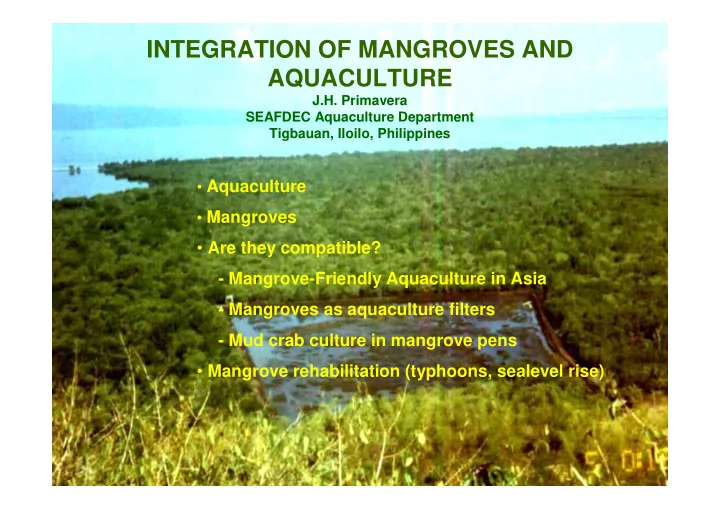
SLIDE 1 INTEGRATION OF MANGROVES AND AQUACULTURE
J.H. Primavera SEAFDEC Aquaculture Department Tigbauan, Iloilo, Philippines
- Aquaculture
- Mangroves
- Are they compatible?
- Mangrove-Friendly Aquaculture in Asia
- Mangroves as aquaculture filters
- Mud crab culture in mangrove pens
- Mangrove rehabilitation (typhoons, sealevel rise)
SLIDE 2
fixed bottom
- !" #!$ %!
- &$%!
- polyculture,
carps, catfish pens intensive
SLIDE 3
SLIDE 5 !
(85.9 million mt, US$66.7 billion)
/012+,0/3 450253
780-217073 +808281063 +10928,0+3 Source: FAO Yearbook 2006
SLIDE 6
Philippine fisheries production
World Aquaculture Production 1950s: 1 Mmt 2006: 67 Mmt (42% total fisheries prod.)
SLIDE 7
5( " # $ % & ' ( ') * + , - . / 0
SLIDE 8
(5 (' 868:;9,,<,,, 867,;-8<,,, 8667;8+,<,,, 8667;+1+<,,,
MANGROVE: POND RATIO ,09;8
(5 (' 868:;9,,<,,, 867,;-8<,,, 8667;8+,<,,, 8667;+1+<,,,
MANGROVE: POND RATIO ,09;8
PHILIPPINES
SLIDE 9 '1 '
&3 4+
&*3333 (*($"33 &$6(*
,($(33 $*6&$
",3.33 (36/3 7 $33333 $,("33 *36.3 8 $33333 $*$(33
/"(333 ,&".*33
,* &*
- SE ASIAN MANGROVES & SHRIMP CULTURE
(=25! 0<+,,83 *(2
&*2 ":/3 *$2
(*
8-?8:@A 80+9%!!
SLIDE 10
*(B'= 1975 1989
SLIDE 11
North Bais Bay, Negros Or., Philippines (Walters, 1996)
1950 1950
1996 1996
Rio Chone Delta, Ecuador (Redmanglar SNF)
SLIDE 12
Carbine (1932): “Mangrove … swamps are ideal for fishpond sites. Most of [these] are removed … only a few should be left for shade” Carbine (1948): “… the bangos [milkfish] industry is important because it made use of … practically valueless [mangrove] land.” Ling (1977): “Aquaculture has … served to reclaim largely unproductive land.Thousands of hectares of mangrove swamps … have been converted into productive fishponds …”
SLIDE 13
BIOGEOGRAPHICAL DISTRIBUTION OF MANGROVES (Duke, 1994) AND PRAWNS (Chong et al., 1996)
SLIDE 14
SLIDE 15
MANGROVE-FISHERIES CONNECTION
SLIDE 16
SLIDE 17 %&
!!"" !$*& " +,*&#$%&
#
'3$$)04
SLIDE 18
/&* 5 1' 66!
SLIDE 19
# C0@A
8+?+7 8+?+7
!
8?9 8?9
A!
8+ 8+
SLIDE 20
Nutrients in effluents drained into natural mangrove stand
SLIDE 21 ;× 9 <#&< 8 7$= ;" 393/3× .3(33> *,&$9333 ">, ;$ 39$&. × &*$33> /&&39,,.
<?&< 8 ;" 39.&&× .3(33> *",$,9,,. ;$ 39$&& × &*$33> /$"&9&&&
+6<6+,0111@(1? 7< ,:/"9&&&<#&< @$::$39333 <?&< 1-<6,80111@0 &,:3"9&&&9< ÷ &$3 $ %- 889018/@0+ @
A%23%%!!@A
SLIDE 22 ' () # *+%,-,"./
+#(, , #(+ (6#(6 #,,
1!1()2 3,*,
!,!! "4 " /(
!,!/kg feed/kg shrimp/d (8+kg shrimp/ha mng &*501,375 kg @ 20 g = 68,750 pcs/ha
(harvest) @ 30 g = 45,833 pcs/ha
2!2,/ 4,27 '!/,'1 1, /
A%!%%"@A
Rate × water vol. 0.158 NH3-N mg/L/d = 6,981 mg NH3-N/d (1 d = 6 h) 0.483 NO3-N mg/L/d = 29,920 mg NO3- N/d Impounded Mangrove (area) 36,902 mg tot. N/d ÷ 320 m2 = 115.3 mg tot. N/m2 mng/d
++7,/
SLIDE 23 $9:,9* "9($9$ % '9 7 ,9( ,9( '9 A 9 "::. $9/ $9( '9 $"9. .9$" % ;B 0"::* .9/$ /9:, % 4 B "::*
!23
@A;!!% !A!%%
SLIDE 24
97 668
SLIDE 25 Summary & Conclusions
- passing pond effluents through mangroves reduced nutrient
levels (in day but not night)
- reduced nutrients due to biol. transformation (plant uptake,
denitrif.), rather than physical dilution (nighttime increases) or tidal flushing
- nutrient removal function of mangroves supports paradigm
shift for aquaculture to clean up effluents before release
- mangrove: pond ratio for effluent processing: 2-9:1 for N,
2-22:1 for P
- implications for Philippines: compliance with national laws:
greenbelt (20-, 50- and 100-m) and mangrove rehabilitation
- f abandoned ponds
- need to reverse present 0.5 ha mangrove: 1 ha pond ratio in
the Philippines
SLIDE 26
"!@A "!@A
SLIDE 27 2.6 3.6 Payback period (years) 38.5 % 27.5% Return on investment 83.90 Negative Net return yr-1 (2 crops) 41.95 Negative Net returns crop-1 7,033.89 5,018.88 Net cash return yr-1 (2 crops) 3,516.95 2,509.44 Net cash return crop-1 24,425.23 23,171.01 Total operating cost run-1 3,475.00 3,475.00 Sub-total 1,500.00 1,5,00.00 Caretaker’s salary 1,975.00 1,975.00
Non-cash costs:
Depreciation 24,467.18 22,205.45 Revenue Total Value (PhP)a Total Value (PhP)a Item 82 kg 164 kg 74 kg 148 kg Production: 1 crop 2 crops 252 g 211 g Corresponding body weight (Table 5) 37.2% 40.4%[ Survival rate (Table 5) Pellets + Fish Biomass Fish Biomass Production data
Cost and return analysis for 1000 m2 mud crab Scylla serrata pens using two feeding treatments.
SLIDE 28 0.59 0.45 0.52
Shannon Index
13.5 13.9 8.05 7.07
Total
7.8 8.2 6.45 5.96
Trees
3.9 39.6 1.41 1.01
Saplings
1.8 90.0 0.19 0.10
Seedlings Basal area (m2 per ha)
104,633 70.3 15,950 9,368
Total
1,267 37.1 1,600 1,167
Trees
12,533 39.9 5,003 3,216
Saplings
90,833 97.6 9,850 4,984
Seedlings Stems/ha Jan 2004 % change Jan 2004 May 2002 Control Pens
Impacts of crab pen culture on mangrove community structure in Zarraga, Aklan, central Philippines.
SLIDE 29 Conclusions
- Incomplete, low-cost pellets can replace fish requirement in
mud crab diets
- Economic analysis showed viability of crab culture in
mangrove pens using fish biomass + pellets to reduce requirement for (low-value) fish, a food item of poor coastal communities
- Presence of crabs results in fewer mangrove seedlings and
saplings, but did not affect trees
SLIDE 30 Code of Practice for Sustainable Use of Mangrove Ecosystems for Aquaculture in Southeast Asia
@ !
C ! C !
SLIDE 31
IFS – small-scale, labor intensive
SLIDE 32 Mangrove conservation in Iloilo and Aklan provinces thru --
- education
- local governance
SLIDE 33
Mangrove Instructional Materials Production for Elementary Level
Module Writers - Purita P. Bilbao, Crisanto Lopez, Jr., Ruth L. Gelvezon, Marievic M. Violeta
Module 1. Starting a Walk to the Mangroves Module 2. Mangroves: Forests Growing by the Sea Module 3. Mangroves: Take a Closer Look Module 4. Mangroves: Our Natural Treasure Traditional uses (Forestry/ Fishery Products) Services Ecological Benefits Social Benefits Values Derived Medicine Wildlife Habitat