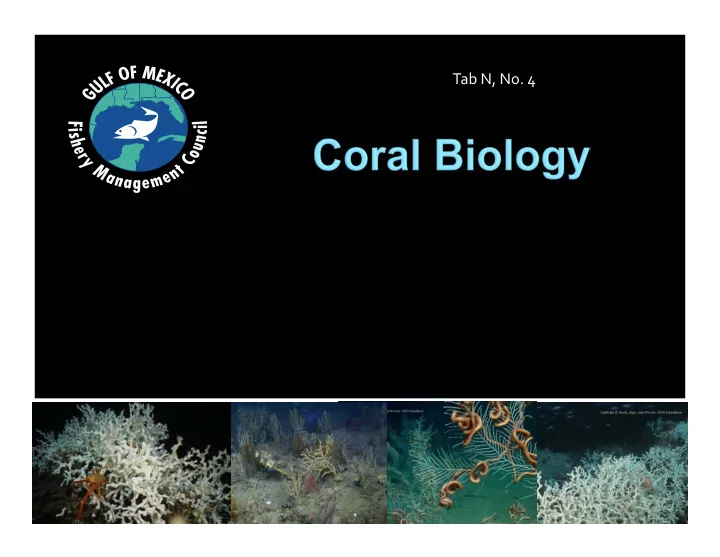
Tab N, No. 4 Shallow Deep LIGHT! No light! Low nutrient- Low - - PowerPoint PPT Presentation

tab n no 4 shallow deep light no light low nutrient low
SMART_READER_LITE
LIVE PREVIEW

Tab N, No. 4 Shallow Deep LIGHT! No light! Low nutrient- Low - - PowerPoint PPT Presentation

Tab N, No. 4 Shallow Deep LIGHT! No light! Low nutrient- Low nutrient zooxanthellae Slow growing Dynamic (generally) environment Static environment Temp, salinity, etc. dark, low oxygen, cold 5-12


slide-1
SLIDE 1

Tab N, No. 4

slide-2
SLIDE 2

Shallow

 LIGHT!  Low nutrient-

zooxanthellae

 Dynamic

environment

  • Temp, salinity, etc.
  • Human forces

Deep

 No light!  Low nutrient  Slow growing

(generally)

 Static environment

  • dark, low oxygen, cold

5-12°

  • High susceptibility
slide-3
SLIDE 3

 Twilight zone  Low light  Edge habitat between shallow water corals and

deep corals

 FGBNMS

NOAA OE

slide-4
SLIDE 4

 ~80 species in the GOM database (not all

deep)

 Reef building  May be solitary

slide-5
SLIDE 5

Image courtesy E. Cordes

slide-6
SLIDE 6

 ~50 species in the GOM database  Black skeleton  Both hard and soft substrates

slide-7
SLIDE 7

 > 145 species in the GOM database  Not in the FMU  Soft sediment/hard substrate

slide-8
SLIDE 8

 What is it?  Why do organisms need it?  What do corals do?

slide-9
SLIDE 9

 Catsharks  Golden crabs  Snowy grouper  Blackbelly rose fish

And more!

Image courtesy E. Cordes

slide-10
SLIDE 10

Golden crab fishery

Courtesy of S. Brooke

slide-11
SLIDE 11

 Pharmaceuticals- Coral

reef associated species (esp. sponges)

 Ages- black, stony,

  • ctocoral

 Increase in the number

  • f cruises (one

scheduled for 2017!)

 Challenges to studying

the Deep

  • $$

2015

  • http://oceanexplorer.noaa.gov/exploratio

ns/15pulleyridge/welcome.html

  • http://oceanexplorer.noaa.gov/exploratio

ns/15biolum/welcome.html

  • http://oceanexplorer.noaa.gov/exploratio

ns/15nautilus/welcome.html

2014

  • http://oceanexplorer.noaa.gov/exploratio

ns/14pulleyridge/welcome.html

  • http://oceanexplorer.noaa.gov/okeanos/

explorations/ex1402/welcome.html

  • http://oceanexplorer.noaa.gov/exploratio

ns/14nautilus/welcome.html

  • http://oceanexplorer.noaa.gov/okeanos/

explorations/ex1403/welcome.html

slide-12
SLIDE 12
slide-13
SLIDE 13

 Developed by NOAA  When ground-truthed, held up in NEA  http://noaa.maps.arcgis.com/apps/webappviewer/index.

html?id=99832718e8aa46c9a1b203578613341e

slide-14
SLIDE 14

West Florida Slope

Courtesy of S. Brooke

slide-15
SLIDE 15

Northern GOM

Courtesy of S. Brooke

slide-16
SLIDE 16

 Mesophotic

C t f NOAA

slide-17
SLIDE 17

https://youtu.be/VpKAOHQV2JE

slide-18
SLIDE 18

Photos from: South Texas Banks Expedition (Schmidt Ocean Institute)

slide-19
SLIDE 19

Images courtesy of E. Cordes

slide-20
SLIDE 20
  • Online mapping for review, discussion,

and decision making

  • Improved access to the ‘data’

supporting management decisions

  • Explore distribution and diversity

patterns of corals in the Gulf of Mexico

  • GIS data download capabilities
  • View individual coral record

information (Name, Species, Depth, and Source)

Coral portal website: http://portal.gulfcouncil.org/