Integrating the Meihana Model when training and completing interRAI - - PowerPoint PPT Presentation

integrating the meihana model when training and
SMART_READER_LITE
LIVE PREVIEW

Integrating the Meihana Model when training and completing interRAI - - PowerPoint PPT Presentation

Integrating the Meihana Model when training and completing interRAI assessments Ashleigh Wiley, interRAI Educator Image: www.rowyourwaka.co.nz What is interRAI? What is Meihana Model? Importance of cultural conversation Using the


slide-1
SLIDE 1

Ashleigh Wiley, interRAI Educator

Integrating the Meihana Model when training and completing interRAI assessments

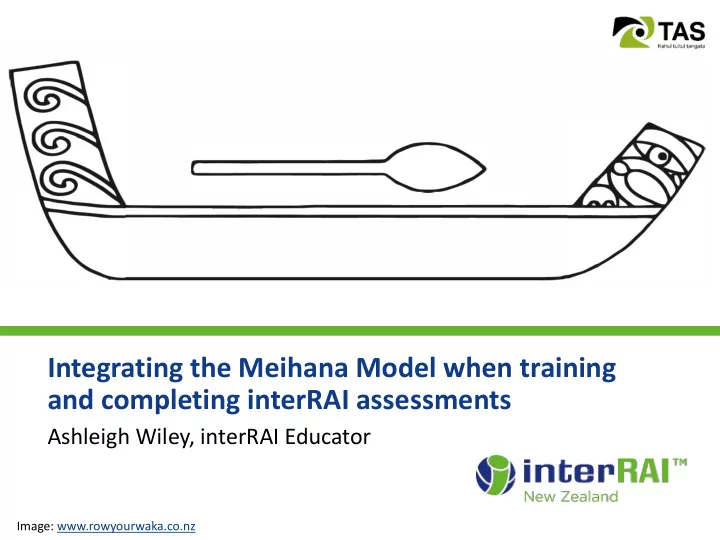
Image: www.rowyourwaka.co.nz
slide-2
SLIDE 2
  • What is interRAI?
  • What is Meihana Model?
  • Importance of cultural conversation
  • Using the Meihana model with interRAI – components of the model

2

slide-3
SLIDE 3

What is interRAI?

3

Comprehensive clinical assessment tools International best practice Used in all 20 DHBs for home care needs assessment Aged residential care facilities Over 100,000 assessments per year

slide-4
SLIDE 4

How does the model help us train and understand health/needs of Māori?

Achieve Hauora Access to health for all Training – Cultural conversation Components

  • f

interactions Factors affecting the voyage to Hauora

4

slide-5
SLIDE 5

Importance of cultural conversation

  • Address health inequalities – improve service delivery for Māori

patients and whānau

  • Scope of practice
  • Use of the Hui process to complete the Kaupapa element during

clinical interaction

  • Culture is a determinant of health

5

slide-6
SLIDE 6

Non-Māori/Māori comparison

6

slide-7
SLIDE 7

The Meihana model

7

slide-8
SLIDE 8

Components of the Meihana Model

8

Patient: Patient identifying as Māori with ethnicity correctly confirmed

  • Often inaccurately recorded
  • All patients should be asked their ethnicity and

have this reviewed over time

  • Cultural safety/competency

Whānau: Support network available to the client

  • Often feel excluded
  • Inclusion important in gathering history and

understanding symptoms and impact on patient/whānau

  • Assess Whānau understanding of the condition,

prognosis, and their expectations around management

slide-9
SLIDE 9

9

Tīnana: Physical health and Functioning of the patient

  • Encourages to assess past and current

functioning to clearly understand the physical status of the patient

  • Considers symptoms, treatments, exercise, diet,

physical exam and substance use

Hinengaro: Emotional and psychological wellbeing of the patient

  • Assessment needs to evaluate psychological

wellbeing

  • Explore the patients perception of their

condition and impact this has on their wellbeing

slide-10
SLIDE 10

10

Wairua: Beliefs regarding connectedness and Spirituality

  • Explore attachments to people, places and taonga – treasured

items

  • Allow a conversation about religion, death and dying
  • A lack of connectedness may be a key risk factor for depression

Taiao: Physical environment of the patient/whānau

  • Home environment- physical and interpersonal

spaces promote privacy and dignity, for example, areas for support networks to attend

  • Are there potential barriers to access the service

like car parking, Māori friendly environment?

slide-11
SLIDE 11

11

Iwi Katoa: Health services and systems that provide patient/whānau support

  • Identify whether the patient/whānau have had

appropriate access to services/systems

  • Exploring current enablers/barriers to access

services helps towards planning care

slide-12
SLIDE 12

12

Factors affecting the journey

slide-13
SLIDE 13

13

Nga hau e wha

(Four winds) Signify the societal/historical influences on Māori

  • Colonisation
  • Racism
  • Migration
  • Marginalisation

Nga Roma Moana

(Ocean Currents) Represent components of the Māori world view

  • Ahua – Way other people see you
  • Tikanga – Maori Culture principles
  • Whānau – Relationships within Maori

world

  • Whenua – Genealogy and connection

to land

slide-14
SLIDE 14

Want to know more?

  • For further information on Te Whare Tapa Whā: Ministry of Health website
  • For further reading on the Meihana Model: Waikare o te Waka o Meihana and

Meihana Model: A clinical Assessment Framework

  • For more information on the Meihana Model: lecture presented by Suzanne

Pitama

  • To practice your pronunciation: Waikato University website which has audio to

help you with pronunciation

  • To increase your Māori vocabulary you can sign up to receive a daily word from

Kupu o te Ra

14

slide-15
SLIDE 15

15

He waka eke noa

We are all on the canoe, with no exception

Image: www.rowyourwaka.co.nz

slide-16
SLIDE 16

www.interrai.co.nz