
SLIDE 1
NEW ZEALAND
Aotearoa
1
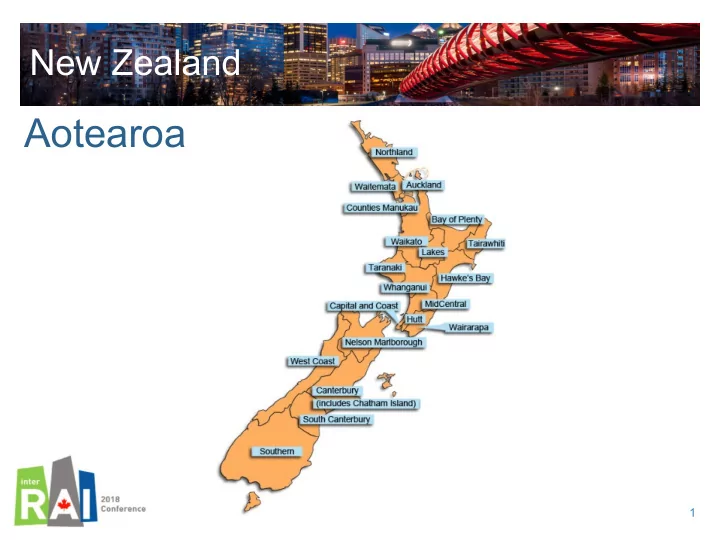
Aotearoa 1 Canadian interRAI Conference 2018 Linking a cultural - - PowerPoint PPT Presentation
New Zealand NEW ZEALAND Aotearoa 1 Canadian interRAI Conference 2018 Linking a cultural conversation with interRAI assessments, using the Meihana model Wellness for Life A Priority for All 3 The Meihana Model The Meihana Model helps
1
3
Acknowledgement Associate Professor Suzanne Pitama Māori/Indigenous Health Institute University of Otago, Christchurch Tel 03 364 3677 Email suzanne.pitama@otago.ac.nz
4
5
Copied with permission: Otago University, Māori Indigenous Health Institute (MIHI). NB: Must not be printed without permission Improving Maori health through clinical assessment: Waikare o te Waka o Meihana Pitama, Suzanne; Huria, Tania; Lacey, Cameron. The New Zealand Medical Journal (Online) The New Zealand Medical Journal (Online);; Christchurch Vol. 127,1393, (May 2, 2014): 107-19
6
7
reviewed over time
symptoms and impact on patient/whānau
their expectations around management
8
9
10
11
Customer Value Business processes Learning and growth
NGĀ TOHUTOHUNGA Guiding principles
Courage We step up, address difficult issues, saying what needs to be said Professionalism We do the job to the highest standard Integrity We gain confidence and trust through ethics, honesty and authenticity
Aroha ki te rawa kore provide support for those who are vulnerable
Aspiration We create new and better ways for success
We uphold the Treaty of Waitangi principles of: Partnership, Participation and Protection
NGĀ TOHUTOHUNGA Guiding principles Aroha ki te rawa kore provide support for those who are vulnerable We uphold the Treaty of Waitangi principles of: Partnership, Participation and Protection
Ministry of Health guiding documents Meihana Model of Clinical Assessment
Our Journey begins with the advice from the Māori Strategy Working Group
interRAI project 2008-2012
Framework for interRAI Assessment
Assessor competencies A cultural conversation National Standards Culturally appropriate assessment practices Culturally appropriate curriculum and delivery
Conceptual framework for the strategy
Waka – the comprehensive clinical assessment Rudder – interRAI Governance Board Oars – Partnership, Participation, Protection Sails – guiding documents In the waka are the interRAI Services team and resources
Review training materials and educator induction Train educators to train
Establish formal link to broker
for Māāori input and feedback Develop workforce cultural capability
Action Plan
2018/21
Guidance for assessors Improving connections Refresh training curriculum People and capability
NGĀ TOHUTOHUNGA Guiding principles
Courage We step up, address difficult issues, saying what needs to be said Professionalism We do the job to the highest standard
We gain confidence and trust through ethics, honesty and authenticity
Aroha ki te rawa kore provide support for those who are vulnerable
Aspiration We create new and better ways for success
We uphold the Treaty of Waitangi principles of: Partnership, Participation and Protection
NGĀ TOHUTOHUNGA Guiding principles Aroha ki te rawa kore provide support for those who are vulnerable We uphold the Treaty of Waitangi principles of: Partnership, Participation and Protection
We step up, address difficult issues, saying what needs to be said
We do the job to the highest standard
We create new and better ways for success
Guiding principles
Aroha ki te rawa kore provide support for those who are vulnerable We uphold the Treaty of Waitangi principles of: Partnership, Participation and Protection
Ministry of Health guiding documents Meihana Model of Clinical Assessment Our Journey begins with the advice from the Māori Strategy Working Group interRAI project 2008-2012
Framework for interRAI Assessment
assessment practices
curriculum and delivery Conceptual framework for the strategy
clinical assessment
Governance Board
Participation, Protection
Services team and resources
Review training materials and educator induction Train educators to train
Establish formal link to broker
for Māori input and feedback Develop workforce cultural capability
Guidance for assessors Improving connections Refresh training curriculum People and capability
16