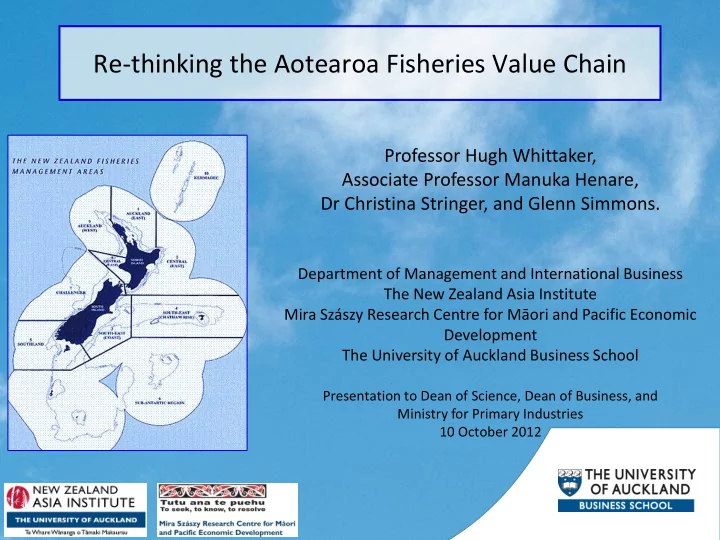
Re-thinking the Aotearoa Fisheries Value Chain Professor Hugh - - PowerPoint PPT Presentation

re thinking the aotearoa fisheries value chain
SMART_READER_LITE
LIVE PREVIEW

Re-thinking the Aotearoa Fisheries Value Chain Professor Hugh - - PowerPoint PPT Presentation

Re-thinking the Aotearoa Fisheries Value Chain Professor Hugh Whittaker, Associate Professor Manuka Henare, Dr Christina Stringer, and Glenn Simmons. Department of Management and International Business The New Zealand Asia Institute Mira


slide-1
SLIDE 1

Re-thinking the Aotearoa Fisheries Value Chain

Professor Hugh Whittaker, Associate Professor Manuka Henare, Dr Christina Stringer, and Glenn Simmons.

Department of Management and International Business The New Zealand Asia Institute Mira Szászy Research Centre for Māori and Pacific Economic Development The University of Auckland Business School

Presentation to Dean of Science, Dean of Business, and Ministry for Primary Industries 10 October 2012

slide-2
SLIDE 2
  • During the last 17 years outsourcing of fish processing has gained

unprecedented momentum – mainly head & gutted fish exported to China for further processing.

  • China has a competitive advantage in recovery and

throughput rates.

  • Processed value added products are then re-exported to key

markets e.g. E.U., Japan, USA.

  • “Outsourcing can be destructive to an economy because the

collective R&D, engineering, and manufacturing capabilities that sustain innovation are lost” (Pisano and Shih, 2009, p. 116).

Background

Stringer, C., Simmons, G. and Rees, E. (2011) Shifting post production patterns: exploring changes in New Zealand’s offshore processing, New Zealand Geographer, 67, 161–173.

slide-3
SLIDE 3

Where is the ‘value add‘ in exports?

NZD 0 NZD 100 NZD 200 NZD 300 NZD 400 NZD 500 NZD 600 Millions

Total Finfish exports 2011

Live (0.6%) Fresh or Chilled (15.5%) Frozen Whole, H&G, Dressed (50.1%) Frozen fillets (32.6%) Dried, salted or smoked (1.2%)

Source: Statistics New Zealand

slide-4
SLIDE 4

Liver and roe (7% of fish weight) roe retained by a few - mostly mealed/oil extracted or dumped Fillets (32% of fish weight) sold

“There is industry awarenesss of the potential to use the whole fish, some boutique players playing with some byproducts, but no proper commercialisation of the opportunities“ (pers. comm. 2012).

Heads (30% of fish weight) very little retained most mealed/oil extracted or dumped

Up to 70% of the fish is turned into low value fishmeal, some oil or wasted

Backbones (15% of fish weight) mealed/oil extracted or dumped Skin (6% of fish weight) mealed/oil extracted or dumped Guts mealed/oil extracted or dumped, some swim bladders dried but mostly mealed or dumped (5% of fish weight) Trimmings (5% of fish weight) minced block, mealed or dumped

slide-5
SLIDE 5

This is what dumping looks like

slide-6
SLIDE 6

Putting a figure on missed opportunity

*Does not include illegally dumped fish, estimated at between 79,000 and 197,000 tonnes 2011 Total Allowable Commercial Catch (TACC) = 631,787 tonnes Total marine landings = 435,000 tonnes Finfish landings = 394,000 tonnes* Finfish domestic sales = 39,000 tonnes Finfish waste 156,000 tonnes Finfish exports = 199,000 tonnes, $778.8m 197,000 tonnes of TACC not caught Includes 59,900 tonnes of fish waste exported (600,000 tonnes during past 10 years) 95,700 tonnes = 21,000 tonnes ($44m) of fishmeal. 2011 average export price for fishmeal was $NZ 2.10kg or $NZ 0.38kg greenweight.

(6th largest export by volume; 8th largest by value)

59,420 tonnes dumped at sea Fish waste if dried could have earned $NZ173.7 million in 2011 Over last 10 years 1.67 million tonnes of fish waste could have earned $NZ1.87 billion instead

  • f $370 million from fishmeal (if dried and

marketed as by Iceland)

Sources: Compiled and calculated from Ministry for Primary Industries and Statistics New Zealand data

slide-7
SLIDE 7

Super-Chilling technology introduced

New Zealand industry average EBITDA less than 10% whereas the Icelandic Industry average EBITDA is more than 30%. Iceland has been able to achieve a high average EBITDA through, for example:

  • Complete transparency
  • Independent auction system
  • A collective commitment to market led innovation

An alternative, value adding, approach

Superchilling technology introduced

slide-8
SLIDE 8

An Icelandic approach to fish waste

slide-9
SLIDE 9

Iceland utilises 96% of the fish

100% utilisation of liver and roe Development of own technology (superchilling) increased fillet yields by 10-15% Heads dried and sold to Nigeria

Nigeria buys dried heads for FOB US $5.50kg and frames/bones for US $2.50kg.

Gelatin extracted from skin and swim bladder for use in a wide range of food products Backbones dried and sold to Nigeria Guts dumped (4%) Trimmings are minced into fish Nuggets Swim bladder dried

slide-10
SLIDE 10

Enzymes from the gut used for cosmetics, hygiene and pharmaceutical products

Canned cod liver products

Pharmaceutical tissue and nerve-regeneration products Hand & foot creams for preventing and treating diabetic ulchers Enzymes used for natural fish flavourings Caviar and spreads Beauty collagens (anti-aging products)

Advanced derivates: aim to use 100% of the fish

Gelatin pharmaceutical capsules Cod liver oil Fish leather used by shoe & fashion industry

Source: (Sigfusson, 2012)

slide-11
SLIDE 11

By-products in 1992 were 1,667 tonnes, increasing to 47,782 tons by 2010

Creating new industries from marine by-products

slide-12
SLIDE 12

Increase real value from the resource by 20% per annum without increasing volume.

A business challenge for Aotearoa

“The real value of a limited resource is not intrinsic to the product itself, nor is it the current price. It is the latent demand

  • f narrow segments populated by rare products” (Prof. Ken Simmonds, 2006).
slide-13
SLIDE 13

Fisheries research funding

Source: Created from MBIE and MPI (2012) data

Research primarily targeted at ‘enhancing value’, but only one commercial operation to date. Aquaculture, $113,962,920, 42% Wild Capture, $118,494,477, 44% Mixed, $38,893,970, 14% Fisheries industry research funding 2000-2011

Total $271 million

Note: Does not include wild fisheries stock assessment funding

slide-14
SLIDE 14

$271m of fisheries research funding

Source: Created from MBIE and MPI (2012) data

Research almost entirely targeted at the production end (live end) of the value chain

$0 $10 $20 $30 $40 $50 $60 $70 $80 $90 $100 Millions

Fisheries industry research funding 2000-2011

$0 $10 $20 $30 $40 $50 $60 $70 $80 $90 Millions

Fisheries industry research funding 2000-2011 Note: Does not include stock assessment research funding.

slide-15
SLIDE 15

Fisheries research funding

Source: Created from MBIE and MPI (2012) data

Value Chain Sector Aquaculture Mixed Wild Capture Totals Wild Capture Resource $3,353,593 $62,333,578 $65,687,171 Wild Catching $560,000 $276,500 $836,500 Aquaculture Farming $82,383,270 $1,366,175 $83,749,445 Harvesting $12,751,515 $271,981 $30,212,603 $43,236,099 Primary Processing $18,030,103 $29,306,847 $25,373,692 $72,710,642 Final Product Processing $782,274 $4,023,610 $75,844 $4,881,728 Processing of Waste - By-products $34,425 $136,623 $171,048 Markets $12,000 $11,764 $54,970 $78,734 Totals $113,993,587 $38,893,970 $118,463,810 $271,351,367

slide-16
SLIDE 16

Impact of R&D on firm performance

Large firms

Experienced a -10.6% drop in labour productivity after three years And a -5.7% drop in multi factor productivity during approval year

Small firms

Experienced a 5-12.5% growth in employment A 20% increase in labour productivity after four years And a 22.5% increase in multi factor productivity after four years

Source: MED, 2011

“There is no doubt that a significant part of the recent evidence on the effectiveness of innovation polices is

  • disappointing. The fact that other countries are uncovering similar problems, particularly in regard to

programmes involving a “science-push” approach to commercialisation of innovation, is little consolation” (MED, 2011. Innovation Policies and Funding in New Zealand: How Effective Are They?).

slide-17
SLIDE 17

The University of Auckland Business School, the New Zealand Asia Institute and the Mira Szászy Research Centre for Māori and Pacific Island Development are committed to ongoing research and collaboration aimed at transforming our seafood industry along a ‘high road’ innovative and sustainable trajectory.

Thank you!