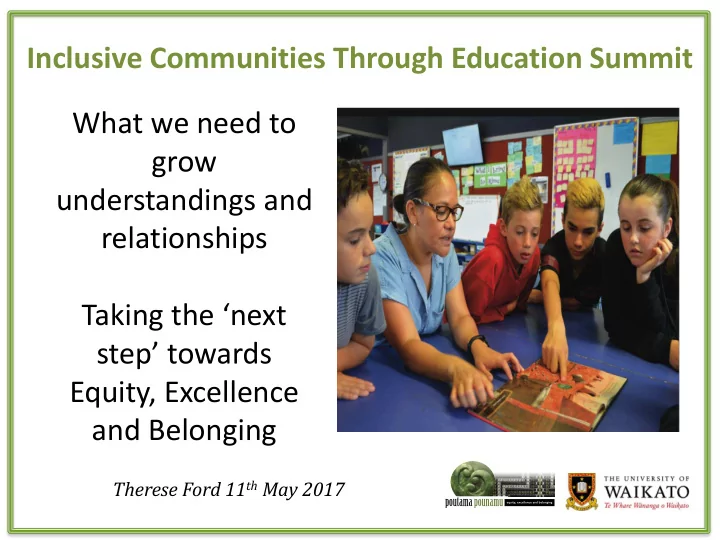
Inclusive Communities Through Education Summit What we need to grow - - PowerPoint PPT Presentation

inclusive communities through education summit
SMART_READER_LITE
LIVE PREVIEW

Inclusive Communities Through Education Summit What we need to grow - - PowerPoint PPT Presentation

Inclusive Communities Through Education Summit What we need to grow understandings and relationships Taking the next step towards Equity, Excellence and Belonging Therese Ford 11 th May 2017 The New Zealand Education Context The


slide-1
SLIDE 1

What we need to grow understandings and relationships Taking the ‘next step’ towards Equity, Excellence and Belonging Inclusive Communities Through Education Summit

Therese Ford 11th May 2017

slide-2
SLIDE 2

The New Zealand Education Context

Sir Professor Mason Durie

Kaupapa Māori

Māori worldview: Hui Taumata 2001 3 goals of education: to live as Māori, to experience good health and well being to contribute as global citizens

Kaupapa Māori Movement

Māori revitalization, for Māori

The Treaty of Waitangi

Partnership: Protection: Participation

slide-3
SLIDE 3

The New Zealand Education Context

Kaupapa Māori Research and Development

Policy effects across the system

Equity, Excellence and Belonging

Poutama Pounamu Maori Education Research Centre

Culturally Responsive Pedagogy of Relations: ETP Culturally Responsive and Relational Pedagogy

slide-4
SLIDE 4

A Culturally Responsive Pedagogy of Relations

  • Draws from metaphors found in kura kaupapa Māori (Smith, 1997) and the narratives of

experience of Māori students, their whānau, principals and teachers in Phase 1 of Te Kotahitanga (Bishop, Berryman, Tiakiwai and Richardson, 2001)

  • Represents a merger between of culturally responsive pedagogy described by Gay (2000) and

Villegas & Lucas (2002) and a pedagogy of relations described by Sidorkin (2002) and Cummins (1995).

  • Where power is shared between self-determining individuals within non-

dominating relations of interdependence;

  • where culture counts;
  • where learning is interactive, dialogic and spirals;
  • where participants are connected to one another; and
  • where there is a common vision for what constitutes excellence in educational
  • utcomes.

(Bishop, Berryman, Cavanagh & Teddy, 2007)

slide-5
SLIDE 5
slide-6
SLIDE 6

Kia Eke Panuku Survey Data 2014

slide-7
SLIDE 7
slide-8
SLIDE 8
slide-9
SLIDE 9

www.poutamapounamu.org.nz therese.ford@waikato.ac.nz