SLIDE 1
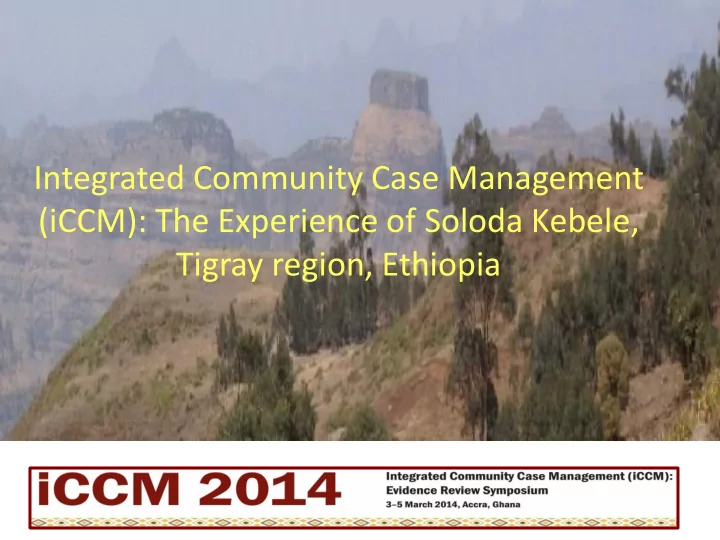
Integrated Community Case Management (iCCM): The Experience of Soloda Kebele, Tigray region, Ethiopia
SLIDE 2
Outline of presentation
Background Information The Implementation of ICCM in Soloda kebele Working with community Achievements Challenges Way forward
SLIDE 3
Background
Tigray is one among the nine regional states in Ethiopia Soloda Keble is one of the 700 rural kebeles in the region: – total population of 5,500 – Under five population of 803 – Two Health Extension Workers (HEWs) – Number of volunteers (women development army (WDA) teams) = 40 – One team of WDA has 25-30 members, who are all women
SLIDE 4
My Responsibility
Trained on HEP packages for 12 months Implement 16 health extension packages categorized in to four:
– Maternal & child health (…iCCM) – Hygiene & sanitation – Communicable disease prevention & control – Health education & communication
SLIDE 5
Six day training was given to both HEWs in April 2011 Necessary materials/ kits were supplied Services provided within and outside the health post Follow up after training received two months later Received supportive supervision and mentoring from HEW supervisors and partner every six months; Routine supportive supervision is made every week by HEW supervisors (health center staff) Experience sharing and review of performances made following supervision after 6 months
The implementation of ICCM in Soloda kebele
SLIDE 6 My kebele has 40 Women Development Army Teams (WDA); one WDA consists of 30 female leaders of 1-5 network members We trained WDA leaders on Health Extension Packages 4 hours per day for 15 days with technical support from the health center. 1 to 5 network leaders trained the 5 members for 96 hours; we did follow up of the training through visit and weekly meeting 1-5 network meet weekly and review the performance on HEP, mobilize community for child health days, and care seeking Kebele steering committee lead the HEP activities
Working with my community
SLIDE 7
Achievements
Services provided in 2013:
90 cases of pneumonia treated with cotrimoxazole tablet all improved 500 cases of diarrhea treated with ORS and zinc 7 cases of malaria (RDT proven FP) treated with Coartem 4 cases of SAM treated with RUTF 1 case of complicated SAM referred to health center Five young infants with very severe disease referred to hospital
SLIDE 8 Changes in the community
treatment has created happiness in the kebele
- Our acceptance and thrust by
the community has increased
- Health care seeking behavior is
for maternal and child health services is improving
- Child deaths became very rare
event in the kebele
SLIDE 9 Challenges
more so for during the first two months of life due to cultural issues
supplies such as zinc
SLIDE 10 Way forward
- Demand creation activities
through strengthening WDA activities
- Using different strategies such
as pregnant mother forums, community conversation,
- utreach strategies
- Keep health post open daily
- Use of health care finance
scheme to avoid gaps in supply
SLIDE 11
Thank you