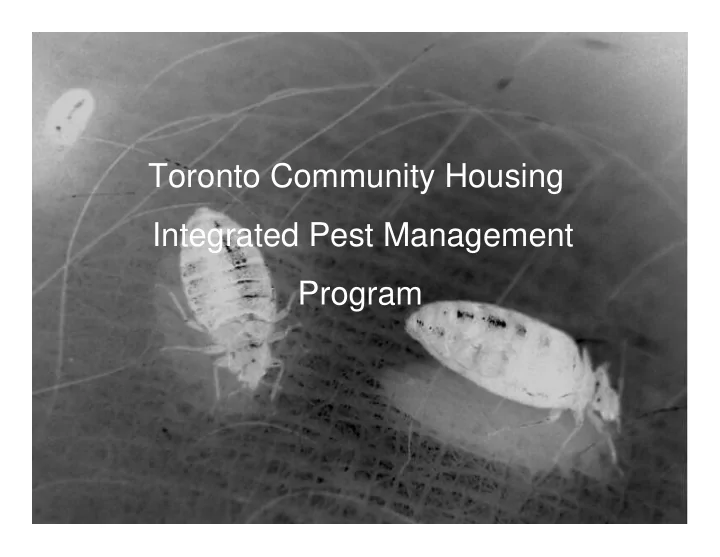
Toronto Community Housing Integrated Pest Management Program The - - PowerPoint PPT Presentation
Toronto Community Housing Integrated Pest Management Program The Goal of this Integrated Pest Management Strategy is to reduce infestations and re-infestations that have such a serious impact on our residents lives, while keeping costs
The Goal of this Integrated Pest Management Strategy is to reduce infestations and re-infestations that have such a serious impact on our residents lives, while keeping costs under control
KNOW YOUR RESPONSIBILITY
The landlord:
- Is responsible for pest management throughout the building
- Must make every effort to control pests and prevent spread
The tenant:
- Must keep their unit clean (as set out in the Residential Tenancies
Act and municipal health and safety requirements)
- Must allow the landlord to conduct inspections
- Must report infestations promptly
- Must prepare unit for treatment
- Must co-operate and all a landlord to complete treatments as
required
KNOW THE ENEMY
COCKROACHES
BED BUGS
Bed Bugs: How big is the issue?
What the experts say:
- 25 million Americans in 2011
- Most difficult to control
- Preparation is the key
- 20% annual growth
- Growth of 30% in GTA
- Will continue to grow
- No silver Bullet
Bed bugs: Elements of a treatment
- 1. Inspect/Assess
- 2. Identify
- 3. Protect Others (Block Inspections/Treatments)
- 4. Preparation
- 5. Treatment
- 6. Follow Up
PREPARATION IS THE KEY!!!
PREVENTION AND MONITORING WHAT TOOLS ARE AVAILABLE
BLOCK INSPECTIONS/TREATMENTS
UNIT LEFT UNIT RIGHT UNIT BELOW UNIT BELOW UNIT BELOW
SOURCE
UNIT ABOVE UNIT ABOVE UNIT ABOVE
TREATMENTS A peek at how it works
BARRIERS TO TREATMENT
- Lack of Preparation of Unit
- Clutter
- Hoarding
- Physical Challenges
- Mental Health Issues
- Access to Unit
- Lack of Compliance by Tenant
- Misinformed tenant/landlord
SUPPORTING VULNERABLE TENANTS
- 9000 Tenants living with serious mental
illness
- 26,000 Seniors
- Lack the capacity to prepare for treatments
- Limited Resources (financially and in
services) to support the necessary preparation work
- Impacts others due to delayed responses
while supporting a tenant
PEST MANAGEMENT STRATEGY
IPM MODEL
- Data collection and analysis
- Education and co-operation of all
stakeholders
- Prevention
- Preparation for treatment
- Best Practices
- On-going process
- Responsible use of pesticides
PEST MANAGEMENT STRATEGY
- A new RFP for pest control providers that includes increased
vendor accountability
- Centralized approach to managing Pest Vendors
- Clear defined roles, responsibilities, specifications, vendor
warranty and comprehensive quality assurance program
- Methods to better track infestations in our communities
- Creating a environment that will better support our vulnerable
tenants who have been challenged by infestation
PEST MANAGEMENT STRATEGY
- Engaging tenants who are already active in their communities
around this issue (eg: Tenant Pest Control Committee)
- Standardizing of unit preparation documents and introduction of
visual aids to overcome language barriers.
- Quality assurance follow-up
- Working with the city to share best practices and improve
collaboration between different divisions.
- Ongoing education of staff and tenants
PROJECTED OUTCOMES
- Stabilize/reduce infestation rates portfolio
wide.
- Ability to better track, monitor and report on
success
- Reduce the impact on vulnerable tenants
- Stabilize costs related to pest management
Contact Information
Deborah Simon 416-981- 4355
Chief Operating Officer deborah.simon@torontohousing.ca
Richard Grotsch 416-981-4054
Manager, Integrated Pest Management richard.grotsch@torontohousing.ca