SLIDE 1 INSPIRE CHALLENGE ACHIEVE
Year 7 Parent Information Evening
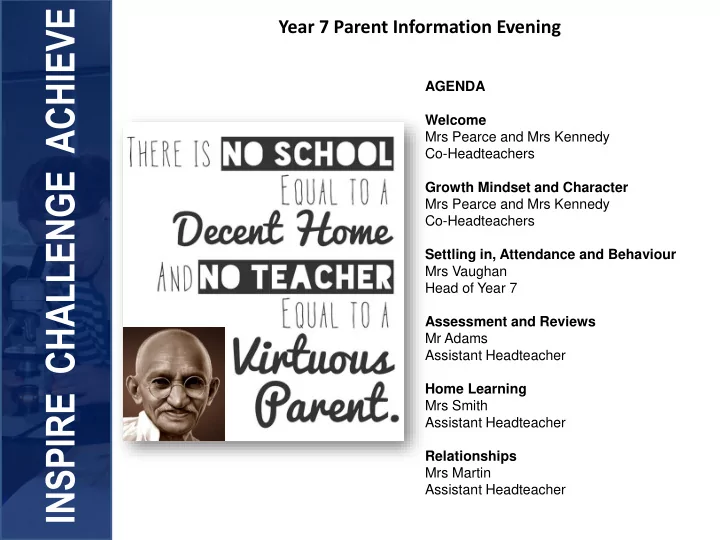
AGENDA Welcome Mrs Pearce and Mrs Kennedy Co-Headteachers Growth Mindset and Character Mrs Pearce and Mrs Kennedy Co-Headteachers Settling in, Attendance and Behaviour Mrs Vaughan Head of Year 7 Assessment and Reviews Mr Adams Assistant Headteacher Home Learning Mrs Smith Assistant Headteacher Relationships Mrs Martin Assistant Headteacher
SLIDE 2
Visions and Values
SLIDE 3 Values
- Respect
- Integrity
- Humility
- Optimism
- Sense of duty
SLIDE 4 Educational Vision
- Self confidence
- Building strong relationships
- Aspirations
- Achieving their very best
Be ready for adulthood, with principled values so as to impact positively on their own lives and those of others. To make for a better world
SLIDE 5
Growth mindset and character
Mrs Anne Kennedy and Mrs Katie Pearce Co-Headteachers
SLIDE 6 INSPIRE CHALLENGE ACHIEVE
Dr Carol Dweck
personality, social psychology and developmental psychology
respond to failure
Mindset”
SLIDE 7
INSPIRE CHALLENGE ACHIEVE
SLIDE 8
Learning isn’t easy, embrace struggle and grow
SLIDE 9
INSPIRE CHALLENGE ACHIEVE
SLIDE 10 INSPIRE CHALLENGE ACHIEVE
Growth mind-set phrases
When your daughter struggles…. You haven’t got this yet. What did you do to prepare for this? Is there anything you could do to prepare differently next time? When you are struggling, you are learning – it’s your brain trying to make new connections. If it was easy you wouldn’t be learning anything Let’s try and break this down into steps It’s okay to make mistakes, provided you learn from them Have a go – I can always work on the mistakes with you when I see where you haven’t got it yet When your daughter is making progress…. Well done – you must have worked really hard on this I can see how you improved this when you went back over it Please share one mistake that you learned from to help you improve You kept going when it was difficult You tried all kinds of different strategies to solve that problem Can you see how the effort you put into this paid off? Compare the difference in this work to what you produced earlier
SLIDE 11 INSPIRE CHALLENGE ACHIEVE
Character (noun)
SLIDE 12 INSPIRE CHALLENGE ACHIEVE
Three Holt Character Virtues
- Stoicism
- Gratitude
- Humility
SLIDE 13
Inspire ~ Challenge ~ Achieve
Stoicism ~ Gratitude~ Humility
SLIDE 14
Be Kind Aim high Work hard Be proud to be a Holt girl
SLIDE 15
Settling in at Secondary School
Mrs Katie Vaughan Head of Year 7
SLIDE 16 First Week at The Holt
- Settled very well
- Learning new routines
- Travelling to school - buses
- Timetables
- Finding way around school
- Uniform
- Rules and consequences
- Made new friends
- Learning new subjects
- New Teachers – one for every subject!
SLIDE 17 Routines & Organisation
- Travelling to school
- Use of Planner, Timetable and Frog
- Organisation:
– Packing bags, correct books and equipment. Organise the night before. – Home Learning routines/times – stick to them! Avoid distractions. – Other activities outside school – work out a “timetable” for home and when Home Learning fits in.
SLIDE 18 Contacting the School
- Communication between home and school
is very important.
- Talk to your daughter about how things are
at school, how she feels and how she is coping with the work. This will give you a basis for deciding whether or not you should contact school.
- Reassure your daughter and suggests ways
- f solving a problem but if, after a couple
- f weeks the problem still remains, then
contact us
SLIDE 19 Who Should I contact?
Mrs Vaughan - first point of contact with parents. Year7Team@holt.wokingham.sch.uk
We can discuss the problem and suggest strategies for supporting your daughter. If the problem is subject related email the year7team and we will forward it to the HOD. Then in follow up emails cc in year7team. Other issues may be dealt with by Mrs Attryde, Year 7 Student Support. If your daughter has special educational needs Mrs Griffiths, our SENCO, will monitor your daughter’s progress and will be in contact with you.
SLIDE 20
Attendance and Behaviour for Learning
SLIDE 21 INSPIRE CHALLENGE ACHIEVE
Attendance
- It is a parent’s legal responsibility to
ensure their child attends school regularly.
- There is a direct link between
attendance and academic achievement.
99% 2 days (10 lessons) off a year 95% 1 day off, on average, a month 90% 1 day off, on average, a fortnight 85% 3 days off, on average, a month 80% 1 day off, on average, a week
SLIDE 22 INSPIRE CHALLENGE ACHIEVE
Attendance
- We try to encourage positive habits for
adulthood; we know that employers do not accept poor attendance.
- We are regularly asked in references for
a students attendance.
- Attendance supports a student’s
successful integration into the school community, and success in their chosen pathways.
SLIDE 23 INSPIRE CHALLENGE ACHIEVE
If a student is ill:
- Contact Mrs Michelle Smith by phone on
the attendance line or by email: absence@holt.wokingham.sch.uk
- Please do this before 9am, and make clear
the reason for absence.
- Sickness and diarrhoea require 24hours
before return to school.
- If students are feeling a bit “under the
weather”, please encourage them to come in.
- Over the counter medication can be
carried by students to self administer.
SLIDE 24 INSPIRE CHALLENGE ACHIEVE
Other Absences :
- We will not authorise holidays unless in
exceptional circumstances.
- Medical appointments will be authorised
absences, but please send the students with a note that gives the time to sign out.
- The Head of Year will make contact if there
are any attendance concerns. Please contact them if there is a reason for a change in attendance.
- We work closely with the EWO.
SLIDE 25 INSPIRE CHALLENGE ACHIEVE
Lateness
- Lateness to registration (AM) results in
a 10 minute late lunchtime detention.
- If students come by bus, and the bus is
delayed, this will not occur.
- All late students must sign in at Student
Support, where registers are updated.
SLIDE 26 INSPIRE CHALLENGE ACHIEVE Behaviour Choices and Consequences
- We encourage students to recognise that
at all times during the school day, they have a CHOICE about the way they behave.
- This includes lesson time, the journey to
lessons and lunch and break times too.
- If they CHOOSE to behave in an
inappropriate way, then there will be CONSEQUENCES.
- We organise types of behaviour into
colours to help you understand…
SLIDE 27
INSPIRE CHALLENGE ACHIEVE
Colour Levels of Behaviour
SLIDE 28 INSPIRE CHALLENGE ACHIEVE How we praise and recognise
Subject Teacher
- Recognition comments to parents through Sims app
- The number of Sims recognition comments are linked to house points.
- Praise postcards – for exceptional and above and beyond behaviour.
- Stickers and stamps – with reasons
- Oral feedback in lessons and around school.
- Written feedback on home learning
- Specific feedback to teams and individuals after competitions
- Heads of Year
- Monitors Sims recognition comments
- Presentation assemblies
- Three per year - Christmas, Easter and Summer for Year 7-10 and 12 and
Autumn and Easter for year 11 and year 13.
- Praise breaks
- Contact home
- £240/£210 café vouchers @ £1 to give out over the year.
Co-Headteachers
- Meet with Co-Headteachers at break time
SLIDE 29
INSPIRE CHALLENGE ACHIEVE
Recognition Comments
Previously we recorded them in the in the planner but teachers will now write comments directly on Parent Sims App and the HOY logs them. Parent Sims App will be launched in the next couple of weeks One comment = one house point
SLIDE 30
INSPIRE CHALLENGE ACHIEVE
SLIDE 31
INSPIRE CHALLENGE ACHIEVE
Consequences
SLIDE 32 INSPIRE CHALLENGE ACHIEVE
Detentions
- In Year 7, students will only have
lunchtime detentions unless they display red behaviour.
- Detentions are 15 or 30 minutes long and
take place in S9 or S6.
- Subject teachers can also give a detention
for misbehaving in their subject.
- From Year 8 a missed home learning will
result in a one hour after school detention.
SLIDE 33 INSPIRE CHALLENGE ACHIEVE
Detentions
- Missed Home learning = 30 minutes
- Equipment = 15 minutes
- PE kit or food tech equipment = 30
minutes
- Uniform = 30 minutes
- Mobile phone use = 30 minutes
SLIDE 34 INSPIRE CHALLENGE ACHIEVE Using Mobile Phones in School
Students are able to use their mobile phone in school at certain times
- Students may only use their phone at break
and lunch time but not whilst walking around.
- The phone must remain switched off for the
rest of the school day.
- If a student feels ill, they should not contact
their parents to pick them up directly – student support will make contact. .
- Headphones should not be used on the school
site.
SLIDE 35
Assessment and Reviews
Mr Ben Adams Assistant Headteacher
SLIDE 36 Rationale
- All expected to aspire to excellence
- Assessment at KS3 is based on
progress
SLIDE 37 Assessment - What we want
- ur system to do….
- Develop knowledge and skills
required for success at GCSE
- High expectations
- Formative feedback
- Periodic summative assessment
- Simple and easy to understand
- Consistent yet flexible
SLIDE 38 So, how do our progress reviews work….?
- KS2 scores plus other attainment
data are used to project an aspirational target GCSE grade range
- The grade ranges are a target for the
students and a planning tool for teachers
SLIDE 39 The new GCSE grades explained
Old New A* 9 8 A 7 B 6 5 C 4 D 3 E 2 F/G 1
SLIDE 40 GCSE target grade ranges
Target grade range 1-4 5-6 6-7 7-8 8-9
SLIDE 41 How will my daughter’s progress be assessed?
- Department marking policies
- Agreed common assessments
- Teachers mark and refer to the criteria
for the target grade range of the student
SLIDE 42 How we report progress
- Top of the grade range or above – blue
- On track to achieve within the target grade range –
green
- Within reach of expectations – amber
- Not meeting grade range expectations – red
SLIDE 43 INSPIRE CHALLENGE ACHIEVE
Target grade range 7-8 Grades 7-8 Year 7 Year 11
Progress
SLIDE 44
Strengths and areas for development
SLIDE 45 Review dates
- 23rd October – English, maths and
science
- 24th January
- Parents’ evening – Thursday 30th January
- 15th July – with tutor comments
SLIDE 46 INSPIRE CHALLENGE ACHIEVE
- Home learning – Frog
- Reviews – SIMS Parent
- Parent logins and passwords
- ros@holt.wokingham.sch.uk
SLIDE 47
Home Learning
Mrs Yvonne Smith Assistant Headteacher
SLIDE 48 INSPIRE CHALLENGE ACHIEVE
Home Learning
SLIDE 49 INSPIRE CHALLENGE ACHIEVE
What is Home learning?
- Home learning is work that is set to be done outside
the timetabled curriculum. It contains an element of independent study in that it is not usually directly supervised by a teacher. It is important in raising student achievement.
- It will include a variety of tasks - including practice
questions, extended writing, learning, research, reading, presentation and revising.
SLIDE 50 INSPIRE CHALLENGE ACHIEVE
Why is Home learning important?
There are clear benefits for students who spend regular periods of time on different learning activities outside school.
HL enables students:
- To develop confidence and self-discipline to work
independently utilising time management, an essential skill for adult life.
- To consolidate and reinforce learning and understanding that
has taken place in the lesson.
- To extend learning through the acquisition of new knowledge
and skills.
- To make more rapid progress individually; to promote quiet
reflection on the work covered in the lesson.
- To prepare for more difficult tasks to be attempted in the
classroom.
SLIDE 51 INSPIRE CHALLENGE ACHIEVE
Home Learning Timetable
SLIDE 52 INSPIRE CHALLENGE ACHIEVE
Home Learning Top Tips
Support your daughter with home learning where possible Try to provide a suitable environment for study. Allow time for home learning Offer guidance and help Make sure HL is in the school bag the night before Help your daughter to plan how she uses her time and keep to a timetable Encourage your daughter to use her planner If your daughter is struggling to understand her HL encourage her to speak to her teacher BEFORE the deadline!
SLIDE 53 INSPIRE CHALLENGE ACHIEVE
Home Learning Top Tips
HL is set on FROG and accessible to parents The internet can be used to access the many useful sites that support school subjects. The Holt School Learning Platform ( FROG) contains a wealth of information. The Learning Resource Centre is open daily until 4.30pm Monday to
- Friday. Students can access ICT resources, home learning resource
boxes and help and support from a dedicated member of staff
SLIDE 54
INSPIRE CHALLENGE ACHIEVE
Relationships
Worries Friendships Independence Mrs Vicki Martin Assistant Headteacher
SLIDE 55
INSPIRE CHALLENGE ACHIEVE
Lisa Damour
SLIDE 56
Anxiety is a well-meaning messenger – it alerts that something is not right and for us to stay on our toes. Girls who learn to face their fears find out just how brave they can be.
SLIDE 57 Great Phrases to Use from Lisa Damour
- Healthy stress happens when we take on new challenges.
- Anxiety is a gift handed down by evolution to keep humans safe.
- Anxiety works to protect us from the world and ourselves but somehow
people think emotional discomfort is a bad thing. But emotional discomfort alerts us to pay attention.
- Say to a girl who has a tricky situation ‘I know that something really scary
has happened’ to acknowledge her worry.
- ‘I’m glad you are worried. That’s the right reaction because right now you
know you are not ready. As soon as you start studying, your nerves will calm down.’
- When a girl gets anxious, we want her to take that emotion seriously and
wonder ‘why is my alarm going off? and what is the best way to get it to quiet down? If a girl says ‘I have anxiety’…..natural response is ‘well of course you do. That’s how you are able to cross streets safely and not get hit by cars’. Anxiety is usually a good thing.
- ‘I know you’re feeling helpless and I can only guess how miserable that
must be’
- ‘Oh…it must feel awful to even think that’
SLIDE 58 Advice from Lisa Damour
- It is the teenager’s job to worry about how everyone
sees her but it is our job to help teenagers take a few steps back from the whole thing.
- Being pushed beyond one’s comfort zone is often a
good thing and the stress students’ encounter at school for the most part happened to be the healthy
- kind. All growth comes with some discomfort – we
send our children to school precisely so that they will be stretched and improved.
- When talking to your daughter ask them ‘can you walk
me through a typical day’
- What is the source of all this stress? Why am I
anxious?
And
- Big friendship groups bring drama!!
SLIDE 59
- Between 5 -12 yrs friendships are
uncomplicated and generally made through parents being friends, live nearby, enjoy the same activities.
- 12 – 16yrs – friendships become more
complicated and volatile.
Facts about Friendships
SLIDE 60
- Seek greater intimacy and trust from friendships
- Teenagers start to seek security and safety
within their peer group, similar to their experiences they have had with their parents when younger.
- Friendships are fluid because of the changes
they are undergoing.
- They will have several friendship issues as they
work out their own identity and mature emotionally, psychologically, physically and socially.
Teenage Friendships
SLIDE 61 Take time to listen Can’t be in a rush but need to make it easy for them to talk
– In the car – Texting – Long walks – Hot chocolate in Sainsbury’s after a family shop – Breakfast at a café on a Saturday morning Teenagers prefer to talk to their friends…but these strategies will encourage them to open up
Teenage Friendships – How can you help?
SLIDE 62 Ask questions
- Don’t wade in with lots of wisdom and solutions.
- Need to recognise that they have the answers inside
them and you need to ask question to help them determine how to act.
– How has this affected you? – How has it affected the other person? And the friendship? – How does this fit with your idea of what a friendship is all about? – Should all friendships last forever? – What do you see as your alternatives?
Teenage Friendships – How can you help?
SLIDE 63 Invite your daughter’s friends over
- Helps you child build the friendship in a
secure environment.
- Strengthens their understanding of each
- ther.
- You can supervise and observe
Teenage Friendships – How can you help?
SLIDE 64 Create opportunities for your daughter to try
- ut/experience new things
- Participation in clubs in and out of school
enables your daughter to make friends with like minded people and of different ages.
- Visits to music concerts, art galleries,
countryside, interesting buildings, different cities – all good to build up cultural understanding.
Teenage Friendships – How can you help?
SLIDE 65 Monitor technology
- Social media is good and bad for teenagers
- Have rules about leaving devices outside of
rooms at the same time every night…by a plug.
- Keep an eye on what they are sending and
receiving….
- Teach them social media etiquette and what
they should do if they are upset by any messages
- Watch TV with them….chance to be together on
the sofa!
Teenage Friendships – How can you help?
SLIDE 66
- Be ready for it – it will happen! It is a
natural stage in adolescence.
When Friends Fall Out
SLIDE 67 Achieving Independence
Allow your daughter to make her
- wn mistakes, face her own
consequences, and solve her own problems….
SLIDE 68 Achieving Independence
- How much should I help? How do I get
the right balance between doing too much or too little, between fussing and allowing them to flounder? Never do anything regularly for your daughter that she is capable of doing for herself.
SLIDE 69
Thank you for your time this evening
year7team@holt.wokingham.sch.uk