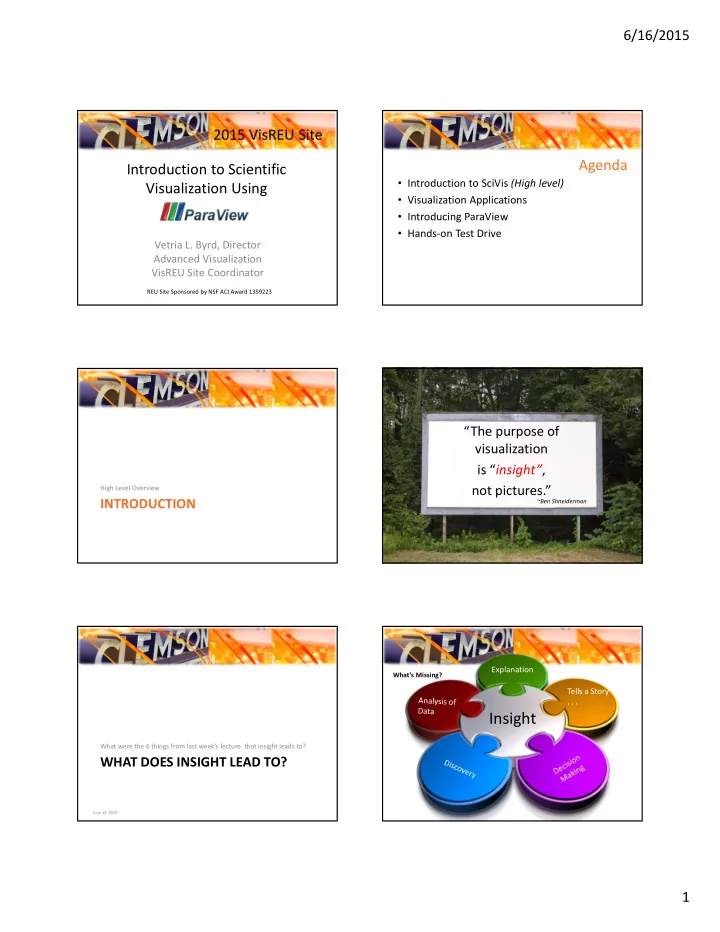
Insight What were the 6 things from last weeks lecture that insight - - PDF document

insight
SMART_READER_LITE
LIVE PREVIEW

Insight What were the 6 things from last weeks lecture that insight - - PDF document

6/16/2015 2015 VisREU Site Agenda Introduction to Scientific Introduction to SciVis (High level) Visualization Using Visualization Applications Introducing ParaView Hands-on Test Drive Vetria L. Byrd, Director Advanced


slide-1
SLIDE 1

6/16/2015 1

2015 VisREU Site Introduction to Scientific Visualization Using

Vetria L. Byrd, Director Advanced Visualization VisREU Site Coordinator

REU Site Sponsored by NSF ACI Award 1359223

Agenda

  • Introduction to SciVis (High level)
  • Visualization Applications
  • Introducing ParaView
  • Hands-on Test Drive

INTRODUCTION

High Level Overview

“The purpose of visualization is “insight”, not pictures.”

~Ben Shneiderman

WHAT DOES INSIGHT LEAD TO?

What were the 6 things from last week’s lecture that insight leads to?

June 15, 2015

Insight

Explanation Tells a Story . . .

What’s Missing?

slide-2
SLIDE 2

6/16/2015 2

Visualization Applications

BioVis GeoVis InfoVis SciVis

VISUALIZATION

Biological Data Non- Numerical Data Geospatial Data Simulated, 3D Phenomena

Research Fields Input Data

Data Visualization Process

Visualizing Data: Exploring and Explaining Data with the Processing Environment by Ben Fry, O’Reilly (p 15)

An iterative process

  • btain the data

provide structure

remove all but the data of interest

apply methods from statistics or data mining to discern patterns or place the data in mathematical context

choose a basic visual model, such as a bar graph, list or tree

improve the basic representation to make it clearer and more visually engaging

Add methods for manipulating the data or controlling what features are visible

Where are you in your projects?

Scientific Visualization Pipeline

http://www.bu.edu/tech/research/training/tutorials/introduction-to-scientific-visualization-tutorial/the-scientific-visualization-pipeline/

What’s Missing?

Scientific Visualization Pipeline

http://www.bu.edu/tech/research/training/tutorials/introduction-to-scientific-visualization-tutorial/the-scientific-visualization-pipeline/

Step 1: Produce Data

  • Simulated Data
  • Images
  • Numerical
  • Some measured value
  • Observed Phenomena

WHAT DOES YOUR DATA LOOK LIKE?

June 15, 2015

slide-3
SLIDE 3

6/16/2015 3

Step 2: Analyze, Filter, Reformat

  • Cleaning up the data

– Removing noise – Replacing missing values – Clamping values to be within a specific range of interest

  • Performing operations

to yield more useful data

Step 3: Apply SciVis Techniques

  • Converts raw information

into something more understandable

  • Visually extracting meaning

from a scientific data set using various techniques

Contour Clip Threshold Glyphs Streamlines

Step 4: Map to Geometry

  • Scalars, vectors,

tensors

  • 1D, 2D, 3D
  • Mesh

Step 5: Render, Post Process Step 6: View Results 2015 VisREU Site Introduction to Scientific Visualization Using

slide-4
SLIDE 4

6/16/2015 4

On The Agenda

  • Basics of Visualization
  • Scientific Visualization

Pipeline

  • Features of ParaView
  • Introduction to ParaView
  • Additional Resources
  • The process of visualization is taking raw data and converting

it to a form that is viewable and understandable to humans.

Basics of Visualization

  • There are a number of steps between raw

data and a finished visualization

  • Single tool or multiple tools might be used

Scientific Visualization

  • Primarily concerned with the visualization
  • f three-dimensional phenomena

(architectural, meteorological, medical, biological, etc.),

  • Where the emphasis is on realistic renderings
  • f volumes, surfaces, illumination sources,

and so forth, perhaps with a dynamic (time) component.

Wikipedia.com

  • Multi-platform parallel data analysis and

visualization application

  • Mature, feature-rich interface
  • Good for general purpose, rapid visualization

Mac Windows Linux

  • Open Source . . . It’s Free!
  • http://www.paraview.org/
  • Built upon the Visualization Toolkit (VTK)

library

  • Primary contributors:

– Kitware, Inc. – Sandia National Laboratory – Los Alamos National Laboratory – Army Research Laboratory

slide-5
SLIDE 5

6/16/2015 5

Grid – regular structure, all voxels (cells) are the same size and shape

Supported Data Types

Curvilinear – regularly gridded mesh shaping function applied

Supported Data Types

Unstructured grid – irregular mesh typically composed of tetrahedra, prisms, pyramids, or hexahedra

Supported Data Types

  • Point data
  • Polygonal data
  • Images
  • Multi-block
  • Adaptive Mesh Refinement (AMR)
  • Time series support

Supported Data Types

  • Isosurfaces
  • Cutting planes
  • Streamlines
  • Glyphs
  • Volume rendering
  • Clipping
  • Height maps
  • & more

Supported Visualization Algorithms

Special Features

  • Supports derived variables
  • Scriptable via Python
  • Saves animations
  • Can run in parallel / distributed mode for large

data visualization

slide-6
SLIDE 6

6/16/2015 6

Supported File Formats

Many more . . .

Visualization Pipeline

  • All processing operations (filters) produce data

sets

  • Can further process the result of every
  • peration to build complex visualizations

– Extract a cutting plane, – Apply glyphs (i.e. vector arrows) to the result

  • Gives a plane of glyphs through your 3D volume

Demonstration

  • WRF weather

forecast data set

– Rectilinear grid – Multiple scalar and vector variables – Time series

  • Can show:

– Clouds – Wind – Temperature

Visualizing your Data Using ParaView

  • Three Basic Steps:

– First your data must be read into ParaView – Next, you may apply any number of filters that process the data to generate, extract, or derive features from the data – Finally, a viewable image is rendered from the data

GETTING STARTED WITH PARAVIEW 3.14.1

Sample Data

Download from http://citi.clemson.edu/viz/sampleData.html

– Find ParaView Section – Right click on headsq.vti – Save Link As: headsq – Save as type: VTI file (.vti) Remember where you save the data file!

June 15, 2015

slide-7
SLIDE 7

6/16/2015 7

Menu Bar Tool Bars Pipeline Browser Object Inspector 3D View

User Interface

  • File – Open -

headsq.vti

  • Click Apply

Should see an

  • utline of the data

set

  • Create an Isosurface

– Click Filters – Common – Contour

  • A new object

appeared in the pipeline browser (Contour 1)

  • Lets explore the

Isosurfaces section:

– Value Range: [0, 4095] – Default value: 2047.5

  • Click Apply

Contour – Extracts the points, curves, or surfaces where a scalar field is equal to a user- defined value. The surface is

  • ften also called an isosurface.
slide-8
SLIDE 8

6/16/2015 8

Isosurfaces

  • Click Delete All
  • Click New Range

Isosurfaces

  • Click Delete All
  • Click New Range
  • Add Range window

appears

– You can change the range of data values – For this tutorial, keep the default

  • Click OK

Notice the range of values

slide-9
SLIDE 9

6/16/2015 9

This may take few seconds to render

Clip Isosurface

  • Select Contour1
  • Select Filters
  • Select Common
  • Select Clip

CLIP - Intersects the geometry with a half

  • space. The effect is to

remove all the geometry

  • n one side of a user-

defined plane.

slide-10
SLIDE 10

6/16/2015 10

Drag arrow point around to front of surface (arrow turns red when selected) It may take a few seconds to render Depending on where you placed the clipping plane the results may be easily seen: parts of the ears are clipped, area around the neck Rotating the view reveals the clipped isosurface Intersects the geometry with a half space. The effect is to remove all the geometry on one side of a user-defined plane.

CLIP

slide-11
SLIDE 11

6/16/2015 11

Slice Isosurface

  • Click eye next to Clip1

to hide the clip plot

  • Select Coutour1
  • Select Filters
  • Select Common
  • Select Slice

SLICE – Intersects the geometry with a plane. The effect is similar to clipping except that all that remains is the geometry where the plane is located. Rotated view Drag arrow point around to front of surface (arrow turns red when selected)

slide-12
SLIDE 12

6/16/2015 12

Intersects the geometry with a plane. The effect is similar to clipping except that all that remains is the geometry where the plane is located.

SLICE

Clip1 has been made visible along with Slice1

Pipeline Browser

headsq.vti Contour1 Clip1 Slice1

GETTING YOUR DATA INTO PARAVIEW (A SAMPLE FILE)

slide-13
SLIDE 13

6/16/2015 13

Supported Data Formats

  • VTK (http://www.vtk.org/VTK/img/file-formats.pdf)
  • EnSight
  • Plot3D
  • Various polygonal formats
  • Users can write data readers to extend

support to other formats

  • Conversion to the VTK format is

straightforward

VTK Simple Legacy Formats

  • ASCII or binary
  • Supports all VTK grid

types

  • Easiest for data

conversion

VTK simple legacy format (http://www.vtk.org/VTK/img/file-formats.pdf)

Simulated Temperature

  • The data

– Simulated temperature values – Sample size: 100 x 100 – Rectilinear Grid

vtk Format

# vtk DataFile Version 2.0 Rectilinear grid of temperature values ASCII DATASET RECTILINEAR_GRID

# vtk DataFile Version 2.0 Rectilinear grid of temperature values ASCII DATASET RECTILINEAR_GRID DIMENSIONS 100 100 1 X_COORDINATES 100 float 0 1 2 3 4 5 6 7 8 9 10 11 12 13 14 15 16 17 18 19 20 21 22 23 24 25 26 27 28 29 30 31 32 33 34 35 36 37 38 39 40 41 42 43 44 45 46 47 48 49 50 51 52 53 54 55 56 57 58 59 60 61 62 63 64 65 66 67 68 69 70 71 72 73 74 75 76 77 78 79 80 81 82 83 84 85 86 87 88 89 90 91 92 93 94 95 96 97 98 99 Y_COORDINATES 100 float 0 1 2 3 4 5 6 7 8 9 10 11 12 13 14 15 16 17 18 19 20 21 22 23 24 25 26 27 28 29 30 31 32 33 34 35 36 37 38 39 40 41 42 43 44 45 46 47 48 49 50 51 52 53 54 55 56 57 58 59 60 61 62 63 64 65 66 67 68 69 70 71 72 73 74 75 76 77 78 79 80 81 82 83 84 85 86 87 88 89 90 91 92 93 94 95 96 97 98 99 Z_COORDINATES 1 float

* Although this is a 2D grid,

the z-coordinate must be included and represented in the DIMENSIONS

* *

vtk Format

# vtk DataFile Version 2.0 Rectilinear grid of temperature values ASCII DATASET RECTILINEAR_GRID DIMENSIONS 100 100 1 X_COORDINATES 100 float 0 1 2 3 4 5 6 7 8 9 10 11 12 13 14 15 16 17 18 19 20 21 22 23 24 25 26 27 28 29 30 31 32 33 34 35 36 37 38 39 40 41 42 43 44 45 46 47 48 49 50 51 52 53 54 55 56 57 58 59 60 61 62 63 64 65 66 67 68 69 70 71 72 73 74 75 76 77 78 79 80 81 82 83 84 85 86 87 88 89 90 91 92 93 94 95 96 97 98 99 Y_COORDINATES 100 float 0 1 2 3 4 5 6 7 8 9 10 11 12 13 14 15 16 17 18 19 20 21 22 23 24 25 26 27 28 29 30 31 32 33 34 35 36 37 38 39 40 41 42 43 44 45 46 47 48 49 50 51 52 53 54 55 56 57 58 59 60 61 62 63 64 65 66 67 68 69 70 71 72 73 74 75 76 77 78 79 80 81 82 83 84 85 86 87 88 89 90 91 92 93 94 95 96 97 98 99 Z_COORDINATES 1 float POINT_DATA 10000 SCALARS temperature float LOOKUP_TABLE default

x-dimension * y-dimension * z-dimension

* *

vtk Format

slide-14
SLIDE 14

6/16/2015 14

# vtk DataFile Version 2.0 Rectilinear grid of temperature values ASCII DATASET RECTILINEAR_GRID DIMENSIONS 100 100 1 X_COORDINATES 100 float 0 1 2 3 4 5 6 7 8 9 10 11 12 13 14 15 16 17 18 19 20 21 22 23 24 25 26 27 28 29 30 31 32 33 34 35 36 37 38 39 40 41 42 43 44 45 46 47 48 49 50 51 52 53 54 55 56 57 58 59 60 61 62 63 64 65 66 67 68 69 70 71 72 73 74 75 76 77 78 79 80 81 82 83 84 85 86 87 88 89 90 91 92 93 94 95 96 97 98 99 Y_COORDINATES 100 float 0 1 2 3 4 5 6 7 8 9 10 11 12 13 14 15 16 17 18 19 20 21 22 23 24 25 26 27 28 29 30 31 32 33 34 35 36 37 38 39 40 41 42 43 44 45 46 47 48 49 50 51 52 53 54 55 56 57 58 59 60 61 62 63 64 65 66 67 68 69 70 71 72 73 74 75 76 77 78 79 80 81 82 83 84 85 86 87 88 89 90 91 92 93 94 95 96 97 98 99 Z_COORDINATES 1 float POINT_DATA 10000 SCALARS temperature float LOOKUP_TABLE default 20.18 20.36 20.54 20.73 20.93 21.13 21.35 21.58 21.82 22.09 22.38 22.70 23.06 23.46 23.92 24.44 25.05 25.77 26.63 27.68 28.99 30.68 32.90 35.99 40.50 47.61 60.00 84.65 142.03 300.00 300.00 300.00 300.00 300.00 300.00 300.00 300.00 289.04 288.50 287.82 : :

vtk Format

  • Open data file
  • Click Apply
  • Add a

Contour Plot

  • Filters
  • Common
  • Contour
slide-15
SLIDE 15

6/16/2015 15

Split Window Click in the second window to select it

Save Your Work Additional Resources

  • ParaView User’s Guide

– Included in the installation

  • More tutorials available:

– http://www.paraview.org/Wiki/The_ParaView_Tutorial

This concludes the Introduction to Scientific Visualization using ParaView

Vetria L. Byrd, PhD Director of Advanced Visualization Clemson University Email: vlbyrd@clemson.edu http://citi.clemson.edu/viz

Congratulations!