INRA Perspective of Livestock production 2050 Food Meat: +70% (465 - - PowerPoint PPT Presentation

inra perspective of livestock production 2050
SMART_READER_LITE
LIVE PREVIEW

INRA Perspective of Livestock production 2050 Food Meat: +70% (465 - - PowerPoint PPT Presentation

J.L Peyraud INRA Perspective of Livestock production 2050 Food Meat: +70% (465 Mt) Milk: +60% (1045 Mt) Eggs: +60% (110 Mt) Societal Challenges Livestock Production: ATF vision Resource Efficiency Healthy livestock and People


slide-1
SLIDE 1

J.L Peyraud INRA

slide-2
SLIDE 2

Perspective of Livestock production 2050

Food Meat: +70% (465 Mt) Milk: +60% (1045 Mt) Eggs: +60% (110 Mt)

slide-3
SLIDE 3

Societal Challenges Livestock Production: ATF vision

  • Resource Efficiency
  • Healthy livestock and People
  • Responsible Livestock Production
slide-4
SLIDE 4

Plant production

(annual crop, grassland)

Agro industry

Bio refinery

Food Bio energy Bio based products Enzymes,…. Cosmetics

Animal production

Public goods Public goods By products By products Manures Animal by products Feed

Soil

Mineral fertilizer

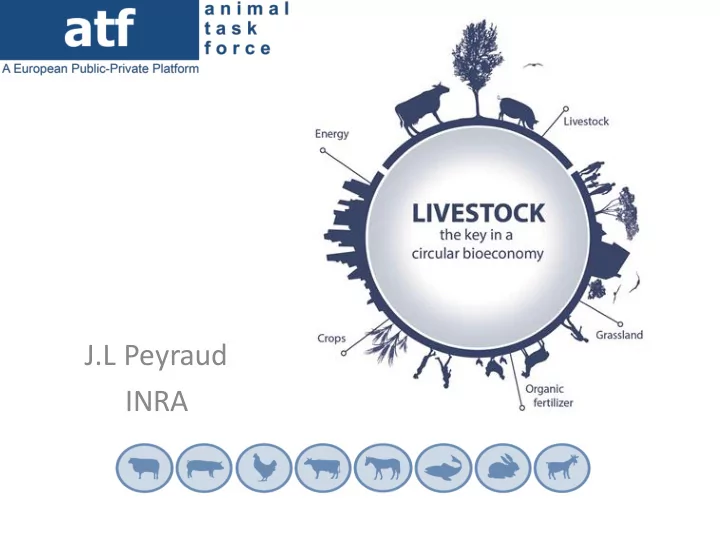
ATF vision: Livestock, the key in a Circular bio-economy

Manures Soybean meal

slide-5
SLIDE 5

Livestock provides food of high nutritional value

  • Digestible Indispensable Amino Acid

Score (FAO, 2007)

  • Content, Proportion and profile of IAA,

Digestiblity

  • Importance of children (brain functions)

Seniors (sarcopeny )

DIAAS index Milk 139 Beef 131 Soya 102 Wheat 65 Peas 82

  • Other micro nutrients
  • Iron (heminic) : 17% of young women (18-29 years old) have iron

deficiency (France)

  • Ca, Vit B12
  • Fatty acids : rumenic acid, omega-3
slide-6
SLIDE 6

Livestock contributes to food security

  • Too simplistic evaluation of livestock

efficiency

  • Confusion between human edible

and non edible protein utilisation

  • Ruminant are inefficient or efficient ?
  • Animal efficiency should be

(re)evaluated

  • Efficiency per kg of edible Prot and per ha
  • LCA analysis – allocations
  • Margins of progress : Use of alternative

feeds, innovative processed by-products and more efficient livestock

Adapted from Wilkinson (2011)

Total PC Pig 3 2,6 Poultry 2,2 2,1 Bovine int- ext 5 - 9 3 - 1 Dairy 3,2 0,7

Kg ed Prot /ha, Adapted from De Vries et de Boer (2010)

Kg plant ed Prot /kg Livestock ed Prot Wheat, peas

slide-7
SLIDE 7

Livestock contributes to a more efficient agriculture

  • Using of marginal land not able to produce

plant products for human

  • Grasslands and rangelands : 73 millions ha (40%

European AA)

  • Productivity vs provision of services
  • Livestock production is required for

an efficient use of land

  • What are the responses curves in various

territories/countries ?

  • Improving synergies considering local

contexts

slide-8
SLIDE 8
  • Reduction of the use of mineral fertilizers
  • 1.8 Mt N vs 2.1 Mt for mineral fertilizers and 310

kt P vs 286 t for mineral fertilizers

  • Reduction/ utilisation of gas losses
  • DSS for improving use of liquid manure

Livestock regulates the ecological cycles

  • Return of Organic Matter to the soil
  • Soil physical properties and soil microbita

(specific and functional biodiversity)

  • Speciation C/N/P to favour soil C sequestration
  • Dissemination of antibiotic resistance
  • Innovative organisations (actors)
  • Multi-functionnality of straw
  • Role of grassland and legumes
  • Regulation of N, P, C flow
  • Protein and N autonomy
slide-9
SLIDE 9

Livestock contributes to GHG mitigation

  • Perspective : 30 - 40% reduction
  • GHG mitigation options
  • Genotyping low methane production for selection
  • Animal health, husbandry and feedquality
  • Manure management
  • Improving C sequestration soils (4 p 1000)
  • Precision livestock farming
  • Balance between meat and milk production

Building Grazing Fertilizers Energy Feeds Ruminal fermentations

  • Cooperation between FACCE and HDHL is promising to enable a

Climate Smart and Sustainable Nutrition Security approach

slide-10
SLIDE 10

Livestock provides non-provisionning ecosystem services

  • Maintenance of grassland and its

services

  • Grassland lifespan and management : C

storage, specific and functional biodiversity

  • Concept of bundles of services
  • Composition of the bundle of services: variation

according to local contexts

  • Synergies and trade off between services
  • Levers that can improve delivery of services
  • Scenario of evolution : farm to food chain and

territory

Rural Vitality Production Heritage Environment

slide-11
SLIDE 11

Too simplistic evaluation of C and feed vs food competition

  • Summing up LCA’s single products in

a Linear Model

  • Does not account for integration in a global

Agro-Ecosystem

  • Ignore the use of non edible protein and

marginal land

  • Does not envisage optimal land use for edible

protein production

  • Does not consider C storage and others services
  • Ignores the effects of the production system
  • Ignores the Feed for Food Footprint
  • Do not quantify the multiples effects induced

by the reduction in livestock production

The cconsumption of protein / kg animal food The C footprint of food (kg CO2 eq/kg) 2 4 6 8 10 Red meat Milk Pig Chicken Egg wheat

slide-12
SLIDE 12

Resource efficiency

  • Assessing the roles and impacts of Livestock
  • Soil sustainability: physical, chemical fertility, functional biodiversity,
  • Evaluation of C footprints of our diets,
  • Contribution of animal production to the protein security,
  • Effects of any reduction in Europe of the consumption of milk and meat products (vs

trade) on the availability of biomass and soil and rural vitality

  • Improving the roles of livestock and the coupling between

livestock and crops

  • Efficient and safe feed chains (cascading approach) : maximal use of biomass (food

then feed), alternative feeds/forages

  • Robust and efficient animals and herds: trade-off between productive and non

productive functions, identification of appropriate phenotypes, new breeding programs

  • Closing the loops: emission factors (allocations), mitigations, maximisation of C

storage, manure management (phosphates),

  • Biorefinery of animal by products,

Research gaps

slide-13
SLIDE 13
  • Resource Efficiency
  • Healthy livestock and People
  • Responsible Livestock Production

Societal Challenges Livestock Production: ATF vision

slide-14
SLIDE 14

Healthy Livestock and people

  • Antimicrobial resistance in the concept of “one health”
  • Mechanism of dissemination: reservoir of resistance, transfer within food chains,
  • Prevention : early detection (PLF), robustness, acquisition and stimulation of

immunity, role and installation of microbiota, feeding and husbandry practices, local

  • rganisation,
  • Alternatives therapies: use of viruses (phages), vaccines development,
  • Disease prevention and control
  • New diagnostic tools,
  • Prediction of pathologic emergences and risk assessment , conditions of pathogens

transmission,

  • Host-pathogen dialog and reciprocal adaptation : pathogen biology, host defences

(inflammatory and immune responses) and interaction, mechanism of infection,

  • Animal Welfare
  • Animal based indicators
  • Emotional processes
  • Nutritional quality of animal products
  • Comprehension of the role of nutrients and the matrix effect

Research gaps

slide-15
SLIDE 15
  • Resource Efficiency
  • Healthy livestock and People
  • Responsible Livestock Production

Societal Challenges Livestock Production: ATF vision

slide-16
SLIDE 16

Responsible Livestock production

  • Responsible farming systems
  • Adaptive capacity of farming system: trade-off between efficiency and resilience
  • Design and transition toward innovative (multi-performing) systems,
  • Impact of innovations on workload and work complexity,
  • More value out from grassland
  • Integration of farm systems into sectors and territories
  • The territorial scale of farming systems: evaluation of services, trade-offs and

synergies between services

  • Benefits and risks of the co-existence of a diversity of systems/ food systems,
  • Collective organisation: chairing the risks, adaptive capacities of certified quality

systems

  • Tools to favour innovation
  • Evaluation methods: global assessment, common and shared approaches/data,
  • Incentives public policies for encouraging more balanced performances,
  • Tools and methods for efficient advising of farmers

Research gaps