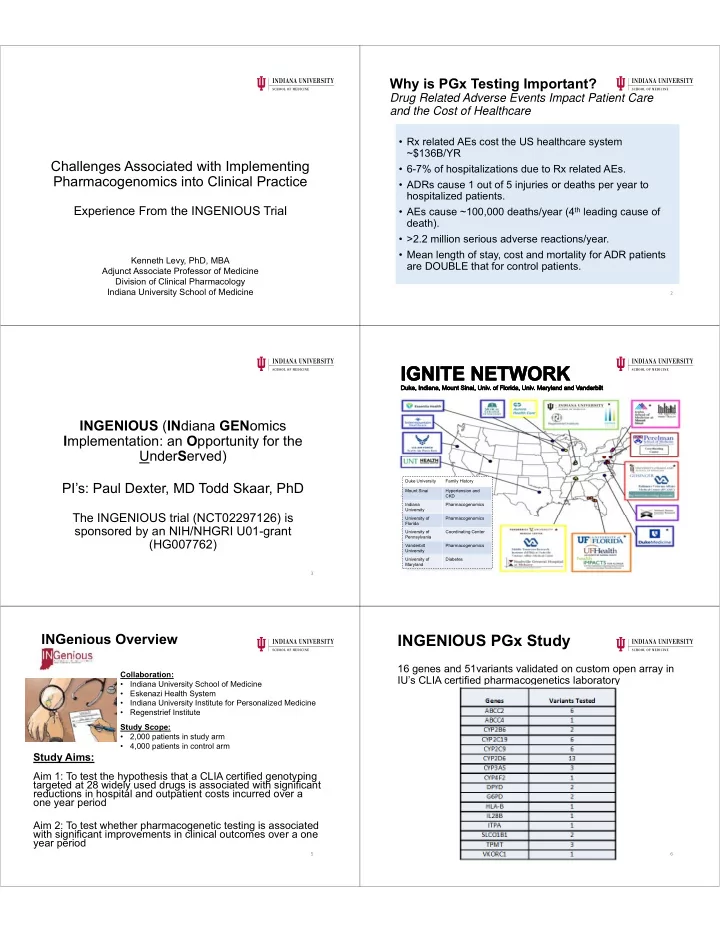
INGENIOUS PGx Study 16 genes and 51variants validated on custom open - - PDF document

ingenious pgx study
SMART_READER_LITE
LIVE PREVIEW

INGENIOUS PGx Study 16 genes and 51variants validated on custom open - - PDF document

Why is PGx Testing Important? Drug Related Adverse Events Impact Patient Care and the Cost of Healthcare Rx related AEs cost the US healthcare system ~$136B/YR Challenges Associated with Implementing 6-7% of hospitalizations due to Rx


slide-1
SLIDE 1

Challenges Associated with Implementing Pharmacogenomics into Clinical Practice

Experience From the INGENIOUS Trial

Kenneth Levy, PhD, MBA Adjunct Associate Professor of Medicine Division of Clinical Pharmacology Indiana University School of Medicine

Why is PGx Testing Important?

Drug Related Adverse Events Impact Patient Care and the Cost of Healthcare

2

  • Rx related AEs cost the US healthcare system

~$136B/YR

  • 6-7% of hospitalizations due to Rx related AEs.
  • ADRs cause 1 out of 5 injuries or deaths per year to

hospitalized patients.

  • AEs cause ~100,000 deaths/year (4th leading cause of

death).

  • >2.2 million serious adverse reactions/year.
  • Mean length of stay, cost and mortality for ADR patients

are DOUBLE that for control patients.

INGENIOUS (INdiana GENomics Implementation: an Opportunity for the UnderServed) PI’s: Paul Dexter, MD Todd Skaar, PhD

The INGENIOUS trial (NCT02297126) is sponsored by an NIH/NHGRI U01-grant (HG007762)

3

Duke University Family History Mount Sinai Hypertension and CKD Indiana University Pharmacogenomics University of Florida Pharmacogenomics University of Pennsylvania Coordinating Center Vanderbilt University Pharmacogenomics University of Maryland Diabetes

INGenious Overview

Study Aims: Aim 1: To test the hypothesis that a CLIA certified genotyping targeted at 28 widely used drugs is associated with significant reductions in hospital and outpatient costs incurred over a

  • ne year period

Aim 2: To test whether pharmacogenetic testing is associated with significant improvements in clinical outcomes over a one year period

Collaboration:

  • Indiana University School of Medicine
  • Eskenazi Health System
  • Indiana University Institute for Personalized Medicine
  • Regenstrief Institute

Study Scope:

  • 2,000 patients in study arm
  • 4,000 patients in control arm

5

INGENIOUS PGx Study

16 genes and 51variants validated on custom open array in IU’s CLIA certified pharmacogenetics laboratory

6

slide-2
SLIDE 2

INGENIOUS PGx 27 Targeted Drug List

  • Amitryptyline
  • Aripiprazole
  • Atomoxetine
  • Azathioprine
  • Capcitabine
  • Citalopram
  • Clopidogrel
  • Codeine
  • Doxepin
  • Efavirenz
  • Escitalopram
  • Esomeprazole
  • 5-Fluorouracil
  • Lansoprazole
  • Mercaptopurine
  • Nortriptyline
  • Omeprazole
  • Pantoprazole
  • Phenytoin
  • Rasburicase
  • Simvastatin
  • Tacrolimus
  • Thioguanine
  • Tramadol
  • Venlafaxine
  • Voriconazole
  • Warfarin

7

INGENIOUS Work Flow

Patient Consented Blood Draw/Saliva Sample Transported to PGx Lab Sample Analyzed and Results into EMR/CDS PGx Reports and Clinical Alerts in EMR Yes PGx Consult if requested

7

Remaining Sample to IU Biobank Pharma

Pharmacogenomic Alert!

This patient has pharmacogenomic information that may impact this prescription Phenotype: Poor Metabolizer Recommendation: Consider an alternative antiplatelet therapy, e.g. prasugrel, or ticagrelor. This patient’s poor metabolizer status predicts poor clopidogrel efficacy. Medication: Clopidogrel Gene(s) involved: CYP2C19

* Clinical Pharmacogenetics Implementation Consortium (CPIC) CPIC guidelines reflect expert consensus based on clinical evidence and peer‐reviewed literature available at the time they are written and are intended only to assist clinicians in decision making

PGx EMR Alerts

Created by Clinical Decision Support Rules

Level of Evidence: Strong*

Click for PGx Report Click for PGx Report Click for PM Consult Click for PM Consult

9

INGENIOUS PGx Report

Page 1

10

INGENIOUS PGx Report

Page 2

Genotype/Phenotype Results

11

INGENIOUS PGx Report

Page 3 (CLIA Requirements)

Variants Tested

12

slide-3
SLIDE 3

PGx lab forwards abnormal results to Adjudication

  • Committee. INGENIOUS

co-Investigator and Fellow pulls medication list from EMR and presents to Consult Committee PGx lab Full PGx panel sent to EMR (G3) Abnormal genotype data (based on CPIC) entered into G3 problem list via MD Fellow (manually Phase I/ IT in phase 2 and 3) Phone Consult with Clinical Pharmacologists Contact PCP or enrolling physician and ask if consult is desired/Add note to EHR Inpatient consult with Clinical Pharmacologist Written consult request through U01 consult committee Outpatient consult scheduled at MDC through IUH

INGENIOUS Consult Workflow

All CPIC variants Actionable variants and drug current Abnormal results All results

13

The Tug-of-War

for Technology Adoption and Changes to Standards of Care

Researchers, Educators and Clinicians Payers, Administrators and Regulators

14

Key Challenges to PGx Adoption

As identified by IGNITE Common Measures Working Group Analysis

15

  • Lack of reimbursement for many genomic tests
  • Few FDA approved or cleared PGx tests
  • Lack of Provider knowledge and Education
  • Lack of Patient understanding and Education
  • EMR systems lacking PGx results entry or reporting
  • CDS systems do not support PGx decision making

and reporting

  • Lack of clinical data supporting benefits of PGx
  • Clinician concerns on liability associated with

genomic Incidentalomes

  • Concerns regarding FDA LDT enforcement

How to Address the Challenges

It Starts with Stakeholder Alignment

  • Senior Executive leadership (CEO/President,

CMO, CFO, Chief Legal Officer and CIO)

  • Senior Clinical leadership (clinical divisions,

nursing and pharmacy)

  • Pathology services
  • Clinical staff
  • P&T committee1
  • Third party payers
  • Patient advocates (community awareness)

1ASHP Guidelines on the Pharmacy and Therapeutics Committee and the Formulary System 16

Implementation Team Structure

Many Healthcare Systems Don’t Practice Good Implementation Science

17

Genomic Implementation

Requires Integrations with the Electronic Medical Record and Clinical Decision and Support Systems

EMR is the key to a successful program

  • Short-term solution
  • Driven by Informatics Committee
  • Functional specifications require input from stakeholders
  • Lead time – planning, coding, implementing and testing
  • Prioritization (internal and vendor) and funding
  • Data input and data mining critical
  • User defined flexibility (change friendly)
  • Long-term Solution
  • EMR systems programming to address genomic medicine
  • Development of standardized CDS algorithms for

genomics

18

slide-4
SLIDE 4

Staff Education

It takes time to change clinical practice

Clinical Training:

  • Critical for short and long-term sustainability
  • Physician, Nursing and Pharmacy teams
  • Pre and post-implementation survey (what went

well and what can be improved)

  • Training and re-training (consider turnover)
  • CME/CE (Industry support?)
  • Adoption of Clinical Pharmacology into Medical

School curriculum

19

Patient Education

Demystify genetics

Supporting Patient Ownership:

  • Alignment of patient education tools and

how to deliver (clinical teams)

  • Patient education tools must simplify the

concept of pharmacogenomics

  • Educated patients are associated with

better outcomes1

1Risk Manag Healthc Policy. 2010;3:61‐72. doi: 10.2147/RMHP.S7500. Epub 2010 Oct 14

20

Sustainability

In the end, sustainability may boil down to cost justification Measuring cost effectiveness a challenging task

Hard versus Soft Costs:

  • Out of pocket costs (capital and variable costs

are straight forward measures

  • Ability to capture and quantify Adverse Events
  • Compare your adverse event rates

(prevalence) to national averages

  • Benchmark costs per Adverse Event
  • Analyze accuracy of adverse event recording
  • Quantifying soft costs takes time (must plan for

it)

21

Changing the Standards of Care

Establishing the medical evidence

Spreading the message Medical intended use Evidence based Medicine

Defining Creating Establishing

22

Technology Adoption Takes Time

Studies providing evidence for improved patient outcomes drive publications and fuel educational programs

Thought Leaders Early Adopters Standard of Care Followers Late Adopters

Adoption Time Standard Timeframe 10 Years

23

National Practice Guidelines

Define Standard of Care Publication of Trial Results

  • Efficacy & Safety
  • Improved HE

National Practice Guidelines

  • Do we see

effect of procedure?

  • How certain are

that effect is real?

Quality Measures

  • What are

criteria?

  • Performance

measurement and reporting

Effectiveness of Pharmacogenomics must be supported by Evidence Based

  • Medicine. Guidelines define requirements and make recommendation for their

usefulness in clinical practice Standard Time for Adoption 10 Years

24

slide-5
SLIDE 5

Clinical Pharmacogenomics

Conclusions:

  • Pharmacogenomic medicine is a powerful tool to inform drug

selection and clinical decision-making

  • Demonstrated potential to improve efficacy and safety of

medications

  • As more clinical data emerges and genotyping costs fall,

there will be increasing utilization and presence in clinical medicine

  • Changes in standards of care take time

25 26

Are We There Yet?

Not Quite, we must continue to align academic research and the IVD industry to expedite adoption of new technology

27

Questions?