Infrasonic resonance of volcanic craters Leighton Watson Hugo Ortiz - - PowerPoint PPT Presentation

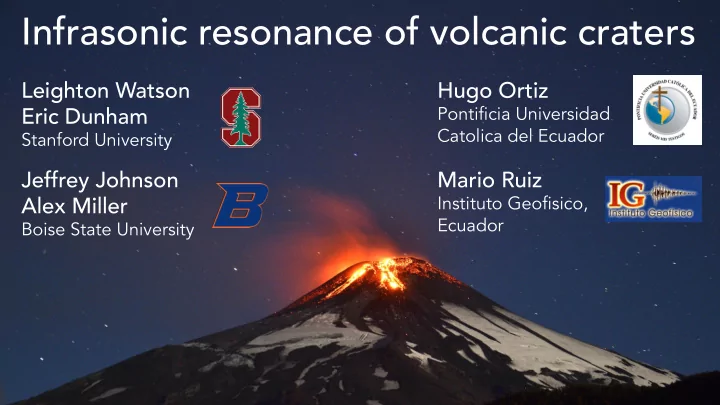
infrasonic resonance of volcanic craters
SMART_READER_LITE
LIVE PREVIEW

Infrasonic resonance of volcanic craters Leighton Watson Hugo Ortiz - - PowerPoint PPT Presentation

Infrasonic resonance of volcanic craters Leighton Watson Hugo Ortiz Eric Dunham Pontificia Universidad Catolica del Ecuador Stanford University Jeffrey Johnson Mario Ruiz Alex Miller Instituto Geofisico, Ecuador Boise State University


slide-1
SLIDE 1

Infrasonic resonance of volcanic craters

Leighton Watson Eric Dunham

Stanford University

Jeffrey Johnson Alex Miller

Boise State University

Hugo Ortiz

Pontificia Universidad Catolica del Ecuador

Mario Ruiz

Instituto Geofisico, Ecuador

slide-2
SLIDE 2

Harmonic peaks seen in infrasound from open-vent volcanoes

Data courtesy of Ortiz and Ruiz

amplitude amplitude amplitude amplitude

slide-3
SLIDE 3

Harmonic peaks seen in infrasound from open-vent volcanoes

Kilauea Kilauea

Data courtesy of Ortiz and Ruiz Fee et al. (2010)

0.5 1 1.5 2 2.5 3 3.5

Frequency (Hz)

Station: RAY Station: SHK

Er Erebus ebus

Miller and Johnson (2017)

Amplitude

amplitude amplitude amplitude amplitude

slide-4
SLIDE 4

Harmonic peaks seen in infrasound from open-vent volcanoes

Goto and Johnson (2011) Data courtesy of Marin, Cardoña and Palma

amplitude amplitude amplitude amplitude

amplitude amplitude amplitude

slide-5
SLIDE 5

Helmholtz resonator Resonant modes of horn

  • Approximate volcanic crater as a

horn open at one end and closed at the other

  • Only discrete wavelengths fit in the

horn

  • Resonant frequency is related to

length of horn Fee et al. (2010); Goto and Johnson (2011) Richardson et al. (2014) After Fee et al. (2010)

  • Resonating cavity
  • Resonant frequency

is related to size of cavity

Harmonic peaks are due to resonance of crater
slide-6
SLIDE 6

Helmholtz resonator Resonant modes of horn

  • Approximate volcanic crater as a

horn open at one end and closed at the other

  • Only discrete wavelengths fit in the

horn

  • Resonant frequency is related to

length of horn Fee et al. (2010); Goto and Johnson (2011) Richardson et al. (2014) After Fee et al. (2010)

  • Resonating cavity
  • Resonant frequency

is related to size of cavity

Acoustic waves are excited by:

  • Explosive bubbles bursts at lava lake surface
  • Unsteady gas flux through crater floor

Harmonic peaks are due to resonance of crater

slide-7
SLIDE 7

Overview of model

Compute transfer function: transfer function: maps source (velocity at base of crater) to observable (pressure perturbation) recorded at receiver

slide-8
SLIDE 8

Overview of model

(1) (1) Resonant modes of crater Resonant modes of crater (2) (2) Acoustic radiation Acoustic radiation

Compute transfer function: transfer function: maps source (velocity at base of crater) to observable (pressure perturbation) recorded at receiver

slide-9
SLIDE 9

(1) Resonant modes of crater

  • Model wave propagation inside crater
  • Compute resonant modes
  • Solve linear acoustics within crater
  • Quasi 1D axisymmetric crater
  • Frequency domain
  • Damping occurs through acoustic

radiation

  • Controlled by impedance contrast

across crater outlet

slide-10
SLIDE 10

(2) Acoustic radiation

  • Model wave propagation from crater
  • utlet to receiver
  • Radiation into a half space
  • Describe acoustic source as a baffled

piston embedded in an infinite plane

  • Do not account for topographic

scattering (Kim et al., 2015)

  • Observations are similar across all

stations in the network

slide-11
SLIDE 11

1 2 3

Frequency (Hz) Amplitude

  • 100

100

Radius (m)

100

Depth (m)

Crater geometry

Model outputs

Transfer Function

slide-12
SLIDE 12

1 2 3

Frequency (Hz) Amplitude

Model outputs

Transfer Function Spectra

2 4 6

Time (s) Amplitude

1 2 3 4 5

Frequency (Hz) Amplitude

Source: velocity profile at base of crater

  • 100

100

Radius (m)

100

Depth (m)

Crater geometry

slide-13
SLIDE 13

1 2 3

Frequency (Hz) Amplitude

Model outputs

Transfer Function Spectra

2 4 6

Time (s) Amplitude

1 2 3 4 5

Frequency (Hz) Amplitude

Source: velocity profile at base of crater

  • 100

100

Radius (m)

100

Depth (m)

Crater geometry

10 20 30

Time (s) Amplitude

20 30

Time (s)

slide-14
SLIDE 14

1 2 3

Frequency (Hz) Amplitude

2 4 6

Time (s) Amplitude

1 2 3 4 5

Frequency (Hz) Amplitude

Source: velocity profile at base of crater

  • 100

100

Radius (m)

100

Depth (m)

Crater geometry

Infrasonic resonance depends on crater depth

140 m Depth to lava lake:

10 20 30

Time (s) Amplitude

PE41B-1: PE41B-1: Johnson et al., Forecasting Paroxysmal Eruptions at Volcán Villarrica (Chile) Using

  • Infrasound. Thursday August 17th, 10:30-10:45 am.
slide-15
SLIDE 15

1 2 3

Frequency (Hz) Amplitude

2 4 6

Time (s) Amplitude

1 2 3 4 5

Frequency (Hz) Amplitude

  • 100

100

Radius (m)

100

Depth (m)

Crater geometry

Infrasonic resonance depends on crater depth

PE41B-1: PE41B-1: Johnson et al., Forecasting Paroxysmal Eruptions at Volcán Villarrica (Chile) Using

  • Infrasound. Thursday August 17th, 10:30-10:45 am.

Source: velocity profile at base of crater

10 20 30

Time (s) Amplitude

140 m Depth to lava lake: 100 m

slide-16
SLIDE 16

1 2 3

Frequency (Hz) Amplitude

10 20 30

Time (s) Amplitude

Gaussian Source function:

2 4 6

Time (s) Amplitude

1 2 3 4 5

Frequency (Hz) Amplitude

Source: velocity profile at base of crater

  • 100

100

Radius (m)

100

Depth (m)

Crater geometry

Infrasonic resonance depends on source function

slide-17
SLIDE 17

1 2 3

Frequency (Hz) Amplitude

2 4 6

Time (s) Amplitude

1 2 3 4 5

Frequency (Hz) Amplitude

  • 100

100

Radius (m)

100

Depth (m)

Crater geometry Gaussian Source function: Brune Source: velocity profile at base of crater

10 20 30

Time (s) Amplitude Amplitude

Infrasonic resonance depends on source function

slide-18
SLIDE 18

1 2 3

Frequency (Hz) Amplitude

1 2 3

Frequency (Hz) Amplitude

Infrasonic resonance depends on crater geometry

Source: velocity profile at base of crater

10 20 30

Amplitude Amplitude

10 20 30

Time (s)

2 4 6

Time (s) Amplitude

1 2 3 4 5

Frequency (Hz) Amplitude

  • 100

100

Radius (m)

100

Depth (m)

Crater geometry

Johnson et al. (2017) in prep

Geometry:

slide-19
SLIDE 19

1 2 3

Frequency (Hz) Amplitude

10 20 30

Amplitude

Source: velocity profile at base of crater

2 4 6

Time (s) Amplitude

1 2 3 4 5

Frequency (Hz) Amplitude

  • 100

100

Radius (m)

100

Depth (m)

Crater geometry

Amplitude

10 20 30

Time (s)

Richardson et al. (2014) Johnson et al. (2017) in prep

Geometry:

Infrasonic resonance depends on crater geometry

slide-20
SLIDE 20

Harmonic infrasound observations can be inverted for:

  • Depth of crater
  • Source function
  • Crater geometry

1 2 3 4 5

Frequency (Hz) Amplitude

5 10

Time (s) Amplitude

Data courtesy of Marin, Cardoña and Palma Villarrica, Chile

slide-21
SLIDE 21

1 2 3 4 5

Frequency (Hz) Amplitude

5 10

Time (s) Amplitude

Invert harmonic infrasound

  • bservations for:
  • Fit frequency and quality factor of

harmonic peak

  • MCMC inversion scheme
  • Depth of crater
  • Source function
  • Crater geometry

Inversion:

Data courtesy of Marin, Cardoña and Palma Villarrica, Chile

slide-22
SLIDE 22

1 2

Frequency (Hz) Amplitude

Data Data uncertainty

5 10

Time (s) Amplitude

Invert infrasound observations for crater geometry and source

slide-23
SLIDE 23

Data Data uncertainty Inversion input

  • 100

100

Radius (m)

50 100 150 200

Depth (m)

1 2

Frequency (Hz) Amplitude

5 10

Time (s) Amplitude

5

Time (s) Amplitude

1 2

Frequency (Hz) Amplitude

Invert infrasound observations for crater geometry and source

slide-24
SLIDE 24

Data Data uncertainty Inversion input

1 2

Frequency (Hz) Amplitude

5

Time (s) Amplitude

1 2

Frequency (Hz) Amplitude

5 10

Time (s) Amplitude

5 10

Time (s)

  • 100

100

Radius (m)

50 100 150 200

Depth (m)

Invert infrasound observations for crater geometry and source

slide-25
SLIDE 25

Inversion uncertainty

5

Time (s) Amplitude

1 2

Frequency (Hz) Amplitude

1 2

Frequency (Hz) Amplitude

Data Data uncertainty Inversion output

5 10

Time (s) Amplitude

5 10

Time (s)

  • 100

100

Radius (m)

50 100 150 200

Depth (m)

Invert infrasound observations for crater geometry and source

slide-26
SLIDE 26

5

Time (s) Amplitude

1 2

Frequency (Hz) Amplitude

1 2

Frequency (Hz) Amplitude

Inversion uncertainty Data Data uncertainty Inversion output

5 10

Time (s) Amplitude

5 10

Time (s)

  • 100

100

Radius (m)

50 100 150 200

Depth (m)

Inverted geometry matches visible observations of Villarrica crater

slide-27
SLIDE 27

Conclusion

Infrasonic resonance is seen at multiple open-vent volcanoes The resonant amplitude spectra is dependent on:

  • Crater depth
  • Geometry
  • Source function

Resonant infrasound observations can be inverted to determine these properties