
SLIDE 1
081143 Bibliotheca Alexandrina Compiled by Ahmed Ghazi, Hadir Ashraf & Manar Badr
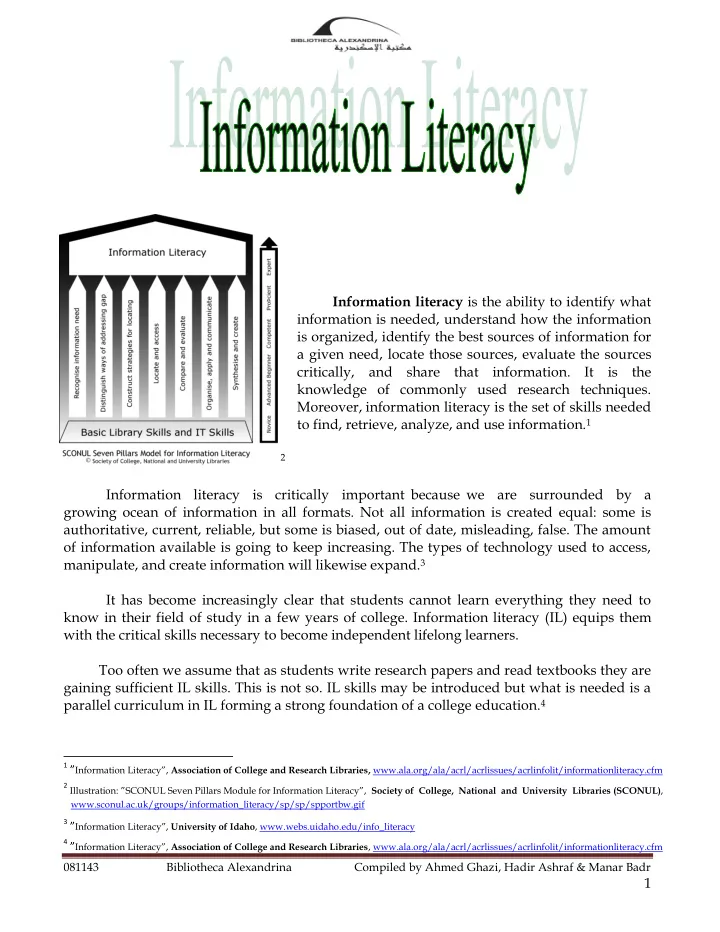
1 Information literacy is the ability to identify what information is needed, understand how the information is organized, identify the best sources of information for a given need, locate those sources, evaluate the sources critically, and share that information. It is the knowledge of commonly used research techniques. Moreover, information literacy is the set of skills needed to find, retrieve, analyze, and use information.1
2
Information literacy is critically important because we are surrounded by a growing ocean of information in all formats. Not all information is created equal: some is authoritative, current, reliable, but some is biased, out of date, misleading, false. The amount
- f information available is going to keep increasing. The types of technology used to access,
manipulate, and create information will likewise expand.3 It has become increasingly clear that students cannot learn everything they need to know in their field of study in a few years of college. Information literacy (IL) equips them with the critical skills necessary to become independent lifelong learners. Too often we assume that as students write research papers and read textbooks they are gaining sufficient IL skills. This is not so. IL skills may be introduced but what is needed is a parallel curriculum in IL forming a strong foundation of a college education.4
1 ”Information Literacy”, Association of College and Research Libraries, www.ala.org/ala/acrl/acrlissues/acrlinfolit/informationliteracy.cfm 2 Illustration: ”SCONUL Seven Pillars Module for Information Literacy”, Society of College, National and University Libraries (SCONUL),
www.sconul.ac.uk/groups/information_literacy/sp/sp/spportbw.gif
3 ”Information Literacy”, University of Idaho, www.webs.uidaho.edu/info_literacy 4 ”Information Literacy”, Association of College and Research Libraries, www.ala.org/ala/acrl/acrlissues/acrlinfolit/informationliteracy.cfm