
SLIDE 1
October 31st, 2013
Infiltration of CNT-M Microstructures using CVD and ALD
Presented by: Collin Brown, Jason Kyle Anderson
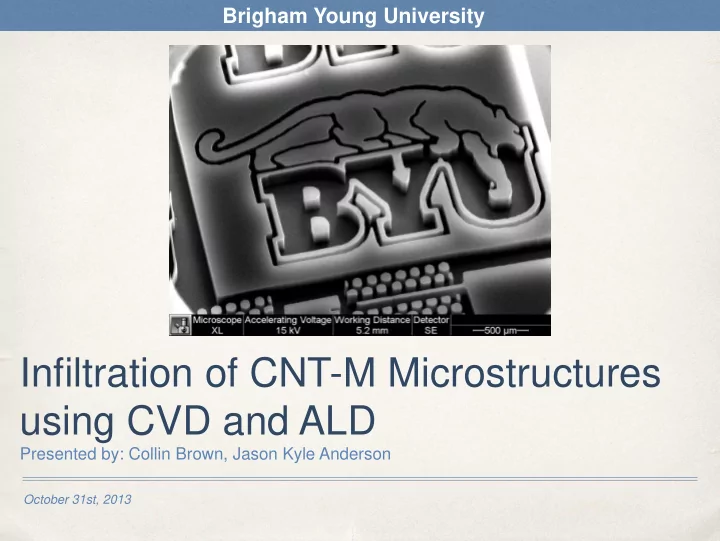
Infiltration of CNT-M Microstructures using CVD and ALD Presented - - PowerPoint PPT Presentation
Brigham Young University Infiltration of CNT-M Microstructures using CVD and ALD Presented by: Collin Brown, Jason Kyle Anderson October 31st, 2013 Brigham Young University Acknowledgments Jason Kyle Anderson for his help in getting the
October 31st, 2013
Presented by: Collin Brown, Jason Kyle Anderson
✤Purpose of Deposition Techniques ✤Overview of CNT-M ✤Theory of Deposition ✤Chemical Vapor Deposition (CVD) ✤Atomic Layer Deposition (ALD) ✤Conversion of CVD system to ALD ✤Initial Results ✤Initial Characterization with SEM, TEM, and XEDS
✤ Create mechanical and electrical components on a
✤Limited selection of materials -
✤Poor aspect ratio (height to width) ✤(~5:1) aspect ratio due to gas
Silicon Wafer Photoresist Mask Hot Ethylene
✤ When used to infiltrate a CNT, called Chemical Vapor Infiltration (CVI) ✤ Flow reactants into chamber constantly, usually at high temperature ✤ Heat the solid precursor so it will volatilize ✤ Flow an inert gas to carry the precursor to the sample ✤ Problems ✤ Uneven Infiltration ✤ Capping
Carbon Nanotube Forest Infiltrated with Mo(CO)6 by Richard Hansen
✤Gaseous form of WF6 self-limits deposition ✤Flow H2, monatomic Hydrogen from Plasma, or Silane ( SiH4 ) ✤H reduces WF6 leaving a layer of W ✤HF gas molecules created
Sample
✤ Automate LabviewTM program to cycle valves for ALD
✤ Constant H (40 sccm) - from a Hydrogen Plasma ✤ 5 seconds of WF6 (0.0142 l at 5 psi, about 2.0 x 10⁻⁴
✤ 120 cycles ✤ 235 degrees C - sample temperature ✤ Ozone treated 1 of the samples for 20 min, for better
✤ 7
No obvious difference between chemical makeup of small or large stuff
✤ scattered peaks have a lattice spacing too large for BCC tungsten ✤ may be an A15 compound, something like Beta-Tungsten
✤ Optimize procedure (Intervals, flow rates, etc.) ✤ Silane vs. Hydrogen ✤ Ozone treatment vs. No Ozone treatment vs. In Situ Ozone treatment ✤ Annealing ✤ Characterization by SEM & TEM cross sectioning, Also X-ray characterization at ALS, FIB ✤ Capping ✤ Grain size uniformity ✤ Electrical conductivity ✤ Mechanical Properties
<http://www.eetasia.com/ART_8800479803_1034362_NT_ca7d6a67.HTM>.
<http://www.oxfordplasma.de/process/arde.htm>.
Allred, and Robert C. Davis. “Effect of Iron Catalyst Thickness on Vertically Aligned Carbon Nanotube Forest Straightness for CNT-MEMS.” Journal of Micromechanics and Microengineering 22 (5) 055044. May 2012 and references cited therein.
Microstructures." Senior Thesis. June 2012.