SLIDE 1
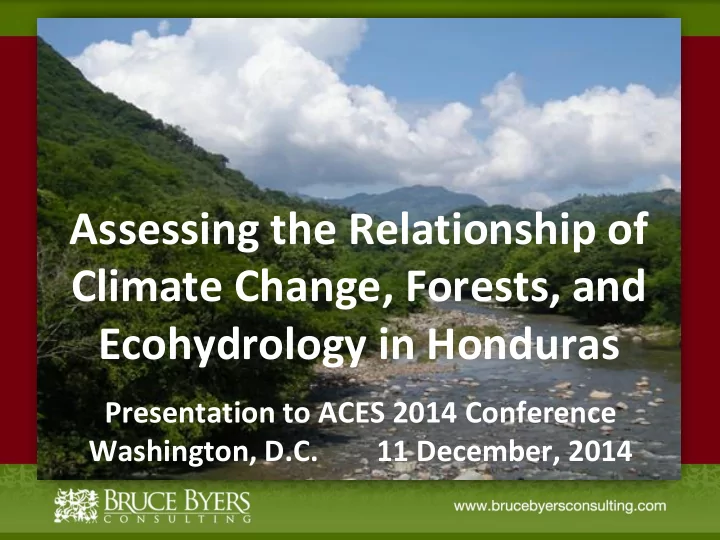
Assessing the Relationship of Climate Change, Forests, and Ecohydrology in Honduras
Presentation to ACES 2014 Conference Washington, D.C. 11 December, 2014
SLIDE 2 Acknowledgments & Disclaimer
- This work was carried out for USAID-
Honduras under the USAID African and Latin American Resilience to Climate Change (ARCC) Project, which ended last month
- The information presented here is the sole
responsibility of the authors and does not necessarily reflect the views of USAID
- Our final report was approved was approved
by USAID in December 2013 and is available
SLIDE 3
SLIDE 4 Research Team
- Bruce A. Byers – Ecologist
Bruce Byers Consulting, Falls Church, VA, USA
- Luis A. Caballero – Ecohydrologist
Department of Environment & Development Studies, Zamorano University, Zamorano, Honduras
- Anton Seimon – Climate Scientist
Climate Change Institute, University of Maine, Orono, ME, USA
SLIDE 5 USAID Context: Climate Change & Ecosystem Services
- USAID’s 2012 Climate Change and
Development Strategy lists 10 “Guiding Principles”, one of which is to “value ecosystem services.”
- The strategy states that “Strategic
investments in ecosystem services can mitigate the impacts of climate change.”
SLIDE 6
Assessment Area: Southern Honduras, Gulf of Fonseca Basin
SLIDE 7
Land Cover & Land Use
SLIDE 8
Cloud Forest
SLIDE 9
Cloud Forest
SLIDE 10
Pine Forest
SLIDE 11
Broadleaf Forest
SLIDE 12
Dry Forest & Shrublands
SLIDE 13
Mangroves
SLIDE 14
Small-scale Agriculture & Pasture
SLIDE 15
Small-scale Coffee
SLIDE 16
Commercial Agriculture -- Sugarcane
SLIDE 17
Commercial Agriculture -- Melons
SLIDE 18
Commercial Shrimp Aquaculture
SLIDE 19
Land Cover & Land Use
SLIDE 20 Ecosystem Services -- Ecohydrology
Sustainable and predictable flows of clean water are the key ecosystem service upon which every socio- economic group, and the economy of southern Honduras, depend.
SLIDE 21 Ecosystem Services -- Ecohydrology
Permanent land cover – of forests
vegetation, or agroforestry farming systems – is critical to maintaining the ecohydrology of the region.
SLIDE 22
Forest Cover & Ecohydrology
Upland forests allow precipitation to infiltrate and recharge groundwater rather than run off, and groundwater flow stabilizes streamflow.
SLIDE 23 Forest Cover & Ecohydrology
Land Cover Infiltration Rate Primary Forest >840 mm/hr Coffee Plantation 89-109 mm/hr Heavily-grazed Pasture 8-11 mm/hr
Source: Hanson et al., 2004. Effects of soil degradation and management practices on the surface water dynamics in the Talgua River Watershed in Honduras.
SLIDE 24 Forest Cover & Ecohydrology
Watershed Permanent Land Cover (%) Runoff (%) Zapotillo 59% 31% Capiro 39% 39%
Source: Bonilla Portillo and Garay, 2013. Rainfall-runoff relationship and suspended sediment concentration in Capiro-Zapotillo micro-watersheds, Guinope, El Paraiso, Honduras.
SLIDE 25 Ecohydrology & Forest Cover
permanent land cover in a watershed is a measure of its vulnerability to the loss of ecohydrological services.
ratio for the five major watersheds of the Gulf
SLIDE 26
Watersheds of the Gulf of Fonseca
SLIDE 27 Permanent Land Cover Ratio for Major Watersheds
River/Watershed Area (km2) Permanent Land Cover (km2) Permanent Land Cover Ratio Choluteca 7109 2546 0.36 Goascoran 1666 465 0.28 Nacaome 2707 581 0.21 Negro 802 77 0.10 Sampile 738 52 0.07
SLIDE 28
Protected Areas Conserve Upland Forests & Mangroves
By maintaining permanent land cover they anchor the resilience of ecohydrological services in southern Honduras.
SLIDE 29
Land Cover & Land Use
SLIDE 30
Protected Areas Conserve Upland Forests & Mangroves
SLIDE 31
Climate Analysis Results
Temperature: IPCC models predict temperature increase of ~ 2º C by 2050
SLIDE 32 Climate Analysis Results
Precipitation: IPCC models predict precipitation decrease of ~ 10-20% by 2050 1986–2005
2016–2035, 2046–2065 2081–2100 1986–2005
1 9 8 6 – 2 5
8 1 – 2 1 2 1 6 – 2 3 5 , 2 4 6 – 2 6 5 2 8 1 – 2 1 1 9 8 6 – 2 5
SLIDE 33
Potential Effects of Climate Change on Ecosystems
SLIDE 34 Potential Effects of Climate Change on Ecosystems
suitable for wetter forest types (e.g., cloud forest, broadleaf forest, dense pine forest) would decrease by almost 50%.
significant ecological change that would affect ecohydrological services.
SLIDE 35
Conclusions
Communities and municipalities of the region, and also the large private-sector commercial agro- industries (shrimp, melons, sugarcane), are all heavily dependent on ecosystem services, especially water.
SLIDE 36
Conclusions
All current livelihoods – from subsistence to agro-industrial – are vulnerable to climate change because it will affect ecosystems, and the services they provide.
SLIDE 37
Conclusions
An integrated, ecosystem-based approach to climate change adaptation is a necessary component of any effective strategy for food and livelihood security, and for economic growth, in southern Honduras.
SLIDE 38
Conclusions
Climate change adaptation in southern Honduras will require watershed- and landscape-scale forest protection and restoration.
SLIDE 39
Land Cover & Land Use
SLIDE 40
Conclusions
Commercial agro-industries are aware of how dependent they are on ecohydrological services and expressed an interest in developing compensation mechanisms that would help protect and restore upper watersheds.
SLIDE 41
Let’s Take Care of the Forests!
SLIDE 42
!
Thank You! Questions & Comments?