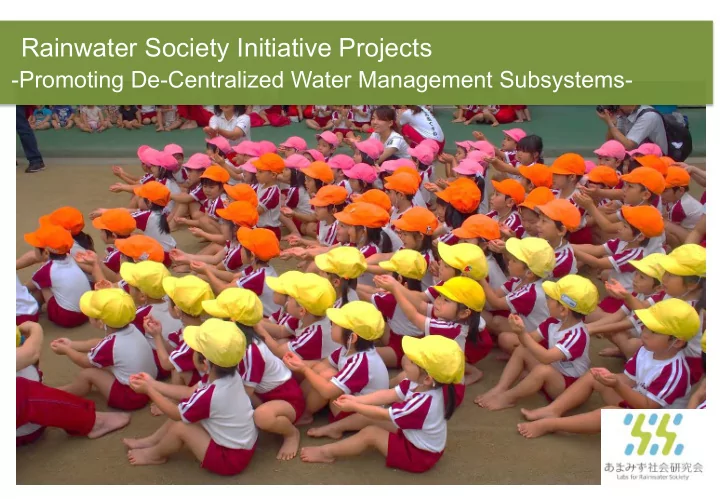
SLIDE 1 Rainwater Society Initiative Projects
- Promoting De-Centralized Water Management Subsystems-
SLIDE 2 Background (Project Target): Urban Water Management Problems
Challenges resulted from Past actions:
- Conventional Approach of Water Management: Neither handle unexpected situations nor expand
coverage areas due to the fact that current water management system is too huge and unchangeability.
- While populations is decreases, is it possible to keep O&M costs of water management infrastructures.
- Comprehensive flood controls and water management only succeeded in new development. It has
not succeeded in existing urban areas. Flood control actions didn’t spread due to its single purpose.
⇒
- :
- ⇒
- Un-sustainability in water/ Floods/ Droughts/ Water shortage in time of earthquake disaster /
Environmental degradation/ Heat-island phenomenon
- Social Challenges: Community degradation related to water/ Loss of opportunities to touch and play
with living nature/ Un-pleasant society
SLIDE 3
Background: Current society that un-recognizes water management systems
Due to feature of the current rainwater management system that bury rainwater pipes into the ground, people cannot recognize how rainwater discharge through their living environment, therefore it makes difficult to evoke people’s interest and understanding about the better rainwater management system. Separate sewerage
Road Rainwater inlet Rainwater pipe to a river when floods to a treatment plants Sewer pipe Rainwater Wastewater
SLIDE 4
A proposed vision: Rainwater Society
We define “Rainwater Society” as a society that under the de-centralized water management system, multi-generational people cooperate to store, infiltrate, and harvest rainwater and increase green spaces at everywhere in a watershed region. Focusing on water which feature is multi-faceted, we envision Rainwater Society as a model of modern social problem-solution method. Rainwater Society should be continually transformed and improved by multi-generational co-creation.
Infiltration Rainwater Storage Raingarden Raingarden Infiltration Infiltration inlet Delay runoff Rainwater Harvesting Rainwater pipe to a river when floods to a treatment plants Sewer pipe
SLIDE 5
Project team: Labs of Rainwater Society
・Kyushu University Faculty of Engineering, ・Kyushu Sangyo University Faculty of Engineering ・Fukuoka University Faculty of Engineering ・Fukuoka Institute of Technology Faculty of Social and Environmental Studies ・The University of Tokyo graduate school of Frontier Sciences ・Kumamoto University Faculty of Advanced Science and Technology ・Tokyo Gakugei University Field Studies Institute for Environmental Education And Fukuoka Association of Architects & Building Engineers
SLIDE 6 Team organization
Group to promote cooperation among multi-generations Group to develop and innovate element technologies Group to create a network among stakeholders Group to gather the threads
Propose a new water management system Innovate element technologies Implementation and appraisal Community based flood control simulation Evaluate an ecosystem service Visualize water management systems Cha-kai (community tea party) Education about rainwater management Rainwater Center Create a watershed-scale network Train a rainwater coordinator Policy recommendations Pictorial map of memories
SLIDE 7
Spread the Concept of Rainwater Society
Spread the concept of Rainwater Society to multi-generations by education and workshop
Amamizu (rainwater) Rangers Kids in kindergarten Environmental education Workshops for adults
SLIDE 8
Open Rainwater Centers
Two centers have been launched.
Rainwater Science Center Convivial Center for Rainwater Harvesting
SLIDE 9
Networking and Human Resource Cultivation
Founding an network to cooperate with stakeholders. Training Rainwater Coordinators.
SLIDE 10 Re-evaluate the Capabilities of Infiltration
- The capabilities of infiltration in green spaces could be re-evaluated.
- Take advantage of the capabilities of infiltration is basic technique for run-off
reduction.
Asphalt Ground Lawn Shrub Ever- green Forest Ag. Field Deciduous trees Forest
SLIDE 11 Invent a rainwater tank with adjusting hole
Implement a 3.7m3-size tank with adjusting hole for floods control Outcomes: Cutting peak runoff / Downsizing tank/ Clarifying the capacity of floods control and water use
[Conventional tank] [Tank with adjusting hole]
Water use Floods control Water use Floods control runoff
- Ensure a certain amount
- f capacity for floods
control
adjusting hole size
capacity for floods control while keep tank size small runoff inflow runoff inflow
SLIDE 12
Infiltration capacity measuring equipment which is simple way and easy to use. People can understand infiltration capacity using this tool.
Innovate a Tool to Measure the Capacity of Infiltration
SLIDE 13
Existing single family house model
Convivial Center for Rainwater Harvesting
Implementation 50years old single house model which infiltrate and harvest all amount of rainwater in this site.
Rainwater foot bath Kame(pots) Storage cases Garden&Stream
SLIDE 14
民区的
Rainwater use, for bathroom Rainwater use Strage case Pipe for infiltration
WATER CIRCULATION TYPE BIOTOPE
Rainwater Use Foot bath Emergency rainwater storage
infiltration infiltration
SLIDE 15 Implementation/Evaluation(In progress)
- Existing Apartment House / Rainwater storage on rooftop and water use at each
balconies.
- Existing Affordable housing / Urban farming with rainwater use.
- Japanese art of archery field / Soil improvement and Implementing Trench.
- Road in a campus / Introducing and infiltrating rainwater to plants in roads.
- Implementing various soils for reevaluating the capabilities of infiltration.
- Existing Junior-high School / Student workshop for planning school renovations.
School Renovation Plan by harvesting rainwater Conceptual section of Existing apartment house
SLIDE 16 Community-scale Floods Control
- Hypothesis: “Inland floods” that occur in and around a community could be prevented
by community-scale actions.
- “Inland floods” often occur locally. Simulating and analyzing inland floods prevention
effect by local community-scale actions.
By introducing rainwater infiltration and rainwater retention into N1, N2, N3, it is possible to prevent overflow from manhole
SLIDE 17
Spread Effects to Other Regions
Unexpected new citizen movements are occurred. New River Festival Cutting downspouts Movement in Machida city,Tokyo
Cutting downspouts movement New Festival: River-Firefly