INDUSTRIAL VIABILITY OF APA-6 MATRIX-BASED BASALT FIBER REINFORCED - - PDF document

industrial viability of apa 6 matrix based basalt fiber
SMART_READER_LITE
LIVE PREVIEW

INDUSTRIAL VIABILITY OF APA-6 MATRIX-BASED BASALT FIBER REINFORCED - - PDF document

18 TH INTERNATIONAL CONFERENCE ON COMPOSITE MATERIALS INDUSTRIAL VIABILITY OF APA-6 MATRIX-BASED BASALT FIBER REINFORCED COMPOSITES A. Alfonso 1 , R. Hoto 1 , J. Andrs 1 , J.A. Garca 1* 1 Instituto de Diseo y Fabricacin (IDF) Universidad


slide-1
SLIDE 1

18TH INTERNATIONAL CONFERENCE ON COMPOSITE MATERIALS

1 Introduction Liquid Composite Molding (LCM) consists of the manufacture of components from polymer matrix compounds, by impregnating a fabric inside an enclosed mold with a low viscosity resin (generally thermoset). The liquid is injected into the mold by pressure difference between the resin inlet and the air outlet; this can either be positive (pressure injection, RTM) or negative (VARI, light RTM, SCRIMP, etc.). Due to the increasing usage of composite materials, it becomes of the utmost importance to manufacture innovative ones which are environmentally friendly (both during their sintering and life cycle) and allow recyclability. This new type of Greencomposites mainly consists of a Thermoplastic (TPC’s) matrix to which different fabrics are embedded through mechanical and even chemical bonding. In fact, the matrix determines most of the mechanical and chemical properties, since it makes up to 90% of the composite. Unlike Thermoset-based matrices, their thermoplastic counterparts can be recycled [1]. In addition, TPC’s do also offer higher mechanical properties such as toughness and resistance to fatigue, and can be welded [1]. Basalt fibers are also being investigated for various reasons. On the one hand, the manufacturing of basalt fabrics results more cost- efficient than that of E-glass fibers, yet their mechanical properties are as good as those of its E- glass counterpart [2]. On the other hand, it presents properties worth remarking such as high-temperature resistance (up to 400ºC), chemical stability and non- combustibility. In addition, basalt fibre is environmentally and ecologically harmless, and free

  • f carcinogens and other health hazards [3][4]. The

present paper summarizes all research done on industrial applicability of those materials plus the use of numerical simulation, which intends to save costs within this context. All the study has been done at the Instituto de Diseño y Fabricación. 2 Materials and Methods In this research work, PA-6 is analyzed as matrix

  • material. It is achieved after the injection of various

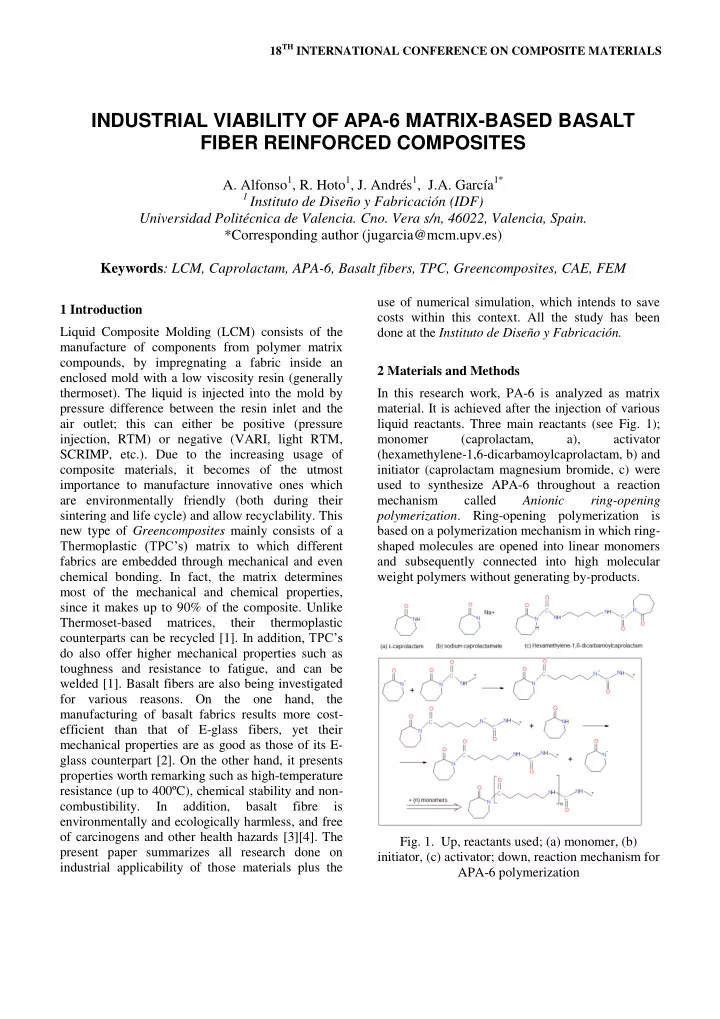
liquid reactants. Three main reactants (see Fig. 1); monomer (caprolactam, a), activator (hexamethylene-1,6-dicarbamoylcaprolactam, b) and initiator (caprolactam magnesium bromide, c) were used to synthesize APA-6 throughout a reaction mechanism called Anionic ring-opening

  • polymerization. Ring-opening polymerization is

based on a polymerization mechanism in which ring- shaped molecules are opened into linear monomers and subsequently connected into high molecular weight polymers without generating by-products.

  • Fig. 1. Up, reactants used; (a) monomer, (b)

initiator, (c) activator; down, reaction mechanism for APA-6 polymerization

INDUSTRIAL VIABILITY OF APA-6 MATRIX-BASED BASALT FIBER REINFORCED COMPOSITES

  • A. Alfonso1, R. Hoto1, J. Andrés1, J.A. García1*

1 Instituto de Diseño y Fabricación (IDF)

Universidad Politécnica de Valencia. Cno. Vera s/n, 46022, Valencia, Spain. *Corresponding author (jugarcia@mcm.upv.es) Keywords: LCM, Caprolactam, APA-6, Basalt fibers, TPC, Greencomposites, CAE, FEM

slide-2
SLIDE 2

The role of the initiator is to provide the polymeric chain with the necessary electrical charge for chain growth in its anionic form (C6H10ON-). The activator consists of a derivated species from caprolactam, in which a carbamoyl group has been attached to its nitrogen atom. By doing so, the carbonyl group gets electrically destabilized, which boosts the chain growth. This reaction must be carefully carried out in a free moisture environment, as the anionic reaction is easily miscarried by proton donating species. Therefore, precursors mixing and processing must be done in a protective atmosphere such as of Ar. 2.1 Experimental Set-up In order to work under proper conditions and meet the necessary reaction conditions, all synthesis were carried out within a glove box (see Fig. 2), to which Ar was infused from an Argon gas cylinder.

  • Fig. 2. Set-up for cast samples, with Argon gas

infusion cylinder (right) and atmospheric air drain pump (left). Ar is denser than atmospheric air, ensuring a faster draining.

  • Fig. 2 shows the layout to first attempt to obtain

APA-6 samples. Caprolactam supplied by two different companies (UBE [5] & Brüggemann [6]) was used in this study. Fig. 3. shows the set-up for the first trials done by vacuum infusion (VI) within the glove-box. Brüggemann’s C10 & C20 [6] were used as initiator and activator respectively. Two main solutions, A (monomer + initiator) and B (monomer + activator) are to be preheated at temperatures below 130ºC (in

  • rder to avoid reaction catalysis at this step [1]) and

mixed up while stirring. Eventually, the final solution was either cast or infused into a mold at a certain mold temperature, and left curing some time. In fact, at temperatures ranging from 140-180ºC, caprolactam monomer polymerizes into highly crystalline PA-6 in 3-30min. depending on the type and amount of initiator and activator added [10]

  • Fig. 3. Layout of the trials carried out within a glovebox:

(a) weighing and warming of the reactants, (b) heated closed mold, (c) additional vacuum pump, for infused samples.

2.2 Set-up for industrial viability Additional investigation and adaptations to bring APA processing into industrial practice is required, due to the specific requirements of storage, handling and processing of the products. Fig. 4 shows the assembly of the injection device designed at the IDF for this proposal [8]. In it, after mixing (in (c)) the activator and initiator (from (a) and (b)), a stepper motor (f) controls the displacement of a piston (e) while monitoring the pressure and temperature of the thermoplastic flowing through (g).

  • Fig. 4. Left, assembly of the injection device

designed at the IDF; right, control system of the device designed for the present study. 2.3 CAE simulation of Themoplastic LCM (TpC- LCM) The mold design requires a previous study of many variables that are dependent on the material, the

slide-3
SLIDE 3

3

18TH INTERNATIONAL CONFERENCE ON COMPOSITE

MATERIALS

process itself and the geometry of the part. Usually, an incomplete study can reduce the part quality in complex geometries. That is why Finite Element Method (FEM) simulation packages are very helpful work tools in the industrial field, as they allow comparing alternative filling sequences. Therefore, it makes it possible to optimize the process while saving costs and lead times. They are based on a discretization of Darcy´s equation. More information

  • n this field is described in [13]. The basic mold of
  • Fig. 3-b is shown in Fig. 5.
  • Fig. 5. Experimental injection mold for TpC-LCM,

with 4 basalt layers: 0º, +45º, -45º, 90º. In basic injection of APA-6, all esential equations used in solving the proposed model by FEM are [13]: Darcy´s Law:

P K v    

Resin Viscosity:

 

5 . 17 10 * 525 . 3 10 * 7 . 2 ) / exp( * ,

3 7

    

 

C B A C T B A T   

Resin reokinetics:

   

1 ns subreactio

  • f

number , *

1

  

i T f t w dt d

n i i

 

     

) / 8432 exp( * 1 * * 11 1 * 33 . 5 ,

04 . 1

T T f       

As can be seen in Fig. 6, the results of the simulation are in good agreement with the expected properties

  • f the APA-6:

 The flow front is accelerated on both the top and the bottom mold walls because of a lower resin viscosity. The mold is warmed up to 150ºC and APA-6 is injected at 110ºC  The injection time is very short compared with traditional thermoset injection (LCM)  The five layers of basalt fiber reinforced were completely wetted by APA6 precursors

  • Fig. 6. TpC-LCM simulation with basalt fiber

reinforcing 4 Results and discussion 4.1 Analysis of the reactants As a proton donating species, the presence of water is to be avoided during the handling and processing as it stops the anionic polymerization. In fact, due to the anionic nature of the reaction, the polymerization is terminated by acidic groups [10], such as water. Namely, different trace amounts of water were measured by means of a Karl Fischer titration method in the following reactants (Table

I). Samples named UBE and Brüggemann consist

  • f pure caprolactam from those manufacturers. C10

& C20 are the commercial products Brüggolen C10 & C20, distributed by Brüggemann. C10 & C20 consist of initiator and activator mixtures with caprolactam respectively. The initiator content (sodium caprolactamate) in Brüggolen C10 is 1 mol/kg concentration in caprolactam, whilst the activator content (hexamethylene - 1,6 dicarbamoyl

  • caprolactam) in Brüggolen C20 is 2mol/kg

concentration in caprolactam [11]. It can be seen that values for C10 are considerably high, maybe due to its salt nature, whose ions attach water molecules more strongly. It must also be remarked that non-specific AP-caprolactam (UBEb) has more moisture than its shortly stored equivalent from Brüggemanna. On the other hand, the fact that old C10 presents higher humidity than its shortly stored counterpart, seems to indicate that moisture

slide-4
SLIDE 4

increases with exposure time to atmospheric air. Therefore, vacuum dissecation at relatively high temperatures proves important before sintering in

  • rder to remove water [12].

Table I. Humidity contents in the reactants obtained by Karl-Fischer titration

H2O (%) SAMPLES 1st H2O 2nd H2O AVERAGE UBEb 0,0135 0,0132 0,0134 Brüggemanna 0,0086 0,0088 0,0087 C10a 3,1364 3,1615 3,15 C10b 3,3290 3,3334 3,33 C20a 0,1676 0,1704 0,17

  • a. Samples after one week of storage in laboratory
  • b. Samples after nine months of storage in laboratory

In order to assess water presence, all reactants were also tested by TGA and thermograms were obtained using a Mettler Toledo TGA/SDTA 851 equipment (Fig. 7 and Fig. 8). Fig. 8 represents the weight loss at the step 100-130ºC, which is caused by both water and caprolactam vapors loss. The main peak shift to lower temperatures with increasing humidity (see

  • Fig. 7), seems to indicate that caprolactam can form

a complex with water molecules and when the latter evaporates so does caprolactam attached to water. Apart from C20 (whose weight loss at 100-130ºC is 0.45% at most), all of the remaining samples present high loss weight values. It is yet to be determined whether it is caprolactam or water which represents the major weight loss at 100-130ºC. Fig. 8 is therefore an indicator of the samples’ humidity.

  • Fig. 7. TGA thermogram tests carried out to 5

Brüggemann’s caprolactam samples: weight loss in time shown above. Derivative peaks shown below.

1 2 3 4 5 6 7 8 9 10 11 12 13 14 15 16 17 1 2 3 4 5 6

Weight loss 100-130ºC ( % wt)

Sample number

Weight loss values at 100-130ºC

UBE Brüggemann C10 C20

  • Fig. 8. Weight Loss at 100-130ºC for 5 random

traces of each set of reactants. 4.2 Obtained samples Various samples of caprolactam from UBE and Brüggemann were sintered at different conditions in

  • rder to assess the effect of several variables in the

final product. For the experiments, two glasses, A and B, each of them a mixture of caprolactam with C10 initiator (Glass A), and C20 activator (Glass B) respectively, were preheated and mixed together into the mold for curing during 30min in an inert atmosphere (see Fig. 2). The added amounts of C10 and C20 are expressed in Tables II, III & IV. Generally, the mold temperature was kept relatively low (150ºC) because synthesis at low temperature boosts crystallization, which translates into better mechanical performance of resulting material [1]. Moreover, preheating proves important for the removal of water, and that’s why preheating temperatures were higher than caprolactam’s melting point (69ºC) [12]. The study trials are summarized in the tables II, III and IV. SEM micrographs were also taken from the polymerized samples. As can be appreciated in Fig. 10, both samples look pretty alike. Differences in compactness can be told, being Brüggemann’s sample much more compact. However, this difference in compactness isn’t necessarily due to the nature of the reactants; for instance, we could be

  • bserving in UBE a surface in which caprolactam

evaporation bubbles have been embedded.

slide-5
SLIDE 5

5

18TH INTERNATIONAL CONFERENCE ON COMPOSITE

MATERIALS

Therefore, a more in-depth study and more samples preparation is needed to make such statements. Table II. Samples infused with C10b and C20b

N Origin Initiator C10 [%wt.] Activator C20 [%wt.] Preheating T (ºC) Curing T (ºC) Basalt fibers Polymerization 1 Brüggemann 2 1.5 100ºC 150 ºC Present Unsuccessful

Table III. Samples cast with reactants C10b and C20b

N Origin Initiator C10 [%wt.] Activator C20 [%wt.] Preheating T (ºC) Curing T (ºC) Basalt fibers Polymerization 2 Brüggemann 2 1.5 100 ºC 150 º C Present Unsuccessful 3 Brüggemann 4 3 150 ºC 150 º C Non-present Successful 4 UBE 4 3 150 ºC 150º C Non-present Successful 5 Brüggemann 4 3 150 ºC 150 ºC Non-present Poor 6 Brüggemann 4 3 150 ºC 150 ºC Present Unsuccessful 7 UBE 4 3 150º C 150 ºC Non-present Intermediate 8 UBE 4 3 150º C 150 ºC Present Unsuccessful

Table I. Samples cast with C10a and C20a

N Origin Initiator C10 [%wt.] Activator C20 [%wt.] Preheating T (ºC) Curing T (ºC) Basalt fibers Polymerization 9 Brüggemann 2 1.5 100 ºC 150 º C Non-present Unsuccessful 10 Brüggemann 4 3 150 ºC 150 ºC Non-present Successful

  • Fig. 9. Left, unsuccessfully polymerized samples (up, with basalt fibers); right, succesfully polymerized samples

(ivory colour).

  • Fig. 10. Up, SEM Micrograph (2000x) of

Polyamide-6 sintered from Brüggemann’s

  • caprolactam. Down, sintered from UBE’s

caprolactam.

  • 4. Conclusions

It can be seen that only those samples preheated at high temperatures (150ºC) and with high concentrations did polymerize successfully. However, all reactants not always polymerize under these same conditions (e.g. samples 5 & 6, although being sintered under the same conditions as samples 7 & 9, did not polymerize). The reason is thought to be that humidity presence is pretty heterogeneous in the reactants and depends on whether the used traces present higher or lower moisture values. Final product presents both high strength and elasticity. Caprolactam and C10 are very sensitive to water

slide-6
SLIDE 6

take-up, and C20 seems less sensitive. These reactants must be stored in aluminum-sealed bags in

  • rder to keep them from absorbing moisture. The

heterogeneity in water take-up explains why some traces of the reactants reacted while others did not (see Fig.6). In fact, moisture in the reactants can be eliminated with heating of the reactants at temperatures lower than 130ºC, temperature at which caprolactam vapours seem to be released (see

  • Fig. 7). The capability of caprolactam to attach to

water molecules when they evaporate seems to explain its volatility, which turns into material loss In order to verify the release of caprolactam vapors and quantify the humidity loss via TGA, further IR analysis of the released vapors and characterization via DSC is expected. In the future, storage and polymerization must take place in an enclosed circuit (see Fig. 4). Applying vacuum conditions within the circuit may prove interesting in order to reduce water’s boiling point and therefore remove water more easily when heating. Moreover, FEM simulation has shown its relevance in the design of TpC-LCM experiments which are to be carried out by both VI and controlled injection rate (Fig. 4, [13]).

  • 5. Acknowledgements

This research work is supported by the Spanish Ministerio de Ciencia e Innovación, project DPI2010-20333. We are grateful to both of our suppliers (Brüggemann [Heilbronn, Germany] and UBE [Castellon, Spain]), for their reactants supply and their assessment in the sintering of Polyamide-6. We must also thank the Instituto de Tecnología Materiales located at UPV and headed by Amparo Ribes, for all tests carried out at their facilities and their assessment, regarding material and humidity characterization measurements via TGA. References

[1] K. van Rijswijk, H.E.N. Bersee, A.Beukers, S.J. Picken, A.A. van Geenen “Optimisation of anionic polyamide-6 for vacuum infusion of thermoplastic composites: Influence of polymerization temperature

  • n matrix properties”. Composites: Part A 37 (2006)

949-956 [2] V.Fiore, G. Di Bella and A.Valenza “Glass- basalt/epoxy hybrid composites for marine applications”. Materials and Design 32 (2011) 2091- 2099. [3] F. M. Kogan and O. V. Nikitina, Solubility of chrysotile asbestos and basalt fibers in relation to their fibrogenic and carcinogenic action, Environmental Health Perspectives 102 Supplement 5, 205–206 (1994) [4] http://www.basfiber.com/basalt-fabric [5] http://www.ube.es/index.html [6] http://www.brueggemann.com/english/caprolactam- anionische-polym.html (Accessed on January 2, 2011) [7] Van Rijswijk K, Bersee HEN, Jager WF, Picken SJ. Optimisation of anionic polyamide-6 for vacuum infusion of thermoplastic composites: choice of activator and initiator. Compos Part A: Appl Sci Manufact 2005;37:949–56. [8] J. Andres, R. Hoto, G. Molle, J.A. García; An efficient equipment for control and monitoring in Green Composites LCM manufacturing. A new proposal for anionic reactive injection molding of caprolactam; International Review of Chemical Engineering (Rapid Communications) - December 2010 (Vol. 2 N. 7) [9] Phytron, Inc, "ZSH 57 to 107 (2-Phase Hybrid Stepper Motor)" ,600 Blair Park Rd, Suite 220, Williston, VT 05495 USA; www.phytron.com [10] K. van Rijswijk, A.A. van Geenen, H.E.N. Bersee. Textile fiber-reinforced anionic polyamide-6

  • composites. Part II: Investigation on interfacial bond

formation by short beam shear test. Composites: Part A 40 (2009) 1033-1043 [11] K. van Rijswijk, S.Lindstedt, D.P.N. Vlasveld. Reactive processing of anionic polyamide-6 for application in fiber composites: A comparative study with melt processed polyamides and nanocomposites. Polymer Testing 25 (2006) 873-887 [12] K. van Rijswijk, H.E.N. Bersee. Reactive processing

  • f textile fiber-reinforced thermoplastic composites –

An overview. Composites: Part A 38 (2007) 666-681 [13] R. R. Hoto, J.Andrés, B. Cabillic, Ll. Gascón, J.A. García; OPTIMIZATION OF MECHANICAL PROPERTIES OF BASALT WOVEN/APA-6 COMPOSITE PARTS BY MEANS OF VELOCITY CONTROL, Proceedings of the 18ICCM, Korea, 2011, unpublished.