
SLIDE 1
INDIA PRESENTATION page Author: Jennifer, August 2005 1 History: “The Indus Valley civilization, one of the
- ldest in the world, dates back at least
5,000 years. Aryan tribes from the northwest invaded about 1500 B.C.; their merger with the earlier Dravidian inhabitants created the classical Indian
- culture. Arab incursions starting in the 8th
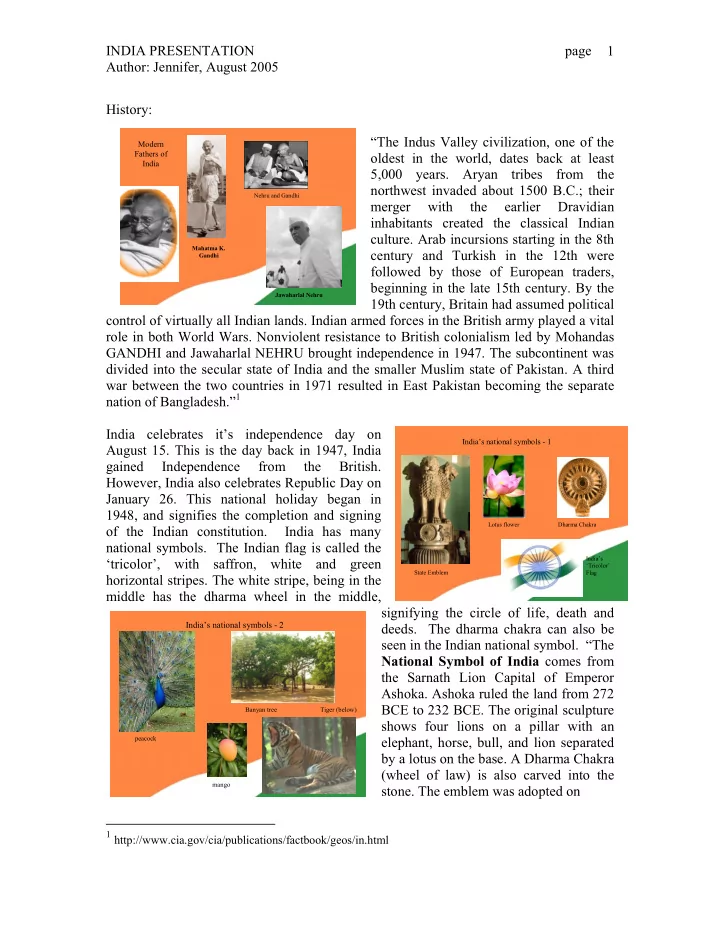
century and Turkish in the 12th were followed by those of European traders, beginning in the late 15th century. By the 19th century, Britain had assumed political control of virtually all Indian lands. Indian armed forces in the British army played a vital role in both World Wars. Nonviolent resistance to British colonialism led by Mohandas GANDHI and Jawaharlal NEHRU brought independence in 1947. The subcontinent was divided into the secular state of India and the smaller Muslim state of Pakistan. A third war between the two countries in 1971 resulted in East Pakistan becoming the separate nation of Bangladesh.”1 India celebrates it’s independence day on August 15. This is the day back in 1947, India gained Independence from the British. However, India also celebrates Republic Day on January 26. This national holiday began in 1948, and signifies the completion and signing
- f the Indian constitution. India has many
national symbols. The Indian flag is called the ‘tricolor’, with saffron, white and green horizontal stripes. The white stripe, being in the middle has the dharma wheel in the middle, signifying the circle of life, death and
- deeds. The dharma chakra can also be
seen in the Indian national symbol. “The National Symbol of India comes from the Sarnath Lion Capital of Emperor
- Ashoka. Ashoka ruled the land from 272
BCE to 232 BCE. The original sculpture shows four lions on a pillar with an elephant, horse, bull, and lion separated by a lotus on the base. A Dharma Chakra (wheel of law) is also carved into the
- stone. The emblem was adopted on
1 http://www.cia.gov/cia/publications/factbook/geos/in.html
Modern Fathers of India
Mahatma K. Gandhi Jawaharlal Nehru Nehru and Gandhi
India’s national symbols - 1
State Emblem Lotus flower Dharma Chakra India’s ‘Tricolor’ Flag
India’s national symbols - 2
mango peacock Banyan tree Tiger (below)