
SLIDE 1
Monitoring Western Snowy Plovers in South Bay Salt Ponds
Christina Donehower and Karine Tokatlian
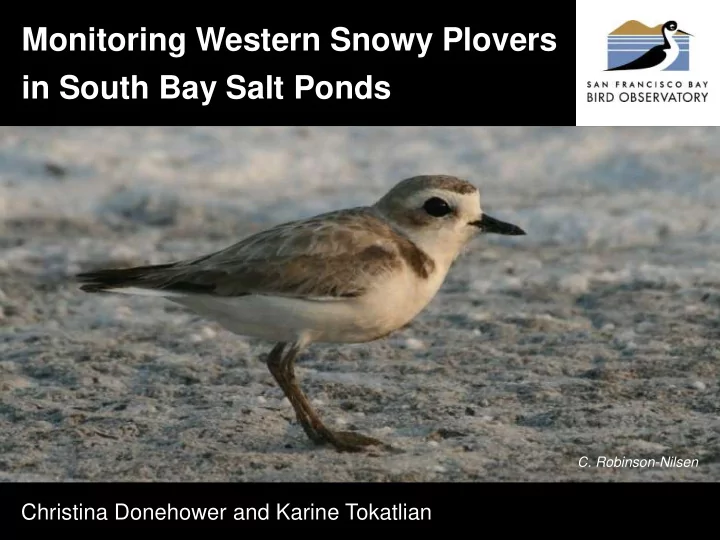
- C. Robinson-Nilsen
in South Bay Salt Ponds C. Robinson-Nilsen Christina Donehower and - - PowerPoint PPT Presentation
Monitoring Western Snowy Plovers in South Bay Salt Ponds C. Robinson-Nilsen Christina Donehower and Karine Tokatlian C. Donehower Western Snowy Plover Pacific Coast population ( Charadrius nivosus nivosus ) breeds from Washington State to
Support 500 breeding adults in RU3 for 10 years Maintain 5-year average productivity of at least 1 fledged chick/male
Support 250 breeding adults within project area Maintain productivity level specified in Recovery Plan
50 100 150 200 250 300 2004 2005 2006 2007 2008 2009 2010 2011 2012 2013 2014
Total plovers observed Year
SBSPRP “Management Trigger”: Declines in any given year below 2006 baseline
Table 1. Number of Snowy Plovers observed in Recovery Unit 3 sites during annual breeding window surveys in May, 2009-2013.
REGION SITE 2009 2010 2011 2012 2013 Alameda Baumberg/Eden Landing 88 184 185 82 97 Coyote Hills Dumbarton Hayward 4 12 8 9 32 Warm Springs 14 27 17 3 1 Napa Napa 12 10 1 3 San Mateo Ravenswood/West Bay 21 42 27 33 59 Santa Clara Alviso 8 11 20 10 Total Unit 3 147 275 249 147 202
Confirmed SNPL nesting in 2013 Island-nesting
(E8, E12, E13, E14, E16B)
(A9, A16, NCM)
(R1, R2, R4, RSF2)
(A22, A23)
Figure 2. Annual apparent Snowy Plover nest fates in South San Francisco Bay from 2008-2012 (number of nests monitored).
2009 2010 2011 California Gull 2 2 2 Northern Harrier 3 Red-Tailed Hawk 2 1 Common Raven 1 1 Ruddy Turnstone 1 Grey Fox 1 Total number of nests monitored 24 21 17
(Robinson-Nilsen 2011, Demers & Robinson-Nilsen 2012)
success (data from 2006-2011)
Table 2. Apparent fledging success (all sites combined) of Snowy Plover chicks in South San Francisco Bay from 2009-2012. Year Fledging Success1 N2 2009 25% 113 2010 41% 39 2011 14% 36 2012 50% 8
1Chicks were considered fledged if they survived to 30 days. 2N is the number of chicks banded.
Cargill
Model1 ΔAICc wi K 1) S(shells + year + TT + age) 0.00 0.73 8 2) S(shells + TT + age) 2.15 0.25 5 3) S(shells + year + TT) 7.49 0.02 7 4) S(shells + TT) 13.66 0.00 4 5) S(year + TT + age) 20.04 0.00 7 6) S(year + TT) 29.30 0.00 6 7) S(TT) 36.74 0.00 3 8) S(shells + year + T + age) 39.43 0.00 7 9) S(shells + T + age) 43.60 0.00 4 10) S(shells + year + T) 46.77 0.00 6
1 Only the top ten models (as ranked by ΔAICc) are shown.
Figure 3. The effects of nest age (1- and 33- day-old nests) and shell enhancements on daily survival rates of Snowy Plover nests at Eden Landing in 2012. Day 1 is March 11.
Long-term effects? Could concentrated nesting increase nest predation? Effects on chick or adult survival? Scale of enhancement?
Right: Active nests and associated “no-work” buffers 4.29.2013
alternatives to color-banding in RU3
for nesting as well as foraging, brood-rearing, wintering
coordination, careful trail design in nesting areas) essential
U.S. Fish and Wildlife Service, Don Edwards San Francisco Bay NWR California State Coastal Conservancy California Dept. of Fish and Wildlife H.T. Harvey and Associates U.S. Geological Survey Ducks Unlimited, McMillen, LLC Triton Marine Orange County Community Foundation Santa Clara Valley Water District SFBBO members and volunteers Oracle California State Parks – Oceano Dunes SVRA And many other collaborating organizations on SBSPRP!