In pairs . You will have a webinar slot with your trainer to talk - - PowerPoint PPT Presentation

in pairs you will have a webinar slot with your trainer
SMART_READER_LITE
LIVE PREVIEW

In pairs . You will have a webinar slot with your trainer to talk - - PowerPoint PPT Presentation

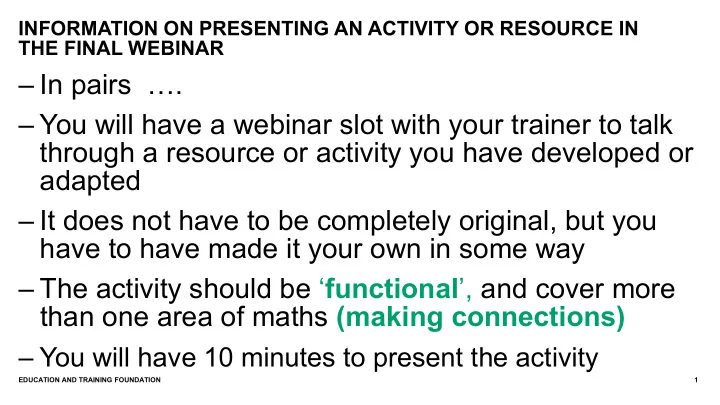
INFORMATION ON PRESENTING AN ACTIVITY OR RESOURCE IN THE FINAL WEBINAR In pairs . You will have a webinar slot with your trainer to talk through a resource or activity you have developed or adapted It does not have to be


slide-1
SLIDE 1

EDUCATION AND TRAINING FOUNDATION 1

– In pairs …. – You will have a webinar slot with your trainer to talk through a resource or activity you have developed or adapted – It does not have to be completely original, but you have to have made it your own in some way – The activity should be ‘functional’, and cover more than one area of maths (making connections)

– You will have 10 minutes to present the activity

INFORMATION ON PRESENTING AN ACTIVITY OR RESOURCE IN THE FINAL WEBINAR

slide-2
SLIDE 2

TEACHING FUNCTIONAL SKILLS MATHEMATICS

WEBINAR 3: NUMBER SKILLS AND NUMBER SENSE

NAME

DATE AND TIME

slide-3
SLIDE 3

EDUCATION AND TRAINING FOUNDATION 3

Participants will: – Examine the place of whole numbers in the Functional Skills Subject Content – Analyse concepts of ‘number sense’ and relational understanding – Compare and contrast different methods of calculation and the links between them

LEARNING OUTCOMES FOR WEBINAR 3

slide-4
SLIDE 4

EDUCATION AND TRAINING FOUNDATION 4

https://nrich.maths.org/6499

COUNTDOWN

slide-5
SLIDE 5

EDUCATION AND TRAINING FOUNDATION 5

Before this webinar you were asked to

  • Read: Subject Content for Whole No
  • Read: Developing alternative strategies
  • Sample: Hexagon Jigsaw (pp 17 – 23)
  • Watch: Kentucky Math

THE PRE-WEBINAR TASKS FOR WEBINAR 3

slide-6
SLIDE 6

EDUCATION AND TRAINING FOUNDATION 6

At what level do learners need to be able to order and compare up to 200? And count to 200? What addition and subtraction skills do learners need at each level?

What multiplication and division skills do learners need at each level?

At what levels do learners need algebra? Make a note of these questions

SUBJECT CONTENT– WHOLE NUMBERS

slide-7
SLIDE 7

EDUCATION AND TRAINING FOUNDATION 7

In groups, answer the four questions on Whole Number in the Subject Content Ground rules for break out rooms

  • 1. Put on your video and introduce yourselves in turn
  • 2. Decide on a spokesperson who will feedback
  • 3. Make sure all members of the group contribute

EXAMINING THE SUBJECT CONTENT FOR WHOLE NUMBERS

slide-8
SLIDE 8

EDUCATION AND TRAINING FOUNDATION 8

https://youtu.be/lhxsNXpoCZ8

KENTUCKY MATH

– Make a note of the mistakes made by Ma and Pa – What do you think has led to these mistakes?

slide-9
SLIDE 9

EDUCATION AND TRAINING FOUNDATION 9

– Instrumental understanding: knowing what to do (i.e. a rule) – Relational understanding: knowing what to do and why

(Skemp, 1976) INSTRUMENTAL AND RELATIONAL UNDERSTANDING

slide-10
SLIDE 10

EDUCATION AND TRAINING FOUNDATION 10

Learners with number sense: – Understand the relative value of numbers, and can see intuitively when an answer is wrong – Use numbers fluidly and flexibly to add, subtract, multiply or divide – Are happy to break numbers apart and regroup them – Use different strategies to count, calculate or estimate

NUMBER SENSE

slide-11
SLIDE 11

EDUCATION AND TRAINING FOUNDATION 11

Work this out as a mental calculation: 18 x 5

Use ‘annotate’ to write on the whiteboard how you found the answer For further ideas on number talks, watch this video:

https://www.youtube.com/watch?v=yXNG6GKFhQM

NUMBER TALKS

slide-12
SLIDE 12

EDUCATION AND TRAINING FOUNDATION 12

– Remembering some basic number facts – Using facts that are known to figure out new facts – Understanding and using relationships between the ‘four rules’ to work out answers and check results – Drawing on a repertoire of mental skills to work out calculations, with some thinking time, e.g. rounding – Approximating calculations to judge whether or not an answer is about the right size – Solving problems, and judging whether answers are reasonable

SKILLS NEEDED FOR MENTAL CALCULATIONS AND NUMBER SENSE

slide-13
SLIDE 13

EDUCATION AND TRAINING FOUNDATION 13

LINKING THE FOUR RULES

Addition Division Multiplication Subtraction

is the inverse of is the inverse of is repeated is repeated

slide-14
SLIDE 14

EDUCATION AND TRAINING FOUNDATION 14

– Doubling – Halving – Multiplying by 10, 100, 1000 – Dividing by 10, 100, 1000

USEFUL NUMBER SKILLS …

slide-15
SLIDE 15

EDUCATION AND TRAINING FOUNDATION 15

Take 5 minutes away from the screen Leave the zoom meeting running but turn on ‘mute’ Remember to unmute yourself when you return

SHORT BREAK

slide-16
SLIDE 16

EDUCATION AND TRAINING FOUNDATION 16

As a pre-webinar task you were asked to read Developing Alternative Strategies by the NRDC

Quiz

DEVELOPING ALTERNATIVE STRATEGIES

slide-17
SLIDE 17

EDUCATION AND TRAINING FOUNDATION 17

Examine the 4 different methods of long multiplication. – How does each method work? – Are there connections between the methods? – For each method, identify one advantage and one disadvantage

LONG MULTIPLICATION

slide-18
SLIDE 18

EDUCATION AND TRAINING FOUNDATION 18

– When would you introduce alternative methods of long multiplication (or division)? – What factors would you need to take into account? – How could you ensure that your learners gained relational understanding of the method (not just instrumental)?

INTRODUCING DIFFERENT METHODS

slide-19
SLIDE 19

EDUCATION AND TRAINING FOUNDATION 19

How could you use this resource with your learners? You can create your own jigsaw with Tarsia Formulator (see next slide) Pre-created jigsaws can be found online e.g. Mr Barton

HEXAGON JIGSAW

slide-20
SLIDE 20

EDUCATION AND TRAINING FOUNDATION 20

– Tarsia Formulator:

http://www.mmlsoft.com/index.php/products/tarsia

– Maths4Life Number: http://www.nrdc.org.uk/?p=286 – Bestimation: http://www.nrdc.org.uk/?p=163 – Fluency without Fear: https://www.youcubed.org/fluency-

without-fear/

FURTHER IDEAS AND RESOURCES

slide-21
SLIDE 21

EDUCATION AND TRAINING FOUNDATION 21

After the webinar, reflect on the session e.g: What did we do that was helpful? What could I apply in my teaching? What could I do differently? Record your reflections in your Reflective Diary and set your self a goal

REFLECTIONS

slide-22
SLIDE 22

EDUCATION AND TRAINING FOUNDATION 22

Before webinar 4: Complete: Subject Content (F,D,P) Sample: Comparing Fractions Watch: Ratio Tables

REMINDER OF PRE-WEBINAR TASKS

slide-23
SLIDE 23

ETFOUNDATION.CO.UK

THANK YOU ANY QUESTIONS?

NAME EMAIL