SLIDE 1 Class 26: review for final exam –solutions, 18.05, Spring 2014
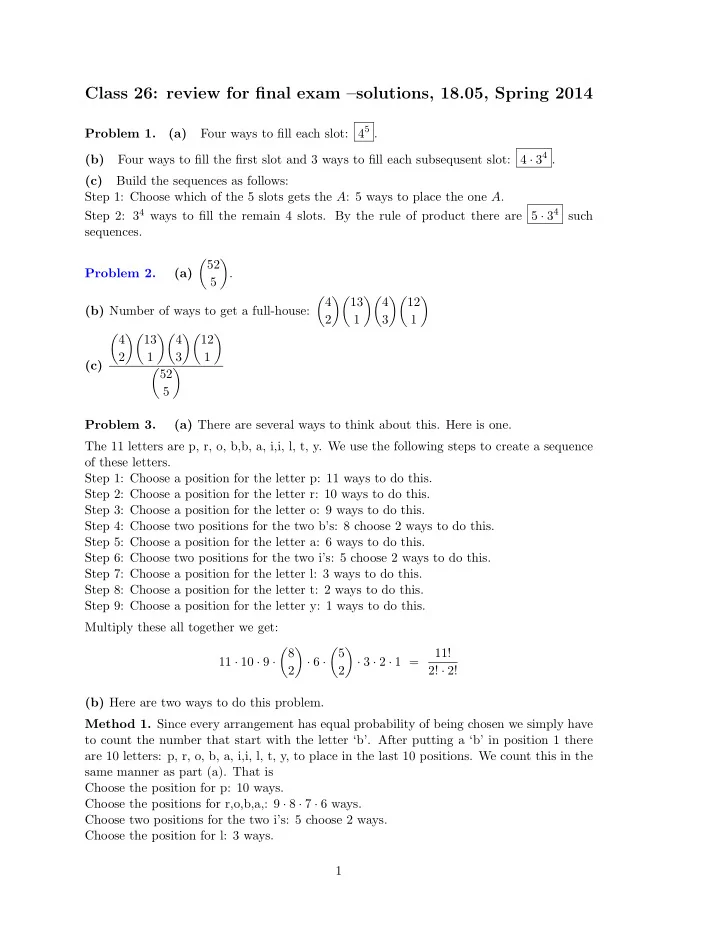
Problem 1. (a) Four ways to fill each slot: 45 . (b) Four ways to fill the first slot and 3 ways to fill each subsequsent slot: 4 · 34 . (c) Build the sequences as follows: Step 1: Choose which of the 5 slots gets the A: 5 ways to place the one A. Step 2: 34 ways to fill the remain 4 slots. By the rule of product there are 5 · 34 such sequences. Problem 2. (a) 52 5
4 13 4 12 (b) Number of ways to get a full-house:
4 2 13 1 2 1 3 1 4 12 3 1
5
(a) There are several ways to think about this. Here is one. The 11 letters are p, r, o, b,b, a, i,i, l, t, y. We use the following steps to create a sequence
Step 1: Choose a position for the letter p: 11 ways to do this. Step 2: Choose a position for the letter r: 10 ways to do this. Step 3: Choose a position for the letter o: 9 ways to do this. Step 4: Choose two positions for the two b’s: 8 choose 2 ways to do this. Step 5: Choose a position for the letter a: 6 ways to do this. Step 6: Choose two positions for the two i’s: 5 choose 2 ways to do this. Step 7: Choose a position for the letter l: 3 ways to do this. Step 8: Choose a position for the letter t: 2 ways to do this. Step 9: Choose a position for the letter y: 1 ways to do this. Multiply these all together we get: 8 5 11! 11 · 10 · 9 · · 6 · 2 · 3 · 2 · 1 = 2 2! · 2! (b) Here are two ways to do this problem. Method 1. Since every arrangement has equal probability of being chosen we simply have to count the number that start with the letter ‘b’. After putting a ‘b’ in position 1 there are 10 letters: p, r, o, b, a, i,i, l, t, y, to place in the last 10 positions. We count this in the same manner as part (a). That is Choose the position for p: 10 ways. Choose the positions for r,o,b,a,: 9 · 8 · 7 · 6 ways. Choose two positions for the two i’s: 5 choose 2 ways. Choose the position for l: 3 ways. 1
SLIDE 2 Class 26: review for final exam solutions, Spring 2014 2 Choose the position for t: 2 ways. Choose the position for y: 1 ways. 10! Multiplying this together we get 10·9·8·7 6· 5 · 2
arrangements start with the 2! 10!/2! letter b. Therefore the probability a random arrangement starts with b is 11!/2! · 2! = 2 11 Method 2. Suppose we build the arrangement by picking a letter for the first position, then the second position etc. Since there are 11 letters, two of which are b’s we have a 2/11 chance of picking a b for the first letter. Problem 4. We are given P(E ∪ F) = 2/3. Ec ∩ F c = (E ∪ F)c ⇒ P(Ec ∩ F c) = 1 − P(E ∪ F) = 1/3. Problem 5. D is the disjoint union of D ∩ C and D ∩ Cc. So, P(D ∩ C) + P(D ∩ Cc) = P(D) ⇒ P(D ∩ C) = P(D) − P(D ∩ Cc) = .4 − .2 = .2. Problem 6. (a) Slots 1, 3, 5, 7 are filled by T1, T3, T5, T7 in any order: 4! ways. Slots 2, 4, 6, 8 are filled by T2, T4, T6, T8 in any order: 4! ways. answer: 4! · 4! = 576. (b) There are 8! ways to fill the 8 slots in any way. Since each outcome is equally likely the probabilitiy is 4! · 4! 8! = 576 = 0.143 = 1.43%. 40320 Problem 7. Let H be the event that the ith
i
hand has one king. We have the conditional probabilities P(H1) = 4 1 48 12
13
P(H2|H1) = 3 1 36 12
39 13
; P(H3|H1 ∩ H2) = 24 12
13
P(H1 ∩ H2 ∩ H3 ∩ H4) = P (H
∩ H
2 ∩ H 3) P(
1 ∩ H2) P(H2|H1) P(H1)
2 24 3 36 4 48 1 12 1 12 1 12 = 26 13 39 13 52 13
Problem 8.
SLIDE 3
Class 26: review for final exam solutions, Spring 2014 3 (a) Sample space = Ω = {(1, 1), (1, 2), (1, 3), . . . , (6, 6) } = {(i, j) | i, j = 1, 2, 3, 4, 5, 6 }. (Each outcome is equally likely, with probability 1/36.) A = {(1, 4), (2, 3), (3, 2), (4, 1)}, B = {(4, 1), (4, 2), (4, 3), (4, 4), (4, 5), (4, 6), (1, 4), (2, 4), (3, 4), (5, 4), (6, 4) } P(A ) P(A B) = ∩ B | P(B) = 2/36 11/36 = 2 .. 11 (b) P(A) = 4/36 = P(A|B), so they are not independent. Problem 9. Let C be the event the contestant gets the question correct and G the event the contestant guessed. The question asks for P(G|C). P(C|G) P(G) We’ll compute this using Bayes’ rule: P(G|C) = . P(C) We’re given: P(C|G) = 0.25, P(K) = 0.7. Law of total prob.: P(C) = P(C|G) P(G) + P(C|Gc) P(Gc) = 0.25 · 0.3 + 1.0 · 0.7 = 0.775. 0.075 Therefore P(G|C) = = 0.097 = 9.7%. 0.775 Problem 10. Here is the game tree, R1 means red on the first draw etc. R1 B1 R2 B2 R2 B2 R3 B3 R3 B3 R3 B3 R3 B3
7/10 3/10 6/9 3/9 7/10 3/10 5/8 3/8 6/9 3/9 6/9 3/9 7/10 3/10
Summing the probability to all the B3 nodes we get 7 P(B3) = 10 · 6 9 · 3 8 + 7 10 · 3 9 · 3 9 + 3 10 · 7 10 · 3 9 + 3 10 · 3 10 · 3 = .350. 10 Problem 11. We have P(A ∪ B) = 1 − 0.42 = 0.58 and we know P(A ∪ B) = P(A) + P(B) − P(A ∩ B). Thus, P(A ∩ B) = P(A) + P(B) − P(A ∪ B) = 0.4 + 0.3 − 0.58 = 0.12 = (0.4)(0.3) = P(A)P(B) So A and B are independent. Problem 12. We have P(A ∩ B ∩ C) = 0.06 P(A ∩ B) = 0.12 P(A ∩ C) = 0.15 P(B ∩ C) = 0.2
SLIDE 4 Class 26: review for final exam solutions, Spring 2014 4 Since P(A ∩ B) = P(A ∩ B ∩ C) + P(A ∩ B ∩ Cc), we find P(A ∩ B ∩ Cc) = 0.06. Similarly P(A ∩ B ∩ Cc) = 0.06 P(A ∩ Bc ∩ C) = 0.09 P(Ac ∩ B ∩ C) = 0.14 Problem 13. To show A and B are not independent we need to show P(A ∩ B) = P(A) · P(B). (a) No, they cannot be independent: A ∩ B = ∅ ⇒ P(A ∩ B) = 0 = P(A) · P(B). (b) No, they cannot be independent: same reason as in part (a). Problem 14. X
1 2 p(X) 1/15 2/15 3/15 4/15 5/15 We compute 1 E[X] = −2 · 15 + −1 · 2 15 + 0 · 3]15 + 1 · [
4
15 + 2 · 5 15 = 2. 3 Thus 2 Var(X) = E((X − 3)2) = 14. 9 Problem 15. We first compute E[X] = 1 2 x · 2xdx = 3 E[X2] = 1 x2 1 · 2xdx = 2 E[X4] = 1 x4 · 2xdx = 1. 3 Thus, Var(X) = E[X2] −
2
1 (E[X]) = 2 − 4 9 = 1 18 and Var(X2) = E[X4] =
2 = 1 3 − 1 4 = 1 . 12 Problem 16. (a) We have X values:
1 prob: 1/3 1/6 1/2 X2 1 1 So, E(X) = −1/3 + 1/2 = 1/6.
SLIDE 5 Class 26: review for final exam solutions, Spring 2014 5 (b) Y values: 1 ⇒ E(Y ) = 5/6. prob: 1/6 5/6 (c) Using the table in part (a) E(X2) = 1 · (1/3) + 0 · (1/6) + 1 · (1/2) = 5/6 (same as part (b)). (d) Var(X) = E(X2) − E(X)2 = 5/6 − 1/36 = 29/36. Problem 17. answer: Make a table X: 1 prob: (1-p) p X2 1. From the table, E(X) = 0 · (1 − p) + 1 · p = p. Since X and X2 have the same table E(X2) = E(X) = p. Therefore, Var(X) = p − p2 = p(1 − p). Problem 18. Let X be the number of people who get their own hat. Following the hint: let Xj represent whether person j gets their own hat. That is, Xj = 1 if person j gets their hat and 0 if not.
100 100
We have, X =
j=1
Since person j is equally likely to
j=1
get any hat, we have P(Xj = 1) = 1/100. Thus, Xj ∼ Bernoulli(1/100) ⇒ E(Xj) = 1/100 ⇒ E(X) = 1. Problem 19. For y = 0, 2, 4, . . . , 2n, y P(Y = y) = P(X = 2) = n y/2 1n . 2 Problem 20. We have fX(x) = 1 for 0 ≤ x ≤ 1. The cdf of X is FX(x) = x fX(t)dt = x 1dt = x. Now for 5 ≤ y ≤ 7, we have y 5 FY (y) = P(Y ≤ y) = P(2X + 5 ≤ y) = P(X − ≤ 2 ) = FX(y − 5 2 ) = y − 5. 2 Differentiating P(Y ≤ y) with respect to y, we get the probability density function of Y, for 5 ≤ y ≤ 7, 1 fY (y) = . 2
SLIDE 6 Class 26: review for final exam solutions, Spring 2014 6 Problem 21. We have cdf of X, F (x) = x λe−λxdx = 1 − e−λx
X
. Now for y ≥ 0, we have FY (y) = P(Y ≤ y) = P(X2 ≤ y) = P(X √ ≤ y) = 1 − e−λ√y. Differentiating FY (y) with respect to y, we have λ fY (y) = 2 y− 1
2 e−λ√y.
Problem 22. (a) We first make the probability tables X 2 3 prob. 0.3 0.1 0.6 Y 3 3 12 ⇒ E(X) = 0 · 0.3 + 2 · 0.1 + 3 · 0.6 = 2 (b) E(X2) = 0 · 0.3 + 4 · 0.1 + 9 · 0.6 = 5.8 ⇒ Var(X) = E(X2) − E(X)2 = 5.8 − 4 = 1.8. (c) E(Y ) = 3 · 0.3 + 3 · 0.1 + 12 · 6 = 8.4. L(d) FY (7) = P(Y ≤ 7) = 0.4. Problem 23. (a) There are a number of ways to present this. X ∼ 3 binomial(25, 1/6), so 1 P(X 3k) = 25 = k 6 k 5 . 6 25−k , for k = 0, 1, 2, . . , 25. (b) X ∼ 3 binomial(25, 1/6). Recall that the mean and variance of binomial(n, p) are np and np(1 − p). So, 1 E(X) = 3np = 3 · 25 · = 75/6, and Var(X) = 9np(1 − p) = 9 · 25(1/6)(5/6) = 125/4. 6 (c) E(X + Y ) = E(X) + E(Y ) = 150/6 = 25., E(2X) = 2E(X) = 150/6 = 25. Var(X + Y ) = Var(X) + Var(Y ) = 250/4. Var(2X) = 4Var(X) = 500/4. The means of X + Y and 2X are the same, but Var(2X) > Var(X + Y ). This makes sense because in X + Y sometimes X and Y will be on opposite sides from the mean so distances to the mean will tend to cancel, However in 2X the distance to the mean is always doubled.
SLIDE 7 Class 26: review for final exam solutions, Spring 2014 7 Problem 24. First we find the value of a: 1 1 f(x) dx = 1 1 = x + ax2 dx = 2 + a 3 ⇒ a = 3/2. The CDF is FX(x) = P(X ≤ x). We break this into cases: (i) b < 0 ⇒ FX(b) = 0. 3 (ii) 0 ≤ b ≤ 1 ⇒ FX(b = b ) x + 2x2 dx = b2 2 + b3 . 2 (iii) 1 < x ⇒ FX(b) = 1. Using FX we get .52 + .53 P(.5 < X < 1) = FX(1) − FX(.5) = 1 − 2
16 Problem 25. (i) yes, discrete, (ii) no, (iii) no, (iv) no, (v) yes, continuous (vi) no (vii) yes, continuous, (viii) yes, continuous. Problem 26. (a) We compute
5
P(X ≥ 5) = 1 − P(X < 5) = 1 −
− (1 − e−5λ) = e−5λ. (b) We want P(X ≥ 15|X ≥ 10). First observe that P(X ≥ 15, X ≥ 10) = P(X ≥ 15). From similar computations in (a), we know P(X ≥ 15) = e−15λ P(X ≥ 10) = e−10λ. From the definition of conditional probability, P(X P(X ≥ 15|X ≥ 15, X 10) ≥ 10) = ≥ P(X ≥ 10) = P(X ≥ 15) = e−5λ P(X ≥ 10) Note: This is an illustration of the memorylessness property of the exponential distribu- tion. Problem 27. (a) We have x 1 FX(x) = P(X ≤ x) = P(3Z + 1 ≤ x) = P(Z − ≤ 3 ) = Φ(x − 1). 3 (b) Differentiating with respect to x, we have d fX(x) = 1 FX(x) = dx x φ( − 1 3 ). 3
SLIDE 8 Class 26: review for final exam solutions, Spring 2014 8 Since φ(x) = (2π)− 1
2 e− x2 2 , we conclude
1 fX(x) = 3 √ 2πe− (x−1)2
2 2·3
, which is the probability density function of the N(1, 9) distribution. Note: The arguments in (a) and (b) give a proof that 3Z+1 is a normal random variable with mean 1 and variance
- 9. See Problem Set 3, Question 5.
(c) We have 2 P(−1 ≤ X ≤ 1) = P(−3 ≤ Z ≤ 0) = Φ(0) − Φ(−2) 3 ≈ 0.2475 (d) Since E(X) = 1, Var(X) = 9, we want P(−2 ≤ X ≤ 4). We have P(−2 ≤ X ≤ 4) = P(−3 ≤ 3Z ≤ 3) = P(−1 ≤ Z ≤ 1) ≈ 0.68. Problem 28. (a) Note, Y follows what is called a log-normal distribution. FY (a) = P(Y ≤ a) = P(eZ ≤ a) = P(Z ≤ ln(a)) = Φ(ln(a)). Differentiating using the chain rule: d fy(a) = d FY (a) = da daΦ(ln(a)) = 1 aφ(ln(a)) = 1 √
2
e−(ln(a)) /2. 2π a (b) (i) We want to find q.33 such that P(Z ≤ q.33) = .33. That is, we want Φ(q.33) = .33 ⇔ q.33 = Φ−1(.33) . (ii) We want q.9 such that
−1
FY (q.9) = .9 ⇔ Φ(ln(q.9)) = .9 ⇔ q.9 = eΦ
(.9) .
(iii) As in (ii) q.5 = eΦ−1(.5) = e0 = 1 . Problem 29. (a) answer: Var(Xj) = 1 = E(X2
j ) − E(Xj)2 = E(X2 j ).
QED (b) E(X4 1
j ) = √
2 ∞ x4e−x2/2 dx. π
−∞
(Extra credit) By parts: let u = x3, v′ = xe−x2/2 ⇒ u′ = 3x2, v = −e−x2/2 1 E(X4
j ) = √
2π
infty +
1 √
x
2 ∞ 3x2e− 2/2 dx π
−∞
The first term is 0 and the second term is the formula for
j ) = 3 (by part (a)). Thus,
E(X4
j ) = 3.
(c) answer: Var(X2
j ) = E(X4 j ) − E(X2 j )2 = 3 − 1 = 2. QED
SLIDE 9 Class 26: review for final exam solutions, Spring 2014 9 (d) E(Y100) = E(100X2
j ) = 100.
Var(Y100) = 100Var(Xj) = 200. The CLT says Y100 is approximately normal. Standardizing gives Y100 100 P(Y100 > 110) = P − √ 200 ) > 10 √ 200
√ 2) = .24 . This last value was computed using 1 - pnorm(1/sqrt(2),0,1). Problem 30. (a) We did this in class. Let φ(z) and Φ(z) be the PDF and CDF of Z. FY (y) = P(Y ≤ y) = P(aZ + b ≤ y) = P(Z ≤ (y − b)/a) = Φ((y − b)/a). Differentiating: d fY (y) = dyFY (y) = d 1 Φ((y dy − b)/a) = 1 φ((y a − b)/a) = √
)2
e−(y−b
/2a2.
2π a Since this is the density for N(b, a2) we have shown Y ∼ N(b, a2). (b) By part (a), Y ∼ N(µ, σ2) ⇒ Y = σZ + µ. But, this implies (Y − µ)/σ = Z ∼ N(0, 1). QED Problem 31. (a) E(W) = 3E(X) − 2E(Y ) + 1 = 6 − 10 + 1 = −3 Var(W) = 9Var(X) + 4Var(Y ) = 45 + 36 = 81 (b) Since the sum of independent normal is normal
- part (a) shows: W ∼ N(−3, 81). Let
W + 3 Z ∼ N(0, 1). We standardize W: P(W ≤ 6) = P 9 ≤ 9 = 9
Problem 32. Method 1 1 U(a, b) has density f(x) =
b − a E(X) = b 1 xf(x) dx =
a
b − a b
a
x dx = x2
b
2(b − a)
= − a2
a
2(b − a) = a + b 2 . E(X2) = b
a
x2f(x) dx = 1 b − a b
a
x2 dx = x3 3(b − a)
a
= b3 − a3 . 3(b − a) Finding Var(X) now requires a little algebra, b3 − a3 Var(X) = E(X2) − E(X)2 = 3(b − a) − (b + a)2 4 4(b3 = − a3) − 3(b − a)(b + a)2 12(b − a) = b3 − 3ab2 + 3a2b − a3 (b = − a)3 12(b − a) 12(b − a) = (b − a)2 12 . Method 2 There is an easier way to find E(X) and Var(X).
SLIDE 10 Class 26: review for final exam solutions, Spring 2014 10 Let U ∼ U(0, 1). Then the calculations above show E(U) = 1/2 and (E(U 2) = 1/3 ⇒ Var(U) = 1/3 − 1/4 = 1/12. Now, we know X = (b − a)U + a, so E(X) = (b − a)E(U) + a = (b − a)/2 + a = (b + a)/2 and Var(X) = (b − a)2Var(U) = (b − a)2/12. Problem 33. (a) Sn ∼ Binomial(n, p), since it is the number of successes in n independent Bernoulli trials. (b) Tm ∼ Binomial(m, p), since it is the number of successes in m independent Bernoulli trials. (c) Sn+Tm ∼ Binomial(n+m, p), since it is the number of successes in n+m independent Bernoulli trials. (d) Yes, Sn and Tm are independent since trials 1 to n are independent of trials n + 1 to n + m. Problem 34. Compute the median for the exponential distribution with parameter λ. The density for this distribution is f(x) = λ e−λx. We know (or can compute) that the distribution function is F(a) = 1 − e−λa. The median is the value of a such that F(a) = .5. Thus, 1 − e−λa = 0.5 ⇒ 0.5 = e−λa ⇒ log(0.5) = −λa ⇒ a = log(2)/λ. Problem 35. Let X = the number of heads on the first 2 flips and Y the number in the last 2. Considering all 8 possibe tosses: HHH, HHT etc we get the following joint pmf for X and Y Y/X 1 2 1/8 1/8 1/4 1 1/8 1/4 1/8 1/2 2 1/8 1/8 1/4 1/4 1/2 1/4 1 Using the table we find 1 E(XY ) = 4 + 21 8 + 21 8 + 41 8 = 5. 4 We know E(X) = 1 = E(Y ) so 5 Cov(X, Y ) = E(XY ) − E(X)E(Y ) = 4 − 1 = 1. 4 Since X is the sum of 2 independent Bernoulli(.5) we have σX =
Cov(X, Y ) Cor(X, Y ) = σXσY = 1/4 1 = (2)/4 . 2 Problem 36. As usual let Xi = the number of heads on the ith flip, i.e. 0 or 1.
SLIDE 11 Class 26: review for final exam solutions, Spring 2014 11 Let X = X1 + X2 + X3 the sum of the first 3 flips and Y = X3 + X4 + X5 the sum of the last 3. Using the algebraic properties of covariance we have Cov(X, Y ) = Cov(X1 + X2 + X3, X3 + X4 + X5) = Cov(X1, X3) + Cov(X1, X4) + Cov(X1, X5) + Cov(X2, X3) + Cov(X2, X4) + Cov(X2, X5) + Cov(X3, X3) + Cov(X3, X4) + Cov(X3, X5) 1 Because the Xi are independent the only non-zero term in the above sum is Cov(X3X3) = Var(X3) = 4 Therefore, Cov(X, Y ) = 1.
4
We get the correlation by dividing by the independent Bernoulli(.5) we have σX = standard deviations. Since X is the sum of 3 3/4 Cov(X, Y ) Cor(X, Y ) = σXσY = 1/4 1 = (3)/4 . 3 Problem 37. (a) X and Y are independent, so the table is computed from the product
- f the known marginal probabilities. Since they are independent, Cov(X, Y ) = 0.
Y \X 1 PY 1/8 1/8 1/4 1 1/4 1/4 1/2 2 1/8 1/8 1/4 PX 1/2 1/2 1 (b) The sample space is Ω = {HHH, HHT, HTH, HTT, THH, THT, TTH, TTT}. P(X = 0, Z = 0) = P({TTH, TTT}) = 1/4. P(X = 0, Z = 1) = P({THH, THT}) = 1/4. Z\X P(X = 0, Z = 2) = 0. P(X = 1, Z = 0) = 0. P(X = 1, Z = 1) = P({HTH, HTT}) = 1/4. P(X = 1, Z = 2) = P({HHH, HHT}) = 1/4. 1 PZ 1/4 1/4 1 1/4 1/4 1/2 2 1/4 1/4 PX 1/2 1/2 1 Cov(X, Z) = E(XZ) − E(X)E(Z). E(X) = 1/2, E(Z) = 1, E(XZ) = xiyjp(xi, yj) = 3/4. ⇒ Cov(X, Z) = 3/4 − 1/2 = 1/4.
(a) X
1 2 Y 1/5 1/5 1 1/5 1/5 2/5 4 1/5 1/5 2/5 1/5 1/5 1/5 1/5 1/5 1
SLIDE 12 Class 26: review for final exam solutions, Spring 2014 12 Each column has only one nonzero value. For example, when X = −2 then Y = 4, so in the X = −2 column, only P(X = −2, Y = 4) is not 0. (b) Using the marginal distributions: E(X) = 1(
5 −2 − 1 + 0 + 1 + 2) = 0.
1 E(Y ) = 0 · 5 + 1 · 2 5 + 4 · 2 = 2. 5 (c) We show the probabilities don’t multiply: P(X = −2, Y = 0) = 0 = P(X = −2) · P(Y = 0) = 1/25. Since these are not equal X and Y are not independent. (It is obvious that X2 is not independent of X.) (d) Using the table from part (a) and the means computed in part (d) we get: 1 Cov(X, Y ) = E(XY )−E(X)E(Y ) = 5(−2)(4) + 1 5(−1)(1) + 1 5(0)(0) + 1 5(1)(1) + 1(2)(4) = 0. 5
a b
Problem 39. (a) F(a, b) = P(X ≤ a, Y ≤ b) =
y2 Inner integral: xy + 2
= xb + b2 x2 . Outer integral: 2 2 b + b2
a
x 2
= . 2 x2y + xy2 So F(x, y) = 2 and F(1, 1) = 1.
1
(b) fX(x) =
1 y2 (x + y) dy = xy + 2
= x + 1 2. By symmetry, fY (y) = y + 1/2. (c) To see if they are independent we check if the joint density is the product of the marginal densities. f(x, y) = x + y, fX(x) · fY (y) = (x + 1/2)(y + 1/2). Since these are not equal, X and Y are not independent.
1
(d) E(X) =
x(x + y) dy dx = 1
y2 y + x 2
1 x2 + x 2 dx = 7 12.
1
( 1 (Or, using (b), E X) = xfX(x) dx =
By symmetry E(Y ) = 7/12.
1
E(X2 + Y 2) =
(x2 + y2 5 )(x + y) dy dx = 6.
1
E(XY ) =
1 xy(x + y) dy dx = 3. 1 Cov(X, Y ) = E(XY ) − E(X)E(Y ) = 3 − 49 144 = − 1 144. Problem 40.
SLIDE 13 Class 26: review for final exam solutions, Spring 2014 13 Standardize: P
i
1
n
Xi − µ σ/√n < 30/n − µ σ/√n
limit 1
theorem) /30 = P(Z < 3) = 0.9987 (from the table of normal probabilities) Problem 41. If p < .5 your expected winnings on any bet is negative, if p = .5 it is 0, and if p > .5 is is positive. By making a lot of bets the minimum strategy will ’win’ you close to the expected average. So if p ≤ .5 you should use the maximum strategy and if p > .5 you should use the minumum strategy. Problem 42. Let Xj be the IQ of a randomly selected person. We are given E(Xj) = 100 and σXj = 15. Let X be the average of the IQ’s of 100 randomly selected people. We have (X) = 100 and σX = 15/ √ 100 = 1.5. The problem asks for P(X > 115). Standardizing we get P(X > 115) ≈ P(Z > 10). This is effectively 0. Problem 43.
- A certain town is served by two hospitals.
- Larger hospital: about 45 babies born each day.
- Smaller hospital about 15 babies born each day.
- For a period of 1 year, each hospital recorded the days on which more than 60% of
the babies born were boys. (a) Which hospital do you think recorded more such days? (i) The larger hospital. (ii) The smaller hospital. (iii) About the same (that is, within 5% of each other). (b) Let Li (resp., Si) be the Bernoulli random variable which takes the value 1 if more than 60% of the babies born in the larger (resp., smaller) hospital on the ith day were boys. Determine the distribution of Li and of Si. (c) Let L (resp., S) be the number of days on which more than 60% of the babies born in the larger (resp., smaller) hospital were boys. What type of distribution do L and S have? Compute the expected value and variance in each case.
SLIDE 14 Class 26: review for final exam solutions, Spring 2014 14 (d) Via the CLT, approximate the .84 quantile of L (resp., S). Would you like to revise your answer to part (a)? (e) What is the correlation of L and S? What is the joint pmf of L and S? Visualize the region corresponding to the event L > S. Express P(L > S) as a double sum. (a) When this question was asked in a study, the number of undergraduates who chose each option was 21, 21, and 55, respectively. This shows a lack of intuition for the relevance of sample size on deviation from the true mean (i.e., variance). (b) The random variable XL, giving the number of boys born in the larger hospital on day i, is governed by a Bin(45, .5) distribution. So Li has a Ber(pL) distribution with
45
pL = P(X > 27) =
k
45 k
Similarly, the random variable XS, giving the number of boys born in the smaller hospital
- n day i, is governed by a Bin(15, .5) distribution. So Si has a Ber(pS) distribution with
15
pS = P(XS > 9) = 15 515 k
≈ .151
k=10
We see that pS is indeed greater than pL, consistent with (ii).
365 365
(c) Note that L =
i=1 Li and S = i=1 Si. So L has a Bin(365, pL) distribution and S
has a Bin(365, pS) distribution. Thus E(L) = 365pL ≈ 25 E(S) = 365pS ≈ 55 Var(L) = 365pL(1 − pL) ≈ 23 Var(S) = 365pS(1 − pS) ≈ 47 (d) mean + sd in each case: For L, q.84 ≈ 25 + √ 23. For S, q.84 ≈ 55 + √ 47. (e) Since L and S are independent, their joint distribution is determined by multiplying their individual distributions. Both L and S are binomial with n = 365 and pL and pS computed above. Thus 365 365
j
pl,sP(L = i and S = j) = p(i, j) =
L(1 − pL)365−i
Thus
364 365
P(L > S) =
0000916
i
≈ .
+1
(We used R to do the computations.)
SLIDE 15 Class 26: review for final exam solutions, Spring 2014 15 Problem 44. We compute the data mean and variance x ¯ = 65, s2 = 35.778. The number
- f degrees of freedom is 9. We look up the critical value t9,.025 = 2.262 in the t-table The
95% confidence interval is
x ¯ −
9,0.025s
√n , ¯ x + t9,0.025s √n
√ 3.5778, 65 + 2.262 √ 3.5778
Problem 45. Suppose we have taken data x1, . . . , xn with mean x ¯. The 95% confidence interval for the mean is x ± z0.025 σ √n. This has width 2 z0.025 σ √ . Setting the width equal n to 1 and substitituting values z0.025 = 1.96 and σ = 5 we get 5 2 · 1.96√n = 1 ⇒ √n = 19.6. So, n = (19.6)2 = 384. . If we use our rule of thumb that z0.025 = 2 we have √n/10 = 2 ⇒ n = 400. Problem 46. The rule-of-thumb is that a 95% confidence interval is x ¯ ± 1/√n. To be within 1% we need 1 √ = 0.01 n ⇒ n = 10000. Using z0.025 = 1.96 instead the 95% confidence interval is z x ¯ ±
0.025
2√ . n To be within 1% we need z0.025 2√ = 0.01 n ⇒ n = 9604. Note, we are still using the standard Bernoulli approximation σ ≤ 1/2. Problem 47. The 90% confidence interval is x ± z0.05 ·
1 2√ . Since z0.05 = 1.64 and n
n = 400 our confidence interval is x ± 1.64 · 1 40 = x ± 0.041 If this is entirely above 0.5 we have x − 0.041 > 0.5, so x > 0.541. Let T be the number
- ut of 400 who prefer A. We have x =
T 400 > 0.541, so T > 216 .
Problem 48. A 95% confidence means about 5% = 1/20 will be wrong. You’d expect about 2 to be wrong. With a probability p = 0.05 of being wrong, the number wrong
- distribution. This has expected value 2, and standard deviation
follows a Binomial(40, p) 40(0.05)(0.95) = 1.38. 10 wrong is (10-2)/1.38 = 5.8 standard deviations from the mean. This would be surprising. Problem 49. We have n = 20 and s2 = 4.062. If we fix a hypothesis for σ2 we know (n − 1)s2 χ σ2 ∼
2 n−1
SLIDE 16 Class 26: review for final exam solutions, Spring 2014 16 We used R to find the critical values. (Or use the χ2 table.) c025 = qchisq(0.975,19) = 32.852 c975 = qchisq(0.025,19) = 8.907 The 95% confidence interval for σ2 is (n − 1) · s2 c0.025 , (n − 1) · s2 c0.975
19 · 4.062 32.852 , 19 · 4.662 53 8
, 35.16] .907 We can take square roots to find the 95% confidence interval for σ [3.09, 5.93] Problem 50. (a) The model is yi = a + bxi + εi, where εi is random error. We assume the errors are independent with mean 0 and the same variance for each i (homoscedastic). The total error squared is E2 =
- (yi − a − bxi)2 = (1 − a − b)2 + (1 − a − 2b)2 + (3 − a − 3b)2
The least squares fit is given by the values of a and b which minimize E2. We solve for them by setting the partial derivatives of E2 with respect to a and b to 0. In R we found that a = 1.0, b = 0.5 Also see the exam 2 and post exam 2 practice material and the practice final.
SLIDE 17
MIT OpenCourseWare https://ocw.mit.edu
18.05 Introduction to Probability and Statistics
Spring 2014 For information about citing these materials or our Terms of Use, visit: https://ocw.mit.edu/terms.