In-House Counsel and Attorney-Client Privilege Protecting - - PowerPoint PPT Presentation

in house counsel and attorney client privilege protecting
SMART_READER_LITE
LIVE PREVIEW

In-House Counsel and Attorney-Client Privilege Protecting - - PowerPoint PPT Presentation

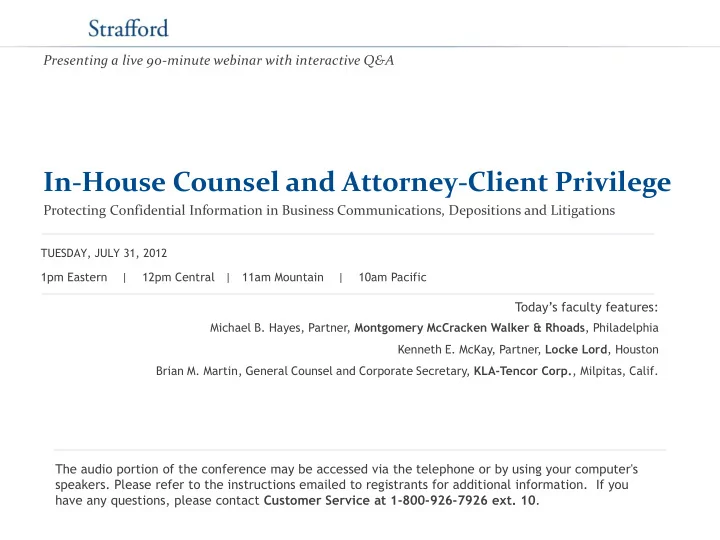
Presenting a live 90-minute webinar with interactive Q&A In-House Counsel and Attorney-Client Privilege Protecting Confidential Information in Business Communications, Depositions and Litigations TUESDAY, JULY 31, 2012 1pm Eastern |


slide-1
SLIDE 1

In-House Counsel and Attorney-Client Privilege

Protecting Confidential Information in Business Communications, Depositions and Litigations

Today’s faculty features:

1pm Eastern | 12pm Central | 11am Mountain | 10am Pacific

The audio portion of the conference may be accessed via the telephone or by using your computer's

  • speakers. Please refer to the instructions emailed to registrants for additional information. If you

have any questions, please contact Customer Service at 1-800-926-7926 ext. 10.

TUESDAY, JULY 31, 2012

Presenting a live 90-minute webinar with interactive Q&A

Michael B. Hayes, Partner, Montgomery McCracken Walker & Rhoads, Philadelphia Kenneth E. McKay, Partner, Locke Lord, Houston Brian M. Martin, General Counsel and Corporate Secretary, KLA-Tencor Corp., Milpitas, Calif.

slide-2
SLIDE 2

Sound Quality If you are listening via your computer speakers, please note that the quality of your sound will vary depending on the speed and quality of your internet connection. If the sound quality is not satisfactory and you are listening via your computer speakers, you may listen via the phone: dial 1-866-961-8499 and enter your PIN -when prompted. Otherwise, please send us a chat or e-mail sound@straffordpub.com immediately so we can address the problem. If you dialed in and have any difficulties during the call, press *0 for assistance. Viewing Quality To maximize your screen, press the F11 key on your keyboard. To exit full screen, press the F11 key again.

slide-3
SLIDE 3

For CLE purposes, please let us know how many people are listening at your location by completing each of the following steps:

  • In the chat box, type (1) your company name and (2) the number of

attendees at your location

  • Click the SEND button beside the box

FOR LIVE EVENT ONLY

slide-4
SLIDE 4

If you have not printed the conference materials for this program, please complete the following steps:

  • Click on the + sign next to “Conference Materials” in the middle of the left-

hand column on your screen.

  • Click on the tab labeled “Handouts” that appears, and there you will see a

PDF of the slides for today's program.

  • Double click on the PDF and a separate page will open.
  • Print the slides by clicking on the printer icon.
slide-5
SLIDE 5

In-House Counsel and Attorney-Client Privilege: Recent Developments and Common Applications

Ken McKay

Litigation Partner Locke Lord LLP 600 Travis, Suite 2800 Houston, Texas 77002 (713) 226-1127 kmckay@lockelord.com

slide-6
SLIDE 6

Overview

  • The Applicable Legal Standards and Factors Considered in

Applying the Privilege to In-House Counsel Communication

  • Recent Developments and Common Applications

– Internal Investigations, including Corporate Miranda Warnings – “At Issue” Waivers relating to External Investigations & Corporate Litigation – Board Presentations – Corporate Acquisitions – Impact of Business Globalization on the Privilege

  • Suggested Best Practices

6

slide-7
SLIDE 7

The Applicable Legal Standards and Factors Considered in Applying the Privilege to In-House Counsel Communication

7

slide-8
SLIDE 8

A Different Standard?

Courts have repeatedly held that there is no distinction between the standard to be applied for in-house and outside counsel for purposes of the attorney-client privilege.

See Hertzog, Calamari & Gleason v. Prudential Ins., 850 F. Supp. 255 (S.D.N.Y. 1994); U.S. v. Mobil Corp., 149 F.R.D. 533 (N.D. Tex. 1993)

But there is a distinction, at least in application.

8

slide-9
SLIDE 9

Why is a different standard applied to in-house counsel?

Principally because in-house counsel often perform non- legal business functions within their organizations and the law requires that privilege analysis distinguish the two Having attorneys serve in dual capacities is the most frequently-cited factor as a basis for denying a claim of privilege. See Teltron, Inc. v. Alexander, 132 F.R.D. 394 (E.D. Pa. 1990); N.C. Elec. Membership

  • Corp. v. Carolina Power & Light Co., 110 F.R.D. 511, 517 (M.D.N.C. 1986)

9

slide-10
SLIDE 10

Satisfying the “Attorney” Requirement

  • f the Attorney-Client Privilege

General Rule: If an in-house counsel is acting in her capacity as an attorney, the attorney-client privilege applies. Where, however, counsel is acting as a business advisor or has

  • nly limited involvement, the privilege does not apply.

“[T]he privilege is limited to confidential communications with an attorney acting in his professional legal capacity for the express purpose of securing legal advice. As a general rule, an attorney who serves a client in a business capacity may not assert the attorney-client privilege because of the lack of a confidential relationship. Thus,

  • rdinary business advice is not protected.”

Teltron, Inc. v. Alexander, 132 F.R.D. 394 (E.D. Pa. 1990). See also The Salvation Army v. Bryson, (2 CA-SA 2011-0091, Ariz. Ct. of Appeals; Mar. 2012) [not yet published]; N.C. Elec. Membership Corp. v. Carolina Power & Light Co., 110 F.R.D. 511, 514 (M.D.N.C. 1986). 10

slide-11
SLIDE 11

No single factor is dispositive in every case.

See N.C. Elec. Membership Corp. v. Carolina Power & Light Co., 110 F.R.D. 511, 516 (M.D.N.C. 1986)

There is no Silver Bullet

11

slide-12
SLIDE 12

Examples of Potentially “Non-Legal” Functions Performed by In-House Counsel

– Conducting investigations – Fact-gathering regarding issues that may later be the subject of litigation – Regulatory compliance issues – Matters concerning the functioning of the entity

See e.g. Giffin v. Smith, 688 S.W.2d 112 (Tex. 1985) (General counsel's communications found not to be privileged despite his role in corporate investigation because there was no evidence that the communication was confidential). 12

slide-13
SLIDE 13

Dual Capacities

In-house counsel routinely handle mixed business and legal functions, sometimes with dual titles such as

̶ Corporate Secretary ̶ Vice President ̶ Board Member

These are sometimes perceived to be capacities separate from their legal functions Apparently, an even higher standard is sometimes applied where such is the case: “[I]n a situation where the author or recipient of allegedly privileged documents functions as a corporate manager as well as an attorney, efforts must include clear designation of those communications sent

  • r received in his capacity as a legal advisor.”

Hardy v. New York News, Inc., 114 F.R.D. 633, 644 (S.D.N.Y. 1987). 13

slide-14
SLIDE 14

How Does an In-House Attorney Meet this Burden?

Court’s finding in Hardy “Although some of the documents [were] addressed to [in- house counsel], there was nothing to indicate that [he] requested or received any of the documents at issue, or the information contained in them, in the capacity of a legal advisor and solely for the purpose of rendering advice to the corporation.”

Hardy v. New York News, Inc., 114 F.R.D. 633, 644 (S.D.N.Y. 1987). 14

slide-15
SLIDE 15

Applicable Test

The client’s communication must be for the primary or dominant purpose of soliciting legal, rather than business, advice.

See N.C. Elec. Membership Corp. v. Carolina Power & Light Co., 110 F.R.D. 511, 514 (M.D.N.C. 1986); Teltron, Inc. v. Alexander, 132 F.R.D. 394, 396 (E.D. Pa. 1990) (“[must be able to] clearly demonstrate that the advice to be protected was given in a professional legal capacity.”); U.S Postal Serv. V. Phelps Dodge Ref. Corp., 852 F. Supp. 156 (E.D.N.Y. 1994). 15

slide-16
SLIDE 16

Factors to be Considered

  • Is the subject “ordinary business activities”?

Whether the subject matter of the document is primarily business-oriented, such as documents discussing cost information, technical data, contract negotiations, delivery problems or lobbying efforts.

See Coleman v. Am. Broad. Cos., 106 F.R.D. 201, 205 (D.C. Cir. 1985) (concluding that communications between an attorney and another individual which relate to business, rather than legal matters, do not fall within the protection

  • f the privilege.); N.C. Elec. Membership Corp. v. Carolina Power & Light Co., 110 F.R.D. 511, 514 (M.D.N.C. 1986).

Stated differently, would the document have been prepared whether

  • r not the attorney was sent a copy?

U.S Postal Serv. V. Phelps Dodge Ref. Corp., 852 F. Supp. 156, 163 (E.D.N.Y. 1994). 16

slide-17
SLIDE 17

Factors to be Considered

  • Do the documents specifically request legal advice or,

if generated by counsel, reference the request for legal advice?

See N.C. Elec. Membership Corp. v. Carolina Power & Light Co., 110 F.R.D. 511, 516 (M.D.N.C. 1986) 17

slide-18
SLIDE 18

Factors to be Considered

  • Was the communication

confidential? Whether the document in question is simply marked “Memorandum” with no notation of confidentiality

See N.C. Elec. Membership Corp. v. Carolina Power & Light Co., 110 F.R.D. 511, 516 (M.D.N.C. 1986)

18

slide-19
SLIDE 19

This is not just a question of labeling. Does the communication itself reveal any confidential information?

See N.C. Elec. Membership Corp. v. Carolina Power & Light Co., 110 F.R.D. 511, 514 (M.D.N.C. 1986) 19

slide-20
SLIDE 20

Can you overuse your “Privileged” stamp?

No case so finding, but perhaps.

20

slide-21
SLIDE 21

Factors to be Considered

Did the attorney have only “Limited Involvement” in the Matter?

  • Whether the document is addressed to a number of individuals,
  • nly one of whom is in-house counsel
  • “Copying the Lawyer” does not create a privileged document.

An entity cannot shield its business transactions from discovery simply by funneling its communications through an attorney.

See U.S Postal Serv. V. Phelps Dodge Ref. Corp., 852 F. Supp. 156 (E.D.N.Y. 1994); Teltron, Inc. v. Alexander, 132 F.R.D. 394, 396 (E.D. Pa. 1990); Hardy v. New York News, Inc., 114 F.R.D. 633 (S.D.N.Y. 1987). 21

slide-22
SLIDE 22

“Limited Involvement” (Cont.)

  • Whether the document is addressed to counsel vs. “cc” and

whether many others, outside of the legal function, were addressees

  • Whether the document refers to her as “counsel”
  • Whether the documents were segregated from other, non-

privileged documents.

  • Whether the document was marked as “Privileged” and/or

“Confidential”

See Hardy v. New York News, Inc., 114 F.R.D. 633,644 (S.D.N.Y. 1987); U.S Postal Serv. V. Phelps Dodge Ref. Corp., 852 F. Supp. 156 (E.D.N.Y. 1994). 22

slide-23
SLIDE 23

Common Applications of the Privilege to In-House Counsel Communication

23

slide-24
SLIDE 24

The In-House Privilege in the Context of Internal Investigations

24

slide-25
SLIDE 25

Objective:

Avoiding the Creation of an Attorney-Client Relationship with an Individual by using an Upjohn or “Corporate Miranda” Warning

25

slide-26
SLIDE 26

Rule 1.13 of the ABA Model Rules of Professional Conduct

(a) A lawyer employed or retained by an organization represents the organization acting through its duly authorized constituents… (f) In dealing with an organization’s directors, officers, employees, members, shareholders or other constituents, a lawyer shall explain the identity of the client when the lawyer knows or reasonably should know that the

  • rganization’s interests are adverse to those of the constituents with whom

the lawyer is dealing. Comment 10: …Care must be taken to assure that the individual understands that, when there is such adversity of interest, the lawyer for the organization cannot provide legal representation for that constituent individual, and that discussions between the lawyer for the organization and the individual may not be privileged.

ABA Model Rules of Prof’l Conduct (1983) (emphasis added)

26

slide-27
SLIDE 27

Case Study: Broadcom Option Backdating Investigation

  • Broadcom’s board hired lawyers to conduct an internal investigation regarding its alleged

practice of backdating stock options. Shortly thereafter, civil suits were filed against the company and several of its executives.

  • The lawyers conducted an interview of the CFO, but never disclosed to him that they

represented only Broadcom and that whatever he told them could later be disclosed at Broadcom’s discretion.

  • The SEC and US Attorney’s Office then commenced an investigation of several Broadcom

executives relating to the company’s option granting practices and Broadcom agreed to allow interviews of its attorneys regarding the internal investigation, including information concerning the CFO’s interview.

  • The CFO was indicted, but claimed that the information from the meetings was privileged.

The lawyers claimed that, at the beginning of the interview, they had provided the CFO with an Upjohn or “Corporate Miranda” warning, but the CFO denied receiving such a warning.

27

slide-28
SLIDE 28

Case Study: Broadcom Option Backdating Investigation

  • The district court held that: “an oral warning, as opposed to a

written waiver of the clear conflict presented by [the law firm’s] representation of both Broadcom and [the CFO], is simply not sufficient to suspend or dissolve an existing attorney-client relationship and to waive the privilege.”

  • Ultimate outcome:

– Ninth Circuit reversed based upon the CFO’s knowledge that the investigation was to be turned over to the company’s auditors and probably the government. – The district court referred the law firm to the California State Bar for disciplinary action.

See United States v. Ruehle, 583 F.3d 600 (9th Cir. 2009); United States v. Nicholas, 606 F.Supp. 2d 1109 (C.D. Cal. 2009). 28

slide-29
SLIDE 29

The Proper Upjohn or Corporate Miranda Warning

  • Disclosures (before the interview begins):

– The lawyer represents the company and not the individual personally. – The interview is part of an investigation being conducted for the purpose of providing legal advice to the company. – The interview is protected by the attorney-client privilege that belongs solely to the company and not the individual. – The privilege is subject to waiver at any time by the company without the individual’s consent or knowledge. – The substance of the interview is to be kept confidential, including as to other employees. – The individual may want to retain outside counsel to represent his interests.

  • Make a written record of the disclosures

See also, Upjohn Warnings: Recommended Best Practices When Corporate Counsel Interacts with Corporate Employees, American Bar Association (http:meetings.abanet.org/webupload/commupload/CR301000/newsletterpubs/ ABAUpjohnTaskForceReport.pdf) 29

slide-30
SLIDE 30

Rule 4.3 of the ABA Model Rules of Professional Conduct

Dealing with Unrepresented Person

“In dealing on behalf of a client with a person who is not represented by counsel,

a lawyer shall not state or imply that the lawyer is disinterested…The lawyer shall not give legal advice to an unrepresented person, other than the advice to secure counsel, if the lawyer knows or reasonably should know that the interests of such person are or have a reasonable possibility of being in conflict with the interests of the client”

When witness becomes upset or worried, temptation to say: “I’m just giving you this warning as a formality” “I’m just asking you these questions to learn the facts” Or answering the question “do I need my own lawyer?”

30

slide-31
SLIDE 31

The In-House Privilege in the Context

  • f “At Issue” Waivers relating to

External Investigations & Corporate Litigation

31

slide-32
SLIDE 32

General Rule: Rule 502 of the Federal Rules of Evidence

Disclosures made in a federal proceeding or to a federal office or agency—Disclosure waives the attorney-client privilege and extends to an undisclosed communication or information is a federal or state proceeding if: (1) the waiver is intentional; (2) the disclosed and undisclosed communications concern the same subject matter; and (3) “they ought in fairness to be considered together”.

(rule also addresses effect if inadvertent disclosure, disclosures made in state court proceedings, the ability of a court to rule that a waiver does not extend to other proceedings, the effect of parties’ agreement as to the effect

  • f a disclosure and the interaction of this rule with other federal and state court rules)
» ((

32

slide-33
SLIDE 33

Case Study: B of A’s Proxy Statement re: Merrill Lynch Acquisition

  • Regarding investigations conducted by the SEC and the NY Attorney General’s office

concerning possible misleading statements in B of A’s proxy statement which solicited approval for the acquisition of Merrill Lynch, B of A claimed that the statements were not misleading and that the bank’s lawyers determined what to disclose, but was not willing to waive the A/C privilege so that the lawyers’ involvement could be investigated.

  • B of A claimed that it had not put the subject matter of legal advice “at issue” because it

had not asserted reliance of legal advice as a justification for any inadequate or wrongful disclosures; but rather, that the disclosures complied with all applicable laws.

  • B of A claimed that a regulator cannot create a basis for waiver of the A/C privilege by

compelling answers to questions that might provoke answers concerning privileged

  • communications. The holder of the privilege alone must affirmatively place the advice he

received from his attorney “at issue” in the case.

  • B of A’s ultimate agreement to waive the privilege and settle with the SEC did not resolve

the question as to the NY AG’s investigation, which is ongoing.

See Securities and Exchange Commission v. Bank of America Corp., 653 F.Supp.2d 507, 508 (S.D.N.Y. 2009)

33

slide-34
SLIDE 34

Question: If B of A had not chosen to waive the privilege, would both investigations have been thwarted due to lack of evidence regarding reliance on legal advice?

Case Study: B of A’s Proxy Statement re: Merrill Lynch Acquisition

34

slide-35
SLIDE 35

The In-House Privilege in the Context of Board Presentations

35

slide-36
SLIDE 36

Case Study: Maxim Option Back-Dating Case

  • Facts: A special committee formed by Maxim’s board of directors

shared the report of its outside counsel’s special investigation with the full board, which included individual board members who were under investigation for alleged wrongdoing,

  • Trial Court Decision

– Maxim waived any claim to privilege regarding communications with outside counsel because board members who were individual defendants were present at the meeting that the relationship between the individual defendant board members and the special committee was “adversarial in nature,” and that the privilege did not therefore survive. – The board presentations waived privilege not merely as to the report itself, but to all communications relating to the subject matter of the investigation.

Ryan v. Gifford, Civ. Action No. 2213-CC (Del. Ch. Nov. 30, 2007) [unpublished opinion]. 36

slide-37
SLIDE 37

Case Study: Maxim Option Back-Dating Case

  • Subsequent Denial of Interlocutory Review

“[T]he relevant factual circumstances here include the receipt of purportedly privileged information by the director defendants in their individual capacities from the Special Committee. The decision would not apply to a situation (unlike that presented in this case) in which board members are found to be acting in their fiduciary capacity, where their personal lawyers are not present, and where the board members do not use the privileged information to exculpate themselves. Similarly, the decision would not affect the privileges of a Special Litigation Committee formed under Zapata,

  • r any other kind of committee that (unlike the Special Committee

here) has the power to take actions without approval of other board members.”

Ryan v. Gifford, 2008 WL 43699 (Del. Ch. 2008). 37

slide-38
SLIDE 38

The In-House Privilege in the Context of Asset Acquisitions

38

slide-39
SLIDE 39

Who Owns the Attorney/Client Privilege After an Asset Acquisition?

  • The answer apparently varies by jurisdiction
  • New York:

– The seller retains the privilege as to communications with its counsel concerning the transaction and as to assets/liabilities not included in the sale. – The buyer acquires the privilege as to pre-closing issues pertaining to post-closing operations

See Tekni-Plex, Inc. v. Meyner & Landis, 674 N.E.2d 663 (N.Y. 1996); Postorivo v. AG Paintball Holdings, Inc., Del. Ch., C.A. No. 2991, VC Parsons (2/7/08) (applying New York law) 39

slide-40
SLIDE 40

Who Owns the Attorney/Client Privilege After an Asset Acquisition?

  • Illinois:

– The buyer generally acquires the privilege as a whole, including assets/liabilities not included in the sale

See American Int’l Specialty Lines Ins. Co. v. NWI-I, Inc., 240 F.R.D. 401 (N.D. Ill 2007) 40

slide-41
SLIDE 41

The Impact of Business Globalization

  • n the In-House Privilege

41

slide-42
SLIDE 42

Question: Are communications between U.S. in-house lawyers and their foreign affiliates protected by the privilege? Answer: It depends on the country and the communication.

42

slide-43
SLIDE 43

Akzo Nobel Case: No Privilege for In-House Counsel Communications

On September 14, 2010, the European Union’s highest court, the European Court of Justice, issued its final opinion excluding communications between in-house counsel and the entity’s employees from the protection of the EU’s counterpart to the attorney-client privilege (“the legal professional privilege”).

Akzo Nobel Chemicals, Ltd. v. European Commission (Case C-550/07 P) [2010]

43

slide-44
SLIDE 44

From Akzo Nobel Opinion:

“An in-house lawyer, despite his enrolment with a Bar or Law Society and the professional obligations to which he is, as a result, subject, does not enjoy the same degree of independence from his employer as a lawyer working in an external law firm does in relation to his client. Consequently, an in-house lawyer is less able to deal effectively with any conflicts between his professional obligations and the aims of his client.” Also cited as a basis for the decision: The court’s concern over the fact that in- house counsel are “dual-purpose” lawyers in that they perform functions in addition to legal representation of the company.

44

slide-45
SLIDE 45

Akzo Nobel Case: Possible Implications

  • Although in the context of an EU investigation into alleged anti-

competitive activities and to document production only, the language of the opinion seems to indicate application by the ECJ to a broader context.

  • Communications with in-house counsel in the United States that

would be clearly privileged must be scrutinized in any company

  • perating in the EU or routinely conducting business there.

Note: The Association of Corporate Counsel (“ACC”) intervened in the case and filed an amicus brief.

45

slide-46
SLIDE 46

Akzo Nobel Case: Possible Implications

Questions:

– If part of an EU investigation (or perhaps any EU proceeding), will the

  • rigin of the communication determine whether a communication is

privileged? Or the location of the proceeding? – May information seized by an EU investigation containing attorney-client communications be shared with its U.S. counterparts? – Does information contained in digital form exist anywhere it can be accessed by computer? – If a U.S. court determines that an entity had no expectation that the communication would be privileged because of its significant business in the EU, will that conceivably affect a domestic privilege determination? – If a U.S. court is asked to determine whether such communications are privileged that would otherwise not be privileged in the EU, what would be the outcome?

46

slide-47
SLIDE 47

Other Countries

  • Privilege Applies to In-House Counsel: Brazil , Mexico
  • Privilege Applies to In-House Counsel under certain circumstances:

– Where advice also given by Outside Counsel: Norway, Portugal, Spain, The Netherlands – For legal advice, but not commingled with management or compliance issues: UK, Germany, Australia

  • Privilege Not Extended to In-House Counsel: Austria, Finland, France

(except communications with outside counsel), Italy, Luxembourg, Sweden

  • No Concept of Privilege Recognized: China (in-house counsel not treated

differently)

47

slide-48
SLIDE 48

Suggested Best Practices

  • Make strategic decisions regarding which types of documents to

protect

  • Reconsider dual titles and perhaps dual functions, where possible
  • Make a practice of specifically referencing the “request for legal

advice” or of the “legal advice” being provided

  • Address communications to counsel rather than using “cc”
  • Label documents to be protected as “Attorney-Client Privileged”

and “Confidential”

  • In addition to in-house counsel themselves, non-lawyers who

interact with in-house lawyers must be educated on privilege parameters

48

slide-49
SLIDE 49

Suggested Best Practices (cont.)

  • Separate factual recitations and business considerations from actual legal advice as

much as possible, i.e. “here is what the law is” or “here is my legal advice”

  • Create a new e-mail rather than hitting the “Reply” option as an initial e-mail may

affect whether the Reply is privileged. See Vioxx Products Liability Litigation, 501 F.Supp.2d 789 (E.D. La. 2007)

  • Understand whether data/communications are being stored on a server in the

European Union or other jurisdiction where privilege may not be recognized

  • Create appropriate Upjohn/Corporate Miranda warning documents for investigation

interviews

  • Consider the information to be disclosed at board meetings and attendees
  • Where absolutely critical to protect privilege, involve outside counsel

49

slide-50
SLIDE 50

In-House Counsel and Attorney-Client Privilege: Recent Developments and Common Applications

Ken McKay

Litigation Partner Locke Lord LLP 600 Travis, Suite 2800 Houston, Texas 77002 (713) 226-1127 kmckay@lockelord.com

slide-51
SLIDE 51

In-House Counsel and the Attorney-Client Privilege: Protecting Confidential Information in Business Communications, Depositions and Litigation ___________________________

Program Materials Prepared by:

Michael Hayes

Partner, Litigation Department and E-Discovery Group Co-Chair Montgomery, McCracken, Walker & Rhoads, LLP 123 South Broad Street Philadelphia, PA 19109 (215) 772-7211 mhayes@mmwr.com

Tuesday, July 31, 2012 51

slide-52
SLIDE 52

Facts Versus Privileged Communications

The attorney-client privilege offers protection against the forced disclosure

  • f confidential communications between client and lawyer.

The privilege does not, however, extend to protect against disclosure of the facts discussed in otherwise confidential attorney-client communications.

52

slide-53
SLIDE 53

Facts Versus Privileged Communications (cont’d)

A fact is one thing and a communication concerning that fact is an entirely different thing. The client cannot be compelled to answer the question, ‘What did you say or write to the attorney?’ but may not refuse to disclose any relevant fact within his knowledge merely because he incorporated a statement of such fact into his communication with the attorney.

Upjohn v. United States, 449 U.S. 383, 395-96 (1981).

Facts are discoverable, the legal conclusions regarding those facts are not. A litigant cannot shield from discovery the knowledge it possessed by claiming it has been communicated to a lawyer; nor can a litigant refuse to disclose facts simply because the information came from a lawyer.

Rhone-Poulenc Rorer, Inc. v. Home Indem. Co., 32 F.3d 851, 864 (3d Cir. 1994).

53

slide-54
SLIDE 54

Documents and the Privilege

Documents which would not be privileged if they remained in the client’s hands do not acquire protection merely because they are transferred to a lawyer.

See United States v. Robinson, 121 F.3d 971, 975 (5th Cir. 1997); Gould, Inc. v. Mitsui Min. & Smelting Co., Ltd., 825 F.2d 676, 679-80 (2d Cir. 1987); see also Zelaya v. UNICO Service Co., 682 F. Supp. 2d 28 (D.D.C. 2010).

Nor does the mere fact that a document acknowledges the existence of an attorney- client communication imbue the document with privilege protection.

See Burton v. R.J. Reynolds Tobacco Co., 177 F.R.D. 491 (D. Kan. 1997) (ordering production of redacted document concerning scientific studies conducted for defendant relating that a draft work statement was submitted to in-house counsel for legal input).

However, documents need not be authored by or addressed to an attorney in order to

  • btain attorney-client privileged status.

See SEPTA v. Caremark PCS Health, L.P., 254 F.R.D. 253, 258 (E.D. Pa. 2008) (“[T]he privilege may also extend to certain documents, that while not involving employees assisting counsel, still reflect confidential communications between client and counsel . . . .”).

54

slide-55
SLIDE 55

Documents and the Privilege (cont’d)

Employees can share privileged communications in order to relay information requested by counsel or to properly inform the corporation of legal advice without waiving the privilege.

See Smithkline Beecham Corp. v. Apotex Corp., 232 F.R.D. 467, 477 (E.D. Pa. 2005).

Drafts of the client’s confidential communications with counsel are protected.

See WebXchange v. Dell, Inc., 264 F.R.D. 123 (D. Del. 2010) (client’s notes memorializing privileged communications with counsel protected by the privilege); see also Laethem Equip. Co.

  • v. Deere & Co., 261 F.R.D. 127, 142 (E.D. Mich. 2009) (“drafts of a [confidential] communication

to an attorney are privileged.”); Adamowicz v. I.R.S., 672 F. Supp. 2d 454 (S.D.N.Y. 2009).

Drafts of documents (including contracts) prepared by counsel or circulated to counsel for comment on legal issues may be privileged to the extent that they contain information not included in the final version.

See Muller v. Walt Disney Prods., 871 F. Supp. 678, 682 (S.D.N.Y. 1994) (“Preliminary drafts of contracts are generally protected by attorney/client privilege, since they may reflect not only client confidences, but also legal advice and opinions of attorneys.”).

55

slide-56
SLIDE 56

What About Facts Compiled, Analyzed and Reported Internally at the Request of Counsel?

Internally-generated corporate reports and analyses may be protected from disclosure depending on the nature of the documents and the circumstances surrounding their creation.

See Holt v. KMI-Continental, Inc., 95 F.3d 123 (2d Cir. 1996) (internal report reviewing employer’s potential exposure for Equal Pay Act violations was protected by the attorney-client privilege as it sought legal advice in connection with employment discrimination action). 

Factual information contained in internal reports commissioned by in-house counsel generally are not protected by the privilege (but may constitute work product depending on the primary motivation for their creation).

See Smith v. Texaco, Inc., 186 F.R.D. 354, 357 (E.D. Tex. 1999) (rejecting claim of privilege in connection with data drawn from employee records an internal report commissioned by in-house counsel subject to discovery). 

However, interpretive material and analyses contained in such reports may constitute confidential communications from client to counsel and therefore fall within the privilege.

See id. (finding “interpretive material comprised of tables, lists, statistical analyses, and graphical representations” contained in report commissioned by in-house counsel were covered by the attorney-client privilege). 56

slide-57
SLIDE 57

Confidentiality and the Privilege in the Corporate Context

In order for the attorney-client privilege to apply, the parties to the communications at issue must have intended and in fact kept them confidential.

See Pritchard v. County of Erie, 473 F.3d 413, 418-19 (2d Cir. 2007).

Communications involving in-house counsel acting primarily in a business role, rather than a legal one, are not entitled to privilege protection.

Marking an email, letter, memorandum or draft “Confidential” and/or “Attorney-Client Privileged” does not guarantee applicability of the privilege, but is a factor courts consider when making privilege determinations. Careless overuse of these labels should, however, be carefully avoided.

In federal court, attorney-client communications in the corporate context remain confidential so long as they are only disseminated to individuals/employees who “need to know” about them.

See WebXchange Inc. v. Dell Inc., 264 F.R.D. 123, 126 (D. Del. 2010); Southeast Pa. Transp.

  • Auth. v. CaremarkPCS Health, L.P., 254 F.R.D. 253, 260 (E.D. Pa. 2008); Williams v.

Sprint/United Mgmt. Co., 238 F.R.D. 633, 641 (D. Kan. 2006); In re Grand Jury Subpoenas, 561

  • F. Supp. 1247, 1258-59 (E.D.N.Y. 1982).

57

slide-58
SLIDE 58

Consider Confidentiality Concerns

In order to properly identify and assess potentially privileged communications, you must consider whether your legal advice was sought and provided in confidence:

 Have the participants in / audience to your privileged communications

been appropriately limited to those who “need to know?”

 Has the confidential nature of your privileged communications been

respected and maintained?

 Have you established and maintained clear distinctions between your

confidential communications as in-house counsel versus communications involving your business role(s)?

 Does your company have any policies or procedures concerning how

confidential legal advice is to be requested, provided, and disseminated? Have they been consistently followed?

58

slide-59
SLIDE 59

Ensure Confidentiality to Protect the Privilege

Maintaining confidentiality in your attorney-client communications is essential to establish privilege and avoid waiver.

At a deposition, the smart deposing lawyer . . . will not merely ask the in-house counsel to repeat communications made to him by upper management and hope that she momentarily forgets the privilege and answers the question. Rather, the lawyer will attempt, through rigorous questioning, to lay a foundation for the argument that the communications are not actually privileged or, alternatively, that the privilege has been waived. For example, the lawyer will ask the in-house lawyer to name all recipients of the subject communication to see if any third parties received the information which, if so, would constitute a waiver of the privilege. Or, the lawyer will question the in-house attorney about all the measures taken to ensure that the communication remained confidential and not subject to disclosure, again hoping to later argue that a waiver has occurred. The equally smart in-house lawyer, therefore, will take the necessary steps - long before receiving a deposition subpoena - to ensure that the privilege is not only established at the time of the communication, but also maintained thereafter. Todd Presnell, Depositions of In-House Counsel – Protecting the Attorney-Client Privilege; In-House Def. Q. 50 (Winter 2007) (emphasis added).

59

slide-60
SLIDE 60

Waiver of the Attorney-Client Privilege In Federal Proceedings

Federal Rule of Evidence 501 governs choice of law issues involving the attorney client privilege.

 Diversity cases: state law applies  Federal question cases: federal law applies

Federal Rule of Evidence 502(f) applies federal law of waiver to all federal proceedings.

60

slide-61
SLIDE 61

Inadvertent Disclosure, Waiver and Federal Rule of Evidence 502

F.R.E. 502 reflects an attempt to reduce the substantial costs and significant risks associated with discovery (including e-discovery).

The Rule also addresses concerns that the inadvertent production of privileged documents in discovery could result in broad subject matter waiver.

FRE 502 Allows for subject matter waiver only where the disclosure is “intentional” and where disclosed and undisclosed communications should “in fairness” be considered together. See F.R.E. 502(a).

61

slide-62
SLIDE 62

Inadvertent Disclosure, Waiver and F.R.E. 502 (continued)

FRE 502 prevents any waiver where the producing party made reasonable efforts both to protect against and rectify the inadvertent disclosure of privileged communications.

The Rule does not address or supplant other common law principles of waiver (such as coerced and implied waivers).

Limits application to “disclosure” not “use”.

62

slide-63
SLIDE 63

F.R.E. 502 Prevents Finding of Subject Matter Waiver Based on Inadvertent Disclosure

(a)

Disclosure made in a federal proceeding or to a federal office or agency; scope of a waiver. – When the disclosure is made in a federal proceeding or to a federal office or agency and waives the attorney-client privilege or work product protection, the waiver extends to an undisclosed communication or information in a federal or state proceeding only if:

(1)

the waiver is intentional;

(2)

the disclosed and undisclosed communications or information concern the same subject matter; and

(3)

they ought in fairness to be considered together.

63

slide-64
SLIDE 64

F.R.E. Rule 502(a) Explanatory Note

Subdivision (a). The rule provides that a voluntary disclosure in a federal proceeding or to a federal office or agency, if a waiver, generally results in a waiver only of the communication or information disclosed; a subject matter waiver (of either privilege or work product) is reserved for those unusual situations in which fairness requires a further disclosure of related, protected information, in order to prevent a selective and misleading presentation of evidence to the disadvantage of the adversary. Thus, subject matter waiver is limited to situations in which a party intentionally puts protected information into the litigation in a selective, misleading and unfair manner. It follows that an inadvertent disclosure of protected information can never result in a subject matter waiver.

64

slide-65
SLIDE 65

F.R.E. Rule 502(a): Intentional Waiver

“A party must intend to waive the privilege or protection in order for there to be a waiver of undisclosed information pursuant to Rule 502(a).” Bear Republic Brewing Co. v. Central City Brewing Co., 275 F.R.D. 43, 47 (D.

  • Mass. 2011).

But see U.S. Airline Pilots Assoc. v. Pension Benefit Guar. Corp., 274 F.R.D. 28, 31 (D.D.C. 2011) (“Deliberate disclosure constitutes an intentional waiver, at least absent credible evidence that the disclosing party was unaware of the contents of the disclosed material.”).

See also Seyler v. T-Systems N. Am. Inc., 771 F. Supp. 2d 284 (S.D.N.Y. 2011) (finding disclosure of privileged e-mails between plaintiff and sister not intentional when counsel did not know that sister was attorney).

65

slide-66
SLIDE 66

F.R.E. Rule 502(a): Fairness

Carpenter v. Churchville Greene Homeowner’s Assoc., 2011 WL 4711961 (W.D.N.Y. 2011) (no subject matter waiver under 502(a) where disclosed testimony was not “selective or misleading,” thus precluding disclosure of subsequent e-mail).

Bear Republic Brewing Co. v. Central City Brewing Co., 275 F.R.D. 43 (D.

  • Mass. 2011) (intentional waiver of material collected by investigator required

disclosure of “circumstances involved with respect to this material.”).

Seyler v. T-Systems N. Am. Inc., 771 F. Supp. 2d 284 (S.D.N.Y. 2011) (finding no subject matter waiver where party disclaimed future use of document).

66

slide-67
SLIDE 67

F.R.E. Rule 502(b): Inadvertent Disclosure

(b)

Inadvertent Disclosure - When made in a Federal proceeding or to a Federal office or agency, the disclosure does not operate as a waiver in a Federal or State proceeding if:

(1)

the disclosure is inadvertent;

(2)

the holder of the privilege or protection took reasonable steps to prevent disclosure; and

(3)

the holder promptly took reasonable steps to rectify the error, including (if applicable) following Federal Rule of Civil Procedure 26(b)(5)(B).

67

slide-68
SLIDE 68

F.R.E. Rule 502(b): Inadvertent Disclosure (cont’d)

 Test for determining whether disclosure was “inadvertent” is whether

“the party intended to produce a privileged document or whether the production was a mistake.”

See Sidney I. v. Focused Retail Prop. I, LLC, 274 F.R.D. 212, 216 (N.D. Ill. 2011); Amobi v. District of Columbia Dep’t of Corr., 262 F.R.D. 45 (D.D.C. 2009). 

“Disclosure is unintentional even if a document is deliberately produced, where the producing party fails to recognize its privileged nature at the time

  • f production.”

Valentin v. Bank of New York Mellon Corp., 2011 WL 1466122 at *2 (S.D.N.Y. 2011); see also Datel Holdings Ltd. v. Microsoft Corp., 2011 WL 866993 (N.D. Cal. 2011) (computer glitch truncated documents precluding reviewing lawyers from recognizing privileged nature of e-mails)

68

slide-69
SLIDE 69

F.R.E. Rule 502(b): Reasonable Efforts to Prevent and Rectify

Pacific Coast Steel v. Leany, 2011 WL 4704217 (D. Nev. 2011) (production

  • f 3 privileged e-mails out of 2.3 million pages produced where party used

software to search material, conducted multiple reviews, objected to documents at deposition and filed motion within three weeks of deposition);

Datel Holdings, Ltd v. Microsoft Corp., 2011 WL 866993 (N.D. Cal. 2011) (“robust measures” involving contract lawyers, quality control team, and privilege team had detailed instructions on how to review material, with court noting that “perfection” not the standard)

Sheet Metal Workers’ Nat’l Pension Fund v. Palladium Equity Ptnrs., LLC, 722 F. Supp. 2d 845 (E.D. Mich. 2010) (party submitted statistics of document review and production and notified adversary following business day after discovering inadvertent disclosure)

69

slide-70
SLIDE 70

F.R.E. Rule 502(b): Not Reasonable

Thorncreek Apts. III, LLC v. Village of Park Forrest, 2011 WL 3489828 (N.D.

  • Ill. 2011) (mere assertion that attorney spent “countless hours” on review,

failure to investigate database pre-production, and review process that identified no privilege documents not reasonable to prevent disclosure; access to database with privileged material for nine months and failure to create privilege log not reasonable to rectify error).

Martin v. State Farm Mut. Auto. Ins. Co., 2011 WL 1297819 (S.D.W.V. 2011) (failure to describe process of reviewing documents and failure to

  • bject when document used at deposition constitutes waiver under Rule

502(b) but not subject matter waiver under 502(a) because not intentional).

  • Mt. Hawley Ins. Co. v. Felman Prods., Inc., 271 F.R.D. 125 (S.D.W.V. 2010)

(counsel failed to test reliability of keyword searches resulting in a large number of disclosed privileged documents and delayed measures to rectify disclosure).

70

slide-71
SLIDE 71

F.R.E. Rule 502(d) & (e)

(d) Controlling Effect of a Court Order- A Federal court may order that the privilege or protection is not waived by disclosure connected with the litigation pending before the court--in which event the disclosure is also not a waiver in any other Federal or State proceeding. (e) Controlling Effect of a Party Agreement – An agreement on the effect of disclosure in a Federal proceeding is binding only on the parties to the agreement, unless it is incorporated into a court order.

71

slide-72
SLIDE 72

Protective Effect of F.R.E. Rule 502(d) Orders

Rule 502(d) Order preventing subject matter waiver:

 SEC v. Bank of America, No. 09 Civ. 6829(JSR), 2009 WL 3297493 (S.D.N.Y.

2009) (granting stipulated protective order that permitted disclosure and waiver

  • f privilege as to certain documents without effecting a broader subject matter

waiver pursuant to Rule 502(a)).

Rule 502(d) Order preventing any waiver:

 Whitaker Chalk Swindle & Sawyer, L.L.P. v. Dart Oil & Gas Corp., 2009 U.S.

  • Dist. LEXIS 15901 (N.D. Tex. 2009) (ordering production of privileged documents

pursuant to Rule 502(d) so as to preserve privilege and protection in dispute between law firm and former client).

Rule 502(d) Order preventing waiver even without pre-production review:

 Radian Asset Assurance, Inc. v. College of the Christian Bros. of New Mexico,

2010 WL 4928866 (D.N.M. 2010) (issuing 502(d) order preserving privilege as to contents of backup tapes and hard drives produced without review).

72

slide-73
SLIDE 73

F.R.E. Rule 502(d) and Selective Waiver: Statement of Congressional Intent

[T]his subdivision does not provide a basis for a court to enable parties to agree to a selective waiver of the privilege, such as to a federal agency conducting an investigation, while preserving the privilege as against other parties seeking the information. . . . While the benefits of a court order under this subdivision would be equally available in government enforcement actions as in private actions, acquiescence by the disclosing party in use by the federal agency of information disclosed pursuant to such an order would still be treated as under current law for purposes of determining whether the acquiescence in use of the information, as opposed to its mere disclosure, effects a waiver of the

  • privilege. The same applies to acquiescence in use by another private

party. 154 Cong. Rec. H7818-19 (Sept. 8, 2008)

73

slide-74
SLIDE 74

The Selective Waiver Doctrine

Designed to allow disclosure of privileged communications to the government only, while maintaining the privilege as to all others.

Introduced by Eighth Circuit in Diversified Indus., Inc. v. Meredith, 572 F.2d 596 (8th Cir. 1977) (en banc)

 Producing internal report to SEC “in separate and nonpublic” investigation was

“limited waiver”

 Court determined “to hold otherwise may have the effect of thwarting the

developing procedure of corporations to employ independent outside counsel to investigate and advise them in order to protect stockholders, potential stockholders and customers.”

74

slide-75
SLIDE 75

Selective Waiver: Other Jurisdictions Have Not Followed

D.C.: Permain Corp. v. United States, 665 F.2d 1214 (D.C. Cir. 1981).

1st Cir.: United States v. Massachusetts Inst. of Tech., 129 F.3d 681 (1st Cir. 1997).

2d Cir.: In re Steinhardt Ptnrs., L.P., 9 F.3d 230 (2d Cir. 1993).

3d Cir.: Westinghouse Elec. Corp. v. Republic of Philippines, 951 F.2d 1414 (3d Cir. 1991).

4th Cir.: In re Martin Marietta Corp., 856 F.2d 619 (4th Cir. 1988).

6th Cir.: In re Columbia/HCA Corp. Billing Practices Litig., 293 F.3d 289 (6th Cir. 2002).

9th Cir: In re Pacific Pictures Corp., ___ F.3d ___, 2012 WL 1293534 (9th Cir. April 17, 2012).

10th Cir.: In re Quest Comm. Int’l, Inc., 450 F.3d 1179 (10th Cir. 2006).

75

slide-76
SLIDE 76

In-House Counsel and the Attorney-Client Privilege: Protecting Confidential Information in Business Communications, Depositions and Litigation ___________________________

Program Materials Prepared by:

Michael Hayes

Partner, Litigation Department and E-Discovery Group Co-Chair Montgomery, McCracken, Walker & Rhoads, LLP 123 South Broad Street Philadelphia, PA 19109 (215) 772-7211 mhayes@mmwr.com

Tuesday, July 31, 2012 76

slide-77
SLIDE 77

The Attorney-Client Privilege in the Corporate Setting

Brian Martin General Counsel KLA-Tencor, Corp. Brian.Martin@kla-tencor.com

slide-78
SLIDE 78

78

Knowledge Gap

 The best evidence of this knowledge gap is

recent case law where courts have been forced to remind us of the following fundamental points:

 Conversations are not privileged simply because a

lawyer is in the meetings.

 E-mails are not privileged because a lawyer is copied

  • n the e-mail.

 Communications are not privileged when a lawyer

serves as a conduit for the communication.

slide-79
SLIDE 79

79

Who is the Client?

 Two principal tests have been used to

determine whether corporate communications fell within the attorney- client privilege: (1) Control group test and (2) Subject matter test.

slide-80
SLIDE 80

80

The Control Group Test

 A corporate employee communicating with

the company's lawyer has to be a member

  • f management with authority to take part

in decisions on the matter in question for the privilege to apply. In re Grand Jury Investigation, 599 F.2d 1224, 1235 (3rd

  • Cir. 1979).
slide-81
SLIDE 81

81

 The control group test essentially requires that the

employee with whom an attorney communicates be a member of senior management for the communication to be privileged.

 Management is the “client.”  The control group test has been severely criticized

because:

 it has a chilling effect on corporate communications;  it frustrates the very purpose of the privilege by discouraging

subordinate employees from communicating important information to corporate counsel;

 it makes it difficult for corporate counsel to properly advise their

clients and to ensure their clients' compliance with the law; and

 it yields unpredictable results.

The Control Group Test

slide-82
SLIDE 82

82

The Subject Matter Test

 The privilege extends to communications

made by any corporate employee so long as the communication is both made at the direction of his superiors and relates to the performance of the employee's duties. Diversified Indus., v. Meredith, 572 F.2d 596 (8th Cir. 1978).

slide-83
SLIDE 83

83

The Upjohn case

 Facts

 Independent auditor uncovered potentially illegal

payments by foreign subsidiaries to foreign gov't

  • fficials to secure government business.

 General Counsel retains outside counsel and confers

with chairman. Initiates investigation by sending questionnaires to management and requesting "full information" concerning any such payments.

 Managers were instructed to treat the process as

highly confidential.

slide-84
SLIDE 84

84

The Upjohn case

 Upjohn Facts continued

 The GC and outside counsel interviewed 33

employees.

 The company disclosed the questionable payments on

the company's Form 8-K and a copy of the Form was submitted to the IRS who began investigations regarding the potential tax implications of the payments.

 The IRS sought the production of the questionnaires

and the GC's files. Upjohn declined production based upon the attorney-client privilege. The IRS instituted an action seeking enforcement of the IRS summons.

slide-85
SLIDE 85

85

Upjohn

 Control group test rejected by Supreme Court

 Lower level employees can embroil the corporation in

serous legal difficulties and thus will have relevant information needed by corporate counsel if he/she is to perform his/her mission of counseling the corporation regarding these issues.

 Privilege protects employee communications and

thereby enables the attorney to counsel the corporation.

slide-86
SLIDE 86

86

Upjohn

 The Supreme Court's holding:

 Sound legal advice serves the public interest

and full disclosure from the client insures that the lawyer is fully informed.

slide-87
SLIDE 87

87

The Upjohn Factors

 The Supreme Court set down five factors to

guide courts in determining the validity of attorney-client privilege claims for communications between legal counsel and lower-echelon corporate employees:

1. The information is necessary to supply the basis for legal advice to the corporation or was ordered to be communicated by superior officers; 2. The information was not available from "control group" management;

slide-88
SLIDE 88

88

The Upjohn Factors (continued)

  • 3. The communications concerned matters

within the scope of the employees' duties;

  • 4. The employees were aware that they were

being questioned in order for the corporation to secure legal advice; and

  • 5. The communications were considered

confidential when made and kept confidential.

slide-89
SLIDE 89

89

The Upjohn Factors (continued)

 When each of these elements is met, a lower-

echelon employee is considered a client under the attorney-client privilege, and the employee's communications with corporate counsel are

  • privileged. Bruce v. Christian, 113 F.R.D. 554,

560 (S.D.N.Y. 1986) (privilege extends to employee communications on matters within the scope of their employment and when the employee is being questioned in confidence in

  • rder for an employer to obtain legal advice).
slide-90
SLIDE 90

90

Clarify the Relationship

 Some courts place the burden on the corporate counsel

to clarify the nature of the relationship with the

  • employee. In those jurisdictions, if a lawyer fails to

clarify that she is solely representing the organization, then the employee can assert the privilege if the employee reasonably believed that the lawyer represented the employee. United States v. Hart, No.

  • Crim. A. 92-219, 1992 WL 348425 (E.D. La. Nov. 16,

1992) (employees reasonably believed that corporate counsel was representing them individually and therefore could invoke privilege).

slide-91
SLIDE 91

Confidential Communications

slide-92
SLIDE 92

92

"Confidential Communications"

 To remain privileged a communication must be

made in confidence and kept confidential. The test is (1) whether the communicator, at the time the communication was made, intended for the information to remain secret from non- privileged persons, and (2) whether the parties involved maintained the secrecy of the

  • communication. See Haines v. Liggett Group,

Inc., 975 F.2d 81 (3d Cir. 1992) (privilege protects verbal and written communications conveyed in confidence for purpose of legal advice).

slide-93
SLIDE 93

93

Confidential Communications

 For organizational clients, the courts have

permitted "need-to-know" agents to have access to privileged documents without destroying confidentiality and relinquishing the privilege. See Coastal States Gas Corp. v. Department of Energy, 617 F.2d 854, 863 (D.C. Cir. 1980); Diversified Indus., Inc. v. Meredith, 572 F.2d 596 (8th Cir. 1977).

slide-94
SLIDE 94

94

Confidential Communications

 The group of "need-to-know" agents is

comprised of employees of the

  • rganization who reasonably need to

know of the communication in order to act in the interest of the corporation. Coastal States Gas Corp. v. Department

  • f Energy, 617 F.2d 854, 863 (D.C. Cir.

1980) (applying a "need-to-know" test to find that indiscriminate circulation of a memorandum constituted disclosure).

slide-95
SLIDE 95

95

Confidential Communications

Exxon and the "Broome Letter"

In-house counsel rendered legal opinion on whether Exxon was required to make royalty payments to the state of Alabama.

 Memo was circulated to senior management  Counsel was not involved with mgmt. decision

State sues and lower court orders production of Broome Letter.

 Content and circulation list  Result: $87m direct damages; $3.42b punitive

damages

slide-96
SLIDE 96

96

Confidential Communications

 Exxon and the "Broome Letter"

(continued)

 Alabama Supreme Court reverses

 Content: non-confidential facts contained in letter

but predominant purpose was a legal opinion letter.

 Circulation: lawyer testified why each person

needed to review the memo and "no mere spectators or 'fyi' recipients."

slide-97
SLIDE 97

Legal Advice

slide-98
SLIDE 98

98

"Legal Advice"

 For the privilege to apply, the

communication must be made for the purpose of securing legal advice or

  • assistance. See In re Six Grand Jury

Witnesses, 979 F.2d 939 (2d Cir. 1992) (privilege protects communications made in confidence to lawyer to obtain legal counsel).

slide-99
SLIDE 99

99

"Legal Advice"

 Business Advice is excluded

 A communication is not privileged simply

because it is made by or to a person who happens to be an attorney.

 When the attorney-client privilege is invoked

with regard to communications with in-house counsel, the court will look particularly closely at whether the counsel was providing business advice, rather than legal advice.

slide-100
SLIDE 100

100

Mixed Advice

 Cases of Mixed Purpose: For the privilege to

apply in such cases, the communication between client and lawyer must be primarily for the purpose of providing legal assistance and not for another purpose. As long as the client's purpose was to gain some advantage from the lawyer's legal skills and training, the services will be considered legal in nature, despite the fact the client may also get other benefits such as business advice or friendship. United States v. Bornstein, 977 F.2d 112 (4th Cir. 1992).

slide-101
SLIDE 101

101

Mixed Advice

 But see: Kramer v. Raymond Corp., No. 90-

5026, 1992 U.S. Dist. LEXIS 7418 at *3-4 (E.D.

  • Pa. May 29, 1992). ( "The attorney-client

privilege is construed narrowly. This is especially so when a corporate entity seeks to invoke the privilege to protect communications to in-house counsel. Because in-house counsel may play a dual role of legal advisor and business advisor, the privilege will apply only if the communication in question was made for the express purpose of securing legal not business advice." ).

slide-102
SLIDE 102

102

Preventative Measures

 Require written request for legal advice on any

sensitive measures

 Keep privileged communications confidential  Counsel should direct investigations

 Use of “Upjohn letters”

 Where experts are used to assist counsel, there

must be a contemporaneous record of the privileged nature of the engagement

 In-house counsel should obtain information from

the most senior source available

slide-103
SLIDE 103

103

Preventative Measures

 Assertion of privilege must be particularized  Resist indiscriminate use of privilege label  Use legal titles in correspondence  Assume non-lawyers neither understand nor

respect the privilege

 Documents setting forth legal advice should

relate only to legal subjects

 Control distribution  Develop procedures to protect confidentiality

slide-104
SLIDE 104

104

5 Strategies for Managing the Privilege

  • 1. Call your team to action.

 Too many in-house lawyers are unacceptably

  • perating under their law-school-vintage

understanding of the privilege.

 Ask one of your team members to take responsibility

for refreshing the group on the law.

One of your law firms would be happy to take responsibility for this training.

Create a “privileged or not” game

Jenner and Block publishes a handy compendium of cases relating to the privilege. www.jenner.com/news/news_item.asp?id=000013872224 .

slide-105
SLIDE 105

105

5 Strategies for Managing the Privilege

2.

Educate your business teams

Watch your language; use of the term “client”

One approach to educating the business teams is to publish a brief white paper explaining the privilege to non-lawyers. http://www.calstate.edu/gc/Docs/AttorneyCl ientPrivilege.pdf

slide-106
SLIDE 106

106

5 Strategies for Managing the Privilege

3.

Develop and implement a standard internal investigation process.

The effectiveness of an internal investigation is dependent upon the actions and decisions made in the first 48 hours.

slide-107
SLIDE 107

107

5 Strategies for Managing the Privilege

4.

Internalize the lessons of Coastal States Gas Corp. v. Department of Energy, 617 F.2d 854 (D.C Cir. 1980) and Exxon v. Department of Conservation and Natural Resources 859 So. 2d 1096, 1100 (Ala. 2002).

slide-108
SLIDE 108

108

5 Strategies for Managing the Privilege

5.

Give Courts a break!