Attorney-Client Privilege Between Affiliated Entities: Who Owns the - - PowerPoint PPT Presentation

attorney client privilege between affiliated entities who
SMART_READER_LITE
LIVE PREVIEW

Attorney-Client Privilege Between Affiliated Entities: Who Owns the - - PowerPoint PPT Presentation

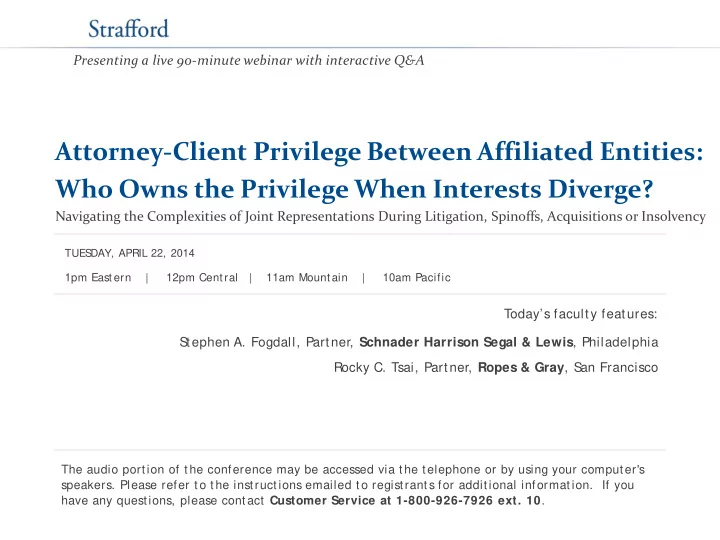
Presenting a live 90-minute webinar with interactive Q&A Attorney-Client Privilege Between Affiliated Entities: Who Owns the Privilege When Interests Diverge? Navigating the Complexities of Joint Representations During Litigation, Spinoffs,


slide-1
SLIDE 1

Attorney-Client Privilege Between Affiliated Entities: Who Owns the Privilege When Interests Diverge?

Navigating the Complexities of Joint Representations During Litigation, Spinoffs, Acquisitions or Insolvency

Today’s faculty features:

1pm East ern | 12pm Cent ral | 11am Mount ain | 10am Pacific

The audio portion of the conference may be accessed via the telephone or by using your computer's

  • speakers. Please refer to the instructions emailed to registrants for additional information. If you

have any questions, please contact Customer Service at 1-800-926-7926 ext. 10.

TUES DAY, APRIL 22, 2014

Presenting a live 90-minute webinar with interactive Q&A

S tephen A. Fogdall, Partner, Schnader Harrison Segal & Lewis, Philadelphia Rocky C. Tsai, Partner, Ropes & Gray, S an Francisco

slide-2
SLIDE 2

Tips for Optimal Quality

S

  • und Qualit y

If you are listening via your computer speakers, please note that the quality

  • f your sound will vary depending on the speed and quality of your internet

connection. If the sound quality is not satisfactory, you may listen via the phone: dial 1-888-601-3873 and enter your PIN when prompted. Otherwise, please send us a chat or e-mail sound@ straffordpub.com immediately so we can address the problem. If you dialed in and have any difficulties during the call, press *0 for assistance. Viewing Qualit y To maximize your screen, press the F11 key on your keyboard. To exit full screen, press the F11 key again.

FOR LIVE EVENT ONLY

slide-3
SLIDE 3

Continuing Education Credits

For CLE purposes, please let us know how many people are listening at your location by completing each of the following steps:

  • In the chat box, type (1) your company name and (2) the number of

attendees at your location

  • Click the word balloon button to send

FOR LIVE EVENT ONLY

slide-4
SLIDE 4

Stephen A. Fogdall Rocky C. Tsai April 22, 2014

slide-5
SLIDE 5

Concepts are simple on the surface, but complex and fact-specific in practice.

 Attorney-Client Privilege  Work-Product Protection  Waiver  Joint Client Doctrine  Common Interest Doctrine

5

slide-6
SLIDE 6

Protects communication between a client and his or her attorney for the purpose of obtaining legal advice. It is a common law doctrine. Privilege belongs to the client, not the attorney.

6

slide-7
SLIDE 7

Communication is only protected if it is made in

  • confidence. The privilege is waived if the

communication is made in the presence of a third party or if the client subsequently shares a privileged communication with a third party. While disclosure to a third party generally waives attorney-client privilege, in certain circumstances protected communications may involve third parties.

7

slide-8
SLIDE 8

Protects documents prepared for, or in anticipation of, litigation. Codified at FRCP 26(b)(3).

8

slide-9
SLIDE 9

Disclosure of documents protected by the work-product doctrine to a non-adversary third party will usually not waive protection unless it “substantially increases the opportunity for potential adversaries to obtain the information.”

9

slide-10
SLIDE 10

 Attorney-Client Privilege

  • Encourage clients to be truthful and open with their

attorneys (“full and frank” disclosure).

  • Ensure that confidences revealed to an attorney will

not be disclosed without consent.

  • Attorneys can be candid with clients about

weaknesses and matters of uncertainty in the law.

 Work-Product Doctrine

  • Allow attorneys to prepare for trial without concern

that other side might benefit or interfere.

  • Protects attorney mental processes.

10

slide-11
SLIDE 11

 Parties working under the supervision and control of

an attorney to aid the attorney in providing legal advice are included within the scope of attorney- client privilege.

 Fact-specific question, but privilege has been

extended to parties, such as:

  • Accountants
  • Investigators
  • Auditors
  • Public-relations consultants
  • Paralegals
  • Translators
  • Patent agents

11

slide-12
SLIDE 12

 Joint Client Doctrine (also known as Co-Client

Representation)

 Common Interest Doctrine (also known as

Joint Defense, Community of Interest)

LAWYER ER CLIENT NT CLIENT NT CLIENT NT CLIENT NT LAWYER ER LAWYER ER

12

slide-13
SLIDE 13

 Protects communication between co-clients

and their common counsel.

 Generally, when former joint clients sue each

  • ther, communications made in the course of

joint representation are discoverable by the co-client, but remain privileged with respect to third parties.

 Attorney representing co-clients should

terminate representation if the co-clients interests become adverse.

13

slide-14
SLIDE 14

 Exception: When an attorney improperly

continues to represent joint clients whose interests have become adverse, their communications going forward are privileged against each other notwithstanding the lawyer’s

  • misconduct. Eureka Inv. Corp. v. Chicago Title
  • Ins. Co., 743 F.2d 932 (D.C. Cir. 1984).

 Attorney representing co-clients should

terminate representation if the co-clients interests become adverse.

14

slide-15
SLIDE 15

 The common interest doctrine allows attorneys

representing different clients with common legal interests to share information without waiving attorney-client privilege.

 The common interest doctrine applies to

maintain attorney-client privilege where the parties can show that: (1) they share a common legal interest with the party with whom the information was shared and (2) the statements for which protection is sought were designed to further that interest.

15

slide-16
SLIDE 16

Common interest privilege should not be confused with the joint client privilege. Common interest privilege applies only when the parties sharing the common interest have separate counsel. Common interest privilege applies to communications between the parties’ attorneys, but not to communications shared directly between the represented parties.

16

slide-17
SLIDE 17

Who Owns the Privilege When Interests Diverge?

 Can parent assert privilege against former

affiliate?

 Can former affiliate waive the privilege?

17

slide-18
SLIDE 18

 Parent/Subsidiary  New Management  Bankruptcy  Sale of Affiliated Company  Post-Merger  Board of Directors

18

slide-19
SLIDE 19

 A lawyer who represents a corporation does

not automatically represent affiliated

  • rganization.

 Whether a lawyer represents affiliated

corporations depends on the particular circumstances (fact-specific inquiry).

19

slide-20
SLIDE 20

 Inter corporate communications (between

parent and sub or two subs) can receive the same protection as comparable intra corporate communications.

 Depends on:

  • The relationship between the parent and subsidiary

corporation (i.e. whether the parent owns a controlling interest in the subsidiary).

  • The common interest that the parent and subsidiary

may have in the subject of a particular communication.

20

slide-21
SLIDE 21

 Generally, counsel may advise an affiliate

corporation without undermining attorney- client privilege (joint-client representation).

 Issues arise, however, when the interests of

the parent and subsidiary diverge.

  • when parent releases control of subsidiary because
  • f insolvency and bankruptcy (e.g. Teleglobe)
  • sale of subsidiary
  • Litigation between entities

21

slide-22
SLIDE 22

Parties:

Teleglobe USA Inc. v. BCE, Inc. (In re Teleglobe Comm’ns Corp.), 493 F.3d 345 (3d Cir. 2007)

  • Canada’s largest telecom company.
  • Decides to stop funding subs, including Teleglobe.

Bell Canada Enterprises, Inc. (“BCE”)

  • Canadian telecom company.
  • Files for bankruptcy in Canada.

Teleglobe, Inc.

  • Wholly-owned U.S. subsidiaries of Teleglobe.
  • File for bankruptcy in Delaware.
  • Sue BCE and seeks discovery of documents.

Subsidiaries (debtors)

22

slide-23
SLIDE 23

 Complaint alleges that BCE reneged on

binding commitments to fund Teleglobe and negligently or fraudulently induced Teleglobe and subs to incur debt in reliance on commitments.

 Subsidiary seeks production of privileged

documents containing legal advice provided to BCE prior to termination of funding.

Teleglobe USA Inc. v. BCE, Inc. (In re Teleglobe Comm’ns Corp.), 493 F.3d 345 (3d Cir. 2007)

23

slide-24
SLIDE 24

Debtors’ Discovery Arguments:

 In-house counsel represented all of the corporate

family members in connection with the parent corporation’s funding decision.

 Alternatively, documents were subject to

discovery under a “conflicted fiduciary” exception to attorney-client privilege. Parent Corporation’s Response:

 No joint representation between parent and

second-tier subs/debtors.

Teleglobe USA Inc. v. BCE, Inc. (In re Teleglobe Comm’ns Corp.), 493 F.3d 345 (3d Cir. 2007)

24

slide-25
SLIDE 25

The Third Circuit’s Privilege Holdings:

 Subsidiaries are entitled to discover otherwise

privileged information only if a joint-client relationship arose between the parent company and the second-tier subs/debtors.

 Question of fact: whether a parent and subsidiaries

have jointly agreed to seek legal advice from counsel.

 “Conflicted fiduciary” exception may be applicable

depending on when the debtors became insolvent.

 Remanded to District Court for further fact finding.

Teleglobe USA Inc. v. BCE, Inc. (In re Teleglobe Comm’ns Corp.), 493 F.3d 345 (3d Cir. 2007)

25

slide-26
SLIDE 26

Lessons Learned:

 Be clear about the scope of parent-subsidiary

joint representations before sharing information with counsel.

 Narrowly define the scope of representation.  Obtain separate counsel on matters in which

the parent and subsidiary are potentially adverse.

Teleglobe USA Inc. v. BCE, Inc. (In re Teleglobe Comm’ns Corp.), 493 F.3d 345 (3d Cir. 2007)

26

slide-27
SLIDE 27

 “When control of a corporation passes to new

management, the authority to assert and waive the corporation’s attorney-client privilege passes as well. New managers installed as a result of takeover, merger, loss of confidence by shareholders, or simply normal succession, may waive the attorney-client privilege with respect to communications made by former officers and directors.” Commodity Futures Trading Comm’n

  • v. Weintraub, 471 U.S. 343, 348 (1985).

27

slide-28
SLIDE 28

 In the absence of a trustee, the debtor in

possession controls the corporation’s attorney- client privilege.

 Where a trustee is appointed in a bankruptcy

proceeding, the attorney-client privilege passes to that individual.

 There is little case law that addresses the transfer

  • f attorney-client privilege pursuant to a plan of

reorganization or liquidation, accordingly it is best to identify who will control the privilege in a bankruptcy plan or liquidation trust agreement.

28

slide-29
SLIDE 29

 The buyer of a subsidiary corporation may have

control to waive the privilege over pre-closing communications between the seller’s general counsel and the subsidiary’s officers concerning the sale negotiation.

 Restatement rule regarding waiver of joint client

privilege: Any co-client may invoke the privilege unless it has been waived by the client who made the communication. If a document embodies communications from two or more co-clients, all

  • f those co-clients must join in the waiver.

Restatement (Third) of the Law Governing Lawyers § 75 cmt. e.

29

slide-30
SLIDE 30

Jurisdictional differences:

 Any attorney-client privilege attached to pre-

merger communications pass to the acquirer in the merger, unless the parties agree otherwise in the merger agreement. Great Hill Equity Partners IV, LP v. SIG Growth Equity Fund I, LLLP, 80 A.3d 155, 160 (Del. Ch. 2013).

 Seller transfers privilege to the buyer on most

topics, except pre-merger privileged communication that relate to the merger. Tekni- Plex, Inc. v. Meyner & Landis, 674 N.E.2d 663, 671 (N.Y. Ct. App. 1996).

30

slide-31
SLIDE 31

Facts:

 Buyers acquired the target company in a merger. The

merger agreement provided that the merger shall have the effects set forth in the agreement and DGCL.

 DGCL provides that after a merger “all rights,

privileges, powers and franchises” are vested in the surviving company.

 The merger agreement did not provide for any

retention of privilege by the sellers.

 After the closing, the buyers sued the sellers alleging

fraudulent concealment during the merger.

Great Hill Equity Partners IV, LP v. SIG Growth Equity Fund I, LLLP, 80 A.3d 155 (Del. Ch. 2013)

31

slide-32
SLIDE 32

Holding:

 Chancellor Strine rejected Tekni-Plex, which

held that the privilege remains with the seller for communications regarding the merger.

 DGCL’s provision that “all rights, privileges,

powers and franchises” must be read broadly and includes attorney-client privilege.

Great Hill Equity Partners IV, LP v. SIG Growth Equity Fund I, LLLP, 80 A.3d 155 (Del. Ch. 2013)

32

slide-33
SLIDE 33

Lessons Learned:

 Parties are free to vary by contract the

automatic transfer of attorney-client privilege to the buyer.

 Sellers may want to negotiate a provision

excluding privileged pre-merger negotiations from the assets transferred to the buyer.

Great Hill Equity Partners IV, LP v. SIG Growth Equity Fund I, LLLP, 80 A.3d 155 (Del. Ch. 2013)

33

slide-34
SLIDE 34

 Directors right to information includes privileged

material.

 Chancellor rejected defendants’ argument that a

board majority can invoke attorney-client privilege against fellow director and deprive him of information.

  • May vary by jurisdiction. See Am. S.S. Owners Mut.

Protection & Indem. Ass’n Inc. v. ALCOA S.S. Co., Inc., 232 F.R.D. 191, 198 (S.D.N.Y. 2005) (federal common law).

 Treated director seeking privileged information as

joint client of board’s counsel.

 Right of equal access to materials.

* Kalisman v. Friedman, CIV.A. 8447-VCL, 2013 WL 1668205 (Del. Ch. Apr. 17, 2013)

34

slide-35
SLIDE 35

Recognized three limitations on a director’s ability to access privileged information:

1.

Ex ante agreement

2.

Special committee

3.

Once sufficient adversity exists between the director and the corporation such that the director could not longer have a reasonable expectation that he was a client of the board’s counsel

Kalisman v. Friedman, CIV.A. 8447- VCL, 2013 WL 1668205 (Del. Ch. Apr. 17, 2013)

35

slide-36
SLIDE 36

Facts:

 Shareholders of Maxim Integrated Products, Inc., filed

a derivative action naming several directors as defendants and alleging breach of fiduciary duty.

 Maxim’s Board formed a Special Committee to

investigate the allegations. The Special Committee retained Orrick as outside counsel to assist in the investigation.

 Special Committee and counsel presented the

findings to Maxim’s Board. Attorneys representing the director defendants were present at the meeting.

 Plaintiffs seek to discover communications from the

investigation.

Ryan v. Gifford, CIV.A. 2213-CC, 2007 WL 4259557 (Del. Ch. Nov. 30, 2007)

36

slide-37
SLIDE 37

 Maxim and Orrick assert attorney-client privilege.

Orrick also asserts work product protection.

 Court holds: Not protected!

  • Plaintiffs had shown good cause under Garner framework

to obtain discovery of communications.

  • Even if Maxim and the Special Committee shared a joint

privilege, they waived it when the Special Committee disclosed the report to the defendants and their

  • attorneys. Presence of attorneys showed that defendants

were attending the meeting in their personal (potentially adverse) capacities, not as fiduciaries.

  • Maxim also waived the privilege by disclosing the reports

conclusions to the public and NASDAQ.

Ryan v. Gifford, CIV.A. 2213-CC, 2007 WL 4259557 (Del. Ch. Nov. 30, 2007)

37

slide-38
SLIDE 38

 Lessons Learned:

  • Back to Basics: Disclosure to third parties (not for the

purpose of legal advice) waives privilege.

  • Absent waiver, communications between the Special

Committee and its separately retained counsel probably would have been covered by attorney-client privilege.

  • Refrain from disclosing the substance of

investigation, except in general terms, in public statements or in submissions to government regulators.

Ryan v. Gifford, CIV.A. 2213-CC, 2007 WL 4259557 (Del. Ch. Nov. 30, 2007)

38

slide-39
SLIDE 39

 Limit scope of engagement before sharing

information.

 Be alert for potential conflicts after interests

diverge.

39

slide-40
SLIDE 40

 Engagement letter for joint representation by outside

counsel should contain:

  • Scope of joint representation (limited to specific matters);
  • Specify clients and note that representation is limited to

those clients and not all affiliates;

  • Note who controls the joint privilege in the event that the

parties later become adverse.

  • But lots of jurisdictional differences, must consult case law.

 In-house counsel can also expressly limit the scope

  • f representation for affiliate or subsidiary. Must be

clearly stated in writing.

  • Avoid disclosure of unrelated legal matters of the parent.

40

slide-41
SLIDE 41

 Be alert for potential conflicts issues during sale of

subsidiary or transaction where the subsidiary may file for bankruptcy.

 Retain separate counsel as soon as it appears that the

parent and subsidiary’s interest may become adverse.

  • If company is separating, end joint representation before

any material legal work for the separation begins.

  • If corporate affiliates need separate outside counsel,

separate inside counsel should be assigned to monitor the firms.

 Outline scope of joint representation in an

engagement letter or sales agreement for spinoffs and acquisitions.

41

slide-42
SLIDE 42

Questions? s?

Stephen en A.

  • A. Fo

Fogda dall ll Schnader Harrison Segal & Lewis LLP Philadelphia, PA 215-751-2000 sfogdall@schnader.com Ro Rock cky C.

  • C. Ts

Tsai ai Ropes & Gray LLP San Francisco, CA 415-315-6300 Rocky.Tsai@ropesgray.com

42