Attorney-Client Privilege in Insurance Disputes Protecting - - PowerPoint PPT Presentation

attorney client privilege in insurance disputes
SMART_READER_LITE
LIVE PREVIEW

Attorney-Client Privilege in Insurance Disputes Protecting - - PowerPoint PPT Presentation

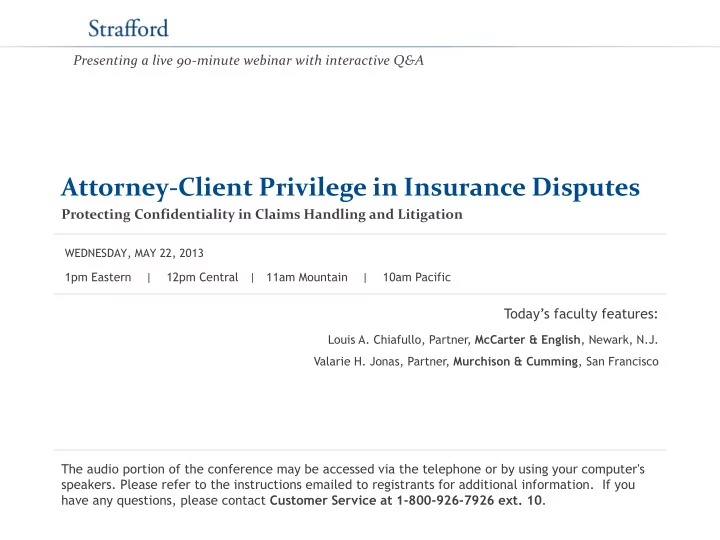
Presenting a live 90-minute webinar with interactive Q&A Attorney-Client Privilege in Insurance Disputes Protecting Confidentiality in Claims Handling and Litigation WEDNESDAY, MAY 22, 2013 1pm Eastern | 12pm Central | 11am


slide-1
SLIDE 1

Attorney-Client Privilege in Insurance Disputes

Protecting Confidentiality in Claims Handling and Litigation Today’s faculty features:

1pm Eastern | 12pm Central | 11am Mountain | 10am Pacific

The audio portion of the conference may be accessed via the telephone or by using your computer's

  • speakers. Please refer to the instructions emailed to registrants for additional information. If you

have any questions, please contact Customer Service at 1-800-926-7926 ext. 10.

WEDNESDAY, MAY 22, 2013

Presenting a live 90-minute webinar with interactive Q&A

Louis A. Chiafullo, Partner, McCarter & English, Newark, N.J. Valarie H. Jonas, Partner, Murchison & Cumming, San Francisco

slide-2
SLIDE 2

Sound Quality If you are listening via your computer speakers, please note that the quality of your sound will vary depending on the speed and quality of your internet connection. If the sound quality is not satisfactory and you are listening via your computer speakers, you may listen via the phone: dial 1-866-927-5568 and enter your PIN when prompted. Otherwise, please send us a chat or e-mail sound@straffordpub.com immediately so we can address the problem. If you dialed in and have any difficulties during the call, press *0 for assistance. Viewing Quality To maximize your screen, press the F11 key on your keyboard. To exit full screen, press the F11 key again.

slide-3
SLIDE 3

For CLE purposes, please let us know how many people are listening at your location by completing each of the following steps:

  • In the chat box, type (1) your company name and (2) the number of

attendees at your location

  • Click the SEND button beside the box

FOR LIVE EVENT ONLY

slide-4
SLIDE 4

If you have not printed the conference materials for this program, please complete the following steps:

  • Click on the + sign next to “Conference Materials” in the middle of the left-

hand column on your screen.

  • Click on the tab labeled “Handouts” that appears, and there you will see a

PDF of the slides for today's program.

  • Double click on the PDF and a separate page will open.
  • Print the slides by clicking on the printer icon.
slide-5
SLIDE 5

Application of the Attorney-Client Privilege in Insurance Defense and in Insurance Coverage Disputes

Louis A. Chiafullo, Esq. McCarter & English, LLP Newark, NJ Valarie Jonas, Esq. Murchison & Cumming, LLP San Francisco, CA

slide-6
SLIDE 6

Attorney-Client Privilege – the Basics

♦ Evidentiary privileges are created by statute and courts are generally powerless to carve out exceptions or create new ones. ♦ The attorney-client privilege has been described as the “‘oldest rule of privilege known to the common law.’” Upjohn Co. v. United States, 449 U.S. 383, (1981), quoting Wigmore, Evidence §2290 (McNaughton Rev. 4th ed. 1961).) ♦ For privilege to attach there must first be an attorney-client relationship, and it only protects confidential communications that are made for the purpose of obtaining or providing legal advice.

6

slide-7
SLIDE 7

Privilege Defined

Privilege attaches where: ♦ 1) legal advice of any kind is sought; ♦ 2) from a professional legal advisor in his capacity as such; ♦ 3) the communication relates to that purpose; and ♦ 4) the communication is made in confidence. ♦ United States v. Evans, 113 F.3d 1457 1461 (7th Cir. 1997)(citing Wigmore Evidence §2290 (McNaughton Rev. 4th ed. 1961).)

7

slide-8
SLIDE 8

Privilege—the Basics

♦ Privilege protection extends only to communications, not facts. ♦ Upjohn Co. v. United States, 449 U.S. 383, 396(1981).

8

slide-9
SLIDE 9

State Law Governs Scope of Privilege in Federal Diversity Cases

♦ Rule 501 of the Federal Rules of Evidence provides that evidentiary privileges are “governed by the principles of the common law as they may be interpreted by the courts of the United States in light of reason and

  • experience. However, in civil actions and proceedings, with respect to an

element of a claim or defense as to which State law supplies the rule of decision, the privilege of a witness, person, government, State or political subdivision thereof shall be determined in accordance with State law.” ♦ See First Pacific Networks Inc. v. Atlantic Mut. Ins. Co., 163 F.R.D. 574, 577 (N.D. Ca. 1995) (A federal court exercising diversity jurisdiction applies California law to issues relating to the attorney-client privilege.)

9

slide-10
SLIDE 10

Who is the “Client” for Purposes of Privilege?

♦ The seminal case which defines who the corporate “client” is for purposes

  • f the attorney client privilege is Upjohn Co. v. United States, 449 U.S. 383

(1981). ♦ In Upjohn, the U. S. Supreme Court rejected the “control group” test, which limited privilege protection to officers and agents responsible for directing the company’s actions, in favor of a broader application of privilege, extending to mid-level and lower level employees—all those who have relevant information needed by the attorney to adequately advise the client.

10

slide-11
SLIDE 11

Is Disclosure Reasonably Necessary to Further the Purpose of the Legal Consultation?

♦ While the Court in Upjohn attempted to create a uniform rule that reflects the reality of corporate litigation, the case has not made application of privilege in the insurance context more predictable. Whether privilege attaches in the corporate context continues to be decided on a case by case basis. ♦ See, e.g., Zurich American Ins. Co. (2007) 155 Cal.App.4th 1485 (remanding on the issue of whether corporate employees fall within the scope of the attorney-client privilege, on a “need to know” basis).

11

slide-12
SLIDE 12

Who Owns the Attorney-Client Privilege? Who Can Waive It?

♦ Determined by state law in diversity cases.

12

slide-13
SLIDE 13

Who Owns Privilege Where Corporation No Longer Exists?

♦ An April 2013, California Court of Appeal decision has addressed the issue

  • f who owns the privilege where a corporation no longer exists.

– Melendrez v. Superior Court , 2013 Cal. App. LEXIS 343 (April 30, 2013) Where a corporation no longer exists and the court is unable to appoint a director or officer to verify discovery, “we believe that the corporation’s attorney-client privilege would be passed to its insurers, the de facto assignee of its policies and the claims against them.”)

13

slide-14
SLIDE 14

Scope of Waiver of Attorney-Client Privilege Also Governed by State Law

♦ Garcia v. Progressive Choice Insurance Co., 2012 U.S. Dist. LEXIS 105932 (S.D.

  • Ca. 2012) (Because attorney-client privilege is governed by state law in

diversity cases, California controlled the scope of waiver of the privilege. California law narrowly construes any waiver of privilege and does not recognize “subject matter” waiver.) ♦ Employers Ins. of Wausau v. California Water Service Co., 2007 U.S. Dist. LEXIS 77363 (N.D. Ca. 2007) (applying California’s narrow view of privilege waiver where documents inadvertently produced)

14

slide-15
SLIDE 15

Work Product Doctrine Under FRCP Rule 26(b)(3)(B)

♦ In cases of diversity jurisdiction, federal courts will apply state law to questions of attorney-client privilege. Work product protection in federal diversity cases, on the other hand, is governed by F.R.C.P. 26(b)(3). ♦ But see, Ward v. Equilon Enterprises, 2011 U.S. Dist. LEXIS 75451 (N.D. Ca. 2011) (“Because the work product doctrine is a statutory privilege under California law, work product materials are not automatically discoverable under Rule 26(b)(1).”)

15

slide-16
SLIDE 16

Scope of Work Product Protection

♦ F.R.C.P. 26(b)(3) provides that a party is not entitled to discovery of “documents and tangible things that are prepared in anticipation of litigation or for trial by or for another party or its representative” unless a showing of substantial need and lack of undue hardship is made. ♦ “The work-product doctrine is a qualified immunity which protects from discovery documents and tangible things prepared by a party or that party’s representative in anticipation of litigation. …The party claiming the work- product privilege bears the burden of establishing that documents claimed as work product were prepared in anticipation of litigation.” (Kintera Inc. v. Convio, 219 F.R.D. 503, 507 (S.D. Ca. 2003))

16

slide-17
SLIDE 17

Fact versus Opinion Work Product

♦ Fact Work-Product—qualified immunity. – “Fact work-product consists of factual material that is prepared in anticipation of litigation or trial. In determining whether documents were prepared in anticipation of litigation, the court should consider whether the documents ‘would have been generated but for the pendency or imminence of litigation.” (Kintera, Inc. v. Convio, 219 F.R.D. 503, 507 (S.D. Ca. 2003), quoting Griffith v. Davis, 161 F.R.D. 687, 698- 99 (C.D. Ca. 1995))

17

slide-18
SLIDE 18

Fact versus Opinion Work Product

♦ Opinion Work-Product—“nearly absolute protection”

– “Where the selection, organization, and characterization of facts reveals the theories, opinions, or mental impressions of a party or the party’s representative, that material qualifies as opinion work product. …In

  • rdering discovery of such materials, the court shall protect against

disclosure of the mental impressions, conclusions, opinions, or legal theories of an attorney or other representative of a party concerning the

  • litigation. Fed.R.Civ.P. 26(b)(3). (Kintera, Inc. v. Convio, Inc., 219 F.R.D. 503,

507 (S.D. Ca. 2003)) – “Opinion work product receives ‘nearly absolute protection.” (Id.)

18

slide-19
SLIDE 19

Who Owns the Work Product Privilege?

♦ Courts generally hold work product belongs to the attorney, and it is the attorney who can waive its protections. ♦ See Hartford Fire Ins. Co. v. Garvey, 109 F.R.D. 323 (N.D. Ca. 1985)(“[A]s attorney work product ‘belongs’ to the attorney, the disclosure will be analyzed under the case law applying to inadvertent disclosure.”) ♦ Hechinger Investment Co. v. Official Committee of Unsecured Creditors, 303 B.R. 18, *10 (Bankr. D. Del. 2003) (“[W]ork product is the privilege of the attorney…thus the attorney is the one who may waive it.”)

19

slide-20
SLIDE 20

Issues Unique to Insurance Defense: No Protection for Insurer-Insured Communications

♦ Neither federal common law nor the vast majority of states recognize any type of insurer-insured privilege. – It appears that only Illinois, Indiana and Missouri recognize an insurer- insured privilege.

20

slide-21
SLIDE 21

The “Tripartite” Relationship

♦ The “joint-defense” or “common interest” doctrine protects information shared among parties involved in litigation who are represented by separate counsel but who are engaged in the joint defense of a claim. – The doctrine is not technically a privilege in and of itself but, instead, creates an exception to the general rule that the attorney-client privilege is waived when privileged information is voluntarily disclosed to a third party. – It was established to facilitate communications between aligned parties in order to protect their common interests in a litigated matter with respect to communications designed to further that joint legal effort.

21

slide-22
SLIDE 22

Tripartite Relationship Defined

♦ Where an insurer retains counsel to defend its insured, a tripartite relationship arises among the insurer, insured and counsel. As a consequence, confidential communications between either the insurer or insured and counsel are protected by the attorney-client privilege, and both insurer and insured are holders of the privilege. Work product also does not lose its protection when it is transmitted to the insurer.

– Bank of America v. Superior Court (2013) 212 Cal.App.4th 1076, 1083.

22

slide-23
SLIDE 23

Tripartite Relationship—a “Coalition”

♦ “Both the insured and the carrier have a common interest in defeating or settling the third party’s claim. …In such a situation, the attorney has two clients whose primary, overlapping and common interest is the speedy and successful resolution of the claim and litigation. …The three parties may be viewed as a loose partnership, coalition or alliance directed toward a common goal, sharing a common purpose which lasts during the pendency

  • f the claim or litigation against the insured. Communications are routinely

exchanged between them relating to the joint and common purpose—the successful defense and resolution of the claim.”

– American Mut. Liab. Ins. Co. v. Superior Court (1974) 38 Cal.App.3d 579, 591- 592.

23

slide-24
SLIDE 24

Suggested Strategies for Protecting Tripartite Communications

♦ Execute a Joint Defense Agreement ♦ Execute a Confidentiality Agreement ♦ Implement Procedures to Maintain the Privilege ♦ Whenever Possible, Avoid Written Communications ♦ Consider Mediating the Insurance Issues

24

slide-25
SLIDE 25

Impact of Reservation of Rights on Privilege

♦ No waiver where tender of defense accepted without reservation:

– Continental Casualty Co. v. St. Paul Surplus Lines Ins. Co., 265 F.R.D. 510 (E.D.

  • Ca. 2010) (Both insurer and insured are “considered the clients of the

defense counsel, and an attorney-client privilege is shared among all of them.”

♦ Finding that ROR does not impact the privilege:

– Bank of America v. Superior Court (2013) 212 Cal.App.4th 1076, 1091(tripartite attorney-client relationship exists notwithstanding reservation of rights)

25

slide-26
SLIDE 26

Impact of ROR on Privilege

Finding ROR may waive attorney-client privilege:

– Higgins v. Karp, 239 Conn. 802, 810 (1997) (Although insured and insurer may have common interest in defeating or minimizing claims against the insured and the insurer retains defense counsel, “the attorney’s only

  • bligation is to the client, the insured.”)

Finding no privilege between insured and insurer:

– In re Pfizer Inc. Securities Litigation, 1993 U.S. Dist. LEXIS 18215 (S.D. N.Y. 1993) (rejecting argument that insured and insurer share common interest and holding that disclosure by insured to insurer waived attorney-client privilege)

26

slide-27
SLIDE 27

Impact of ROR on Privilege

♦ No privilege where insurer denies defense and indemnity obligation: – Where the policy includes a duty to defend and insurer denies or rejects that duty, communications between that counsel and the insurer are not protected from disclosure under either the attorney-client privilege or the joint defense privilege.

  • North River Ins. v. Philadelphia Reinsurance,

797 F. Supp. 363, 367 (D.N.J. 1992)

  • Vermont Gas Systems, Inc. v. United States Fidelity & Guaranty Co.,

151 F.R.D. 268, 277 (D. Vt. 1993)

  • Remington Arms Co. v. Liberty Mutual Ins. Co.,

142 F.R.D. 408, 417-18 (D. Del. 1992)

  • CAMICO Mutual Insurance Co v. Heffler Radetich & Saitta, C.A. No. 11-4753 (E. D. Pa. Jan.

28, 2013).

27

slide-28
SLIDE 28

Impact of ROR on Privilege—Independent Counsel

♦ Where ROR leads to appointment of independent counsel:

– No Privilege: Lectrolarm Custom Systems, Inc. v. Pelco Sales, Inc., 212 F.R.D. 567 (E.D. Cal. 2002) (“[M]ost important element of the attorney client privilege” is missing when a conflict of interest requires the appointment of independent counsel.) – In Continental Casualty Co. v. St. Paul Surplus Lines Ins. Co., 265 F.R.D. 510 (E.D. Cal. 2010), the court noted that the attorney-client privilege does not extend to communications between an insured, an attorney, and insurer who is defending with a reservation of rights, let alone to an insurer that is not defending at all.

28

slide-29
SLIDE 29

Impact of ROR on Privilege—Independent Counsel

– California Civil Code § 2860 (d) independent counsel is to “disclose to the insurer all information … except privileged materials relevant to coverage disputes” and any information disclosed by independent counsel to the insurer is “not a waiver of the privilege as to any other party.” – Privilege remains in effect: Bank of America v. Superior Court (2013) 212 Cal.App.4th 1076 (Even where independent counsel is appointed, both insured and defense counsel have a duty “to disclose to the insurer all information concerning the action except privileged materials relevant to coverage disputes, and timely to inform and consult with the insurer on all matters relating to the claim. (Civ. Code §2860, subd. (d).) Any information disclosed by the insured or by independent counsel is not a waiver of the privilege as to any other party.”)

29

slide-30
SLIDE 30

Other Issues Unique to Insurance Coverage Disputes

♦ When does privilege attach? ♦ Who is the attorney for purposes of the privilege in insurance coverage dispute? ♦ Providing advice versus performing functions of an insurance company in investigating and resolving claims

30

slide-31
SLIDE 31

Is In-House Insurer Counsel Acting as an Attorney or in a Corporate Business Capacity?

♦ “The application of the work product doctrine is particularly difficult in the context of insurance claims.”

– Gilliard v. Great Lakes Ins., 2013 U.S. Dist. LEXIS 56968 (D.S.C. 2013) (finding that “the proponent of work product protection must establish that the ‘driving force’ behind the preparation of each requested document is the prospect of litigation) – “Insurance companies have a duty to investigate, evaluate, and adjust claims made by their insureds. The creation of documents during this process is part of the ordinary course of business of insurance companies, and the fact that litigation is pending or may eventually ensue does not cloak such documents with work product protection.” HSS Enters, LLC v. Amco Co., 2008 U.S. Dist. LEXIS 11841 at *4 (W.D. Wash. 2008)

31

slide-32
SLIDE 32

Claims Handling and Privilege

♦ “It is settled that the attorney-client privilege is inapplicable where the attorney merely acts as a negotiator for the client, gives business advice or

  • therwise acts as a business agent.” (Aetna Cas. & Surety Co. v. Superior Court

(1984) 153 Cal.App.3d 467, 475). ♦ Church Mutual Ins. Co. v. Clay Center Christian Church, 2012 U.S. Dist. LEXIS 10552 (D. Neb. 2012) (work product protection inapplicable to report created in ordinary course of business). ♦ Mission National Ins. Co. v. Lilly, 112 F.R.D. 160, 163 (D. Minn. 1986) (work product immunity did not apply were “immediately upon receiving notice

  • f the [incident], [insurer decided] to employ attorneys to fulfill its ordinary

business function of claims investigation.”)

32

slide-33
SLIDE 33

Claims Handling and Privilege

♦ St. Paul Reinsurance Co. v. Commercial Fin. Corp., 197 F.R.D. 620, 636 (N.D. Iowa 2000) (It is the insurer’s business to investigate claims.) ♦ Harper v. Auto-Owners Ins. Co., 138 F.R.D. 655, 663 (S.D. Ind. 1991) (“[A] document or thing produced or used by an insurer to evaluate an insured’s claim in order to arrive at a claims decision in the ordinary and regular course of business is not work product regardless of the fact that it was produced after litigation was reasonably anticipated.”)

33

slide-34
SLIDE 34

Trends— Dominant Purpose

♦ Some jurisdictions look to the “dominant purpose” of hiring counsel. – Costco Wholesale Corp. v. Superior Court of Los Angeles County (2000) 47 Cal.4th 725 (Trial court must “determine dominant purpose of the relationship between the insurance company and its in-house attorneys. i.e., was it one of attorney-client or one of claims adjuster-insurance corporation… .”)

34

slide-35
SLIDE 35

Trends—Dominant Purpose

♦ New Jersey courts have also addressed the issue in terms of the "predominant purpose" of the attorney-insurer relationship: – Munich Reinsurance America, Inc. v. American National Insurance Company, 2011 U.S. Dist. LEXIS 41826 (D.N.J. 2011) (proper inquiry is whether the attorney-client relationship is “predominantly for the purpose of rendering legal services”) (quoting Louisiana Municipal Police Employers Retirement System v. Sealed Air Corp., 252 F.R.D. 300 (D.N.J. 2008))

35

slide-36
SLIDE 36

Attorney Involvement Not Necessarily the Key to Privilege Attaching

♦ With respect to work product under FRCP 26(b)(3), the District Court of New Jersey has found that counsel’s participation in the investigation of the claim will not insulate the resulting work product from production.

– American Home Assurance Co. v. U.S., 2009 U..S. Dist. LEXIS 93957 (D.N.J. 2009) (report of investigator not attorney work-product under FRCP Rule 26 (b)(3) even where insurer believed it was prepared in anticipation of litigation: “[S]imple involvement of counsel in an insurer’s claim investigation does not transform the investigation to one undertaken in anticipation of litigation. …Generally work-product protection is not afforded to documents prepared prior” to a coverage decision being made.)

36

slide-37
SLIDE 37

“Predominant Character” of the Communication

♦ New York courts have taken a slightly different approach, focusing on the “predominant character” of the communication itself. Because the “business” of an insurer is to investigate claims, where counsel performs this investigative function, attorney-client communications which occur before the insurer renders its coverage decision will not be protected from discovery.

– Geneva Mortgage Corp. v. Certain Underwriters at Lloyd’s London, 836 N.Y.S.2d 499 (2006) (Reports made by attorneys who conducted the investigation of a claim on behalf of the insurer and communications from the carrier to the attorney, prior to the date the carrier rejected the claim, are not subject to privilege or work product protection.)

37

slide-38
SLIDE 38

Was the Document Created in the Ordinary Course of Business or in Anticipation of Litigation?

♦ Application of work product protection to claim file under Rule 26 depends on “whether, under the specific facts of the case, the claims analysis would have been created because of anticipated litigation or whether it would have been created in the ordinary course of business.” (Safeco Ins. Co. v. M.E.S. Inc., 2011 U.S. Dist. LEXIS 140700 (E.D.N.Y. 2011)) ♦

  • St. Paul Fire & Marine Co. v. SSA Gulf Terminals, Inc., 2002 U.S. Dist. LEXIS

11776 (E.D. La. 2002) (for work product protection to attach, insurer must establish that “primary motivating purpose” of investigations, reports and meetings “was to aid in future litigation.”) ♦ Raritan Bay Federal Credit Union v. Cumis Ins. Society, Inc., 2010 U.S. Dist. LEXIS 112640 (D.N.J. 2010) (investigator’s communications with insurer’s counsel and notes and summaries of interviews of witnesses were prepare in ordinary course of insurer’s investigation of claim and therefore not subject to work product or attorney-client protection.)

38

slide-39
SLIDE 39

Was the Document Created Before or After Claims Decision Was Made?

♦ Bombard v. Amica Mutual Ins. Co., 783 N.Y.S.2d 85 (2004) (holding that reports prepared by insurance investigators, adjustors or attorneys before the decision is made to pay or reject a claim are not privileged and are discoverable even where such reports are motivated in part by the potential for litigation with insured.) ♦ Illiana Surgery and Medical Center LLC v. Hartford Fire Ins. Co., 2010 U.S. Dist. LEXIS 122827 (D. Ind. 2010) (outside counsel’s work did not “equate to legal advice” where outside counsel conducted phone conferences with in- house adjusters and never rendered a coverage opinion)

39

slide-40
SLIDE 40

Was the Document Created Before or After Claims Decision Was Made?

♦ Tilden-Coil constructors, Inc. v. Landmark American Ins. Co., 2010 U.S. Dist. LEXIS 106369 (W.D. Wash. 2010) (outside counsel’s review of documents in preparation for drafting denial letters not subject to work product protection.)

40

slide-41
SLIDE 41

Burden on Insurer to Establish that Each Document Is Subject to Privilege

♦ Consugar v. Nationwide Ins. Co. of America, 2011 U.S. Dist. LEXIS 61756 (M.D. Pa. 2011) (The date the insurer “decided the possibility of litigation was substantial and imminent” is not the relevant inquiry. Insurer must provided privilege log specifying grounds for application of protection with respect to each document.)

41

slide-42
SLIDE 42

General Principles—You Can’t Convert Non- Privileged Information Into Privileged Information

♦ “Any relevant fact may not be withheld merely because it was incorporated into a communication involving an attorney.” (Upjohn Co. v. United States, 449 U.S. at 395-396.) ♦ “It is established that otherwise routine, non-privileged communications between corporate officers of employees transacting the general business of the company do not attain privileged status solely because in-house or

  • utside counsel is ‘copied in’ on correspondence or memoranda.” (Zurich

American Ins. Co. v. Superior Court (2007) 155 Cal.App.4th 1485, 1504.) ♦ Where documents are generated as an “inherent and long-standing part” of the defendant’s business, “that litigation appeared imminent is of no moment.” The documents therefore are not subject to privilege. (MBIA

  • Ins. Corp. v. Countrywide Loans, 93 A.D.3d 574, 575 (2012).)

42

slide-43
SLIDE 43

Bad Faith Exception to Privilege

♦ In some jurisdictions the insured is entitled to discovery of privileged communications in the claim file where the documents “may cast light” on whether the insurer acted in bad faith. – See Boone v. Vanliner Ins. Co., 744 N.E.2d 154 (Ohio 2001) (“In an action alleging bad faith denial of insurance coverage, the insured is entitled to discover claims file materials containing attorney-client communications related to the issue of coverage that were created prior to the denial of coverage.”) – Panattoni Construction, Inc. v. Travelers, 2012 U.S. Dist. LEXIS 178273 (W.D. Wash. 2012) (in bad faith cases insurer-attorney communications are subject to disclosure if relevant to the issue of bad faith.)

43

slide-44
SLIDE 44

Discovery of Claim File—Bad Faith

♦ Indeed, even where the insurer has denied coverage after the inception of the coverage litigation, it may be required to turn over privileged information from its claim file, up to the date of denial. – See C.B. Fleet Co. v. Colony Speciality Ins., 2013 U.S. Dist. LEXIS 6504 (N.D. Ohio 2013).

44

slide-45
SLIDE 45

Advice of Counsel Defense: Opening the Door

♦ The deliberate injection of the advice of counsel into a case waives the attorney-client privilege as to communications and documents relating to the advice.

– Handgards, Inc. v. Johnson & Johnson, 413 F.Supp. 926 (N.D. Ca. 1976)

45

slide-46
SLIDE 46

Best Practices for Preserving Privilege

♦ Role of privilege log ♦ Bifurcation of bad faith claim in jurisdictions that allow discovery of privileged communications in claim file ♦ In camera inspection ♦ Decide whether advice of counsel will be used early on ♦ Limit written communications

46

slide-47
SLIDE 47

Privilege Issues Unique to Insured-Broker Relationship -- Hypothetical

♦ In a coverage litigation relating to an underlying professional negligence claim, the insured and an employee of its broker – WillMar – had multiple communications relating to the claim, the relevant insurance policies, and the potential for coverage under those policies. These communications included a discussion of relevant case law and potential legal strategy. The broker both received and authored communications, and notes were taken by the insured and the broker memorializing phone conversations during which the above subjects were

  • discussed. The broker employee was also a licensed attorney, but in

many communications an automated email “footer” stated that the broker was not providing legal advice.

47

slide-48
SLIDE 48

Hypothetical - continued

♦ During discovery, the insurers moved to compel all documents prepared by, transmitted to, or summarizing communications with the broker. In response, the insured sought to withhold the communications pursuant to the attorney-client privilege, claiming that in addition to being its insurance broker, Aon also provided legal counsel and, thus, any communications between them were subject to the privilege. ♦ Do the insurers get the documents?

48

slide-49
SLIDE 49

Privilege and Brokers

♦ Cellco Partnership d/b/a Verizon Wireless v. Certain Underwriters at Lloyd’s, London, et al., 2006 WL 1320067 (D.N.J. 2006).

– Insurers moved to compel production of communications that were prepared by, transmitted to, or that summarized communications with the insured’s insurance broker, Aon. – The insured sought to withhold these communications pursuant to the attorney-client privilege, claiming that Aon also provided legal counsel and, thus, any communications between them were subject to the privilege. – The insured relied in part on the fact that the Aon employee responsible for handling its claim submission was also a licensed attorney and was providing legal counsel to the insured.

49

slide-50
SLIDE 50

Privilege and Brokers

– The court rejected Cellco’s argument, finding that there was no retainer agreement between Aon and Cellco, and finding that Cellco failed to sufficiently demonstrate how Aon’s role and function changed to that of legal counsel from insurance broker. The court also found that the broker/attorney employed by Aon explicitly stated that the information he was providing was not intended to be legal advice. – The court concluded, based upon these facts, that neither Aon nor the insured could have reasonably believed that an attorney-client relationship existed or that they had an expectation of confidentiality surrounding their communications.

50

slide-51
SLIDE 51

Privilege and Brokers

♦ In re Tetra Technologies Inc., No. 4:08-cv-0965, 2010 WL 1335431 (S.D. Tex. April 5, 2010).

– Tetra argued that its insurance brokers were its agents and therefore fell within the ambit of the attorney-client privilege. Plaintiffs argued that many of Tetra’s communications with its brokers took place in the context of a dispute between Tetra and its insurer – thus, the brokers were simply facilitators and not agents. – The court held that, even in situations where an insured and its insurers are in a dispute, an insurance broker can nonetheless act as the insured’s agent when the purpose of the communication was made “to facilitate the rendition of legal services.” The court noted that what is vital to the attorney-client privilege is that “the communication be made in confidence for the purpose of obtaining legal advice from a lawyer.” The court ruled that it would review in camera the communications that the plaintiffs alleged did not meet such criteria to determine whether or not that particular communication fell within the attorney-client privilege.

51

slide-52
SLIDE 52

Privilege and Brokers

♦ Amtel Corp. v. St. Paul Fire & Marine Ins. Co., 409 F. Supp. 2d 1180 (N.D.

  • Cal. 2005)

– Insurer moved to compel the production of attorney-client privileged materials that the insured, Amtel, had sent to its insurance broker. The insurer argued that brokers are independent contractors and do not act as agents for either the insurer or insured. – The court rejected that argument by noting that the broker had negotiated the policies at issue and thereafter served as a “necessary advisor” to Amtel on insurance coverage and claim issues. Accordingly, the court ruled that “[g]iven the relationship between [the broker] and Amtel, the attorney-client privilege was not waived because [the broker] was present to further Amtel’s interests and disclosure to [the broker] was reasonably necessary to provide information to the insurers.”

52

slide-53
SLIDE 53

Privilege and Brokers

♦ SR Int’l Bus. Ins. Co. v. World Trade Center Prop., LLC, No. 01 Civ. 9291, 2002 WL 1334821 (S.D.N.Y. June 19, 2002) (third-party insurance broker no within scope of attorney-client privilege). ♦ J.E. Dunn Constr. Co. v. Underwriters at Lloyd’s, London, No. 05-0092-CV, 2006 WL 1128777 (W.D. Mo., April 25, 2006) (communications to third-party broker not privileged, even where insured and broker entered into joint defense agreement, because broker’s interest in litigation was to minimize its own liability to the insured – therefore, there was no “common interest”)

53

slide-54
SLIDE 54

Contacts

Louis A. Chiafullo, Esq. McCarter & English, LLP Four Gateway Center 100 Mulberry Street Newark, New Jersey 07102 973-848-5340 lchiafullo@mccarter.com Valarie Jonas, Esq. Murchison & Cumming LLP Embarcadero Center West 275 Battery Street, Suite 550 San Francisco, California 94111 415.524.4316 vjonas@murchisonlaw.com

54