
SLIDE 1
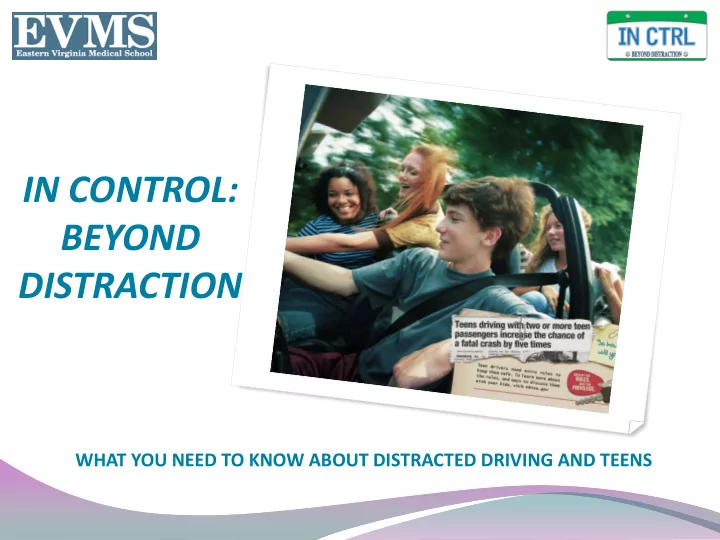
IN CONTROL: BEYOND DISTRACTION
WHAT YOU NEED TO KNOW ABOUT DISTRACTED DRIVING AND TEENS
IN CONTROL: BEYOND DISTRACTION WHAT YOU NEED TO KNOW ABOUT - - PowerPoint PPT Presentation
IN CONTROL: BEYOND DISTRACTION WHAT YOU NEED TO KNOW ABOUT DISTRACTED DRIVING AND TEENS What is the Issue? Motor vehicle crashes are the leading cause of death and severe injury for teens. 1 Distracted driving is one of the greatest
WHAT YOU NEED TO KNOW ABOUT DISTRACTED DRIVING AND TEENS
Motor vehicle crashes are the leading cause of death and severe injury
for teens.1
Distracted driving is one of the greatest contributors to crashes and near-
crashes.1
Teen drivers have the highest incidence of distracted driving, and are
Over half of 11th and 12th grade students
admitted to texting or emailing while driving.2
www.carsafetynow.org
Teens are the most aggressive and earliest adopters of
new technology.2-4
Wireless technologies (e.g., smart phones, iPods) have
become commonplace.2-4
Texting is the most common and preferred means of communicating for
teens.2-4
Teens’ natural tendencies toward risk-taking make
them more comfortable with distractions while driving.2-4
www.carsafetynow.org
Whether hand-held or hands-free, the cognitive demands of cell phone
use while driving degrade performance.
Texting and manipulating hand-held devices requires drivers to spend up
to 400 percent more time with their eyes off the road.
Approximately 10% percent of all fatal crashes
and 18% percent of all crash injuries each year are known to involve distraction. Each year in the US, over 3,000 people are killed and over 400,000 are injured in motor vehicle crashes involving a distracted driver. 4
www.carsafetynow.org
Talk to teens about the dangers of driving distracted! Tell them your rules for
driving safely.
Cell phones aren’t the only source of distraction in the car. Other
passengers, loud music, food, and applying make-up (among many others) can be a source of distraction for the driver.
Parents can restrict teens from cell phone use while behind the wheel by
downloading an app to their teen’s smart phone. See your app store for availability.
Set the example! Believe it or
not, teens will assimilate the behaviors adults exhibit while behind the wheel.
www.carsafetynow.org
Presentation slides provided as a public service by Eastern Virginia Medical
School Department of Pediatrics as part of the In Control: Beyond Distraction program.
Funding provided by the Virginia Highway
Safety Office.
For more information, please visit www.carsafetynow.org
Sources Cited:
1.
Centers for Disease Control and Prevention. (2014). Youth Risk Behavior Surveillance--United States, 2013. Morbidity and Mortality Weekly Report, (26):576.
2.
Ishigami, Y., & Klein, R. (2009). Is a hands-free phone safer than a handheld phone? Journal of Safety Research, 40(2), 157-164.
3.
Hosking, S., Young, K., & Regan, M. (2009). The effects of text messaging on young drivers. Human Factors, 51(4), 582-592.
4.
National Highway Traffic Safety Administration. (2015). Traffic Safety Facts Research Note: Distracted Driving 2013 (No. DOT HS 812 132). Washington, DC: National Center for Statistics and Analysis.
www.carsafetynow.org