
SLIDE 1
1
. Improving the Performance of Interactive TCP Applications using Service Differentiation
- W. Noureddine and F. Tobagi
Department of Electrical Engineering Stanford University Stanford, CA, USA
Proceedings of IEEE Infocom New York, NY June 2002
Introduction (1)
- Everyone has experience with bad delays
– Interactive apps (audioconference, telnet, games) need response time about 150ms – Web needs about 5 seconds, with some Web applications (ie- stock trading) less
- Delays can be from overloaded servers
– But content providers can fix – Concentrate on delays from network
Introduction (2)
- Telnet delay from typed character until echo
– Includes transmission, propagation, queue – If loss, then TCP retransmit
- Web delay the same, but also from
connection establishment
– HTTP 1.0 has one connection per object – HTTP 1.1 allows multiple objects per conect.
Introduction (3)
- Internet designed for throughput
– TCP probes for maximum data rate even if causes loss
- Periods of sending followed by idle (time-out)
– Large queues because increases utilization – But not necessarily best for interactive applications!
- This paper
– Classes of traffic (in DiffServ) – Telnet > Web > FTP – Window size for Web
Outline
- Introduction
(done)
- Simulation Setup
(next)
- The Effects of Congestion
- QoS Framework
- App Based Differentiation
- TCP-State Based Differentiation
- Conclusions
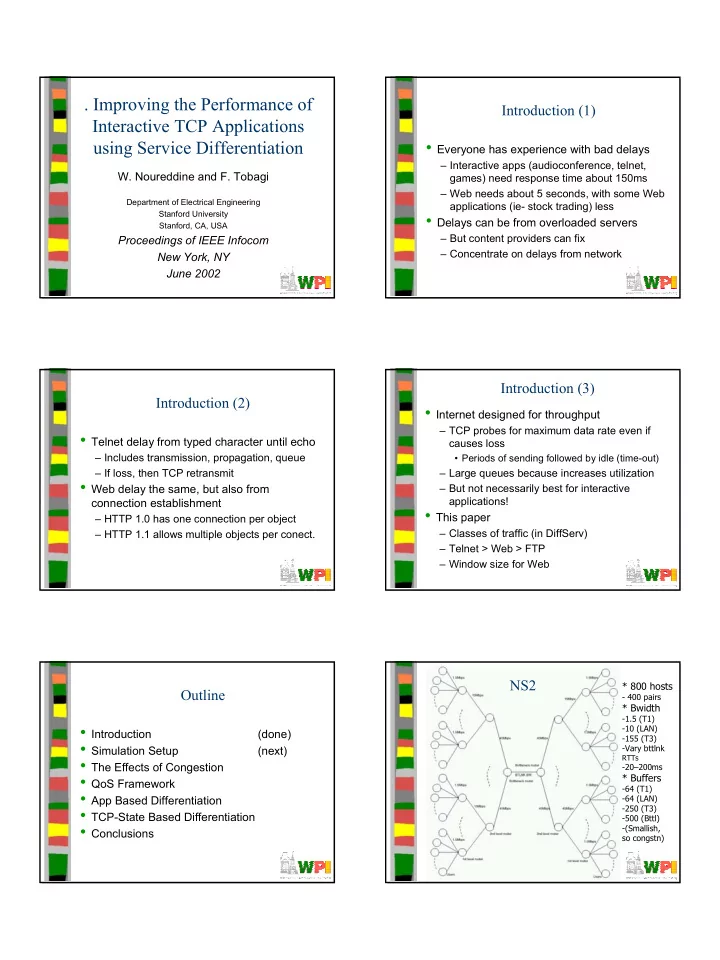
NS2
* 800 hosts
- 400 pairs
* Bwidth
- 1.5 (T1)
- 10 (LAN)
- 155 (T3)
- Vary bttlnk
RTTs
- 20–200ms
* Buffers
- 64 (T1)
- 64 (LAN)
- 250 (T3)
- 500 (Bttl)
- (Smallish,
so congstn)