Improvements to the Co-simulation Interface for Geographically - - PowerPoint PPT Presentation

improvements to the co simulation interface for
SMART_READER_LITE
LIVE PREVIEW

Improvements to the Co-simulation Interface for Geographically - - PowerPoint PPT Presentation

Improvements to the Co-simulation Interface for Geographically Distributed Real-time Simulation 45th Annual Conference of the IEEE Industrial Electronics Society (IECON) 15th 17th October 2019, Lisbon Paper: LD-029874 1 Improvements to the


slide-1
SLIDE 1

Improvements to the Co-simulation Interface for Geographically Distributed Real-time Simulation Steffen Vogel | 16.10.2019 1

M.Sc. Steffen Vogel
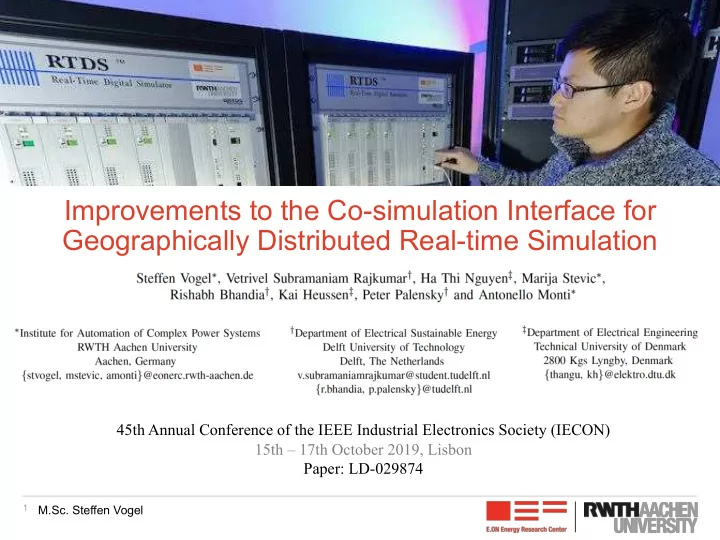
Improvements to the Co-simulation Interface for Geographically Distributed Real-time Simulation

45th Annual Conference of the IEEE Industrial Electronics Society (IECON) 15th – 17th October 2019, Lisbon Paper: LD-029874

slide-2
SLIDE 2

Improvements to the Co-simulation Interface for Geographically Distributed Real-time Simulation Steffen Vogel | 16.10.2019 2

Contents

■ ERIGrid Transnational Access Exchange ■ The concept of Geographically Distributed Co-simulation ■ System Architecture ■ Test case description ■ Main contributions

1. Improved calculation of Dynamic Phasor Coefficients by moving window average 2. Investigation of IETF RTP protocol for streaming real-time simulation data 3. Fidelity Improvements / Bug Fixes 4. CoSiF – A reusable library for distributed real-time simulation

■ Future plans

slide-3
SLIDE 3

Improvements to the Co-simulation Interface for Geographically Distributed Real-time Simulation Steffen Vogel | 16.10.2019 3

Geographically Distributed Real-time Simulation (GD-RTS)

■ A single digital real-time simulation

spanning multiple simulators / simulation sites

■ Motivation

≡ Large-scale system-level simulatoins ≡ Exchange of Knowledge, Human- and Hardware Ressources ≡ Overcome constraints caused by data confidientiality

Comm. network From monolithic RTS to GD-RTS Digital Real-Time Simulator (DRTS) DRTS 1 DRTS 2 DRTS 3 Subsystem 3 Subsystem 2 Subsystem 1 Subsystem 3 Subsystem 2 Subsystem 1

slide-4
SLIDE 4

Improvements to the Co-simulation Interface for Geographically Distributed Real-time Simulation Steffen Vogel | 16.10.2019 4

Background / Motivation

■ Global Real-time SuperLab:

≡ 8 sites, 10 simulators, 8 links

■ Simple ITM or P/Q, Vrms, f

Interface Algorithms

■ Long setup time ■ Huge variations in network

quality

  • M. Stevic et al., “Virtual integration of laboratories over long distance for

real-time co-simulation of power systems,” in IECON 2016 - 42nd Annual Conference of the IEEE Industrial Electronics Society, 2016, pp. 6717–6721.

slide-5
SLIDE 5

Improvements to the Co-simulation Interface for Geographically Distributed Real-time Simulation Steffen Vogel | 16.10.2019 5

System Architecture

■ 2 Labs:

≡ 2 RTDS Simulators ≡ 2 VILLASnode Gateways ≡ Decentral / Fully-meshed VPN for

  • ptimal point-to-point connection with lowest latency
slide-6
SLIDE 6

Improvements to the Co-simulation Interface for Geographically Distributed Real-time Simulation Steffen Vogel | 16.10.2019 6

Network Connectivity

■ National Research and Education Networks (NRENs)

≡ DFN, SURFnet, GÉANT

■ Mean Round-trip time: 𝟐𝟑 𝒏𝒕 ■ Routing hops:

𝟐𝟒

■ Sending rate:

≤ 𝟐𝟏 𝒍𝑸𝒍𝒖/𝒕

10 15 20 25 30

RTT [ms]

0.1 0.2 0.3 0.4 0.5 0.6 0.7 0.8 0.9 1

Probability

500 Packets/sec 1000 Packets/sec 2000 Packets/sec 5000 Packets/sec 10000 Packets/sec 15000 Packets/sec 17000 Packets/sec 20000 Packets/sec

slide-7
SLIDE 7

Improvements to the Co-simulation Interface for Geographically Distributed Real-time Simulation Steffen Vogel | 16.10.2019 7

Real-time Transport Protocol (RTP)

■ Different co-sim links vary significantly

in quality of serivce (QoS)

■ Adaptive adjustment of

communication parameters is helpful

■ Additive Increase –

Multiplicate Decrease (AIMD)

time [s] sending rate [kHz]

10 20 30 40 50 60 70 1 2 3

Packet Loss

1 2 1 4 1 8 1 16 r r r r

■ Discontinuties in sending rate cause

frequency disturbances in simulation

■ Only useful for initial estimation, not

during live simulation

0.5 1 1.5 2 2.5 3 3.5 4 4.5 5

  • 6.22498
  • 6.22496
  • 6.22494
  • 6.22492
  • 6.2249

Sequence Difference

106 0.5 1 1.5 2 2.5 3 3.5 4 4.5 5 Time [s] 59.96 59.98 60 60.02 Frequency [Hz]

slide-8
SLIDE 8

Improvements to the Co-simulation Interface for Geographically Distributed Real-time Simulation Steffen Vogel | 16.10.2019 8

Test Scenario & Methodology

■ Simple scenario helped debugging and understanding ■ 3 Stages: monolithic, decoupled, distributed

13.8/230 kV

Load 1

~

230/115 kV

Load 2 SS1 SS2

~ ~

13.8/230 kV 230/115 kV

Load 2 Load 1

a) Monolithic Model b) Decoupled / Distributed Model

Line 2 Line 1

slide-9
SLIDE 9

Improvements to the Co-simulation Interface for Geographically Distributed Real-time Simulation Steffen Vogel | 16.10.2019 9

Dynamic Phasor Interface Algorithm (DP-IA)

Window . . . Mean Mean Mean Mean Mean . . .

Calculation of Dynamic Phasor Coefficients from Time-domain Signals.

slide-10
SLIDE 10

Improvements to the Co-simulation Interface for Geographically Distributed Real-time Simulation Steffen Vogel | 16.10.2019 10

Dynamic Phasor Interface Algorithm (DP-IA)

Cartesian to Polar Magnitude Phase Cartesian to Polar Magnitude Phase . . . . . .

Reconstruction of Time-domain Signals from Dynamic Phasor coefficients.

slide-11
SLIDE 11

Improvements to the Co-simulation Interface for Geographically Distributed Real-time Simulation Steffen Vogel | 16.10.2019 11

Simulation Results: Instantaneous V/I

  • ■ Test cases:

≡ Voltage Source in SS1 (left) ≡ Change of magnitude, freuquency, phase

■ No error in steady-state ■ Delayed update of

≡ Voltage magnitude SS1 (1/2 RTT) ≡ Current magnitude on left side (1 RTT)

slide-12
SLIDE 12

Improvements to the Co-simulation Interface for Geographically Distributed Real-time Simulation Steffen Vogel | 16.10.2019 12

Simulation Results: P/Q RMS

■ Change of source magnitude in SS1 (left side)

0.4 0.5 0.6 0.7 0.8 0.9 1 1.1 1.2 16 17 18 19 20

P [MW]

Original

  • Dcpl. SS1
  • Dist. SS1

Dcpl.SS2

  • Dist. SS2

0.4 0.5 0.6 0.7 0.8 0.9 1 1.1 1.2 6 6.5 7 7.5 8

Q [MVAr] Time [s]

slide-13
SLIDE 13

Improvements to the Co-simulation Interface for Geographically Distributed Real-time Simulation Steffen Vogel | 16.10.2019 13

Limits of GD-RTS

0.34 0.36 0.38 0.4 0.42 0.44 0.46

  • 200

200 400

Voltage [kV]

SS1dcpl SS1dist Original SS2dcpl SS2dist

0.34 0.36 0.38 0.4 0.42 0.44 0.46

Time [s]

  • 0.1
  • 0.05

0.05 0.1

Current [kA]

■ Phase jump of 𝜌 of 𝑊

./0

slide-14
SLIDE 14

Improvements to the Co-simulation Interface for Geographically Distributed Real-time Simulation Steffen Vogel | 16.10.2019 14

Fidelity Improvements I

■ Mismatch in DFT window length for 60 Hz systems ■ Fundamental period of 60 Hz is not evenly dividable by a 𝑈

. = 50 𝜈𝑡 time-step

■ Optimal Simulation Timestep: ■ Uneven time-steps might cause other issues in relation to synchronization of

simulators

slide-15
SLIDE 15

Improvements to the Co-simulation Interface for Geographically Distributed Real-time Simulation Steffen Vogel | 16.10.2019 15

Fidelity Improvements II

■ Mismatch in active / reactive power due to internal time-step delays between

network solution and control systems of DRTS

■ Phase compensation for controlled sources required

sin (rad) + + dp1_phase Mag (pk) Freq (Hz) AbsPhase (rad) 2* X 2*

Phase Compensation for Controlled Sources

60.0 X t compensation_steps X recon_dp1 dp1_mag 60.0 compensation

slide-16
SLIDE 16

Improvements to the Co-simulation Interface for Geographically Distributed Real-time Simulation Steffen Vogel | 16.10.2019 16

Usability Improvements

■ Use of GPS time (GTSYNC) to coordinate synchronized simulation start

≡ Alignment of measurements ≡ Synchronized reference phasors

■ Open problem for OPAL-RT systems

slide-17
SLIDE 17

Improvements to the Co-simulation Interface for Geographically Distributed Real-time Simulation Steffen Vogel | 16.10.2019 17

Co-Simulation Interface Library: „CoSiF

■ Re-usable library blocks for different:

≡ Interface Algorithms: Dynamic Phasors, PQ + 𝑊

/:., 𝑔, 𝜚

≡ Simulation Platforms: RTDS, OPAL+RT

■ Open Source: GPLv3

≡ https://fein-aachen.org/projects/cosif/

D H Y ssD_IAtlineSE ssD_IBtlineSE ssD_ICtlineSE D H Y ssD_IAtlineRE ssD_IBtlineRE ssD_ICtlineRE ssD_IFBUS ifH_phC ifH_phB ifH_phA DOKHKKu x_ HyOYHYKd ssD_SRCBUS ssD_VsrcC ssD_VsrcB ssD_VsrcA DOKHYPy x_ HdOHbDgg GEN Co-sim interface vKOu

ssD_TLINE T-LINE NAME LINE CONSTANTS fHYKxgK TLINE CALCULATION BLOCK CONTROL AND MONITOR IN THIS SUBSYSTEM Processor Assignment Auto

Dynamic Load RxxL dist_ssD_DLD A B C

Subsystem H - SSH Subsystem D - SSD

slide-18
SLIDE 18

Improvements to the Co-simulation Interface for Geographically Distributed Real-time Simulation Steffen Vogel | 16.10.2019 18

Future Plans

■ More tests with off-nominal frequencies at the interface ■ Ongoing ERIGrid Transnational Access with DTU Denmark

≡ Distributed-PHIL with Quasi Stationary Back-to-Back Converter ≡ Energy Based Metric (EBM) for error quantification

■ FPGA / PCIe-based DRTS interfaces

≡ Migration of DP-IA into VILLASnode

slide-19
SLIDE 19

Improvements to the Co-simulation Interface for Geographically Distributed Real-time Simulation Steffen Vogel | 16.10.2019 19

Acknowledgements

■ TU Delft

≡ Prof. Palensky ≡ Rishabh Bhandia

■ DTU Denmark

≡ Prof. Kai Heussen

■ Funding

≡ ERIGrid H2020 ≡ Urban Energy Lab 4.0 EFRE.NRW ≡ RESERVE H2020

■ Software Development / Distribution

≡ Fein Aachen e.V.

Förderer der Energie- und Informationstechnik für zukünftige Netze Aachen e.V.

slide-20
SLIDE 20

Improvements to the Co-simulation Interface for Geographically Distributed Real-time Simulation Steffen Vogel | 16.10.2019 20

E.ON Energy Research Center Mathieustraße 10 52074 Aachen Germany Steffen Vogel T +49 241 80 49577 stvogel@eonerc.rwth-aachen.de https://www.eonerc.rwth-aachen.de

Contact