Important Viral Infec,ons Viral Infec,ons a/er Hematopoie,c - - PDF document

important viral infec ons viral infec ons a er hematopoie
SMART_READER_LITE
LIVE PREVIEW

Important Viral Infec,ons Viral Infec,ons a/er Hematopoie,c - - PDF document

2/22/13 Important Viral Infec,ons Viral Infec,ons a/er Hematopoie,c CMV Cell Transplanta,on HHV-6 Adenovirus Michael Boeckh, MD EBV Fred


slide-1
SLIDE 1

2/22/13 1

Viral ¡Infec,ons ¡a/er ¡Hematopoie,c ¡ Cell ¡Transplanta,on ¡

Michael ¡Boeckh, ¡MD ¡ Fred ¡Hutchinson ¡Cancer ¡Research ¡Center ¡ University ¡of ¡Washington ¡ SeaFle, ¡WA, ¡USA ¡

¡

Important ¡Viral ¡Infec,ons ¡

  • CMV ¡ ¡
  • HHV-­‑6 ¡
  • Adenovirus ¡
  • EBV ¡
  • BK ¡virus ¡
  • Respiratory ¡viruses ¡

Important ¡Viral ¡Infec,ons ¡

  • CMV ¡ ¡
  • HHV-­‑6 ¡
  • Adenovirus ¡
  • EBV ¡
  • BK ¡virus ¡
  • Respiratory ¡viruses ¡

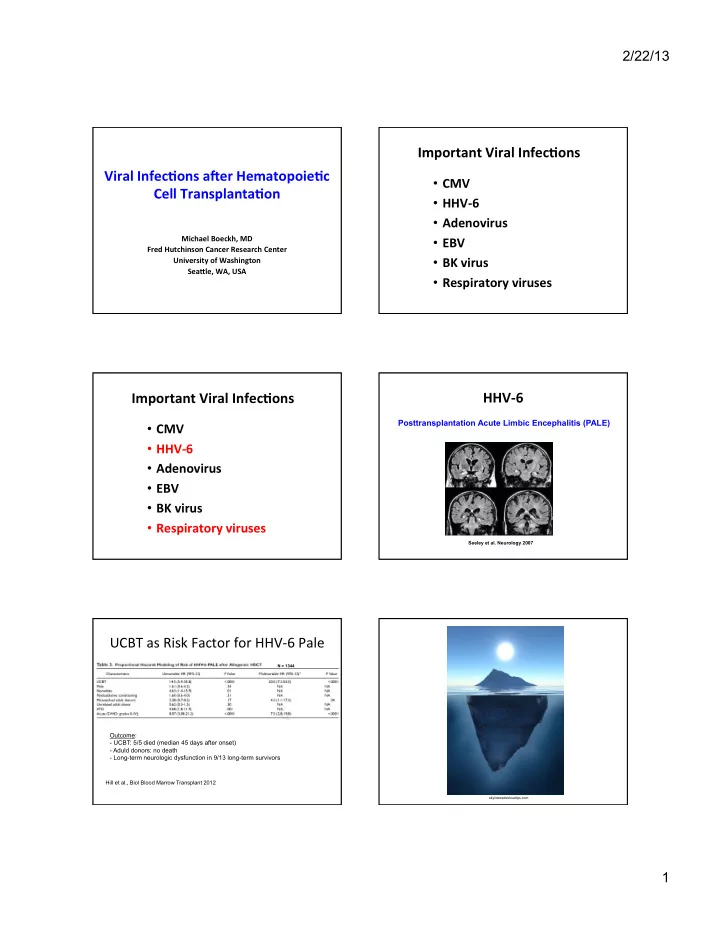
HHV-­‑6 ¡ ¡

Seeley et al. Neurology 2007

Posttransplantation Acute Limbic Encephalitis (PALE)

UCBT ¡as ¡Risk ¡Factor ¡for ¡HHV-­‑6 ¡Pale ¡

Hill et al., Biol Blood Marrow Transplant 2012

N = 1344

Outcome:

  • UCBT: 5/5 died (median 45 days after onset)
  • Aduld donors: no death
  • Long-term neurologic dysfunction in 9/13 long-term survivors

skylinetradeshowtips.com

slide-2
SLIDE 2

2/22/13 2

skylinetradeshowtips.com

Delirium Neurocognitive Dysfunction

Pneumonia GvHD Cytopenias CMV Infection Chromosomal Integration

HHV-­‑6 ¡a/er ¡HCT ¡

Prospec,ve ¡Study ¡

Zerr et al. Blood 2011

56 84 Day

Dilirium screening 3x/wk Viral load 2x/wk 1x/wk 2x/wk Neuropsychologic testing

HHV-­‑6 ¡and ¡Delirium ¡

Zerr et al. Blood 2011

HHV-­‑6: ¡Neurocogni,ve ¡Decline ¡

Zerr et al. Blood 2011

HHV-­‑6 ¡and ¡Acute ¡GvHD ¡

Hepatic stage 1-4 Gastrointestinal stage 1-4 Skin stage 3-4 Hepatic stage 2-4 Gastrointestinal stage 2-4 Skin stage 4 Overall aGVHD grades 2-4 Overall aGVHD grades 3-4 .1 .3 1 2 5 20 Any HHV-6 HHV-6 >1000 Hazard Ratio and 95% Confidence Interval

Covariates 2,6 1,2,6 3,7 3 2 2,8 4,5 4,5 2,6 2,3,6 3 3 2,3 1,2 1,4 1,4

Zerr et al., BBMT 2012

HHV-6

Take Home Points ¡

  • HHV-6 can cause severe encephalitis. The risk

appears to be higher after cord blood transplantation.

  • HHV-6 has been associated with dilirium.
  • HHV-6 has been associated with early mortality and

GvHD.

  • Both ganciclovir and foscarnet have been used to

treat HHV-6 disease.

  • Preventions strategies have not been studied in

randomized trials – Preemptive therapy – Prophylaxis

  • New drugs on the horizon: CMX-001
slide-3
SLIDE 3

2/22/13 3

Respiratory ¡Virus ¡Infec=ons ¡ ¡ in ¡Immunocompetent ¡Hosts ¡

  • Substan=al ¡impact ¡on: ¡

– Quality ¡of ¡life ¡ – Economic ¡burden ¡on ¡society ¡

  • Healthcare ¡visits ¡(>25 ¡million ¡in ¡U.S.) ¡
  • Unnecessary ¡use ¡of ¡an=bio=cs ¡ ¡
  • School/work ¡absenteeism ¡(>20 ¡million ¡days) ¡
  • Death ¡and ¡hospitaliza=on ¡ ¡ ¡ ¡ ¡ ¡ ¡ ¡ ¡ ¡ ¡ ¡ ¡ ¡ ¡ ¡ ¡ ¡ ¡ ¡ ¡ ¡ ¡ ¡ ¡ ¡ ¡ ¡ ¡ ¡ ¡ ¡ ¡

uncommon ¡in ¡older ¡children ¡ ¡ ¡ ¡ ¡ ¡ ¡ ¡ ¡ ¡ ¡ ¡ ¡ ¡ ¡ ¡ ¡ ¡ ¡ ¡ ¡ ¡ ¡ ¡ ¡ ¡ ¡ ¡ ¡ ¡ ¡ ¡ ¡ ¡ ¡and ¡ adults ¡

Heikkinen and Jarvinen, Lancet 2003;361:51-9

Respiratory Viruses after Transplantation

Significance Documented morbidity RSV PIV Influenza HMPV Uncertain significance Rhinovirus Coronaviruses Bocavirus Polyomaviruses (Wu, Ki)

Respiratory ¡Virus ¡Infec=ons ¡ ¡ in ¡Transplant ¡Recipients ¡

Clinical ¡features: ¡

  • High ¡frequency ¡of ¡pneumonia ¡and ¡death ¡ ¡
  • Rapid ¡clinical ¡progression ¡
  • Atypical ¡presenta=ons ¡
  • Prolonged ¡viral ¡shedding ¡ ¡
  • Frequent ¡asymptoma=c ¡infec=on ¡

– 10-­‑40% ¡of ¡pa=ents ¡are ¡asymptoma=c ¡at ¡some ¡point ¡while ¡posi=ve ¡ for ¡an ¡RV ¡

  • High ¡rates ¡of ¡nosocomial ¡acquisi=on ¡

Symptoms ¡in ¡HCT ¡Recipients ¡

Peck, ¡et ¡al. ¡Blood ¡2007;110:1681-­‑88 ¡

Proportion of samples with symptoms reported: virus-positive versus virus-negative samples Proportion of Sample with Symptoms Reported: Virus-Positive versus Virus-Negative Samples

0.00 0.10 0.20 0.30 0.40 0.50 0.60 0.70 0.80 0.90 1.00

1 2 3 4 5 6 7 8 9 10 11 12 RSV PIV MPV Influenza Negative samples

Runny Cough Watery Sore Shortness Sputum Wheezing Sinus Sinus Stuffy Muscle Fever nose eyes throat of Breath congestion headache nose aches >38° º C

Symptoms ¡in ¡HCT ¡Recipients ¡

Peck, ¡et ¡al. ¡Blood ¡2007;110:1681-­‑88 ¡

Proportion of samples with symptoms reported: virus-positive versus virus-negative samples

0.00 0.10 0.20 0.30 0.40 0.50 0.60 0.70 0.80 0.90 1.00

1 2 3 4 5 6 7 8 9 10 11 12 RSV PIV MPV Influenza Negative samples

Runny Cough Watery Sore Shortness Sputum Wheezing Sinus Sinus Stuffy Muscle Fever nose eyes throat of Breath congestion headache nose aches >38° º C

0% ~30% Influenza

Proportion of Sample with Symptoms Reported: Virus-Positive versus Virus-Negative Samples

slide-4
SLIDE 4

2/22/13 4

Clinical Course in Transplant Recipients ¡

Clinical Course is often difficult to predict in immunosuppressed subjects. Clinical signs unreliable. Mild URIs can progresses rapidly to the lower tract disease. Upper Respiratory Infection Lower Respiratory Infection Median 7 days

7 14 21 28 35 42 49 56 63 70

  • 7

0.1 1 10 Lymphocytes

Days after Transplantation

Prophylaxis Rx of Disease BAL, histopathology SV, culture, PCR, IHC

+

Pre-emptive Upper respiratory Virus Detection: DFA, SV, PCR

Therapeutic Strategies ¡ ¡

Respiratory Viruses

¡

Progression ¡to ¡RSV ¡LRD ¡ Lymphopenia ¡

§ ¡150 ¡HCT ¡pa,ents ¡with ¡RSV ¡URI ¡ § ¡All ¡ages ¡ § ¡Progression ¡to ¡LRD: ¡25% ¡ ¡ Significant ¡ ¡

  • ­‑ ¡Lymphopenia ¡

¡ ¡ Not ¡significant ¡ ¡

  • ­‑ ¡Stem ¡cell ¡source ¡
  • ­‑ ¡Donor ¡type/match ¡
  • ­‑ ¡Age ¡
  • ­‑ ¡Gender ¡
  • ­‑ ¡Smoking ¡status ¡
  • ­‑ ¡FEV-­‑1 ¡
  • ­‑ ¡Time ¡a/er ¡HCT ¡ ¡
  • ­‑ GVHD ¡
  • ­‑ ¡RSV ¡type ¡
  • ­‑ ¡Neutralizing ¡an,body ¡,ter ¡ ¡
  • ­‑ ¡donor/recipient ¡pretransplant ¡
  • ­‑ ¡recipient ¡at ¡the ¡,me ¡of ¡URI ¡

¡ Boeckh ¡& ¡Kim, ¡unpublished ¡

Lymphopenia

Progression ¡to ¡RSV ¡LRD ¡ Lymphopenia ¡

Lymphopenia

§ ¡150 ¡HCT ¡pa,ents ¡with ¡RSV ¡URI ¡ § ¡All ¡ages ¡ § ¡Progression ¡to ¡LRD: ¡25% ¡ ¡ Significant ¡ ¡

  • ­‑ ¡Lymphopenia ¡

¡ ¡ Not ¡significant ¡ ¡

  • ­‑ ¡Stem ¡cell ¡source ¡
  • ­‑ ¡Donor ¡type/match ¡
  • ­‑ ¡Age ¡
  • ­‑ ¡Gender ¡
  • ­‑ ¡Smoking ¡status ¡
  • ­‑ ¡FEV-­‑1 ¡
  • ­‑ ¡Time ¡a/er ¡HCT ¡ ¡
  • ­‑ GVHD ¡
  • ­‑ ¡RSV ¡type ¡
  • ­‑ ¡Neutralizing ¡an,body ¡,ter ¡ ¡
  • ­‑ ¡donor/recipient ¡pretransplant ¡
  • ­‑ ¡recipient ¡at ¡the ¡,me ¡of ¡URI ¡

¡ Boeckh ¡& ¡Kim, ¡unpublished ¡

Progression ¡to ¡RSV ¡LRD ¡ Ribavirin ¡and ¡steroids ¡

OR (95% CI) p-value Age in years < 25 1.0 ≥ 25 1.8 (0.6 – 5.5) 0.30 Lymphocyte count at URI > 500 1.0 101 – 500 2.4 (0.7 – 8.1) 0.15 ≤ 100 7.4 (2.1 – 26.4) 0.002 Ribavirin None or low dose 1.0 High dose 0.3 (0.1 – 1.2) 0.09 Steroids No 1.0 Yes 1.7 (0.6 – 4.3) 0.30

Multivariable Model ALC < 300/mm3 ALC > 300/mm3

Ribavirin

Boeckh & Kim, unpublished

Preemptive Aerosolized Ribavirin and RSV Pneumonia after HCT

Chemaly et al. Medicine 2006

slide-5
SLIDE 5

2/22/13 5

All ¡RSV ¡LTD ¡Cohort: ¡Mul=variate ¡analysis ¡

N=118 ¡

Covariates ¡ HR ¡95% ¡CI ¡ P-­‑value ¡ Ribavirin: ¡Systemic ¡vs. ¡None ¡ 0.71 ¡(0.28-­‑1.76) ¡ 0.454 ¡ ¡ ¡ ¡ ¡ ¡ ¡ ¡ ¡ ¡ ¡ ¡ ¡ ¡ ¡ ¡ ¡ ¡ ¡ ¡ ¡Aero ¡vs. ¡None ¡ 0.33 ¡(0.17-­‑0.64) ¡ 0.001 ¡ ¡ Oxygen ¡at ¡Dx: ¡>2L/Ven=lator ¡vs. ¡None/<2L ¡ 2.73 ¡(1.58-­‑4.71) ¡ <.001 ¡ ¡ Cell ¡source: ¡BM/Cord ¡vs. ¡PBMC ¡ 2.44 ¡(1.28-­‑4.64) ¡ 0.006 ¡ ¡ Steroid ¡pre ¡DX: ¡>2 ¡mg/kg ¡vs. ¡<=2 ¡mg/kg ¡ 2.46 ¡(1.24-­‑4.92) ¡ 0.010 ¡ ¡

Overall mortality at 90 days

Covariates ¡ HR ¡95% ¡CI ¡ P-­‑value ¡ Ribavirin: ¡Systemic ¡vs. ¡None ¡ 0.55 ¡(0.18-­‑1.68) ¡ 0.296 ¡ ¡ ¡ ¡ ¡ ¡ ¡ ¡ ¡ ¡ ¡ ¡ ¡ ¡ ¡ ¡ ¡ ¡ ¡ ¡ ¡Aero ¡vs. ¡None ¡ 0.26 ¡(0.12-­‑0.55) ¡ <.001 ¡ ¡ Oxygen ¡at ¡Dx: ¡>2L/Ven=lator ¡vs. ¡None/<2L ¡ 3.42 ¡(1.78-­‑6.57) ¡ <.001 ¡ ¡ Cell ¡source: ¡BM/Cord ¡vs. ¡PBMC ¡ 2.48 ¡(1.15-­‑5.31) ¡ 0.020 ¡ ¡

Pulmonary death at 90 days

Waghmare et al., IDSA, 2012

Palivizumab: ¡No ¡Effect ¡on ¡Survival ¡ ¡

Stra=fied ¡by ¡Oxygen ¡Use ¡

¡

0.0 ¡ 0.1 ¡ 0.2 ¡ 0.3 ¡ 0.4 ¡ 0.5 ¡ 0.6 ¡ 0.7 ¡ 0.8 ¡ 0.9 ¡ 1.0 ¡ 0 ¡ 10 ¡ 20 ¡ 30 ¡ 40 ¡ 50 ¡ 60 ¡ 70 ¡ 80 ¡ 90 ¡ 100 ¡

¡

0.1 ¡ 0.2 ¡ 0.3 ¡ 0.4 ¡ 0.5 ¡ 0.6 ¡ 0.7 ¡ 0.8 ¡ 0.9 ¡ 1.0 ¡ 0 ¡ 10 ¡ 20 ¡ 30 ¡ 40 ¡ 50 ¡ 60 ¡ 70 ¡ 80 ¡ 90 ¡ 100 ¡

Probability of Overall Survival Days after RSV- LRI Days after RSV-LRI Probability of Death due to Respiratory Failure

No oxygen without palivizumab No oxygen with palivizumab Oxygen without palivizumab Oxygen with palivizumab

Overall Survival

Death due to Respiratory Failure

p=0.040 p=0.016 Seo et al., BBMT 2013

Management of RSV in HCT Recipients at FHCRC (2/2013)

¡

  • RSV URI

– Lymphocyte count > 300

  • No radiographic and clinical findings of LRI
  • Observation with daily exam, clinical trial being developed

– Lymphocyte count < 300

  • No radiographic and clinical findings of LRI
  • Aerosolized ribavirin 6 g per day (divided in 3 doses) for 7

days

  • RSV LRI

– Radiographic and/or clinical findings of LRI – Aerosolized ribavirin 6 g per day (divided in 3 doses) for 10-14 days

Human ¡Rhinovirus ¡ Prospective Study

Months after transplantation 1 2 3 4 12

Sample Size N=500 Weekly portablespirometry (KoKo Peak Pro6) + symptom survey (paper/web-based) Nasal wash weekly Nasal wash if symptoms Pulmonary function testing (Sensormedics)
  • Goal: Prospective, systematic assessment
  • f long-term complications of incident

respiratory viral infection after HCT

Quantitative PCR for RSV, hMPV, PIV, FLU, RV, CV, ADV, Bocavirus

Prospective Study

Months after transplantation 1 2 3 4 12

Sample Size N=500 Weekly portablespirometry (KoKo Peak Pro6) + symptom survey (paper/web-based) Nasal wash weekly Nasal wash if symptoms Pulmonary function testing (Sensormedics)

slide-6
SLIDE 6

2/22/13 6

569 Informed Consent

36

No Allogeneic HCT

57

No Paired Symptom Survey & Nasal Wash

476 Final Analytic Cohort

(>1 research sample and survey)

Longitudinal ¡Study ¡Cohort

¡

12% pediatric

>8,000 nasal washes >13,000 symptom surveys and airflow measurements

RV ¡Cumula=ve ¡Incidence ¡

¡

59% ¡incidence ¡any ¡RV ¡by ¡day ¡365 ¡ ¡ ¡ ¡ ¡ ¡ ¡

Early ¡Studies ¡of ¡HRV ¡in ¡ ¡ HCT ¡Recipients ¡

  • 1990–96: ¡ ¡29 ¡HRV-­‑posi=ve ¡pa=ents; ¡1 ¡in ¡BAL ¡
  • 1992–97: ¡ ¡22 ¡pa=ents ¡with ¡HRV ¡(viral ¡culture) ¡

– 7 ¡had ¡fatal ¡HRV-­‑associated ¡pneumonia; ¡4 ¡with ¡co-­‑ pathogens ¡

  • 1999: ¡Consecu=ve ¡BALs ¡samples ¡from ¡77 ¡

– 6 ¡posi=ve ¡by ¡RT-­‑PCR ¡(culture ¡nega=ve) ¡ – 5/6 ¡died ¡of ¡pneumonia ¡ – All ¡6 ¡had ¡co-­‑pathogens ¡detected ¡in ¡BAL ¡

  • Bowden. ¡Am ¡J ¡Med ¡1997;103:27-­‑30 ¡ ¡ ¡ ¡ ¡ ¡ ¡ ¡ ¡ ¡ ¡ ¡ ¡ ¡ ¡ ¡ ¡ ¡ ¡ ¡ ¡Ghosh ¡et ¡al. ¡CID ¡1999;29:528-­‑32 ¡ ¡ ¡ ¡ ¡ ¡ ¡ ¡ ¡ ¡ ¡ ¡ ¡ ¡ ¡ ¡ ¡ ¡ ¡ ¡ ¡ ¡ ¡ ¡ ¡ ¡ ¡

Ison ¡et ¡al. ¡CID ¡2003:36;1139-­‑43 ¡

HRV ¡Fatal ¡Cases ¡

Gutman, et al. BMT 2007;40:809-11

Of 52 LRTI cases (RSV, PIV, FLU, HRV), case #2 was the only one with nonmyeloablative conditioning ¡

¡

Coronavirus (n=22) Rhinovirus (n=45) Symptom OR (95% CI) p OR (95% CI) p Rhinorrhea 1.4 (0.7–2.6) 0.33 2.3 (1.3–4.1) 0.004 Sinus congestion 0.9 (0.4–2.2) 0.83 3.4 (1.8–6.9) <0.001 Post-nasal drip 0.7 (0.3–1.6) 0.38 2.4 (1.3–4.8) 0.009 Shortness of breath 0.9 (0.3–2.8) 0.79 1.5 (0.7–3.3) 0.32 Sputum 0.9 (0.4–2.0) 0.74 1.9 (1.1–3.3) 0.03 Cough 1.9 (0.9–4.1) 0.12 2.3 (1.3–4.2) 0.006 Wheezing – – 2.0 (0.8–5.1) 0.16 Fever 0.8 (0.3–1.8) 0.58 0.7 (0.4–1.2) 0.22

Milano/Campbell, et al. Blood 2010;115:2088-94

Rhinovirus ¡& ¡Coronavirus ¡Detec,on ¡and ¡ Associated ¡Symptoms ¡ ¡ ¡ ¡ ¡ ¡ ¡ ¡ ¡ ¡ ¡ ¡(N=215 ¡ pa,ents, ¡62 ¡posi,ve) ¡

Coronavirus (n=22) Rhinovirus (n=45) Symptom OR (95% CI) p OR (95% CI) p Rhinorrhea 1.4 (0.7–2.6) 0.33 2.3 (1.3–4.1) 0.004 Sinus congestion 0.9 (0.4–2.2) 0.83 3.4 (1.8–6.9) <0.001 Post-nasal drip 0.7 (0.3–1.6) 0.38 2.4 (1.3–4.8) 0.009 Shortness of breath 0.9 (0.3–2.8) 0.79 1.5 (0.7–3.3) 0.32 Sputum 0.9 (0.4–2.0) 0.74 1.9 (1.1–3.3) 0.03 Cough 1.9 (0.9–4.1) 0.12 2.3 (1.3–4.2) 0.006 Wheezing – – 2.0 (0.8–5.1) 0.16 Fever 0.8 (0.3–1.8) 0.58 0.7 (0.4–1.2) 0.22

Milano/Campbell, et al. Blood 2010;115:2088-94

Rhinovirus ¡& ¡Coronavirus ¡Detec,on ¡and ¡ Associated ¡Symptoms ¡ ¡ ¡ ¡ ¡ ¡ ¡ ¡ ¡ ¡ ¡ ¡(N=215 ¡ pa,ents, ¡62 ¡posi,ve) ¡

slide-7
SLIDE 7

2/22/13 7

Milano/Campbell, et al. Blood 2010;115:2088-94

Prolonged Viral Shedding

5 10 15 20 25 30 35 40 45 50 0-­‑2 ¡ 3-­‑4 5-­‑6 7-­‑8 9-­‑10 11-­‑12 >12 Duration ¡of ¡episodes, ¡weeks % ¡Episodes HRV HCoV

% Episodes Duration of virus shedding episodes (weeks) Median ¡for ¡both ¡= ¡3 ¡weeks ¡ Asymptoma=c ¡Shedding ¡ Coronavirus ¡= ¡47% ¡ Rhinovirus ¡= ¡13% ¡ HCoV HRV

56 patients with HRV >1 month: 82% same strain – 26 A, 7 B, and 10 C

HRV ¡Morbidity ¡and ¡Mortality ¡

Kraft, et al. J Clin Micro 2012;50:1061-3

Severity of HRV infection in immunocompromised adults similar to that

  • f 2009 pH1N1 influenza

¡

Is ¡HRhV ¡a ¡Pulmonary ¡Pathogen? ¡

Gutman, et al. BMT 2007;40:809-11

Overall ¡Survival ¡in ¡HCT ¡Recipients ¡with ¡ Respiratory ¡Virus ¡Detec,on ¡in ¡Lower ¡ Respiratory ¡Tract ¡Samples ¡

Days after Transplantation

Survival Probability HRV with copathogen HRV w/o copathogen Influenza A RSV PIV

Seo et al. ASBMT 2013

HRV ¡Treatment ¡

  • No ¡agent ¡available, ¡no ¡studies ¡in ¡transplant ¡
  • Pleconaril ¡(capsid ¡binder) ¡

– Decreased ¡symptoms ¡by ¡median ¡of ¡1 ¡day, ¡associated ¡ with ¡loss ¡of ¡culturable ¡virus ¡

  • BTA798 ¡(vapendavir, ¡oral ¡capsid ¡binder) ¡

– Phase ¡2b ¡study ¡achieved ¡primary ¡endpoint: ¡ ¡ sta=s=cally ¡significant ¡reduc=on ¡of ¡cold ¡symptoms ¡in ¡ asthma=cs ¡

  • SNG001 ¡(inhaled ¡beta-­‑interferon) ¡

– Phase ¡2 ¡study: ¡ ¡in ¡pa=ents ¡with ¡difficult ¡to ¡treat ¡ asthma, ¡reduced ¡asthma ¡symptom ¡severity ¡and ¡ improved ¡lung ¡func=on ¡

Hayden, et al. CID 2003;36:1523-32 Pevear, et al. AAC 2005;49:4492-99

Respiratory Viruses

Take Home Points ¡

  • Highly immunosuppressed patients with CRV infections have a high risk of

– Pneumonia – Late airflow obstrcution – Death

  • Risk factor for progression from upper to lower tract disease include

– Early after transplantation: lymphopenia – Late after transplantation: unknown (preexisting lung conditions ?)

  • Rhinovirus

– More evidence that it is a true pulmonary pathogen

  • RSV

– Aerosolized ribavirin is most effective when used early in the course of pneumonia – Recent data suggest no major effect of palivizumab

  • Influenza: treatment of choice are neuraminidase inhibitors (e.g.
  • seltamivir, zanamivir)
  • Infection control remains critical

– Handwashing – Influenza vaccination of all contacts including healthcare workers – Restriction of infected healthcare workers from work while sick with a respiratory virus illness

slide-8
SLIDE 8

2/22/13 8

Acknowledegements ¡

Danielle ¡Zerr ¡ Angela ¡Campbell ¡ Sachiko ¡Seo ¡ Alpana ¡Waghmare ¡ YaeJean ¡Kim ¡ Su-­‑Mi ¡Choi ¡ Hu ¡Xie ¡ Katherine ¡Guthrie ¡ Wendy ¡Leisenring ¡ ¡