Implied Certification Doctrine Defending Implied Certification - - PowerPoint PPT Presentation

implied certification doctrine
SMART_READER_LITE
LIVE PREVIEW

Implied Certification Doctrine Defending Implied Certification - - PowerPoint PPT Presentation

Presenting a live 90-minute webinar with interactive Q&A Lender Risks of False Claims Act Liability After Sup. Courts Escobar Ruling Upholding Implied Certification Doctrine Defending Implied Certification Theory of FCA Claims in


slide-1
SLIDE 1

The audio portion of the conference may be accessed via the telephone or by using your computer's

  • speakers. Please refer to the instructions emailed to registrants for additional information. If you

have any questions, please contact Customer Service at 1-800-926-7926 ext. 10.

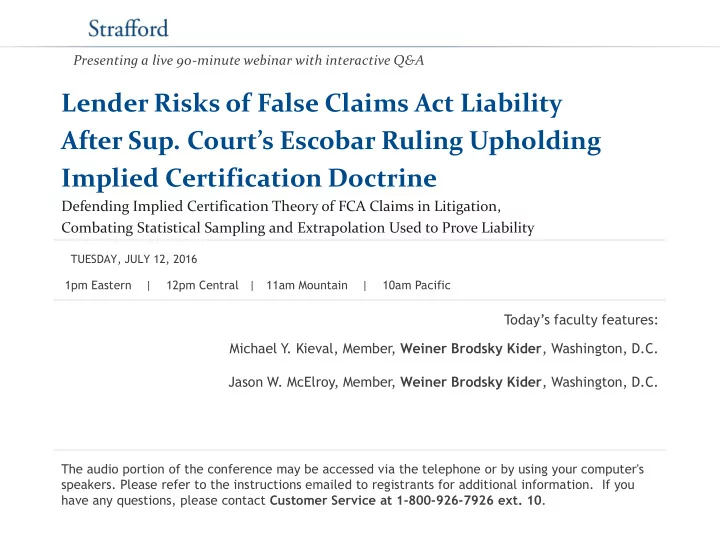
Presenting a live 90-minute webinar with interactive Q&A

Lender Risks of False Claims Act Liability After Sup. Court’s Escobar Ruling Upholding Implied Certification Doctrine

Defending Implied Certification Theory of FCA Claims in Litigation, Combating Statistical Sampling and Extrapolation Used to Prove Liability

Today’s faculty features:

1pm Eastern | 12pm Central | 11am Mountain | 10am Pacific TUESDAY, JULY 12, 2016

Michael Y . Kieval, Member, Weiner Brodsky Kider, Washington, D.C. Jason W. McElroy, Member, Weiner Brodsky Kider, Washington, D.C.

slide-2
SLIDE 2

Tips for Optimal Quality

Sound Quality If you are listening via your computer speakers, please note that the quality

  • f your sound will vary depending on the speed and quality of your internet

connection. If the sound quality is not satisfactory, you may listen via the phone: dial 1-866-873-1442 and enter your PIN when prompted. Otherwise, please send us a chat or e-mail sound@straffordpub.com immediately so we can address the problem. If you dialed in and have any difficulties during the call, press *0 for assistance. Viewing Quality To maximize your screen, press the F11 key on your keyboard. To exit full screen, press the F11 key again.

FOR LIVE EVENT ONLY

slide-3
SLIDE 3

Continuing Education Credits

In order for us to process your continuing education credit, you must confirm your participation in this webinar by completing and submitting the Attendance Affirmation/Evaluation after the webinar. A link to the Attendance Affirmation/Evaluation will be in the thank you email that you will receive immediately following the program. For additional information about continuing education, call us at 1-800-926-7926

  • ext. 35.

FOR LIVE EVENT ONLY

slide-4
SLIDE 4

Program Materials

If you have not printed the conference materials for this program, please complete the following steps:

  • Click on the ^ symbol next to “Conference Materials” in the middle of the left-

hand column on your screen.

  • Click on the tab labeled “Handouts” that appears, and there you will see a

PDF of the slides for today's program.

  • Double click on the PDF and a separate page will open.
  • Print the slides by clicking on the printer icon.

FOR LIVE EVENT ONLY

slide-5
SLIDE 5

5

Lender Risks of False Claims Act Liability After Supreme Court’s Escobar Ruling

July 12, 2016

Jason McElroy

mcelroy@thewbkfirm.com

Michael Kieval

kieval@thewbkfirm.com

5

slide-6
SLIDE 6

False Claims Act 31 U.S.C. § 3729(a)

History of the Act

  • Enacted in 1863, the FCA “was originally aimed principally at stopping

massive frauds perpetuated by large contractors during the Civil War.” United States v. Bornstein, 423 U. S. 303, 309 (1976)

  • The U.S. was billed for “nonexistent or worthless goods, charged

exorbitant prices for goods delivered, and generally robbed in purchasing the necessities of war.” United States v. McNinch, 356 U. S. 595, 599 (1958)

  • Congress responded by imposing civil and criminal liability for 10 types
  • f fraud on the Government. Act of Mar. 2, 1863, ch. 67, 12 Stat. 696

Current Version of the Act

  • 31 U.S.C. 3729(a) imposes civil liability on “any person who…knowingly

presents, or causes to be presented, a false or fraudulent claim for payment or approval”

  • Generally, the False Claims Act establishes civil liability for making a

“false or fraudulent” claim for payment by the federal government, including making a false statement that is material to a false claim

6

slide-7
SLIDE 7

Theories Giving Rise to Liability Under the False Claims Act

Factually False Claims

  • A factually false claim occurs where the claimant supplies “an incorrect

description of goods or services provided, or a request for reimbursement for goods or services never provided.” United States ex.

  • rel. Mikes v. Straus, 274 F.3d 687, 697 (2d Cir. 2001)

Legally False Claims: Two Theories

  • FCA liability may also arise from a claim that is legally false
  • (1) Express False Certification: where claimant expressly certifies

compliance with a regulation or other condition when submitting claim for payment

  • (2) Implied False Certification: where claimant impliedly certifies

compliance with regulation or other condition simply by submitting claim for payment

7

slide-8
SLIDE 8

Implied Certification Doctrine

Trends in the Use of the Doctrine

  • In implied false certification, the claimant does not expressly certify

compliance with the regulation or condition at issue

  • Some courts have held that simply by presenting a claim for payment,

the claimant has impliedly certified compliance with any regulation that imposes an express precondition on the payment sought

  • The U.S. Department of Justice has made waves in recent years with

big-dollar FCA lawsuits and settlements based on alleged noncompliance with regulations governing residential lending – Namely, that lenders failed to comply with Federal Housing Administration regulations governing FHA-insured home loans – Thus, alleging that lenders submitted “implied” false certifications of compliance with a statute, regulation or contractual provision

8

slide-9
SLIDE 9

Implied Certification Doctrine: Annual Certification of FHA-Loans

  • FCA allegations based on annual certifications are a

“fraudulent inducement,” or “promissory fraud” theory of liability – See, e.g., U.S. ex rel Hendow v. Univ. of Phoenix, 461 F.3d 1166 (9th Cir. 2006); United States ex rel. Main v. Oakland City Univ., 426 F.3d 914 (7th Cir. 2005)

  • HUD requires annual certifications as a condition of

participation in the FHA-insurance program

  • See 24 C.F.R. § 202.5(m)

– “Each lender and mortgagee must submit an annual certification on a form prescribed by the Secretary”

  • Annual Certification form states that the lender is in

compliance with FHA regulations

9

slide-10
SLIDE 10

Implied Certification Doctrine: Annual Certification of FHA-Loans

  • Annual Certification theory often predicated on initial

application as well

– Initial application to HUD for FHA approval states that the applicant “has and will comply with the requirements” of the HUD Secretary

  • Annual Certifications:

– “I certify that to the best of my knowledge, the above named mortgagee conforms to all HUD-FHA regulations necessary to maintain its HUD-FHA approval . . . .”

  • Certification was altered in 2010, but

Government/Relator allegations find no difference between the two:

– “I certify that the lender complied and agrees to continue to comply with HUD-FHA regulations, handbooks, Mortgagee Letters, Title I letters, policies, and terms of any agreements entered into with [HUD] . . . .”

10

slide-11
SLIDE 11

Implied Certification Doctrine: Annual Certification of FHA-Loans

  • In order to plead fraudulent inducement as a theory

under the FCA, the Government/Relator must plead that the Defendants had no intention of performing according to the terms of the contract. United States ex rel. Longhi v. Lithium Power Techs., Inc., 575 F.3d 458, 468 n.5 (5th Cir. 2009)

– There is no inference of fraudulent intent not to perform “from the mere fact that a promise made is subsequently not performed.” United States ex rel. Willard v. Humana Health Plan of Tex., Inc., 336 F.3d 375, 386 (5th Cir. 2003) – “Absent evidence of fraud before entry, non-performance after entry into an agreement for government subsidies does not impose liability under the FCA.” United States v. Sanford-Brown, Ltd., 788 F.3d 696, 710 (7th Cir. 2015)

11

slide-12
SLIDE 12

Implied Certification Doctrine: FHA- Loan Level Certifications

  • Loan-level certifications occur on the application for

insurance itself – HUD Form 92900-A

– Importantly, the Supreme Court long ago ruled that an application for insurance, standing alone, does not constitute a claim under the FCA. United States v. McNinch, 356 U.S. 595 (1958)

  • “In agreeing to insure a home improvement loan the FHA

disburses no funds nor does it otherwise suffer immediate financial detriment. It simply contracts, for a premium, to reimburse the lending institution in the event of future default, if any.” Id. at 599 – The Supreme Court in McNinch expressly reserved the question

  • f whether such an application could later give rise to a false

claim upon default of the loan insured. Id. at 599 n.6.

  • Many courts have found that the filing of a false application for

insurance may create an “inchoate” FCA action that accrues

  • nce a claim is filed on the false application
  • This is the essence of most Government/Relator allegations

involving loan level certifications – Escobar’s focus on the language of the claim form itself calls these lower court rulings into question

12

slide-13
SLIDE 13

Implied Certification Doctrine

Before Escobar—Circuit Split

  • There was disagreement among the Circuit Courts over the validity and

the scope of the “implied certification” theory of liability

  • The Fifth Circuit never adopted this theory of FCA liability. See United

States ex rel. Steury v. Cardinal Health, Inc., 625 F.3d 262, 268 (5th Cir. 2010)

  • The Seventh Circuit rejected the theory, reasoning that only express (or

affirmative) falsehoods can render a claim “false or fraudulent.” See United States v. Sanford-Brown, Ltd., 788 F. 3d 696, 711–12 (7th Cir. 2015)

  • Most other courts (e.g., Fourth, Ninth, and D.C. Circuits) had accepted

that “implied false certifications” are available only where the underlying statute or regulation expressly states the claimant must comply in order to be paid. See United States ex. rel. Mikes v. Straus, 274 F.3d 687, 697 (2d Cir. 2001)

13

slide-14
SLIDE 14

U.S. Supreme Court’s June 16 ruling in Universal Health v. Escobar

Facts

  • Defendant sought reimbursement from Medicaid for certain mental

health services. Escobar, 579 U.S. __, slip op. at 5

  • Because the employees who provided the mental health services

allegedly did not meet qualification and licensing requirements under Medicaid regulations, the reimbursement requests were alleged to be false claims on the theory that the claims impliedly certified that the employees met the relevant regulatory requirements. Id. at 6-7

Procedural History

  • The District Court dismissed the action, explaining that a regulation had

to be a “condition of payment” to be actionable and that the provider qualification regulations were not a condition of payment. Id. at 6

  • The First Circuit reversed, finding that the qualification requirements

were a precondition of payment. Id. at 7

14

slide-15
SLIDE 15

U.S. Supreme Court’s June 16 ruling in Universal Health v. Escobar

Holding

  • The Supreme Court unanimously held that “implied certification” can

present a viable theory for liability under the False Claims Act, but also stressed the heightened materiality requirement. Id. at 8

  • By not disclosing the violations of qualifications and licensing

requirements, the Defendant’s Medicaid reimbursement claims constituted

  • misrepresentations. Id. at 10-11
  • Implied certification could apply where:

– (1) the claim does not merely request payment, but also makes specific representations about the goods or services provided, and – (2) the Defendant’s failure to disclose noncompliance with material statutory, regulatory, or contractual requirements makes those representations misleading half-truths. Id. at 11

  • A regulation need not be labeled a “condition of payment” to trigger

implied certification, but the materiality standard is “demanding” (specifically addressed later) Id. at 15

Disposition

  • The Court vacated the First Circuit’s decision and remanded the case. Id.

at 18

15

slide-16
SLIDE 16

FCA’s Scienter Requirement in Universal Health v. Escobar

Holding on Scienter Requirement

  • Scienter is dual-pronged:

– Must both knowingly violate a provision, and know that it is material to the government

  • Not conclusive whether govt. expressly calls it condition of payment

– A Defendant can have “actual knowledge” that a condition is material even if the Government does not expressly call it a condition of payment. Id. at 12 – A Defendant’s failure to appreciate the materiality of a condition would amount to “deliberate ignorance” or “reckless disregard” of the “truth or falsity of the information” even if the Government did not spell this out. Id. at 13

  • E.g., when selling guns to the government, the seller would know the guns must

shoot, even if the government did not explicitly set this out as a condition of payment

  • Following the D.C. Circuit, the FCA’s scienter requirement demands

that “the defendant knowingly violated a requirement that the defendant knows is material to the government’s decision.” Id. at 2; United States v.

  • Sci. Apps. Int’l Corp., 626 F.3d 1257, 1271 (D.C. Cir. 2010); United

States ex rel. Purcell v. MWI, Inc., 807 F.3d 281, 287 (D.C. Cir. 2015); United States ex rel. Davis v. District of Columbia, 793 F.3d 120, 124 (D.C. Cir. 2015)

16

slide-17
SLIDE 17

Escobar: Broad Certification on All Regulations and Statutes Not Enough

No Sweeping Theory for FCA Liability

  • The Supreme Court emphasized the importance of

specific language and certifications on the claim for payment itself. Escobar, Slip Op. at 11

– Representations that are false must be contained/made on the claim for payment – These specific respresentations may be false where the defendant has knowledge that makes those representations false or misleading half-truths

  • “[I]f the Government required contractors to aver their

compliance with the entire U.S. Code and Code of Federal Regulations, then under this view, failing to mention noncompliance with any of those requirements would always be material. The False Claims Act does not adopt such an extraordinarily expansive view of liability.” Id. at 17 (emphasis added)

17

slide-18
SLIDE 18

Escobar: Broad Certification on All Regulations and Statutes Not Enough

  • The FCA is “not an all-purpose antifraud statute, or a vehicle for

punishing garden-variety breaches of contract or regulatory violations.” Id. at 15 (citations omitted)

  • Second Circuit adopted a similar view with respect to broad

certifications only a few weeks before the issuance of Escobar:

  • “[B]anks are subject to thousands of laws and regulations that

could plausibly affect the ‘validity, performance, or enforceability

  • f the terms of the Lending Agreement[]’ . . . . Reading this

provision as the relators urge would give rise to ‘exactly the kind

  • f overbroad certification requirement’ that we have previously

rejected.” Bishop v. Wells Fargo, No. 15-2449, 2016 U.S. App. LEXIS 8366, at *21 (2d Cir. May 5, 2016)

  • See also United States ex rel. Thomas v. Black Veatch Special

Projects Corp., 820 F.3d 1162, 1176 (10th Cir. 2016) (“It is not enough that the plaintiff identifies any violation of any applicable provision as a basis for FCA liability.”)

18

slide-19
SLIDE 19

Escobar: Express and Implied Certification Theories

Express and Implied Certification Theories Combined into General False Certification Theory – Escobar does not delineate between express and implied false certification claims – Instead, it draws the line saying that statements that are facially true may be “misleading half-truths” by a party’s failure to disclose information that was not necessarily requested

  • Herein lies the implied falsity
  • Escobar emphasized that FCA liability attaches to the

claim for payment, and not the underlying fraudulent

  • activity. Liability attaches under false certification

theories to a claim that “does not merely request payment, but also makes specific representations about the goods or services provided.” Id. at 11

19

slide-20
SLIDE 20

Use of Statistical Sampling and Extrapolation in FCA Litigation Against Lenders

Recent DOJ and HUD Litigation

  • Because the “implied certification” theory survives, a case

pending in the Fourth Circuit, concerning the use of statistical sampling to prove FCA liability without having to examine individual transactions, takes on additional importance

  • Quicken Loans filed suit against the DOJ and HUD

alleging that they were improperly assessing their compliance with the HUD-administered FHA-lending regulations by finding minor violations in specific loans, and extrapolating those findings across their entire loan portfolio – DOJ later filed suit against Quicken Loans under the FCA, asserting violations based on upon the implied certification theory, supported by the statistical extrapolation method

20

slide-21
SLIDE 21

Use of Statistical Sampling and Extrapolation in FCA Litigation Against Lenders

  • Statistical extrapolation has been used increasingly in

the FCA context – In cases against lenders, statistical extrapolation would allow the DOJ to assume defects in loans it has not investigated or even reviewed – When combined with implied certification, this would allow lawsuits to proceed based on asserted regulatory violations from a small sample of loans––all without any credible allegation of fraud

21

slide-22
SLIDE 22

Use of Statistical Sampling and Extrapolation in FCA Litigation Against Lenders

Arguments Against Statistical Sampling

  • A U.S. District Court recently refused to permit a qui tam

relator to extrapolate findings from sampling to establish FCA liability. United States ex rel. Wall v. Vista Hospice Care, Inc., No. 3:07-cv-00604-M, 2016 U.S. Dist. LEXIS 80160 (N.D. Tex. June 20, 2016) – The District Court concluded that sampling evidence was not sufficiently reliable in proving that the alleged false claims were actually submitted. Id. at *47 – The District Court also noted that sampling might be appropriate where the evidence establishes that a defendant’s objective approach was similar in all cases.

  • Id. at *37

22

slide-23
SLIDE 23

Use of Statistical Sampling and Extrapolation in FCA Litigation Against Lenders

United States ex rel. Michaels v. Agapé Senior Cmty., Inc., No. 15-2145, 2015 U.S. App. LEXIS 21895 (4th Cir.

  • Sep. 29, 2015)
  • The Fourth Circuit is currently facing a unique case disputing the critical

issue on the use of statistical sampling to establish FCA liability

  • The DOJ defends the role of statistical sampling by maintaining that its

very purpose is to draw inferences about a universe of differing claims – Federal Rule of Evidence 702 and established Daubert standards should act as safeguards against inappropriate sampling

  • Agapé argues that statistical sampling allows relators to take a shortcut

past the most fundamental elements of their burden of proof – Agapé urges the Fourth Circuit not to permit the relators to sidestep their burden of proof and their due process rights – Agapé insists that aggregate data cannot adduce the requisite evidence of both falsity and scienter

  • But keep in mind the difference between pleading and

evidentiary standards – Rule 8(a) requires only a short and plain statement of the claims and the facts upon which they rely

23

slide-24
SLIDE 24

Use of Statistical Sampling and Extrapolation in FCA Litigation Against Lenders

Potential Impact of Escobar on Statistical Sampling

  • Because Escobar focuses on the claim language, many

lender/FHA FCA cases may not be amenable to such sampling – FHA-specific cases rely heavily on allegations of underwriting deficiencies – Scienter and materiality will be more difficult to prove on a “pattern and practice” level under Escobar – Escobar’s focus on the representations made in the claim for payment itself will likely require more specific pleading for FHA-specific cases based on underwriting – Will make annual certification claims more difficult as well – as the alleged false statements come in the form

  • f participatory certifications and are not relevant to the

Government’s payment decision

24

slide-25
SLIDE 25

Escobar’s Strengthened Materiality Inquiry

  • The Supreme Court emphasized that the FCA’s

materiality requirement is “rigorous.” Escobar, Slip Op. at 14

  • “The materiality standard is demanding.” Id. at 15

A misrepresentation would NOT be deemed material:

  • (1) simply because the Government designates

compliance with a particular statutory, regulatory, or contractual requirement as a condition of payment,

  • (2) because the Government would have the option to

decline to pay if it knew of the noncompliance, or

  • (3) if the noncompliance was minor or insubstantial. Id. at

15-16

25

slide-26
SLIDE 26

Escobar’s Strengthened Materiality Inquiry

Factors affecting whether regulatory violation is material:

  • (1) whether regulation is identified as condition of payment

(but not dispositive either way),

  • (2) whether Defendant knows the Government

consistently refuses to pay claims based on noncompliance with particular statutory, regulatory, or contractual requirement, and

  • (3) if Government pays claim in full despite having actual

knowledge that certain requirements were violated, this is strong evidence the requirements were not material. Id. at 16

26

slide-27
SLIDE 27

Can Escobar be raised on 12(b)(6)?

  • Yes
  • The supreme court addressed this in footnote 6,

which is sure to be cited often:

– “We reject Universal Health’s assertion that materiality is too fact intensive for courts to dismiss False Claims Act cases on a motion to dismiss or at summary judgment. The standard for materiality that we have outlined is a familiar and rigorous one. And False Claims Act plaintiffs must also plead their claims with plausibility and particularity under Federal Rules of Civil Procedure 8 and 9(b) by, for instance, pleading facts to support allegations of materiality.” Escobar, Slip Op. at 16 n.6

  • This raises an interesting question re: Rule 9(b) – i.e.,

how particularized must allegations be to survive dismissal?

– Most circuits have adopted a relaxed 9(b) standard for False Claims Act pleading – See United States ex rel. Grubbs v. Ravikumar Kanneganti, 565 F.3d 180 (5th Cir. 2009)

27

slide-28
SLIDE 28

Best Practices in Defending FCA Litigation Against FHA Lenders

Consider:

  • Has the Government/Relator pleaded double falsity?
  • Is the purported misrepresentation a misrepresentation at

all?

  • How explicit is it?
  • Is the purported misrepresentation material to the

Government’s payment decision?

  • How is it labeled?
  • What has the Government’s practice been historically?
  • Did the Government know of the alleged deficiency before

paying the claim?

  • Who presented the claim for payment?
  • What is the relevance of the incontestability clause to the

Government/Relator’s theory?

Challenge the sufficiency of the pleadings

  • Force the Government/Relator to explain the theory of liability
  • Test that theory while also giving the court the opportunity to

reject other, more aggressive theories before discovery

28

slide-29
SLIDE 29

29

Weiner Brodsky Kider PC

www.thewbkfirm.com

  • Tel. 202-628-2000

Jason McElroy

mcelroy@thewbkfirm.com

Michael Kieval

kieval@thewbkfirm.com