Implementing Powerful Implementing Powerful Ratio ionale le fo - - PowerPoint PPT Presentation

implementing powerful implementing powerful
SMART_READER_LITE
LIVE PREVIEW

Implementing Powerful Implementing Powerful Ratio ionale le fo - - PowerPoint PPT Presentation

Remin inder: Remin inder: Implementing Powerful Implementing Powerful Ratio ionale le fo for A Actio ion P Pla lannin ing Ratio ionale le fo for A Actio ion P Pla lannin ing Instruction Through Instruction Through Action


slide-1
SLIDE 1

1

Idaho Reading First Idaho Reading First Idaho Reading First Idaho Reading First 2007 Fall Leadership Meeting 2007 Fall Leadership Meeting 2007 Fall Leadership Meeting 2007 Fall Leadership Meeting

Elizabeth Jankowski, WRRFTAC Elizabeth Jankowski, WRRFTAC Elizabeth Jankowski, WRRFTAC Elizabeth Jankowski, WRRFTAC

Implementing Powerful Implementing Powerful Instruction Through Instruction Through Action Planning Action Planning

2

Remin inder: Remin inder: Ratio ionale le fo for A Actio ion P Pla lannin ing Ratio ionale le fo for A Actio ion P Pla lannin ing

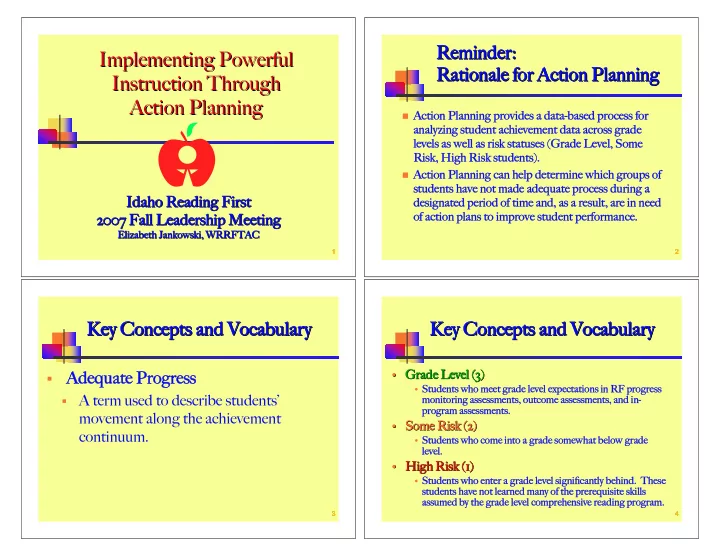
Action Planning provides a data-based process for

analyzing student achievement data across grade levels as well as risk statuses (Grade Level, Some Risk, High Risk students).

Action Planning can help determine which groups of

students have not made adequate process during a designated period of time and, as a result, are in need

  • f action plans to improve student performance.

3

Key C Concepts a and V Vocabula lary Key C Concepts a and V Vocabula lary

  • Adequate P

Progress

A term used to describe students’

movement along the achievement continuum.

4

Key C Concepts a and V Vocabula lary Key C Concepts a and V Vocabula lary

  • Grade Level (3)

Grade Level (3) Grade Level (3) Grade Level (3)

  • Students who meet grade level expectations in RF progress

Students who meet grade level expectations in RF progress monitoring assessments, outcome assessments, and in- monitoring assessments, outcome assessments, and in- program assessments. program assessments.

  • Some Risk (2)

Some Risk (2) Some Risk (2) Some Risk (2)

  • Students who come into a grade somewhat below grade

Students who come into a grade somewhat below grade level. level.

  • High Risk (1)

High Risk (1) High Risk (1) High Risk (1)

  • Students who enter a grade level significantly behind. These

Students who enter a grade level significantly behind. These students have not learned many of the prerequisite skills students have not learned many of the prerequisite skills assumed by the grade level comprehensive reading program. assumed by the grade level comprehensive reading program.

slide-2
SLIDE 2

5

5 Ways to Define Adequate Progress

Student Status in Fall Student Status in Spring

At or Above Grade Level All Grades * At Grade Level Some Risk All Grades * At Grade Level High Risk Grades K - 1 * At Grade Level High Risk Grades 2-3 * At Grade Level or *Some Risk

Steps in in A Actio ion P Pla lannin ing Steps in in A Actio ion P Pla lannin ing

Analyzing Performance Data Analyzing Performance Data Analyzing Performance Data Analyzing Performance Data

6

Today Today’ ’s P Presentation D Data s P Presentation D Data: :

A.

  • A. Combined Idaho RF Adequate

Combined Idaho RF Adequate Progress Data on IRI Progress Data on IRI B.

  • B. Example Idaho RF School Data

Example Idaho RF School Data C.

  • C. Guided Practice: Your School Data

Guided Practice: Your School Data

Steps in in A Actio ion P Pla lannin ing Steps in in A Actio ion P Pla lannin ing

Analyzing Performance Data Analyzing Performance Data Analyzing Performance Data Analyzing Performance Data

7

Idaho RF K-3 IRI Benchmark Data 2004-05 K-3 Benchmark Data: 72% 2005-06 K-3 Benchmark Data: 72.6% 2006-07 K-3 Benchmark Data: 71%

8

Adequate Progress Table

State Level Idaho Reading First IRI Data 2006-07 School Year

% and/or # Students Moved % and # Stayed Grade

*From High Risk to Some Risk or Grade Level From High Risk to Grade Level From Some Risk to Grade Level At or Above Grade Level

K 1 2 3

* - Grades 2 and 3 combine High Risk to Some Risk and High Risk to Grade Level data to determine Adequate Progress # - Should indicate a fraction depicting the number of students making adequate progress over the number of students who started the time period at the specified status level, e.g. 10/12 students made adequate progress. % Number % # % # % # % # % #

67% 375/561 82% 611/747 95% 761/799 23% 28/124 45% 126/280 80% 1470/1843 41% 106/261 43% 292/683 94% 1204/1278 34% 112/334 44% 349/787 95% 985/1042

Idaho RF Average Adequate Progress Across K-3 = 73%

slide-3
SLIDE 3

9

Adequate Progress Table

State Level Idaho Reading First IRI Data 2006-07 School Year

% and/or # Students Moved % and # Stayed Grade

*From High Risk to Some Risk or Grade Level From High Risk to Grade Level From Some Risk to Grade Level At or Above Grade Level

K 1 2 3

% Number % # % # % # % # % #

67% 375/561 82% 611/747 95% 761/799 23% 28/124 45% 126/280 80% 1470/1843 41% 106/261 43% 292/683 94% 1204/1278 34% 112/334 44% 349/787 95% 985/1042

Average Idaho RF Kindergarten Proficiency 80% Average Idaho RF Kindergarten Proficiency 83%

10 10 10 10 10 10 10 10 10 10 10

Adequate Progress Table

State Level Idaho Reading First IRI Data 2006-07 School Year

% and/or # Students Moved % and # Stayed Grade

*From High Risk to Some Risk or Grade Level From High Risk to Grade Level From Some Risk to Grade Level At or Above Grade Level

K 1 2 3

% Number % # % # % # % # % #

67% 375/561 82% 611/747 95% 761/799 23% 28/124 45% 126/280 80% 1470/1843 41% 106/261 43% 292/683 94% 1204/1278 34% 112/334 44% 349/787 95% 985/1042

Average Idaho RF First Grade Proficiency

71% Average Idaho RF First Grade Proficiency 72%

11 11 11 11 11 11 11 11 11 11 11

Adequate Progress Table

State Level Idaho Reading First IRI Data 2006-07 School Year

% and/or # Students Moved % and # Stayed Grade

*From High Risk to Some Risk or Grade Level From High Risk to Grade Level From Some Risk to Grade Level At or Above Grade Level

K 1 2 3

% Number % # % # % # % # % #

67% 375/561 82% 611/747 95% 761/799 23% 28/124 45% 126/280 80% 1470/1843 41% 106/261 43% 292/683 94% 1204/1278 34% 112/334 44% 349/787 95% 985/1042

Average Idaho RF Second Grade Proficiency

68% Average Idaho RF

Second Grade

Proficiency 72%

12 12 12 12 12 12 12 12 12 12 12

Adequate Progress Table

State Level Idaho Reading First IRI Data 2006-07 School Year

% and/or # Students Moved % and # Stayed Grade

*From High Risk to Some Risk or Grade Level From High Risk to Grade Level From Some Risk to Grade Level At or Above Grade Level

K 1 2 3

% Number % # % # % # % # % #

67% 375/561 82% 611/747 95% 761/799 23% 28/124 45% 126/280 80% 1470/1843 41% 106/261 43% 292/683 94% 1204/1278 34% 112/334 44% 349/787 95% 985/1042

Average Idaho RF Third Grade Proficiency

63% Average Idaho RF

Third Grade

Proficiency 67%

slide-4
SLIDE 4

13 13 13 13 13 13

Steps in Action Planning Steps in Action Planning

Analyzing Performance Data

Conclusions: Conclusions:

Overall, the Comprehensive Reading Programs for

Grade Level students are meeting their needs.

For all grade levels, the instruction both inside and

  • utside the 90+ minute reading block for High Risk

students is not sucient. This instruction needs to be intensifi fied.

For all grade levels, the extra instruction provided for

Some Risk students needs to be intensifi fied.

14 14 14 14 14 14

Today Today’ ’s P Presentation D Data s P Presentation D Data: :

A.

  • A. Combined Idaho RF Adequate

Combined Idaho RF Adequate Progress Data on IRI Progress Data on IRI B.

  • B. Example Idaho RF School Data

Example Idaho RF School Data C.

  • C. Guided Practice: Your School Data

Guided Practice: Your School Data

Steps in in A Actio ion P Pla lannin ing Steps in in A Actio ion P Pla lannin ing

Analyzing Performance Data Analyzing Performance Data Analyzing Performance Data Analyzing Performance Data

15 15 15 15 15 15

Steps in in A Actio ion P Pla lannin ing Steps in in A Actio ion P Pla lannin ing

  • 1. Analy

lyze P Perfo formance D Data

  • 2. Prio

iorit itiz ize a and O Order A Actio ion Pla lans

  • 3. Create A

Actio ion P Pla lans

16 16 16 16 16 16

Steps i in A Action P Pla lanning

Preliminary Steps

  • Collect school level adequate progress data

from each grade level showing the extent of movement in the three status level groups (GL/SR/HR).

  • Aggregate and display data.
slide-5
SLIDE 5

17 17 17 17 17 17 17 17 17 17 17

The Big The Big Picture Picture

18 18 18 18 18 18 18 18 18 18 18

The Big The Big Picture Picture School A School A K-3 K-3 RF Outcome Data Across Years F Outcome Data Across Years

19 19 19 19 19 19 19 19 19 19 19 20 20 20 20 20 20 20 20 20 20 20

Adequate Progress Table

School A Reading First IRI Data 2006-07 School Year

% and/or # Students Moved % and # Stayed Grade

*From High Risk to Some Risk or Grade Level From High Risk to Grade Level From Some Risk to Grade Level At or Above Grade Level

K 1 2 3

* - Grades 2 and 3 combine High Risk to Some Risk and High Risk to Grade Level data to determine Adequate Progress # - Should indicate a fraction depicting the number of students making adequate progress over the number of students who started the time period at the specified status level, e.g. 10/12 students made adequate progress. % Number % # % # % # % # % #

slide-6
SLIDE 6

21 21 21 21 21 21

How D Do I I D Do F Fill I ill In t the Data C Chart?

Grade K 15 2

22 22 22 22 22 22 22 22 22 22 22

Adequate Progress Table

School A Reading First IRI Data 2006-07 School Year

% and/or # Students Moved % and # Stayed Grade

*From High Risk to Some Risk or Grade Level From High Risk to Grade Level From Some Risk to Grade Level At or Above Grade Level

K 1 2 3

* - Grades 2 and 3 combine High Risk to Some Risk and High Risk to Grade Level data to determine Adequate Progress # - Should indicate a fraction depicting the number of students making adequate progress over the number of students who started the time period at the specified status level, e.g. 10/12 students made adequate progress. % Number % # % # % # % # % #

13% 2/15 52% 12/23 90% 38/42

23 23 23 23 23 23

How Do I Do Fill In the Data Chart?

Grade K 23 12

24 24 24 24 24 24 24 24 24 24 24

Adequate Progress Table

School A Reading First IRI Data 2006-07 School Year

% and/or # Students Moved % and # Stayed Grade

*From High Risk to Some Risk or Grade Level From High Risk to Grade Level From Some Risk to Grade Level At or Above Grade Level

K 1 2 3

* - Grades 2 and 3 combine High Risk to Some Risk and High Risk to Grade Level data to determine Adequate Progress # - Should indicate a fraction depicting the number of students making adequate progress over the number of students who started the time period at the specified status level, e.g. 10/12 students made adequate progress. % Number % # % # % # % # % #

13% 2/15 52% 12/23 90% 38/42

slide-7
SLIDE 7

25 25 25 25 25 25

How Do I Do Fill In the Data Chart?

Grade K 42 38 2

26 26 26 26 26 26 26 26 26 26 26

Adequate Progress Table

School A Reading First IRI Data 2006-07 School Year

% and/or # Students Moved % and # Stayed Grade

*From High Risk to Some Risk or Grade Level From High Risk to Grade Level From Some Risk to Grade Level At or Above Grade Level

K 1 2 3

* - Grades 2 and 3 combine High Risk to Some Risk and High Risk to Grade Level data to determine Adequate Progress # - Should indicate a fraction depicting the number of students making adequate progress over the number of students who started the time period at the specified status level, e.g. 10/12 students made adequate progress. % Number % # % # % # % # % #

13% 2/15 52% 12/23 90% 38/42

27 27 27 27 27 27 27 27 27 27 27

Adequate Progress Table

School A Reading First IRI Data 2006-07 School Year

% and/or # Students Moved % and # Stayed Grade

*From High Risk to Some Risk or Grade Level From High Risk to Grade Level From Some Risk to Grade Level At or Above Grade Level

K 1 2 3

* - Grades 2 and 3 combine High Risk to Some Risk and High Risk to Grade Level data to determine Adequate Progress # - Should indicate a fraction depicting the number of students making adequate progress over the number of students who started the time period at the specified status level, e.g. 10/12 students made adequate progress. % Number % # % # % # % # % #

Your Turn! Complete Adequate Progress Table for Grades K and 1 at your building.

28 28 28 28 28 28 28 28 28 28 28

Adequate Progress Table

School A Reading First IRI Data 2006-07 School Year

% and/or # Students Moved % and # Stayed Grade

*From High Risk to Some Risk or Grade Level From High Risk to Grade Level From Some Risk to Grade Level At or Above Grade Level

K 1 2 3

* - Grades 2 and 3 combine High Risk to Some Risk and High Risk to Grade Level data to determine Adequate Progress % Number % # % # % # % # % #

13% 2/15 52% 12/23 90% 38/42 31% 4/13 33% 6/18 89% 70/79

35% 6/17 43% 15/35 98% 43/44

19% 4/21 35% 12/34 95% 37/42

slide-8
SLIDE 8

29 29 29 29 29 29

How Do I Do Fill In the Data Chart?

Grade 2 17 6

30 30 30 30 30 30 30 30 30 30 30

Adequate Progress Table

School A Reading First IRI Data 2006-07 School Year

% and/or # Students Moved % and # Stayed Grade

*From High Risk to Some Risk or Grade Level From High Risk to Grade Level From Some Risk to Grade Level At or Above Grade Level

K 1 2 3

* - Grades 2 and 3 combine High Risk to Some Risk and High Risk to Grade Level data to determine Adequate Progress % Number % # % # % # % # % #

13% 2/15 52% 12/23 90% 38/42 31% 4/13 33% 6/18 89% 70/79

35% 6/17 43% 15/35 98% 43/44

19% 4/21 35% 12/34 95% 37/42

31 31 31 31 31 31 31 31 31 31 31

Adequate Progress Table

School A Reading First IRI Data 2006-07 School Year

% and/or # Students Moved % and # Stayed Grade

*From High Risk to Some Risk or Grade Level From High Risk to Grade Level From Some Risk to Grade Level At or Above Grade Level

K 1 2 3

* - Grades 2 and 3 combine High Risk to Some Risk and High Risk to Grade Level data to determine Adequate Progress # - Should indicate a fraction depicting the number of students making adequate progress over the number of students who started the time period at the specified status level, e.g. 10/12 students made adequate progress. % Number % # % # % # % # % #

Your Turn! Complete Adequate Progress Table for Grades 2 and 3 at your building.

32 32 32 32 32 32 32 32 32 32 32

Adequate Progress Table

School A Reading First IRI Data 2006-07 School Year

% and/or # Students Moved % and # Stayed Grade

*From High Risk to Some Risk or Grade Level From High Risk to Grade Level From Some Risk to Grade Level At or Above Grade Level

K 1 2 3

* - Grades 2 and 3 combine High Risk to Some Risk and High Risk to Grade Level data to determine Adequate Progress % Number % # % # % # % # % #

13% 2/15 52% 12/23 90% 38/42 31% 4/13 33% 6/18 89% 70/79

35% 6/17 43% 15/35 98% 43/44

19% 4/21 35% 12/34 95% 37/42

The Completed Table

slide-9
SLIDE 9

33 33 33 33 33 33

Steps in in A Actio ion P Pla lannin ing Steps in in A Actio ion P Pla lannin ing

  • 1. Analy

lyze P Perfo formance D Data

  • 2. Prio

iorit itiz ize a and O Order A Actio ion Pla lans

  • 3. Create A

Actio ion P Pla lans

34 34 34 34 34 34 34 34 34 34 34

Adequate Progress Table

School A Reading First IRI Data 2006-07 School Year

% and/or # Students Moved % and # Stayed Grade

*From High Risk to Some Risk or Grade Level From High Risk to Grade Level From Some Risk to Grade Level At or Above Grade Level

K 1 2 3

% # % #

13% 2/15 52% 12/23 90% 38/42

K

Adequate Adequate Progress Progress

65%

35 35 35 35 35 35 35 35 35 35 35

Adequate Progress Table

School A Reading First IRI Data 2006-07 School Year

% and/or # Students Moved % and # Stayed Grade

*From High Risk to Some Risk or Grade Level From High Risk to Grade Level From Some Risk to Grade Level At or Above Grade Level

K 1 2 3

% Number % # % # % # % # % #

31% 4/13 33% 6/18 89% 70/79

Grade 1

Adequate Progress

73%

36 36 36 36 36 36 36 36 36 36 36

Adequate Progress Table

School A Reading First IRI Data 2006-07 School Year

% and/or # Students Moved % and # Stayed Grade

*From High Risk to Some Risk or Grade Level From High Risk to Grade Level From Some Risk to Grade Level At or Above Grade Level

K 1 2 3

% Number % # % # % # % # % #

35% 6/17 43% 15/35 98% 43/44

Grade 2

Adequate Progress

74%

slide-10
SLIDE 10

37 37 37 37 37 37 37 37 37 37 37

Adequate Progress Table

School A Reading First IRI Data 2006-07 School Year

% and/or # Students Moved % and # Stayed Grade

*From High Risk to Some Risk or Grade Level From High Risk to Grade Level From Some Risk to Grade Level At or Above Grade Level

K 1 2 3

% Number % # % # % # % # % #

19% 4/21 35% 12/34 95% 37/42

Grade 3

Adequate Progress

55%

38 38 38 38 38 38

Steps in Action Planning Steps in Action Planning

Analyze Performance Data

Grade High Risk Students Some Risk Students At Grade Level Kindergarten First Grade Second Grade Third Grade

  • Place a check in each box for which data indicates a written

Place a check in each box for which data indicates a written Action Plan is needed. Action Plan is needed. Your Turn: Your Turn: Complete Summary Box on

  • mplete Summary Box on

Page 3 of Action Planning Workbook Page 3 of Action Planning Workbook

39 39 39 39 39 39

Steps in in A Actio ion P Pla lannin ing

  • 1. Analy

lyze P Performance D Data

  • 2. Prioritize a

and O Order A Action P Pla lans

  • 3. Create A

Action P Pla lans

40 40 40 40 40 40

Steps in Action Planning Steps in Action Planning

Prioritize and Order Action Plans

Action P lan Number G rad e and Group(s) Targeted b y Action P lan Dat e Action P lan to be Created Dat e Action P lan to be Implemented

1 2 3 4 5

  • Identify dierent groups of students that can be served by the same action plan.
  • Prioritize fi

first grade groups at all levels and/or second and third grade groups that are in the high risk category.

  • Prioritize action plans for groups with high numbers of students.

Grade 1 High Risk 9/20/2007 Grade 1 Some Risk 9/20/2007 Grades 2 and 3 High Risk 9/27/2007 Grade K High Risk and Some Risk 10/10/2007

Your Turn: Your Turn: Complete Priority List on

  • mplete Priority List on

Page 3 of Action Planning Workbook Page 3 of Action Planning Workbook

slide-11
SLIDE 11

41 41 41 41 41 41

Steps in in A Actio ion P Pla lannin ing Steps in in A Actio ion P Pla lannin ing

  • 1. Analy

lyze P Perfo formance D Data

  • 2. Prio

iorit itiz ize a and O Order A Actio ion Pla lans

  • 3. Create A

Actio ion P Pla lans

42 42 42 42 42 42

Create specifi

fic comprehensive plans to improve student performance for targeted groups.

Organize plans around the critical variables for

school actions.

Critical variables are located in the

WRRFTAC Practices Handbook

Steps in in A Actio ion P Pla lannin ing

Create Action Plans

43 43 43 43 43 43

Steps i in A Action P Pla lanning

Create Action Plans

44 44 44 44 44 44

  • Critical Variables for School Action

Critical Variables for School Action Plans Plans

Materials and Instructional Practices Time/Coverage/Mastery and Grouping

Practices

Assessment Practices Data Utilization Practices

Steps i in A Action P Pla lanning

Create Action Plans

slide-12
SLIDE 12

45 45 45 45 45 45

  • Critical Variables for School Action

Critical Variables for School Action Plans Plans

Professional Development Schoolwide Organization and Support School Leadership: Principal Reading First Coach

Steps i in A Action P Pla lanning

Create Action Plans

46 46 46 46 46 46 46 46 46 46 46

(Page 6 of Action Planning (Page 6 of Action Planning Workbook) Workbook)

47 47 47 47 47 47 47 47 47 47 47

Action Plan for Targeted Group Action Plan for Targeted Group

48 48 48 48 48 48 48 48 48 48 48

Schoolwide Action Plan Schoolwide Action Plan

slide-13
SLIDE 13

49 49 49 49 49 49

Be S

Specifi fic!

Tell what you will do dierently. Plan actions that are observable and

measurable.

Sucient detail is needed so that it is

possible to determine when the action has been implemented.

Steps in Action Planning Steps in Action Planning

Creating Action Plans

50 50 50 50 50 50

Steps i in A Action P Pla lanning

Create Action Plans Create Action Plans

Describing Action Steps in Specific, Observable, Measurable Terms

Category Example Non-Example Time and Grouping We will increase the time spent providing additional instruction for students performing somewhat below grade level from 20 to 40 minutes per day in Grade 1. This increase will require changes in the schedule and personnel allotted to Grade 1. A school-wide schedule reflecting this change will be prepared by the building principal (changes should be detailed in the other major affected categories). We will increase the time spent in providing instruction for students performing somewhat below grade level.

51 51 51 51 51 51

Steps i in A Action P Pla lanning

Create Action Plans Create Action Plans

Describing Action Steps in Specific, Observable, Measurable Terms

Category Example Non-Example Leadership (Principal) The building principal will conduct 5-minute observations during reading instruction in each K-3 classroom at least one time per week. The principal will follow the (XYZ) format for 5-minute observations. The building principal will increase his visibility in classrooms. Assessment and Data Analysis Students who are significantly below grade level will be assessed weekly with the ABC progress monitoring tool. All grade level team meetings will meet at least twice per month to analyze progress monitoring data. We will increase progress monitoring for our students who are significantly below grade level.

52 52 52 52 52 52

Making the Action Plan a Functional Making the Action Plan a Functional Document Document

Once completed, Action Plan(s) should be shared

with faculty and sta.

All actions should be detailed, and the data used

to drive these actions should be imparted to sta as well.

The leadership team should meet on regular basis

to communicate progress on implementation of all steps listed on the Action Plan(s).

slide-14
SLIDE 14

53 53 53 53 53 53

Practic ice a and A Applic licatio ion

54 54 54 54 54 54

Grade High Risk Students Some Risk Students At Grade Level Kindergarten First Grade Second Grade Third Grade

Sample Action Plan Sample Action Plan

Grades 2/3 - High Risk Students

55 55 55 55 55 55 55 55 55 55 55

Area for Action Plan Action to Be Taken

(be specific enough so that it is possible to determine when the action has been implemented )

Person Responsible Report on Progress of Implementation

Materials and Instructional Practices Students with phonics deficits as determined by the ABC Phonics Screener will receive direct instruction on missing decoding skills using the EFG Supplemental Phonics Program in place of teacher-generated activities. Time/Coverage/Mastery and Grouping Practices Students will receive teacher-led instruction on phonics deficits using the EFG Supplemental Phonics Program for 30 minutes daily followed by 15-minutes of fluency development at the student’s independent level during this 45-minute small group instructional period (outside block). Assessment Practices Progress monitoring will be increased from one time per month to every two weeks. Coach will assist teachers in placing students at the appropriate level within the EFG Program. Data Utilization Practice s Professional Development Instructional staff that will be teaching the EFG Supplemental Phonics Program will receive a half-day of initial training on the program. The coach will then model 2 lessons within the classroom, co-teach 2 lessons, and conduct

  • bservations with feedback for teachers using the

program. Schoolwide Organization and Support School Leadership: Principal The principal will participate in the initial half-day training on the EFG Supplemental Phonics

  • Program. The principal and coach will co-
  • bserve and provide feedback to all teachers

using the program within the first two weeks of implementation. Reading First Coach The coach will receive one day of initial training

  • n the EFG Supplemental Phonics Program from

the program consultant.

Sample Action Plan for Targeted Group: Grades 2/3 Some Risk Students Grades 2/3 Teachers

Reading Coach Grades 2/ 3 Teachers

Principal Reading Coach

Reading Coach Grades 2/ 3 Teachers Reading Coach Grades 2/ 3 Teachers

56 56 56 56 56 56 56 56 56 56 56 Grade High Risk Students Some Risk Students At Grade Level Kindergarten First Grade Second Grade Third Grade

Steps i in A Action P Pla lanning

Create Action Plans Create Action Plans

Going Back to School A Going Back to School A

slide-15
SLIDE 15

57 57 57 57 57 57 57 57 57 57 57

Going Back to School A: Going Back to School A: Questions to Consider

  • Materials and Instructional Practices

– Are these students receiving daily practice on critical skills introduced in the CRP? – Do these students receive pre-teaching and/or re- teaching of skills introduced in daily CRP lessons? – Do these students receive extra small group instruction focused specifically on their areas of focused specifically on their areas of deficit deficit, i.e. phonemic awareness, letter-sound correspondence, alphabetic principle, etc. – Are many of the students entering first grade with basic language deficits? If so, do they or could they benefit from explicit instruction on basic language skills?

58 58 58 58 58 58 58 58 58 58 58

Going Back to School A: Going Back to School A: Questions to Consider

  • Materials and Instructional Practices

– If different materials are being used with these students during reading instruction outside of the reading block, are they all aligned? – – Do these students receive instruction that is explicit, Do these students receive instruction that is explicit, interactive, and interactive, and sufficiently intensive both inside and sufficiently intensive both inside and

  • utside of the scheduled reading block?
  • utside of the scheduled reading block?

59 59 59 59 59 59 59 59 59 59 59

Going Back to School A: Going Back to School A: Questions to Consider

  • Time/Coverage/Mastery and Grouping Practices

– Are these students receiving a sufficient amount of time for reading instruction?

  • Recommendations:

– 90+ minute reading block – Additional time suggestions: 30 minutes Some Risk students – Additional time suggestions: 45-60 minutes High Risk students

– Are the most struggling readers in the smallest instructional groups?

60 60 60 60 60 60 60 60 60 60 60

Going Back to School A: Going Back to School A: Questions to Consider

  • Assessment Practices

– Are diagnostic assessments are to determine the type(s) of and the extent of skill gaps each student has? – Is progress monitoring used to monitor student growth

  • n a frequent basis?
  • Recommendation: 2x month for some risk students
  • Recommendation: 1x per week for high risk students
slide-16
SLIDE 16

61 61 61 61 61 61 61 61 61 61 61

Going Back to School A: Going Back to School A: Questions to Consider

  • Data Utilization

– Are teachers using progress monitoring data to inform their instruction or are they merely collecting data? – Do teachers have some type of decision rule they to use for analyzing data?

62 62 62 62 62 62

Your T Turn Your T Turn

Look at the #1 priority for creating Action

Plans on your list.

With the time we have available, begin

analyzing the system available for these

  • students. Decide which variables may need

adjustments and begin writing an Action Plan for this group.

63 63 63 63 63 63

Next S Steps

The work you do on Action Planning will

be directly connected to the site visits this year.

Movement with Adequate Progress data

will be part of the accountability process at the end of the current school year.